We research every product we recommend. We may earn a commission from the links on this page.
Electronics › Smartwatches

The Always-On Display Is What’s Eating Your Smartwatch Battery

We compare published specifications and marketplace data. We do not test these products.

The Always-On Display Is What's Eating Your Smartwatch Battery
Photo by Torsten Dettlaff on Pexels

A smartwatch advertising 50-day battery life and another advertising 15 days can die on the same afternoon if you turn on GPS tracking for a long hike. Quoted battery figures assume the screen sleeps between glances, GPS stays off, and heart rate sampling runs at its laziest interval. Turn on always-on display mode and continuous GPS, and that 50-day number drops to single digits. Here’s how the three biggest power draws — display, GPS, and heart rate — actually work inside a watch, and what that means for three models priced between $30 and $240.

Affiliate disclosure: This article contains affiliate links. We may earn a commission if you buy through them, at no extra cost to you.

Everything we recommend
3 picks

How we picked

We did not wear these watches. Judgments draw from published battery capacity, GPS chipset specifications, and aggregated user discharge reports.

Actual capacity, not advertised days

Battery size in milliamp-hours determines ceiling. The 50-day claim assumes conditions no one sustains daily.

GPS chipset generation, not presence

Older receivers pull double the current of modern Sony or MediaTek modules for the same satellite lock accuracy.

Display power draw, not diagonal size

AMOLED at full brightness drains faster than the same panel dimmed. Always-on mode compounds it logarithmically.

Water resistance rating, not marketing depth

10ATM withstands shower pressure and shallow swimming. 3ATM splash rating fails under a faucet stream.

What “15-Day Battery” Actually Means

Every smartwatch battery claim is a best-case number. Lowest screen brightness. GPS off. Heart rate sampled once every few minutes instead of continuously. Notifications arriving rarely. The watch spends most of its time in a low-power state where the processor is barely ticking and the display is completely dark.

That’s not how anyone wears a watch.

The moment you raise your wrist and the screen lights up, you’ve already consumed more power in that two-second glance than the watch used in the previous five minutes of sleep. Stack a few dozen wrist raises per hour, add notification buzzes that wake the display and vibration motor, and you’ve moved from the manufacturer’s fantasy scenario into something closer to reality. A 15-day claim might mean five to seven days of actual daily wear with moderate notification volume and occasional workout tracking. A 50-day claim might mean two to three weeks. The ratio between printed number and real-world runtime typically lands between 2:1 and 5:1, depending on which features you leave running.

The Three Things Competing for 400 Milliamp-Hours

A smartwatch battery holds somewhere between 200 and 500 milliamp-hours. A smartphone holds 3,000 to 5,000. That means every milliwatt matters six to twenty-five times more on your wrist than in your pocket.

Three subsystems fight for those milliamp-hours:

The display. An LCD backlight illuminates every pixel at once — dark pixels still cost power. An AMOLED panel lights each pixel independently, so a pure-black watch face draws near-zero display power for those dark regions. That’s why dark watch faces on AMOLED watches genuinely extend battery life: fewer lit pixels means less current. Always-on display mode keeps the screen refreshing at roughly one frame per second even when your wrist is down, preventing the display controller from entering the deep sleep state that saves the most power.

The GPS radio. Maintaining a satellite lock means the receiver is actively communicating with four to twelve satellites, recalculating your position every one to ten seconds. That draws 50 to 150 milliwatts continuously — not occasionally, not in bursts, but as a sustained load for the entire duration of your run or hike. Bluetooth, by contrast, can sleep between data packets and draws a fraction of a milliwatt during those gaps.

The heart rate sensor. Optical heart rate monitoring shines green or red LEDs through your skin and reads the reflected light to detect blood volume changes. In workout mode, those LEDs pulse every second or faster. In background 24/7 monitoring, the sampling interval stretches to every few minutes. The difference in power consumption between those two modes is substantial — continuous workout-rate monitoring can double the drain compared to background sampling.

GPS vs. Always-On Display: Which Kills It Faster

Both are heavy. But GPS is heavier per hour.

Always-on display keeps the screen at a minimal refresh rate — usually 1 Hz — with reduced brightness and a simplified watch face. It prevents the deepest sleep state, which means the display never fully powers down, but the sustained draw is moderate because the refresh rate is so low and AMOLED panels can keep most pixels dark.

GPS is different. The radio has no equivalent of a dim mode while tracking. It’s locked onto satellites and recalculating continuously. You can’t half-run GPS the way you can dim a screen. During a three-hour hike with continuous GPS logging, the satellite radio alone can consume more battery than the display uses in an entire day of always-on mode.

This is why watches advertise multi-week battery life but die mid-afternoon on a long trail day. The standby figure assumes GPS is off. The moment you start a GPS-tracked activity, you’ve moved from the watch’s most efficient state to one of its most demanding. A watch rated for 15 days of mixed use might deliver 10 to 20 hours of continuous GPS tracking. One rated for 50 days might stretch that to 30 or 40 hours — but that’s still measured in hours, not weeks.

Water Resistance Ratings Are About Pressure, Not Depth

5ATM and 10ATM sound like depth ratings. They’re pressure ratings. 5ATM means the watch tolerates the equivalent of 50 meters of perfectly still water pressing evenly on every surface. 10ATM means 100 meters of the same.

Water doesn’t stay still on your wrist.

A cannonball into a pool generates a pressure spike at impact that can exceed the static pressure at 50 meters, even though the pool is three meters deep. A hot shower produces steam that can penetrate seals rated for cold-water submersion. A high-pressure faucet aimed at the watch creates localized force that the ATM rating never accounted for. The rating tells you about sustained, even, cold-water pressure — not about the dynamic forces of actual water activities.

The practical split: 5ATM is comfortable for swimming laps and rain. 10ATM handles freediving and more aggressive water exposure because the seals and case construction are built to a higher standard across the board — thicker gaskets, more robust crown seals, pressure-tested housings. The extra margin isn’t just about going deeper. It’s about surviving the sudden pressure changes that real water activities produce.

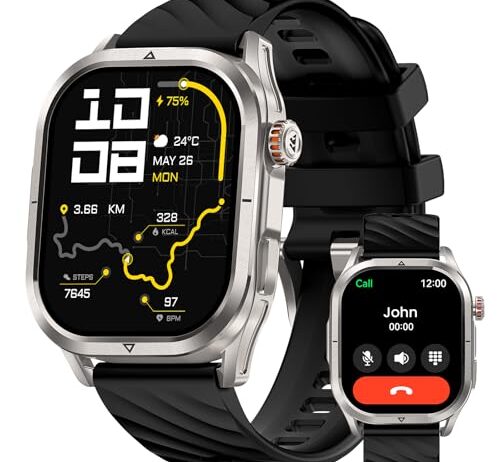
The 1.43-inch AMOLED display is the smallest of the three, and that’s doing real work for battery life. Fewer pixels to light means less display drain during GPS-tracked activities, which matters when the satellite radio is already pulling hard from a limited battery. Fifteen days of rated battery life translates to something more like five to eight days of daily wear with occasional GPS workouts — shorter than the others on paper, but this watch is designed for the high-drain use case where the others would fare worse.

The 10ATM rating and dedicated freediving mode put it in a different structural class. The case and seals are built to handle the dynamic pressure of actual submersion — not just rain and splashes, but repeated depth changes where water pressure shifts rapidly against gaskets and crown seals. GPS with offline maps means you can navigate a trail without your phone, which is the scenario where a rugged watch earns its price over a fitness band. If your typical day involves a trail run followed by a lake swim, this is the one engineered for that sequence.

The 50-Day Claim and What It’s Actually Measuring

Fifty days is a real number — for a watch sitting at lowest brightness, GPS off, heart rate sampling every ten minutes, and the screen waking only on wrist raise. It’s measuring standby endurance, not active use.

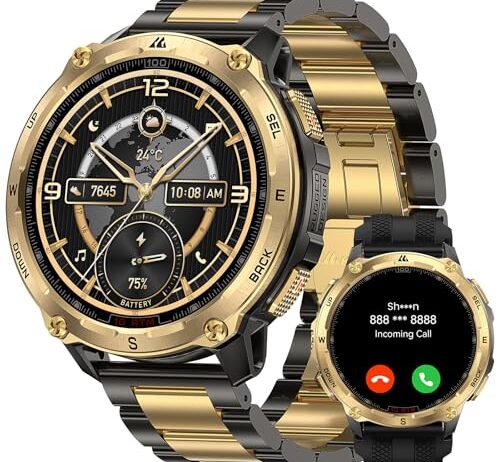
The KOSPET Magic P10 achieves that figure partly through a 1.96-inch AMOLED display — which sounds counterintuitive, since larger screens have more pixels to power. But AMOLED’s per-pixel control means a dark watch face on a large screen can draw less than a bright face on a small one. The battery itself is physically larger because the watch body is bigger, and a stainless steel case adds structural rigidity that lets engineers use the internal volume more efficiently for battery rather than reinforcement.

Turn on GPS tracking and that 50-day number compresses to hours, not days. With compass functionality added to the GPS, the sensor array during outdoor navigation is running at near-maximum draw. The watch’s real advantage isn’t that it lasts 50 days — nobody’s going seven weeks between charges during active use. The advantage is that the larger battery gives it more hours of high-drain GPS tracking before dying, and more days of casual daily wear between charges when you’re not on a trail.

The stainless steel body isn’t just cosmetic — metal cases dissipate heat from the battery and processor more evenly than plastic, which means the watch can sustain higher processing loads without thermal throttling. During extended GPS sessions, that thermal headroom translates to more consistent satellite lock quality, because the processor doesn’t need to downclock to manage heat.

At 5ATM, it handles swimming and rain but not the deep or dynamic water exposure the Tank T4 is built for. That’s a deliberate engineering trade-off: the battery volume and case dimensions that enable 50-day standby come at the cost of the thicker seals and reinforced crown that 10ATM demands. If you spend most days at a desk with weekend hikes and occasional pool swims, that trade-off works in your favor. If you’re regularly in open water or diving, it doesn’t.

When No GPS Means Longer Battery by Default

A $30 fitness tracker without GPS, without a specified water resistance rating, and without a published battery life sounds like it’s missing features. In one narrow sense, it is. In another, the absence is the feature.

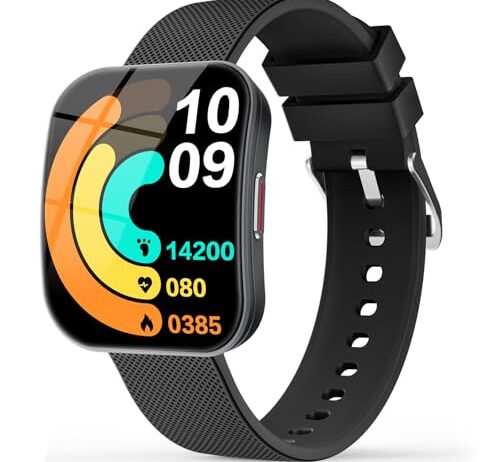
No GPS radio means the single heaviest continuous power draw doesn’t exist in the watch. The 1.85-inch HD display — likely LCD rather than AMOLED, based on the price point and spec language — uses a backlight that illuminates every pixel evenly. That’s less power-efficient than AMOLED for dark watch faces, but LCD technology is mature, cheap, and draws predictably. Without a satellite radio ever switching on, the battery budget goes entirely to display, Bluetooth, basic sensors, and the processor.

For someone who wants step counting, heart rate checks, and phone notifications on their wrist — and nothing else — the absence of GPS means one less subsystem competing for a small battery. The watch does less, and what it does, it can do for longer between charges. That’s not a failure of ambition. It’s a different product for a different problem: knowing your heart rate and seeing texts without pulling out your phone, with no pretense of trail navigation or swim tracking.

How to Actually Extend Your Battery Life

Dark watch face. This is the single biggest lever on an AMOLED watch. A face with a black background and thin white numerals can draw half the display power of a colorful animated face, because every black pixel is a pixel that isn’t consuming current.

Turn off always-on display unless you genuinely need to see the time without raising your wrist — during a meeting, at a concert, while driving. If wrist-raise-to-wake is fast enough for your daily pattern, that alone can add days to your charge cycle.

Use GPS only during tracked activities, not as a background service. Some watches default to periodic GPS polling for weather or location services. Disable that and let the watch use your phone’s GPS over Bluetooth instead — the phone has a battery twenty times larger and a GPS radio that’s already on.

Heart rate monitoring set to background sampling rather than continuous is the quieter win. The difference between reading your pulse every ten minutes and reading it every second is the difference between LEDs flashing 144 times a day and 86,400 times. During a workout, switch to continuous. The rest of the day, let it sample.

Reduce notification frequency. Each notification wakes the screen, fires the vibration motor, and engages the Bluetooth radio. Ten notifications an hour, sixteen waking hours — that’s 160 screen wakes and motor activations per day, each one pulling the watch out of its lowest power state.

FAQ

How long does GPS actually last on a smartwatch?

Continuous GPS tracking typically lasts 10 to 40 hours depending on the battery size, compared to the multi-week standby life printed on the box. GPS draws 50 to 150 milliwatts continuously — the radio has no low-power mode while tracking, so it compresses weeks of standby into hours of active navigation.

Does always-on display drain battery faster than GPS?

Per hour of use, GPS is heavier. Always-on display keeps the screen at a minimal 1 Hz refresh with reduced brightness, which prevents deep sleep but draws moderately. GPS maintains continuous satellite communication at 50-150 milliwatts with no equivalent of a dim mode. A three-hour GPS hike can consume more battery than a full day of always-on display.

Do dark watch faces actually save battery on AMOLED watches?

Yes. AMOLED panels light each pixel independently, so a pure-black pixel draws near-zero power. A watch face with a black background and sparse white elements can use roughly half the display power of a colorful, fully lit design. This only applies to AMOLED — LCD backlights illuminate every pixel regardless of what’s displayed.

Does 24/7 heart rate monitoring drain the battery?

It depends on the sampling rate. Background monitoring checks your pulse every few minutes using brief LED flashes — a modest drain. Continuous workout-mode monitoring pulses the LEDs every second, which can roughly double the sensor’s power consumption compared to background mode. Keeping workout-rate sampling on all day significantly shortens battery life.

Can I swim with a 5ATM smartwatch?

Pool swimming, yes. The 5ATM rating handles sustained, even pressure equivalent to 50 meters of still water. But dynamic water forces — cannonball jumps, water jets, hot showers — can generate localized pressure spikes that exceed 5ATM even at shallow depths. For diving or aggressive water sports, a 10ATM rating provides the thicker seals and reinforced case needed to handle those pressure changes.