We research every product we recommend. We may earn a commission from the links on this page.
Automotive › Air Compressors & Inflators

Cordless Tire Inflator Battery Life: How Many Tires Before It Dies

We compare published specifications and marketplace data. We do not test these products.

Air Compressor Duty Cycle Limits How Long the Motor Runs
Photo by Mazhar Ulazhar on Pexels

A cordless tire inflator rated at 150 PSI sounds like it can handle anything — until it dies halfway through your second tire. The number on the box is a pressure ceiling, not a promise about how many tires the battery can push air into. What actually determines that is a combination of voltage, battery capacity in watt-hours, and whether the motor drives one piston or two. A 12V unit with 4,000 mAh stores 48 watt-hours of energy. A 20V unit with 2,000 mAh stores 40. The first number is bigger, but the second one compresses air faster — which means it runs for less time per tire, and less runtime per tire means more tires per charge.

Affiliate disclosure: This article contains affiliate links. We may earn a commission if you buy through them, at no extra cost to you.

Everything we recommend
4 picks

How we picked

We did not inflate tires with these units. Picks are based on published specs, energy calculations, and owner reports.

Watt-hours, not milliamp-hours

mAh ignores voltage. We calculated actual stored energy — volts times amp-hours — to compare runtime on equal terms.

Cylinder count, not PSI ceiling

PSI is a pressure limit. Dual cylinders double air displacement per motor cycle, cutting runtime and stretching the battery further.

Swappable battery, not just big battery

A removable pack lets you keep working with a spare. A sealed battery means waiting for a recharge.

Owner experience over rated capacity

Where owners report actual tire counts per charge, that outweighs any calculated estimate.

PSI Is a Ceiling, Not a Range

Every inflator in this category tops out at 150 or 160 PSI. That number tells you the maximum pressure the pump can deliver — and for a standard passenger tire at 32-35 PSI, it is wildly irrelevant. You will never approach half that ceiling.

What matters is volume. A typical passenger car tire holds roughly 0.7 to 1.0 cubic feet of air at operating pressure. If you’re topping off from 25 PSI to 35 PSI, you need less volume than if you’re filling from flat. But the battery doesn’t care about your target pressure — it cares about how long the motor runs, and the motor runs until enough air has been pushed through the hose.

So the question isn’t “can this reach 35 PSI?” — they all can. The question is how many cubic feet of air the battery can deliver before it hits cutoff voltage and the motor stops.

The Watt-Hour Number Nobody Compares

Battery capacity shows up as milliamp-hours or amp-hours, and bigger sounds better. But mAh without voltage is meaningless. A 4,000 mAh battery at 12 volts stores 48 watt-hours. A 2,000 mAh battery at 20 volts stores 40 watt-hours. The first one holds more total energy — about 20 percent more. But the second one delivers that energy at nearly double the voltage, which means the motor spins faster, compresses air faster, and finishes each tire in less time.

This is the trade-off that the milliamp-hour number hides. A higher-voltage motor drawing the same current produces more wattage — volts times amps. At 120 watts, a 20V motor compresses air at roughly the rate a 12V motor would need to draw 10 amps to match. Higher wattage means faster compression. Faster compression means shorter runtime per tire. Shorter runtime per tire means the battery stretches across more tires before it dies.

The low-voltage unit has more stored energy and less power. The high-voltage unit has less stored energy and more power. For a single tire, both finish the job. For four tires in sequence, the faster unit wins — because it spends less total motor time and wastes less energy as heat in the motor windings.

One Piston or Two — and Why It Matters for the Battery

A single-cylinder inflator drives one piston. Each stroke compresses a fixed volume of air, and between strokes the motor is doing no useful work — it’s just swinging the crank back around. The airflow pulses. The motor loads and unloads with every cycle.

A dual-cylinder inflator runs two pistons in opposition. While one is compressing, the other is drawing in air. This does two things: it doubles the air displacement per motor revolution, and it smooths the load on the motor. The motor sees a more consistent draw rather than sharp spikes, which reduces peak current and the heat that comes with it.

For the battery, this means the dual-cylinder unit moves the same volume of air in roughly half the motor runtime. Half the runtime is half the energy spent. It also means the motor runs cooler, which matters because lithium-ion batteries deliver less usable energy when the motor is pulling hard current spikes — voltage sags under load, and a battery that reads 20 volts at rest may drop to 18 or lower during a heavy compression stroke. Smoother load means less sag, which means more of the battery’s rated capacity actually reaches the motor as useful work.

What Happens to Airflow as the Battery Drains

Lithium-ion cells hold their voltage fairly steady through most of the discharge curve, then drop sharply near the end. For the first 70-80 percent of the charge, a 20V nominal pack delivers close to its rated voltage. In that last 20 percent, voltage falls off — and with it, motor speed, compression rate, and airflow.

This means your third and fourth tires inflate slower than your first. The motor is turning, but it’s turning slower, compressing less air per cycle, and the inflator that took three minutes on the first tire might take five on the fourth. You’re not imagining it. The battery isn’t broken. That’s just what voltage sag looks like at the end of a discharge cycle.

A unit with a higher-wattage motor hits this wall later, because it draws down the battery faster but finishes each tire faster too — the question is whether it finishes all four before the voltage cliff. A lower-wattage motor stretches the plateau but takes so long per tire that total runtime still exhausts the pack.

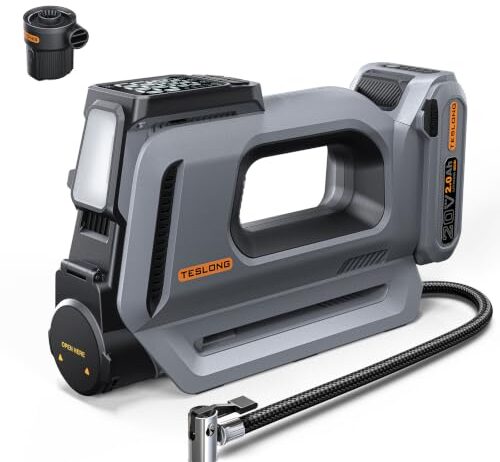
The Teslong runs a dual-cylinder motor at 20 volts and 120 watts. That combination — two pistons plus high wattage — is the most direct answer to the four-tire problem in this set. Two pistons double the air displaced per revolution, and 120 watts means the motor is spinning fast enough to move that air quickly. Less motor time per tire, less battery per tire.

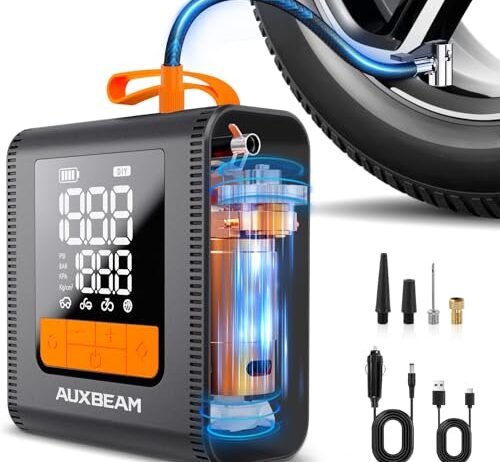
The battery is a removable 2.0 Ah pack — 40 watt-hours. That is less stored energy than the AUXBEAM’s 48 watt-hours, but it depletes slower per tire because the motor finishes faster. And because the pack is removable, a second battery means no waiting. The included 45W charger brings a dead pack back in roughly an hour, so you can keep one charging while the other works. For anyone who owns a truck or SUV with tires that hold 1.5 to 2.5 cubic feet of air each, that swap capability is the difference between finishing the job and waiting in the driveway.

Cold Weather and the Charge You Thought You Had

Temperature drops and tire pressure drops track each other — roughly one PSI for every ten degrees Fahrenheit. The first hard freeze of fall can take all four tires from 35 PSI to 28 overnight. That’s the morning you need the inflator, and it’s also the morning the battery performs worst.

Lithium-ion cells lose capacity in cold weather. A pack rated at 2.0 Ah at room temperature may deliver 1.5 Ah or less at 20°F. The chemistry slows down. Internal resistance rises. Voltage sags earlier and harder. A unit that comfortably finishes four tires in July may struggle with three in December — not because anything is wrong with it, but because the battery is colder and each tire needs more air.

This is where removable batteries matter most. You can keep a spare pack indoors, warm, and swap it in when the cold one fades. A sealed battery lives in the trunk, at ambient temperature, and whatever capacity it has at that temperature is all you get.

What Owners Actually Get Per Charge

One verified owner of the AUXBEAM H4 reports using it on a tractor tire — a larger-volume tire than a standard passenger car — going from 21 PSI to 30 PSI. That single tire took the battery from full down to two bars out of four. One tire, half the battery, on a nine-PSI fill. The owner needed to recharge before starting the second tire.

That lines up with the math. A 48 watt-hour battery running a 12V single-cylinder motor needs to compress a large volume of air at relatively low power. The motor runs a long time. Long runtime means high total energy draw. A tractor tire is bigger than a car tire, but not by as much as you might think — a large SUV tire holds comparable volume, and four of those back-to-back is a longer job than one tractor tire.

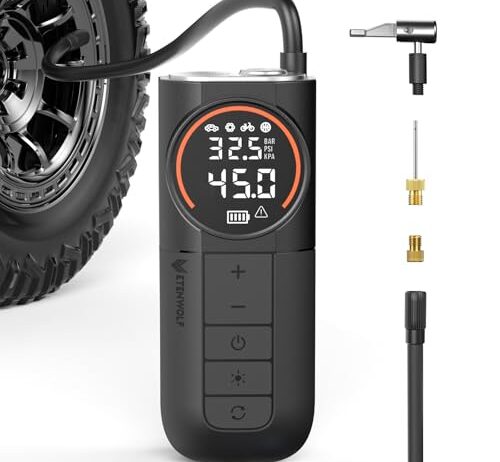
An owner of the ETENWOLF S1 describes a similar experience more bluntly: it discharges quickly on a single tire. Without published battery capacity or voltage, there’s no way to calculate why — but the reported result matches what you’d expect from a compact, budget-priced unit where the battery is small enough to keep the price under forty dollars.

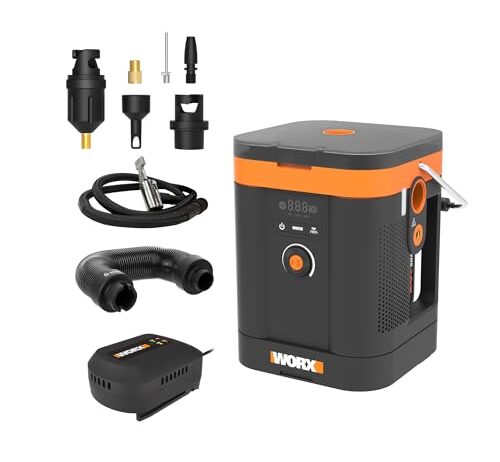
The WORX WX098L runs on the same 20V PowerShare battery that fits every other WORX cordless tool. If you own a WORX drill, trimmer, or blower, you already have spare batteries. That turns the inflator from a single-use gadget with one pack into a tool that can pull from a pool of charged batteries across an entire shed.

It also delivers 11.6 CFM airflow — a high figure for a portable unit. CFM measures volume delivery rate: how many cubic feet of air pass through the hose per minute. Higher CFM means each tire fills faster, which means less motor runtime, which means less battery drain. At 11.6 CFM, a standard car tire holding 0.7 to 1.0 cubic feet at operating pressure fills its volume quickly. The 2.0 Ah battery stores 40 watt-hours at 20 volts, identical to the Teslong — but the practical capacity is whatever you have on the shelf. Two batteries is 80 watt-hours. Three is 120. The constraint moves from chemistry to how many packs you’ve accumulated.

The Decision That Matters Before November

If you own one car with standard passenger tires and you keep them topped off — adding five or six PSI once a month — almost any cordless inflator will handle that. The battery question only bites when tires drop significantly, which happens twice: first cold snap of fall and first freeze of winter.

For that scenario, you need either a unit fast enough to finish four tires on one charge or a unit that lets you swap batteries when the first one fades. The Teslong does both — dual cylinders for speed, removable battery for capacity. The WORX adds ecosystem flexibility if you’re already in the PowerShare family. The AUXBEAM has the most stored energy on paper but the lowest power to use it, which means longer runtime per tire and more battery consumed per job. The ETENWOLF is the least expensive and the least transparent about what’s inside — a pattern that shows up in owner reports as surprise when the battery doesn’t last.

Buy before the temperature drops. Not because prices change — they don’t, meaningfully — but because the morning you need it is the worst morning to learn your inflator can’t finish the job.

FAQ

How many car tires can a cordless inflator fill on one charge?

It depends on watt-hours — voltage times amp-hours — not milliamp-hours alone. A 20V, 2.0 Ah unit (40 Wh) with a dual-cylinder motor can typically finish four standard passenger tires from moderately low pressure. A 12V, 4.0 Ah unit (48 Wh) stores more energy but compresses air slower, so it may use more battery per tire and struggle to finish all four.

Does a cordless tire inflator lose power as the battery drains?

Yes. Lithium-ion batteries hold steady voltage for most of the discharge, then drop sharply near the end. Your last tire will inflate slower than your first. The motor still reaches full pressure — it just takes longer, because voltage sag reduces motor speed and airflow in the final 20 percent of the charge.

Is a removable battery better than a built-in battery for tire inflation?

For multi-tire jobs, yes. A removable battery lets you swap in a charged spare and keep working. A built-in battery means waiting for a full recharge before you can finish. In cold weather, you can also keep a spare battery indoors at room temperature, where it holds more capacity than a pack stored in a cold trunk.

Does higher PSI mean a tire inflator can do more tires per charge?

No. PSI is a pressure ceiling — the maximum the pump can deliver. A standard car tire runs at 32-35 PSI, well below the 150-160 PSI rating on most portable inflators. What determines how many tires you get is battery capacity in watt-hours, motor wattage, and how efficiently the pump moves air — not the maximum pressure it can reach.

What does dual cylinder mean for tire inflator battery life?

A dual-cylinder inflator uses two pistons instead of one, doubling the air displaced per motor revolution. This cuts the motor runtime needed per tire roughly in half compared to a single-cylinder unit at the same RPM. Less runtime means less battery consumed, so the same battery finishes more tires.