
We research every product we recommend. We may earn a commission from the links on this page.
Automotive › Coolers & Refrigerators

How Hot Is Too Hot for a 12V Compressor Fridge?

We compare published specifications and marketplace data. We do not test these products.

Why Your Car Fridge Struggles on a Hot Day
Photo by MART PRODUCTION on Pexels

Every portable compressor fridge sold today claims the same floor: -4°F. What none of them tell you is the ambient temperature where that number stops being real. A compressor doesn’t generate cold — it moves heat from inside the box to outside it. When outside is 115°F and you’re asking it to hold 0°F, that’s a 115-degree gradient the system has to pump against, and every degree of that gap costs more energy than the last. Here’s what that means for the four compressor fridges worth comparing right now, and how to pick the one that actually fits your vehicle and your climate.

Affiliate disclosure: This article contains affiliate links. We may earn a commission if you buy through them, at no extra cost to you.

Everything we recommend
4 picks
Top pick
Compact, proven, efficient in the gradient

Compact, proven, efficient in the gradient

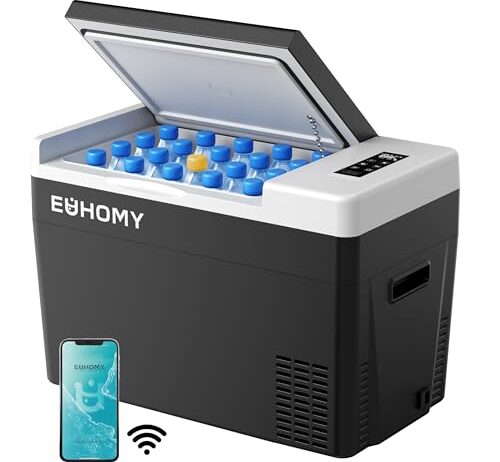
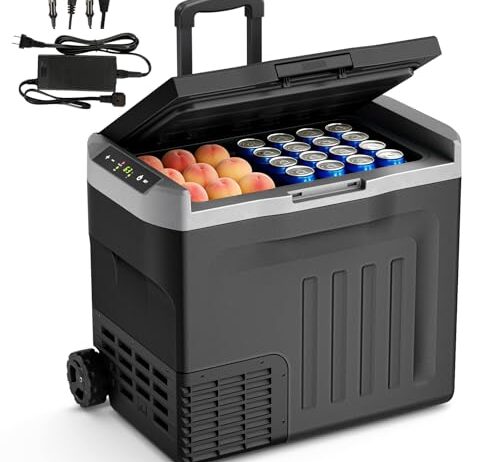
EUHOMY 12 Volt Refrigerator, 31QT(29L) Compressor Electric Cooler APP Control, Car Fridge -4℉~68℉, Portable Refrigerator 12/24V DC 100-240V AC, Portable Freezer for Camping, Boat, Travel
★ 4.4 789 reviews

The smallest exterior surface in the set means the least heat leaking in per hour. App control lets you adjust the setpoint from inside the car without opening the trunk and letting hot air flood the compartment.
How we picked

We do not run these fridges in vehicles. Judgement rests on published compressor specifications, thermal efficiency ratings, and aggregated user reports.

Thermal gradient capacity, not floor temperature

The claimed low matters less than the compressor’s ability to sustain it when ambient temperature climbs above 100°F.

Surface area relative to volume

Smaller exterior walls reduce heat intrusion per quart of capacity, lowering the continuous load on the compressor in high heat.

Dual-zone thermal advantage

Running one compartment warmer drops average internal setpoint, giving the compressor headroom it lacks when cooling the full volume to freezing.

Real-world runtime data, not draw ratings

Manufacturer wattage claims don’t account for compressor duty cycle under sustained heat. User reports of battery depletion rates do.

The Gradient Is the Whole Story

A compressor fridge works exactly like the one in your kitchen, just smaller. Refrigerant gas gets compressed, which heats it up. That hot gas passes through coils on the outside of the box, where it dumps heat into the surrounding air and condenses into liquid. The liquid then passes through an expansion valve into coils inside the box, where it evaporates and absorbs heat from the compartment. The cycle repeats.

The critical variable is the temperature difference between inside and outside. At 75°F ambient, holding 35°F means the compressor is fighting a 40-degree gradient. Manageable. The compressor cycles on, runs for a while, cycles off, rests. At 115°F ambient, holding 0°F means a 115-degree gradient — nearly three times the work. The compressor doesn’t cycle off. It runs continuously, pulling maximum current, and still may not reach the setpoint.

This isn’t a design flaw in any particular fridge. It’s thermodynamics. Every compressor fridge on this list claims -4°F to 68°F. That range is real — in a 70°F room. In a 115°F car trunk, the achievable minimum climbs, the power draw spikes, and the compressor runs harder and hotter. How much it climbs depends on three things: insulation quality, cabinet surface area, and how much cooling capacity the compressor actually has relative to the box it’s trying to cool.

Why Size Cuts Both Ways

A bigger box holds more food. It also has more surface area for heat to leak through.

A 31-quart cooler has roughly two-thirds the exterior surface of a 64-quart unit. Less surface means less heat ingress per hour, which means the compressor can maintain a deeper setpoint with the same duty cycle — or maintain the same setpoint while drawing less power. In a hot vehicle, that’s the difference between a compressor that cycles and one that runs nonstop.

But there’s a counterweight: thermal mass. A 64-quart box filled with frozen food has far more cold mass inside it than a 31-quart box. That mass acts as a buffer. Open the lid in 110°F air, and the frozen contents absorb the heat pulse without the interior temperature spiking as sharply. A half-empty small cooler recovers slowly because there’s nothing inside to stabilize it — just air, which holds almost no thermal energy.

The practical upshot: if you’re loading the cooler full and keeping it closed, the smaller box wins on power efficiency in extreme heat. If you’re opening it repeatedly throughout the day — pulling drinks, grabbing lunch — the larger box with more frozen mass inside handles the disruption better. Neither answer is universal. It depends on how you actually use the thing.

The EUHOMY 31-quart is the same capacity as the B0GH7HRT78 — identical specs, same brand, same 29-liter interior, same -4°F to 68°F range, same 12/24V DC and 100-240V AC input, same app control. The difference is that this one has 789 owner reviews backing up those specs with real-world use, while the other has one.

Why the small box matters in heat: every square inch of exterior wall is a pathway for thermal energy to enter the compartment. A 31-quart cabinet has meaningfully less surface than a 43- or 64-quart unit. In a car trunk at 115°F, the compressor in this box is fighting less heat ingress per hour than the same compressor would fight in a larger cabinet. That translates directly to lower duty cycle, lower power draw, and a better chance of actually reaching the deep-freeze end of the temperature range on a brutally hot day.

The trade-off is obvious: 29 liters is not a lot of space. You’re fitting a weekend’s worth of food for one or two people, not a week’s provisions for a family. If that’s enough, the thermal math works in your favor.

What Dual-Zone Actually Changes in the Heat

Single-zone means one compartment, one setpoint. If you want frozen steaks and cold drinks, everything sits at 0°F and your beer is half-frozen when you pull it out. Or you compromise at 35°F and nothing actually freezes.

Dual-zone splits the interior into two independently controlled sections. One can hold 0°F for frozen food while the other sits at 38°F for drinks and produce. That split changes the power equation in heat.

When both zones are set to 0°F, the compressor works just as hard as a single-zone unit — same total volume, same gradient. But when one zone is set to 35°F and the other to 0°F, the average thermal load drops. The warmer zone requires less cooling per hour, which gives the compressor breathing room. In a 110°F car, that breathing room might be the difference between the compressor maintaining both setpoints and the compressor running continuously but losing ground on the colder zone.

There’s a mechanical nuance worth understanding. Some dual-zone systems run two separate compressor loops. Others — more common at this price range — use a single compressor with a damper or valve that directs cold air to each zone proportionally. The single-compressor design can’t truly optimize for both zones independently; it cools the colder zone first and diverts excess capacity to the warmer one. In extreme heat, the colder zone gets priority and the warmer zone may run slightly above its setpoint.

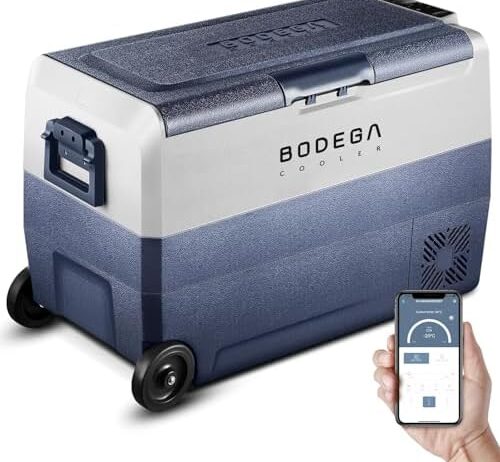
The BODEGACOOLER 64-quart is the largest cooler in this set by a wide margin — more than double the volume of the 31-quart EUHOMY units. Normally, that extra size would be a liability in extreme heat: more surface area, more heat ingress, harder work for the compressor. Dual-zone operation changes that calculation.

Set one zone to 35°F for drinks and the other to 0°F for frozen food. The 35°F zone needs far less cooling per hour than a 0°F zone would — the gradient between 115°F ambient and 35°F interior is 80 degrees, versus 115 degrees for a 0°F target. By running half the box at a less aggressive setpoint, you’re cutting the total thermal load substantially compared to running the full 64 quarts at 0°F.

This is also the unit with app control and the deepest review base at 1,752 owners. At 12/24V DC and 100-240V AC, it runs from a vehicle outlet, an auxiliary battery, or shore power at a campsite. The practical scenario: drive to camp in the heat, plug into shore power if available, and let the compressor catch up overnight when ambient temperatures drop. The dual-zone flexibility means you’re not forced into an all-or-nothing temperature choice while the box is still pulling down.

The Battery Question Nobody Answers Clearly

A 12V compressor fridge draws current from your vehicle’s electrical system. How much current depends on the setpoint, the ambient temperature, and how hard the compressor is working. In mild conditions, the compressor cycles — runs for a few minutes, shuts off, coasts on the insulation. Power draw averages out to something modest.

In extreme heat, the compressor may run continuously. Continuous operation at 12V can pull several amps, and over eight hours of parking, that adds up fast. A standard car battery holds roughly 50-70 amp-hours, but you can only safely use about half of that before the voltage drops low enough to prevent starting the engine.

Most compressor fridges include a low-voltage cutoff — a circuit that shuts the compressor down when battery voltage drops below a threshold, typically around 11.5V to 11.8V. This protects your starting battery from being fully drained. But here’s the catch: the cutoff doesn’t care about your food. It cares about your battery. When it triggers, the compressor stops, and your cooler starts warming up. In 115°F ambient, the interior temperature rises fast once the compressor stops.

The real solution isn’t a smarter cutoff — it’s a separate auxiliary battery dedicated to the fridge. Run the cooler off a secondary battery, and the vehicle’s starting battery stays untouched. This is standard practice for overlanding rigs and long-distance camping setups, and it’s worth considering if you’re running a compressor fridge in serious heat for more than a day trip.

Wheels Sound Minor Until You’re in the Sun

Here’s a scenario that matters more than it seems: your vehicle is parked in direct sunlight. The trunk is 130°F. The compressor fridge is fighting for its life. You could move the cooler to the shade — under a tree, under an awning, into a tent vestibule — and immediately drop the ambient temperature the compressor sees by 20 to 40 degrees.

Now try lifting a loaded 43-quart cooler. Full of food and ice packs, you’re looking at 50-plus pounds. Out of a trunk, across gravel, to a shady spot thirty feet away. You’ll do it once. You won’t do it three times a day as the sun moves.

Wheels change that calculus. Roll it out of the trunk, roll it to shade, roll it back when you load up. It sounds like a convenience feature. In extreme heat, it’s a thermal management strategy — the easiest way to reduce the gradient the compressor fights is to reduce the ambient temperature around the box, and the easiest way to reduce ambient is to get the box out of the sun.

How to Pre-Cool and Why It Matters More Than You Think

The hardest work a compressor fridge does is the initial pulldown — taking the interior from ambient temperature to your setpoint. If the box starts at 90°F and you’re targeting 0°F, that’s a 90-degree pulldown. Every item you put inside that’s warm adds thermal mass the compressor has to cool.

Pre-cool the fridge the night before on AC power, in a climate-controlled room. Load it with already-cold or frozen items. When you put it in the vehicle the next morning, the interior is already at setpoint, and the frozen contents are acting as a thermal battery — absorbing any heat that leaks in through the walls and keeping the compressor’s workload to maintenance rather than pulldown.

The difference is dramatic. A pre-cooled, fully loaded fridge in a hot car might see the compressor cycle normally — running 30-40% of the time to offset heat ingress. The same fridge loaded warm in a hot car will run the compressor continuously for hours just to pull down, burning through battery capacity before you’ve driven an hour.

This applies to every compressor fridge equally. It’s not a feature. It’s physics. But it’s the single highest-impact thing you can do to improve real-world performance in heat, and it costs nothing.

Matching the Fridge to the Vehicle

A 31-quart cooler fits in a sedan trunk with room to spare. A 64-quart cooler does not — it needs an SUV cargo area or a truck bed, and it needs to sit where air can circulate around the condenser coils on the outside of the cabinet. Pushing a compressor fridge against the wall of a trunk, blocking the exterior coils, traps the rejected heat right next to the box and raises the effective ambient temperature the system sees. Airflow matters.

In a truck bed with a tonneau cover, temperatures can exceed the cabin temperature by 20-30 degrees on a sunny day. A cooler in a covered truck bed at 2 PM in July might be sitting in 140°F air. That’s an extreme case, and even a well-insulated compressor fridge will struggle to hold freezing temperatures against that gradient for long. If you’re running a cooler in a truck bed, shade the cover or crack the tailgate for ventilation. Small interventions move the thermal math significantly.

FAQ

Will a 12V compressor fridge drain my car battery overnight?

It can. In hot weather, the compressor may run continuously, drawing several amps from your vehicle battery hour after hour. Most compressor fridges include a low-voltage cutoff that shuts the compressor down before the battery drops too low to start the engine — typically around 11.5V. But once the cutoff triggers, the fridge stops cooling and the interior warms up quickly in hot ambient air. For overnight or multi-day use, a dedicated auxiliary battery is the reliable solution.

Can a portable compressor fridge actually reach -4°F in a hot car?

At 70°F ambient, yes — every fridge in this class can reach its rated minimum. At 110°F or higher, the achievable minimum temperature climbs because the compressor is fighting a much steeper temperature gradient. Whether a given unit reaches -4°F at high ambient depends on its insulation thickness, compressor capacity, and how much surface area is exposed to heat. Pre-cooling the fridge and its contents before loading it into a hot vehicle gives the compressor a major head start.

Does a compressor cooler use more electricity in hot weather?

Yes, significantly. The compressor cycles on and off in mild conditions, resting between cycles. In extreme heat, it runs continuously to offset constant heat ingress through the insulated walls. Continuous operation draws more total power per hour than cycling, which depletes a battery faster. Higher ambient temperatures also mean the compressor works against a steeper thermal gradient, which increases current draw per unit of cooling — it takes more energy to move each BTU of heat when the difference between inside and outside is large.

Is a bigger or smaller compressor fridge better for hot climates?

It depends on how you use it. A smaller fridge (31 quarts) has less surface area for heat to enter, so the compressor works less to maintain temperature — better for efficiency and battery life. A larger fridge (64 quarts) loaded with frozen items has more thermal mass, which buffers temperature spikes when you open the lid. If you’re keeping it sealed in a hot trunk, smaller wins on power draw. If you’re opening it throughout the day, the thermal mass of a fully loaded larger unit stabilizes temperature better.

Does dual-zone cooling save power compared to single-zone?

It can, depending on your setpoints. If both zones are set to the same deep-freeze temperature, the compressor workload is identical to a single-zone unit of the same size. But if one zone is set to a moderate refrigerator temperature (say 35°F) while the other holds 0°F, the average thermal load across the whole unit drops. The warmer zone requires less cooling effort, which gives the compressor some relief — meaningful in high ambient heat where every degree of reduced gradient helps.