We research every product we recommend. We may earn a commission from the links on this page.
Automotive › Hand Fuel Pumps

Rated GPM Drops the Moment You Lift the Nozzle

We compare published specifications and marketplace data. We do not test these products.

Fuel Pump Flow Drops as the Hose Climbs
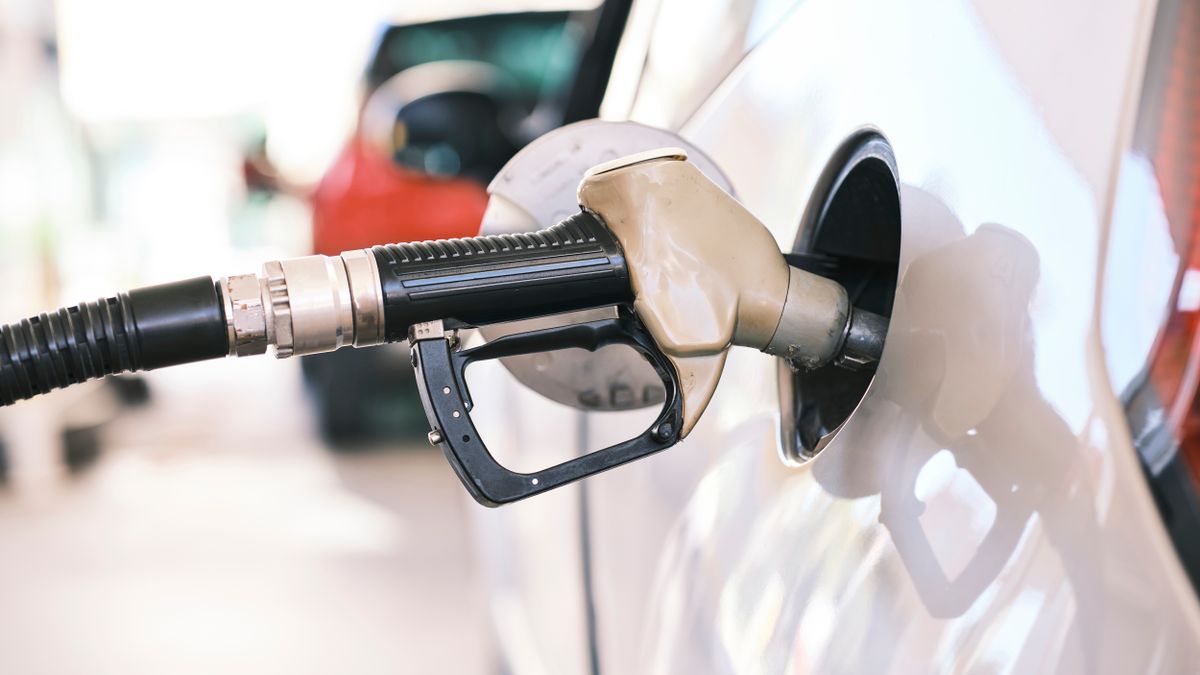
Photo by Engin Akyurt on Pexels

A portable fuel transfer pump rated at 5 GPM will move closer to 3.5 gallons per minute the moment you raise the nozzle three feet above the fuel can. Every foot of vertical lift consumes about 0.4 PSI of the pump’s discharge pressure, and that pressure is all a small DC motor has to give. The number on the box is real — it just describes a condition you’ll almost never use: outlet and inlet at the same height, no hose resistance, no cold-stiffened rubber fighting you. Four current pumps span a 3.2x range in rated flow and a 2.5x range in price, but the one that fits your job depends less on the printed GPM than on where the fuel needs to go and what’s powering the motor when it gets there.

Affiliate disclosure: This article contains affiliate links. We may earn a commission if you buy through them, at no extra cost to you.

Everything we recommend
4 picks

How we picked

We did not connect these pumps to a fuel can. Selections are based on published specifications, discharge physics, and owner-reported behavior.

Rated flow minus lift loss, not rated flow alone

A 12 GPM pump at three-foot lift still outflows a 3.8 GPM pump at level. We compared what remains after the vertical penalty.

Power source matched to job length, not wattage

USB runs a level transfer. A tool battery handles vertical lift under load. We matched power type to realistic use duration.

Adapter fit from owner evidence, not adapter count

Every pump ships four adapters. Owners report which ones actually seat into standard fuel cans without modification.

Connection reliability, not feature count

Auto-stop and trigger nozzles appear on all four. Hose-to-nozzle leak reports separate the ones that hold up from the ones that don’t.

The number on the box is measured at zero lift

Every portable fuel transfer pump is rated at atmospheric discharge — inlet and outlet at the same elevation, no vertical work, no hose friction. That’s the bench condition, and it’s real. It’s also the condition you’ll use least. The moment fuel has to travel upward — into a truck bed, a boat tank, a generator mounted on a trailer — the pump’s DC motor is fighting gravity with a fixed pressure budget.

The math is simple. A column of gasoline exerts about 0.4 PSI per vertical foot. A three-foot lift from a ground-level fuel can to a truck bed consumes roughly 1.2 PSI. That doesn’t sound like much until you realize a small twelve-volt diaphragm pump may only produce 4 to 6 PSI total. Losing 1.2 of it to gravity means losing twenty to thirty percent of the motor’s working capacity — and the flow drops by roughly that same fraction.

A pump rated at 3.8 GPM at level will deliver something closer to 2.7 to 3 GPM at a three-foot lift. A pump rated at 5 GPM will move about 3.5 to 4. And a pump rated at 12 GPM still delivers 8 to 9 — which is more than double what the smaller pumps manage at level. The rated number matters, but only as a starting point for the subtraction you’re about to do.

Level transfers and vertical transfers are different jobs

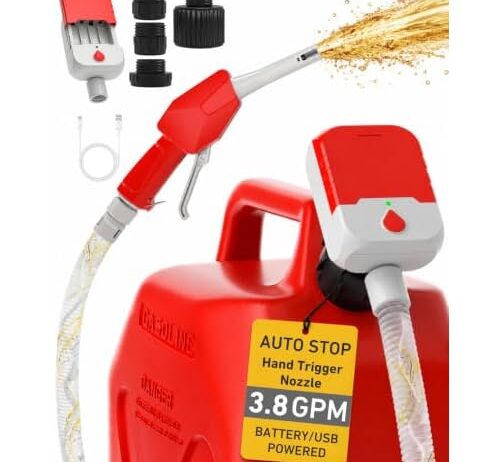
Filling a lawn mower from a can sitting on the same garage floor is a level transfer. The pump barely works against gravity, hose friction is the main resistance, and even a 3.8 GPM pump will finish a two-gallon fill in about thirty seconds. USB power — standard 5V — can handle this. The motor torque required to push fuel horizontally through four feet of hose is low enough that a USB connection maintains adequate voltage throughout.

Lifting fuel three feet into a truck bed is a different animal. The motor draws higher current under load, battery voltage sags as internal resistance climbs, and the pump’s already-reduced pressure has to push fuel through the full hose length plus the vertical rise. This is where battery quality and voltage matter. A twelve-volt battery under load might drop to eleven volts; the motor slows proportionally, and flow drops further than the pure lift penalty predicts.

The practical question isn’t which pump has the highest GPM. It’s which direction your fuel needs to travel.

USB power has a ceiling, and it’s low

Two of these pumps advertise USB power alongside battery operation. At 5V and roughly 2A, USB delivers about 10 watts. A twelve-volt battery at the same current delivers 24 watts — more than double the available motor torque. That gap is invisible during a level transfer. It becomes the bottleneck the moment the pump has to push fuel upward or through a long hose run.

USB is viable for topping off a small engine from a can on the same surface. It is not viable for sustained vertical transfers where the motor needs every watt it can draw. One owner using the MISFANS pump for extended liquid transfers noted that batteries died during longer sessions — and that’s with AA cells, not a tool battery with real amp-hour capacity. The takeaway: USB is a backup mode for light duty, not a primary power source for the jobs that justify owning a transfer pump in the first place.

Adapters ship with every pump — fitment is another question

All four pumps include four adapters. The number is identical. The fit is not.

Multiple owners of the MISFANS pump report that the pump body itself does not seat into a standard five-gallon fuel can without forcing it, and that forcing it pops the end cap off the pump. One owner describes the pump sitting loose even with an adapter threaded on, causing the hose to slip out of its holder and drip fuel onto the ground. Owners of the Bonviee report that none of the provided fittings fit their gas cans, and the fill-spout clip won’t open enough to latch onto a car’s fuel inlet.

The Keimi draws a similar complaint: one owner found that none of the connections fit, period. These are not isolated incidents — they point to a category-wide problem where “four adapters” covers the most common thread sizes but not the most common can geometries. The adapter may thread on; the assembly may still wobble, leak, or pop free under the pump’s own vibration.

If you already own the fuel cans you plan to use, measure the opening diameter and thread pitch before buying. No pump in this category guarantees universal fit, regardless of how many adapters ship in the box.

The Bonviee accepts DeWalt 20V and Milwaukee 18V batteries — the two largest cordless tool ecosystems in North America. That matters more than it looks. A high-capacity tool battery (5.0Ah or above) holds its voltage under load far better than a proprietary cell or a set of AA batteries. When the pump is fighting a three-foot lift and drawing peak current, that voltage stability is the difference between steady flow and a motor that bogs down halfway through the can.

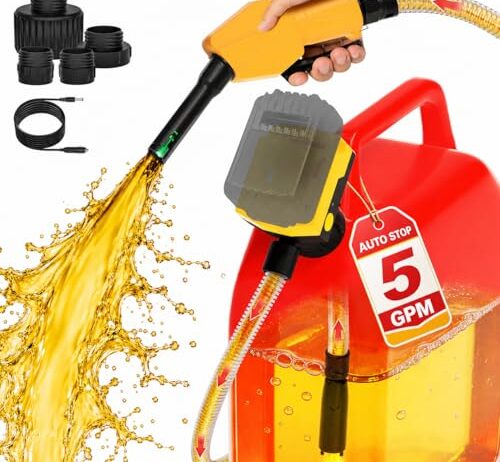
At 5 GPM rated, the Bonviee sits in the middle of this set — roughly 3.5 to 4 GPM at a typical truck-bed lift. That’s fast enough to move five gallons in under ninety seconds even after the vertical penalty. The bare-tool price means you’re not paying for a battery you’ll use once and shelve; you’re using a battery that already lives in your drill or impact driver and gets charged regularly.

The trade-off is real: owners report that the included adapters don’t fit all gas cans, and the storage bag is too small for the hoses and pump together. One owner pumping oil — a thicker fluid than gasoline — found it painfully slow, which is consistent with a diaphragm pump sized for fuel-weight liquids being asked to move something with three to five times the viscosity. For gasoline and diesel at moderate lift heights, the combination of tool-battery voltage and mid-range flow rate makes this the pump that fits the widest range of actual refueling jobs.

Cold hoses kink, and kinks kill flow faster than lift does

Rubber fuel hose stiffens below about 40°F. The elastomer molecules lose mobility, the hose wall hardens, and bends that flexed freely in summer lock into kinks that pinch the inner diameter. A kink doesn’t just slow flow — it can stall it entirely, because the pump’s limited pressure can’t force fuel past a collapsed section of hose.

A 51-inch hose gives you routing options in warm weather: loop it over a tailgate, arc it into a side-fill port, run it around an obstruction. In January, that same hose wants to hold whatever shape it froze into overnight. You either warm it — engine exhaust duct, heated garage, hot water over the outside — or you fight it, and fighting it means kinks.

Shorter hose runs reduce the problem, but none of these pumps offer a heated or silicone hose option. If you regularly transfer fuel in cold conditions, expect to add five minutes of hose prep to every session, or budget for an aftermarket silicone fuel line that stays flexible below freezing.

Auto-stop works until it doesn’t

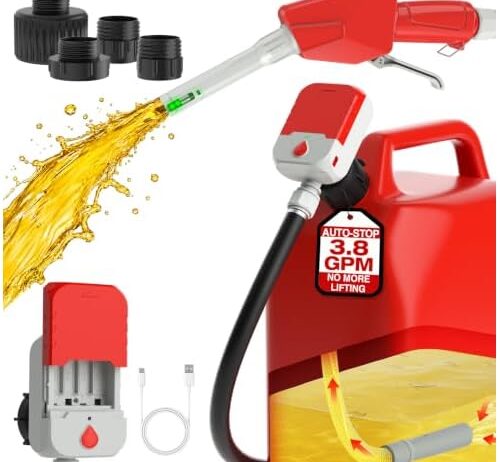
All four pumps feature auto-stop — a sensor that cuts the motor when the destination container is full. The mechanism varies: some use a float that rises with the fuel level, others use a pressure switch or conductive probe. Float-based designs are vulnerable to sloshing. When fuel surges inside a tank during transfer, the float bounces, and the pump cuts out prematurely. You pull the trigger again, it runs for three seconds, stops. Again. Stop. The container is half full and the pump thinks it’s done.

One Keimi owner describes the opposite failure: the pump overflows the container rather than shutting off. Both failure modes — premature shutoff and no shutoff — exist in the same product category because the sensor is fighting turbulent liquid in a container that’s vibrating from the pump motor itself.

The practical workaround is manual oversight. Treat auto-stop as a backup, not a replacement for watching the fill level. If you’re transferring into an opaque tank where you can’t see the fuel level, auto-stop is the only signal you have — and it’s unreliable enough that keeping a hand on the trigger nozzle is worth the inconvenience.

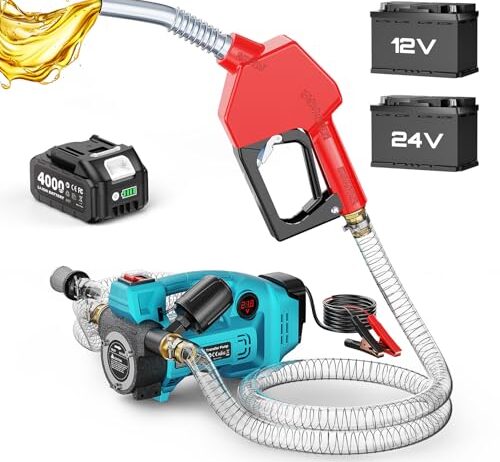
The SEESII is rated at 12 GPM — more than triple the two entry-level pumps and more than double the Bonviee. Even after a thirty-percent vertical-lift penalty, it’s moving roughly 8 to 9 GPM. That’s still more than double what the 3.8 GPM pumps deliver at level, with no lift at all. For anyone filling equipment tanks, topping off a boat, or transferring diesel from a drum to multiple vehicles, the arithmetic favors raw flow rate because the percentage loss is the same but the absolute remainder is larger.

It ships with a 4.0Ah battery and accepts 12V, 24V, or 18V input, which means it can run from a vehicle’s electrical system as well as its own cell. The tri-voltage flexibility matters on a farm or job site where the nearest outlet might be the truck itself.

The risk is real: the SEESII has only 15 reviews, and one verified buyer reports the pump did not work with the supplied battery at all. That’s a single data point, not a pattern — but it’s the only owner evidence available. The pump is marketed for diesel and kerosene, not gasoline, so compatibility with gas-can adapters and gasoline-grade seals is worth confirming before purchase. At $134.99, it costs 2.5 times the entry-level pumps, but for high-volume diesel transfer where time per gallon is the constraint, the flow-rate margin absorbs the lift penalty in a way no 3.8 GPM pump can.

Hose connections leak where you swap them most

The weakest point on any of these pumps is the junction between hose and nozzle or hose and pump body. These are friction-fit or threaded connections designed to be disassembled — for storage, for adapter changes, for replacing a damaged hose. Every disconnect-reconnect cycle wears the seal surface slightly. Over dozens of uses, the fit loosens.

One MISFANS owner describes the hose-to-nozzle connection leaking after a single day of use, turning a clean refueling job into a gasoline spill. Another notes that the pump cap doesn’t seal tightly enough to prevent leaks if the can tips over — which means stored fuel is essentially open to air. These aren’t defects unique to one brand. They’re consequences of the cost constraint that puts a $55 pump in a consumer’s hands: the fittings are injection-molded plastic or thin brass, the hose is commodity rubber, and the tolerances are loose enough that vibration from the pump motor can work a connection free over time.

Check every connection before each use. A quarter-turn of thread engagement is the difference between a clean transfer and fuel on your shoes.

Match the pump to the job, not the flow rate to the price

A 3.8 GPM pump transferring fuel at level across a garage floor moves five gallons in about eighty seconds. That’s fast enough for lawn-mower fills, generator top-offs, and can-to-can transfers where both containers sit on the ground. USB power handles it. A set of AA batteries handles it. The motor barely breaks a sweat because gravity isn’t in the equation.

The same pump asked to lift fuel three feet into a truck bed slows to roughly 2.7 GPM. Five gallons now takes almost two minutes — still reasonable for a single vehicle, but the motor is working harder, the battery is draining faster, and the hose stiffness and adapter fit problems that didn’t matter at level become friction that compounds with every additional foot of lift.

The Bonviee at 5 GPM with a tool battery handles that truck-bed lift without dropping below 3.5 GPM — and a DeWalt 5.0Ah battery has enough capacity to transfer twenty or thirty gallons before voltage sag becomes a factor. The SEESII at 12 GPM is overkill for a single truck but earns its price when you’re filling three machines on a farm or pumping diesel from a 55-gallon drum where the transfer time at 3.8 GPM would be fifteen minutes.

The question isn’t which pump is best. It’s where the fuel needs to go and how much of it moves in a day.

FAQ

How much does flow rate drop when pumping fuel up into a truck bed?

A three-foot lift — roughly the height from ground level to a truck bed — costs about twenty to thirty percent of the pump’s rated flow. A 3.8 GPM pump will deliver around 2.7 to 3 GPM, a 5 GPM pump will deliver about 3.5 to 4 GPM, and a 12 GPM pump will still move roughly 8 to 9 GPM. The loss comes from gravity: every vertical foot of fuel column consumes about 0.4 PSI of the pump’s fixed discharge pressure.

Can I use my existing DeWalt or Milwaukee battery with a fuel transfer pump?

The Bonviee pump accepts DeWalt 20V and Milwaukee 18V batteries directly — it ships as a bare tool with no battery included. No adapter or modification is needed if you already own batteries from either platform. The other pumps in this category use proprietary cells, AA batteries, or USB power and are not cross-compatible with tool-battery ecosystems.

Is USB power enough to run a fuel transfer pump?

For level transfers where the inlet and outlet are at the same height, USB at 5V can maintain enough motor torque to move fuel at a reduced but usable rate. For any transfer that involves lifting fuel — into a truck bed, a boat tank, or a raised generator — USB provides roughly half the wattage of a twelve-volt battery and the motor will bog down under the added load. Treat USB as a backup for light duty, not as a primary power source.

How long does it take to transfer five gallons with a portable pump?

At rated flow with no vertical lift: about 79 seconds at 3.8 GPM, 60 seconds at 5 GPM, or 25 seconds at 12 GPM. At a three-foot lift into a truck bed, add roughly twenty to thirty percent to those times. Real-world transfers take longer still because of hose routing, adapter fit, and the few seconds of priming before steady flow begins.

Why does my fuel transfer pump slow down when I raise the nozzle?

The pump’s DC motor produces a fixed amount of discharge pressure. Raising the nozzle above the fuel can creates a column of liquid that pushes back against the pump — about 0.4 PSI per vertical foot for gasoline. That backpressure directly reduces the pressure available to move fuel through the hose, and flow drops proportionally. The pump isn’t failing; it’s working against gravity with a limited pressure budget.

Do fuel transfer pump adapters fit all gas cans?

No. Every pump in this category ships with multiple adapters covering common thread sizes, but thread compatibility does not guarantee a secure physical fit. Owners across multiple brands report pumps that won’t seat into standard five-gallon cans without modification, adapters that thread on but wobble loose under vibration, and clips that won’t latch onto vehicle fuel inlets. Measure your can’s opening diameter and thread pitch before purchasing.