We research every product we recommend. We may earn a commission from the links on this page.
Automotive › Air Compressors & Inflators

Duty Cycle Is the Tire Inflator Spec Nobody Prints

We compare published specifications and marketplace data. We do not test these products.

Air Compressor Duty Cycle Limits How Long the Motor Runs
Photo by Mazhar Ulazhar on Pexels

Every cordless tire inflator has a duty cycle — the ratio of run time to mandatory rest time before the motor overheats. No manufacturer in this category prints it on the box. That missing number is why your inflator shuts off at 28 PSI when you set it to 35, and why the fix isn’t a bigger battery.

Affiliate disclosure: This article contains affiliate links. We may earn a commission if you buy through them, at no extra cost to you.

Everything we recommend
4 picks

How we picked

We did not inflate tires with these compressors. Selections are based on published motor specs, thermal architecture, and owner-reported runtime behavior.

Watt-hours, not voltage

A 20V battery at 2.0Ah stores less total energy than a 12V at 4.0Ah. We compared usable energy, not headline voltage.

Cylinder count, not pressure rating

Two cylinders split the thermal load per stroke. That matters more for sustained runtime than a 10 PSI difference in peak rating.

Airflow rate where stated

Higher CFM means shorter motor runtime per tire. Shorter runtime means less heat buildup before the duty cycle forces a pause.

Owner reports of mid-job shutoff

Real-world thermal shutdowns reveal what no spec does — whether the unit finishes a full-size tire in one continuous run.

150 PSI Means Nothing Without a Duty Cycle

Four cordless inflators. Three of them rate 150 PSI. The fourth rates 160. That 10 PSI difference is meaningless for a passenger car tire at 35 PSI, and it tells you nothing about whether the unit can deliver air continuously long enough to get there.

Duty cycle does. A 50% duty cycle means five minutes on, five minutes off. A compressor with that rating and a slow airflow will inflate a sedan tire partway, shut down to cool, and finish the job after a rest. A compressor with 100% duty cycle — rare and expensive in this size class — runs until the battery dies or the tire is full, whichever comes first.

None of these four units carries a duty cycle rating. That is standard for this price range. What you can do is read the thermal architecture — cylinder count, wattage, airflow — and predict which ones will finish the job and which ones will make you wait.

Why the Motor Stops Before the Battery Dies

Copper wire in the motor windings heats up according to a simple rule: double the current, quadruple the heat. That’s the I²R relationship, and it’s why a compressor working hard against a nearly full tire — drawing maximum current to push air past high back-pressure — gets hot faster than one topping off a half-flat bike tire.

The insulation wrapped around those copper windings is a polymer film rated for sustained temperatures between 130°C and 180°C, depending on grade. Exceed that threshold for long enough and the coating breaks down, the windings short against each other, and the motor is finished. Not overheated-for-the-moment finished. Permanently finished.

Thermal shutdown circuits exist to prevent exactly that. When the motor or battery temperature crosses a threshold, the unit cuts power. From the outside, this looks identical to a dead battery — the compressor simply stops. The difference is that a dead battery stays dead, and a thermally protected motor restarts after a few minutes of cooling. If your inflator quits and comes back after sitting, heat was the reason.

Two Cylinders, Half the Heat Per Stroke

A single-cylinder compressor does all its compression work in one chamber. Every stroke compresses the full volume of air against the full back-pressure of the tire, and the piston, cylinder wall, and motor absorb all of the resulting heat.

A dual-cylinder design splits that work. Each piston handles half the compression per stroke, generating less heat per cylinder per unit of air delivered. The motor still does the same total work to move the same volume of air to the same pressure — thermodynamics does not negotiate — but the heat is distributed across more surface area, and each individual component runs cooler at any given moment.

The practical result: a dual-cylinder compressor can sustain continuous operation longer before triggering a thermal shutdown, because it takes longer for any single component to reach its temperature limit. This is the same principle behind twin-cylinder shop compressors, scaled down to battery-powered portables.

CFM Is the Speed. Duty Cycle Is the Distance.

Airflow in cubic feet per minute tells you how fast air enters the tire. A unit pushing 11.6 CFM fills a 225/65R17 SUV tire from 20 to 35 PSI faster than one pushing 6 CFM — simply because it moves more volume per minute.

Speed matters here for a reason that has nothing to do with impatience. The faster the tire fills, the less time the motor runs continuously, and the less heat accumulates before the job is done. A high-CFM inflator might finish a passenger tire in one unbroken run where a slower unit would trigger thermal protection halfway through.

But CFM and duty cycle are independent numbers. A high-CFM motor drawing heavy current can overheat faster than a low-CFM motor with better thermal management. Airflow rate tells you how quickly you’ll reach target pressure on one tire. Duty cycle tells you whether you can do all four without a cooling break in between.

Watt-Hours: The Number That Isn’t on the Front of the Box

Voltage sells inflators. “20V” sounds stronger than “12V,” and it usually is — higher voltage motors can deliver more torque per amp of current drawn. But voltage alone does not tell you how long the battery lasts.

Total energy is voltage times amp-hours. A 12V battery at 4.0Ah stores 48 watt-hours. A 20V battery at 2.0Ah stores 40 watt-hours. The 12V unit has 20% more total energy despite the lower headline voltage. Whether that translates to longer runtime depends on how efficiently each motor converts stored energy into compressed air, but the math is clear: the bigger number on the sticker is not always the bigger battery.

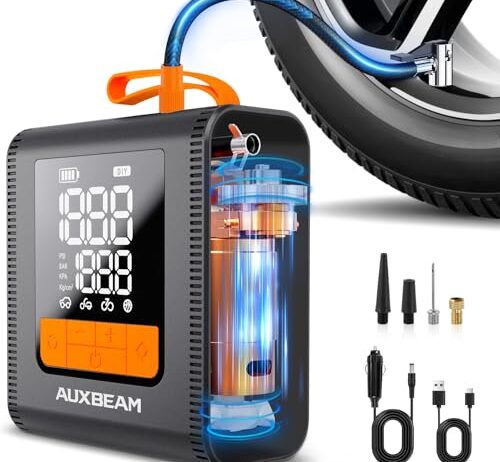
This matters most when you’re inflating multiple tires in sequence. The motor may never overheat — it may simply run out of charge. One owner of the AUXBEAM H4 reported filling a single tractor tire from 21 to 30 PSI and draining the battery to half, needing a recharge before the second tire. That’s a 48Wh battery exhausted by the volume of one large agricultural tire.

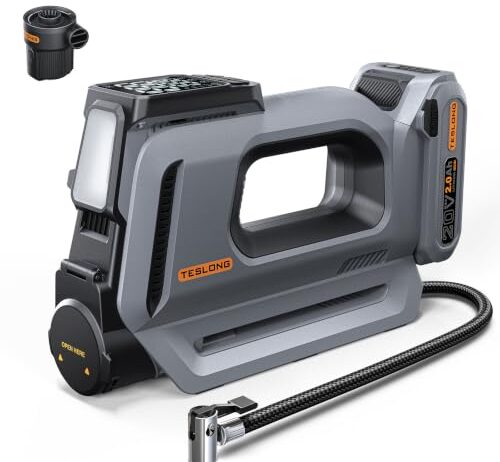
The Teslong runs a dual-cylinder compressor at 120W on a 20V removable battery. Two pistons sharing the compression work means each cylinder generates less heat per stroke than a single piston doing the same job alone. That thermal headroom is what keeps the motor running longer before a protection circuit intervenes.

At 40 watt-hours of battery capacity, total energy is actually lower than the 48Wh AUXBEAM unit below — so this is not a runtime advantage from a bigger battery. It’s an efficiency advantage from distributing mechanical work. The motor can use more of those 40 watt-hours before heat forces a stop, which is the difference between finishing an SUV tire in one pass and waiting five minutes in a parking lot. The 45W charger means a dead battery recovers faster than units with lower-wattage charging, which matters if you’re doing all four tires and run out of charge between the second and third.

How Long Between Tires — and Why Nobody Can Tell You

The honest answer: it depends on the tire you just inflated, the ambient temperature, and the duty cycle of the specific motor inside your specific inflator. None of which you know, because none of it is printed anywhere.

Here is what the physics gives you. Motor cooling in a cordless inflator is passive — no fan, no liquid cooling, just air against a warm housing. Heat dissipates faster when the temperature difference between the motor and the surrounding air is large, and slower as the motor cools toward ambient. On a 95°F August afternoon with the inflator sitting on blacktop, “cool down” takes longer than it does in a 50°F garage.

A practical rule for any compressor in this size class: if the unit shuts off on its own, wait until the housing feels no warmer than the air around it. That is not a published guideline. It is what thermal shutdown protection is designed to enforce — the motor should not restart while the housing is still radiating heat from the last run.

If the unit does not shut off on its own and you’re doing multiple tires in sequence, feel the housing between tires. Warm is normal. Too hot to hold comfortably means the motor is closer to its thermal limit than you want, and a five-minute pause costs less than a replacement motor.

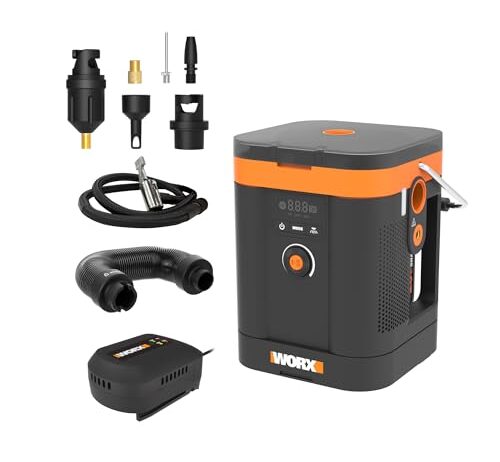
The WORX WX098L pushes 11.6 CFM on the same 20V, 2.0Ah platform as the Teslong. Where the Teslong manages heat by splitting it across two cylinders, the WORX manages it by finishing quickly — higher airflow means the tire reaches target pressure in fewer minutes of continuous motor operation.

The distinction matters. A dual-cylinder unit can run longer. A high-CFM unit needs to run for a shorter period. Both strategies reduce the chance of a thermal shutdown mid-tire, but they fail differently under stress. Push the WORX through four consecutive large-volume tires and it may overheat because it’s a single motor running hard, even though each individual tire took less time. The Teslong may handle the marathon better because its per-stroke heat generation is lower. For one or two passenger tires at a time — a roadside flat, a seasonal pressure check — the WORX’s speed advantage is the one you’ll actually feel. Battery and charger come in the box, which is not universal at this price point.

The Budget Trap: Missing Specs on Cheap Inflators

A cordless inflator at $40 is not automatically worse than one at $120. Small piston compressors are simple machines — a motor, a cylinder, a battery, a pressure sensor — and the cost of those components does not scale linearly with performance. A $40 unit can inflate a bicycle tire or top off a sedan tire that’s down 5 PSI without any thermal issues, because the work required is small.

Where cost correlates with capability is sustained heavy use: filling a fully flat 265/70R17 truck tire from zero to 35 PSI, or doing all four tires on an SUV after a seasonal temperature drop. That job demands continuous high-current draw for minutes at a time, and the components that survive it — heavier copper windings, larger heat sinks, dual cylinders — cost more to manufacture.

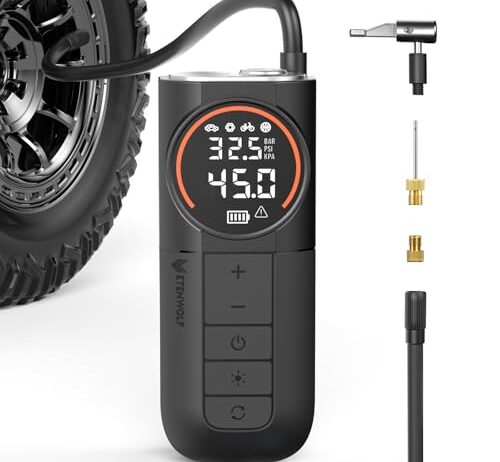
When battery capacity and motor wattage go unmentioned on a product, you cannot calculate total energy, estimate thermal headroom, or predict whether the unit will finish your specific tire. That does not mean the unit is bad. It means you’re buying a guess. One owner of the ETENWOLF S1 reported it discharging on a single tire. Without knowing battery capacity or wattage, there’s no way to determine whether that was a thermal event, a capacity limitation, or a defective unit.

Match the Inflator to the Tire, Not the Other Way Around

A motorcycle tire holds roughly 3 liters of air. A sedan tire holds about 12. A light truck tire can hold 25 or more. The work required to pressurize each one is proportional to volume times target pressure, and the heat generated scales with that work.

An inflator rated for “car tires, motorcycles, balls, bikes” is describing the objects it can physically connect to, not the ones it can inflate without overheating. Any compressor with a Schrader valve adapter can connect to any standard tire valve. Whether it can deliver enough air to fill that tire before the motor reaches its thermal limit is a different question — one answered by wattage, airflow, battery capacity, and duty cycle, not by a compatibility list.

For sedan tires at routine top-off pressures — 5 to 10 PSI below target — almost any cordless inflator in this price range will finish the job. For truck tires, SUV tires, or any tire that’s fully flat, you need either high CFM to finish quickly or dual cylinders to manage heat across a longer run. The penalty for getting this wrong is not a broken inflator. It’s sitting in a parking lot for ten minutes between each tire, waiting for a thermal shutdown to clear.

FAQ

How long can I run a cordless tire inflator before it overheats?

It depends on the motor’s duty cycle, which most portable inflators do not rate. Practically, a single-cylinder unit running at full load may trigger thermal protection in 5 to 10 minutes of continuous use. Dual-cylinder models distribute heat better and can run longer. If the housing is too hot to hold comfortably, stop and let it cool to ambient temperature before restarting.

Can I inflate all four tires without stopping between them?

On a sedan with tires down only a few PSI each, most cordless inflators can do all four without overheating. On an SUV or truck with larger volume tires or a bigger pressure deficit, expect to pause between at least one pair of tires for cooling. Feel the housing — if it’s painfully hot, wait five minutes.

Why does my inflator shut off before reaching the PSI I set?

Two possible causes: thermal protection tripping because the motor is too hot, or battery depletion. If the inflator restarts after sitting for a few minutes, heat was the reason. If it only works again after charging, the battery ran out. Both look identical from the outside.

Does a dual-cylinder inflator overheat less than a single-cylinder?

It distributes heat across more surface area, so each component stays cooler at any given moment. The total heat produced is the same for the same work — two cylinders don’t eliminate heat, they spread it. The practical result is longer continuous runtime before thermal protection activates.

Does higher wattage mean faster inflation or cooler operation?

Neither directly. Higher wattage means the motor can do more mechanical work per second, which can translate to faster airflow. But higher wattage also means higher current draw, which generates more resistive heat in the windings. A high-wattage motor with poor thermal management can overheat faster than a lower-wattage motor with better cooling or dual cylinders.