We research every product we recommend. We may earn a commission from the links on this page.

Why Your Outdoor LED Lights Look Wrong (And What Color Temperature Actually Does)

We compare published specifications and marketplace data. We do not test these products.

2700K or 5000K: The Number That Decides How a Room Feels
Photo by ZhiCheng Zhang on Pexels

The difference between 5000K and 6500K on an outdoor LED fixture is 1,500 Kelvin — a number that means nothing until you install the light and your brick house looks gray. Color temperature controls the hue of white light your fixture produces, and choosing wrong turns a security upgrade into the harshest thing on your street. Here’s how the Kelvin scale actually works and what it means for the light hitting your yard.

Affiliate disclosure: This article contains affiliate links. We may earn a commission if you buy through them, at no extra cost to you.

Everything we looked at
4 picks

How we picked

We do not install these fixtures on homes. Judgments are based on LED specifications, weatherproofing ratings, and marketplace review patterns.

Kelvin rating, not brand claims

Color temperature is published for every fixture; we prioritized models where the Kelvin value matched the stated use case.

Adjustability after installation

Lights with rotatable heads let you correct aim and coverage without removing the fixture from the wall or soffit.

IP rating, not marketing language

IP65 is the minimum for outdoor exposure; weatherproofing claims without a rating were ignored.

Wattage relative to coverage area

High-wattage floods are designed for large areas; residential porches need far less power to avoid light trespass.


Color Temperature Isn’t Brightness

This is the single most common misread in outdoor lighting. A buyer sees 6500K and assumes it’s brighter than 5000K because the number is higher. It isn’t. Color temperature measures the hue of white light — where it sits on the spectrum from amber to blue — not how much light the fixture produces. That’s lumens, a completely separate specification.

The Kelvin scale comes from heating a theoretical block of material until it glows. At 2700K it glows warm orange, like a candle. At 5000K it’s a neutral white close to midday sun. At 6500K it pushes into the blue range — overcast-sky territory. The number tells you what color the light is, not how far it throws or how many square feet it covers.

Where it gets confusing: cooler light does appear brighter to the human eye, even at the same lumen output. Your eye’s sensitivity shifts toward blue-green wavelengths in low-light conditions, so a 5000K fixture and a 3000K fixture producing identical lumens will look like the cooler one is working harder. It’s a perceptual trick, not a performance difference. And it’s why so many buyers install 6500K thinking they’re getting more security coverage when they’re really just getting bluer light.

What Happens Inside the LED

Every white LED starts blue. The chip itself emits blue light — that’s the physics of the semiconductor material. What makes it “white” is a phosphor coating over the chip that absorbs some of that blue emission and re-emits it at longer wavelengths. More phosphor conversion means warmer light. Less means more of the original blue gets through.

A 5000K LED has a phosphor mix that lets enough blue through to read as crisp and neutral without tipping into the obviously blue range. A 6500K LED uses a thinner or different phosphor layer that allows substantially more blue emission, producing that stark, clinical tone. Neither is defective. They’re doing exactly what they were designed to do.

This matters because you can’t adjust it after purchase. Unlike a smart bulb with tunable color, a fixed outdoor flood light is locked to its phosphor coating permanently. The 5000K you buy is the 5000K you live with until you replace the fixture.

The 5000K vs. 6500K Split in Practice

Stand outside at noon on a clear day. That’s roughly 5000K — neutral, high-contrast, colors look accurate. Now stand outside under heavy overcast. That bluer, flatter light is closer to 6500K. Both are “daylight” in the loosest sense. But one makes your yard look like your yard. The other makes it look like a parking lot.

At 6500K, warm-toned surfaces suffer most. Red brick turns grayish. Natural wood siding loses its warmth and reads as flat. Tan or cream stucco picks up a cold cast. The blue content in the light suppresses the red and yellow wavelengths that give those materials their character. If your house is painted cool gray or white, 6500K won’t clash as badly — but it will still read as institutional to anyone walking past.

At 5000K, you get enough blue content for sharp contrast and good visual acuity without the color distortion. Greens stay green. Earth tones hold. It’s the reason commercial facilities that need both visibility and visual comfort — car dealerships, hospital exteriors, well-designed retail — tend to land at 5000K rather than pushing to 6500K.

The practical difference shows up most at property boundaries. A 6500K flood aimed at your driveway throws blue-tinted light onto your neighbor’s bedroom window. The same fixture at 5000K is still bright, still functional for security, but the spill reads as less aggressive because it carries less of the short-wavelength blue that the eye perceives as harsh.

When 6500K Makes Sense (And When It Doesn’t)

There are legitimate reasons to go to 6500K outdoors. If you’re lighting a commercial loading dock, a warehouse exterior, or a construction site where color rendering matters less than raw contrast, the cooler temperature maximizes visual acuity. Security cameras with older sensors also tend to produce slightly sharper images under 6500K because the higher blue content matches their peak sensitivity range.

For residential use, 6500K is almost always too much. The complaints are consistent: “looks like a prison yard,” “my neighbors asked me to change it,” “makes everything look dead.” These aren’t subjective quibbles — they’re the predictable result of putting commercial-grade color temperature on a house. Your eye adapts to it eventually when you’re standing in it, but everyone else on the street sees an unnaturally blue patch on an otherwise warm-toned block.

The fog problem is real too. Cooler light scatters more in humid air and mist because shorter wavelengths bounce off water particles more readily. If you live anywhere with morning fog, dew-heavy nights, or regular humidity, a 6500K flood creates a visible haze of scattered light around the fixture that a 5000K unit handles noticeably better.

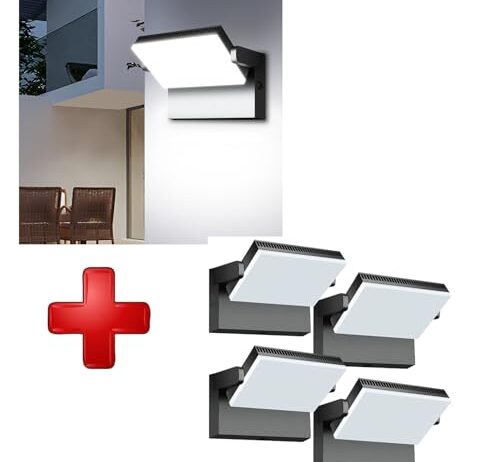
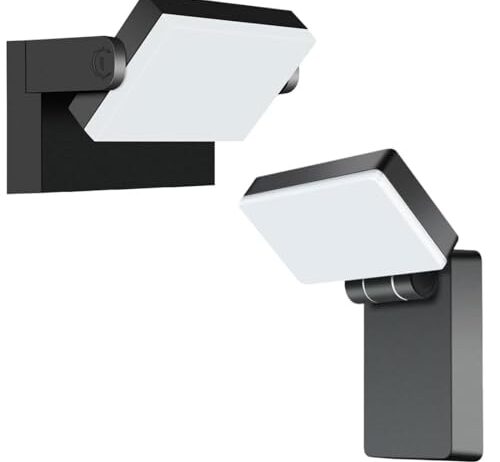
The adjustable head is the feature that earns this one its place. Most outdoor floods lock their aim at installation: you drill, you mount, you hope you guessed right about where the light needs to fall. A 360° head lets you correct after the fact — point it at the walkway this month, swing it toward the driveway next month when the tree canopy shifts.

At 60W and 5000K, this sits in the neutral middle of the outdoor range. It’s bright enough to light a section of yard without the blue cast that makes residential spaces feel commercial. The color stays close to what natural daylight looks like at noon, which means your landscaping colors don’t shift when the lights come on. Two fixtures in the pack give you paired coverage — one on each side of a garage door, or staggered along a fence line where a single unit would leave gaps.

Wattage and Color Temperature Are Doing Different Jobs

A 20W fixture and a 120W fixture can both be 5000K. They’ll produce the same color of light. The difference is how much of it — the 120W unit pushes dramatically more lumens, covering more area at higher intensity. Color temperature tells you what that light looks like. Wattage (and lumens) tell you how much of it there is.

This distinction matters when you’re scaling up. A single 60W flood at 5000K on a small porch looks clean and residential. Five 120W floods at the same 5000K on a building facade produce an overwhelming amount of neutral-cool light — technically the same color, but the sheer volume of it changes how the space feels. Intensity amplifies the perception of color temperature. High-output 5000K doesn’t feel the same as low-output 5000K, even though the Kelvin number is identical.

If you’re lighting a large area and want to avoid that institutional feel, lower wattage per fixture with more fixtures spread wider often produces better results than fewer high-wattage units concentrated in spots. You get even coverage without the harsh pools and dark gaps that make a yard feel surveilled rather than lit.

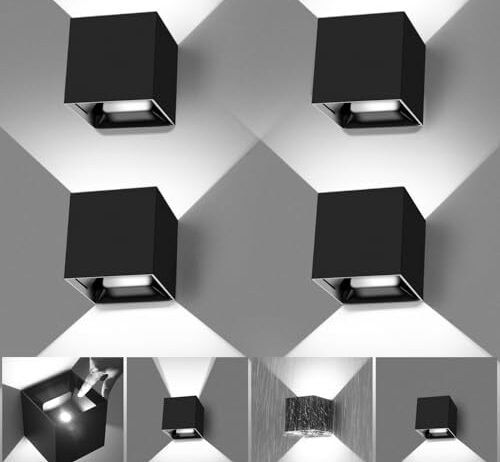
Wall-mounted fixtures with a fixed beam pattern do something floods can’t: they control where light goes. A flood throws wide. A wall light washes the surface it’s mounted on and the ground directly below. That’s a fundamentally different approach to outdoor lighting — illumination by proximity rather than projection.

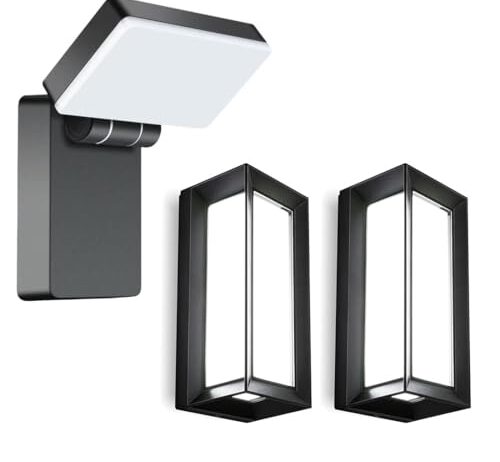
At 5000K, the color stays in the neutral range that reads as clean without reading as cold. The IP65 rating means the internals are sealed against dust and low-pressure water jets — rain, sprinkler overspray, hose-down when you’re cleaning the porch. Three in the pack let you run a consistent color line across multiple entry points: front door, side door, garage. Mixing fixtures from different manufacturers or different color temperatures is how you end up with a house that looks like three different buildings at night. A matched set avoids that.

How to Match What You Already Have

The hardest version of this problem isn’t picking a color temperature for a new install — it’s adding fixtures to a house that already has outdoor lighting. If your existing porch light runs at 3000K (warm white) and you add a 5000K flood on the same wall, the difference is immediately visible. One glows amber. The other glows white. They look like they belong to different houses.

Check your existing bulbs first. Most LED bulbs print the Kelvin rating on the base or the box. If your porch runs 3000K, your path lights run 3000K, and your landscape spots run 3000K, adding a 5000K security flood creates a jarring mismatch that’s visible from the street.

You have two options. Match the temperature — which may mean going warmer on the new fixture than you’d otherwise choose — or commit to replacing everything in one pass so the whole house reads as one consistent color. The second option is more work upfront but eliminates the patchwork look that accumulates when you buy outdoor lights one at a time over several years.

If you’re starting from scratch with no existing fixtures to match, 5000K is the safest default for mixed-use residential. It’s cool enough for security visibility, neutral enough not to distort surface colors, and close enough to natural daylight that it doesn’t register as artificial from the street.

The Terminology Problem

“Daylight.” “Cool white.” “Bright white.” “Natural white.” These terms appear on packaging and product titles interchangeably, and none of them have standardized Kelvin ranges across manufacturers. One brand’s “daylight” is 5000K. Another’s is 6500K. A third uses “daylight” for anything above 4000K.

Ignore the words. Look for the Kelvin number. If a listing doesn’t include one, you’re guessing — and guessing wrong means drilling holes, running wire, and installing a fixture you’ll want to replace the moment you see it at night. A product that won’t tell you its color temperature before purchase is asking you to gamble on the single specification that determines whether you like looking at your house after dark.

“Bright white” is especially misleading. It implies more light. It delivers different-colored light. A 3000K bulb and a 5000K bulb at the same lumen output produce the same amount of illumination — one just looks warmer and the other looks cooler. “Bright” in this context is a marketing synonym for “cooler,” which is a color choice, not an intensity upgrade.

FAQ

What color temperature is best for outdoor security lights?

5000K is the most common choice for residential security lighting. It produces neutral white light with enough contrast for cameras and visibility without the harsh blue cast of 6500K. If your priority is maximum contrast in a commercial or industrial setting, 6500K works — but for a house on a residential street, 5000K avoids the institutional look and neighbor complaints.

Why do my new outdoor LED lights look so blue?

Your fixtures are likely rated at 6500K or higher, which produces light heavy in blue wavelengths. This is sometimes labeled “daylight” but sits well above actual noon sunlight in blue content. The blue appearance is especially obvious next to warmer existing lights or against warm-toned surfaces like brick and wood. The only fix is replacing the fixture or bulb with a lower Kelvin rating — 5000K for neutral white, 3000K for warm.

Is 5000K or 6500K brighter?

Neither, inherently. Color temperature and brightness are independent specifications. A 5000K light and a 6500K light with the same lumen output produce the same amount of light — the 6500K version just appears brighter because the human eye is more sensitive to blue-green wavelengths in low-light conditions. Check the lumen rating for actual brightness; check Kelvin for color.

Will 6500K outdoor lights bother my neighbors?

Likely, yes. 6500K light carries more blue wavelengths, which scatter more visibly in humid air and register as harsher at a distance. Light spill from a 6500K flood onto an adjacent property reads as more aggressive than the same fixture at 5000K or lower, even at identical brightness. If your fixtures face toward a neighbor’s windows, 5000K or lower reduces complaints without sacrificing security visibility.

What does IP65 mean on an outdoor light?

IP65 means the fixture is completely sealed against dust (the 6) and protected against low-pressure water jets from any direction (the 5). It handles rain, sprinklers, and hose spray. It does not mean the fixture can be submerged. For standard outdoor wall and flood light mounting, IP65 is sufficient for all normal weather exposure.