Every LED parking lot light you can buy will get dimmer. Not in a decade — in months. The semiconductor junction that produces the light degrades under heat, and the fixture’s thermal design determines how fast. None of the outdoor LED fixtures sold today publish enough thermal data to predict exactly when, but the physics narrows it down. Here’s how to read what the numbers actually tell you, and what to do when they don’t.
Affiliate disclosure: This article contains affiliate links. We may earn a commission if you buy through them, at no extra cost to you.
Everything we recommend
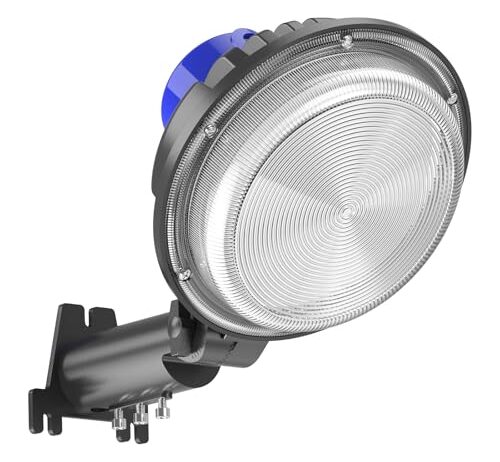
The one where you can do the math
AIKVSXER 200W LED Barn Light Dusk to Dawn,30000LM Outdoor Yard Light 6500K200W with a stated 30,000 lumens gives you a real efficacy number — 150 lm/W — to measure fade against. Dusk-to-dawn sensor and 6500K cool white for yards and barns.
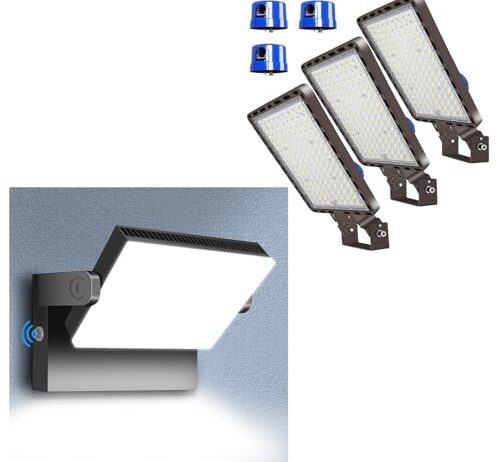
Wall light plus lot lights in one run
ledmo 1 Pack 150W LED Outdoor Wall Lights with Photocell Wall Mount 3 Pack 350W LED Parking Lot Light 5000K IP65One 150W wall pack and three 350W parking fixtures at 5000K neutral white. IP65 rated, which keeps heatsink surfaces cleaner internally over years of outdoor exposure.
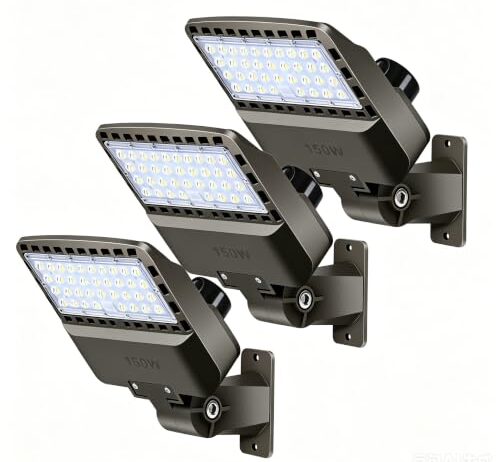
Three fixtures, uniform starting point
Juyace 150W LED Parking lot Light Dusk to Dawn ShoeBox Flood Light (3 PackA three-pack of 150W shoebox lights with dusk-to-dawn switching. Lower wattage per fixture means less heat per unit, but without a lumen spec you're trusting the LED quality on faith.
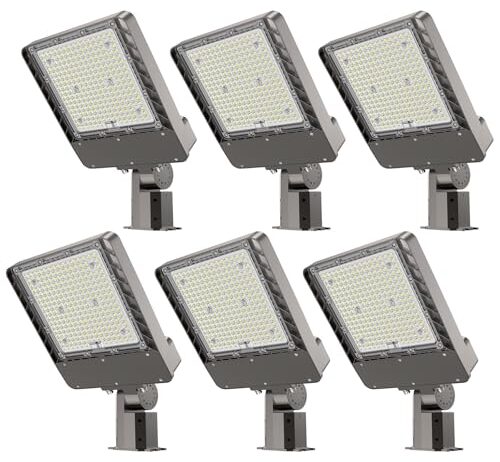
Six across a full lot
AIKVSXER 300W LED Parking Lot Light 75000LM Commercial Street Lights 6 PackSix 300W fixtures claiming 75,000 lumens each — an efficacy of 250 lm/W that, if accurate, suggests very low thermal waste per lumen. The full-lot coverage means no single fixture's fade makes the whole space feel dark.
How we picked
We did not install these fixtures. The assessment relies on published specifications, semiconductor physics, and marketplace review data.
Lumens per watt determines how much heat the junction must dissipate to produce a given light output.
Heat dissipation determines junction temperature, which governs the rate of semiconductor degradation and lumen fade.
Multiple lower-wattage fixtures distribute heat load and prevent single-point fade from darkening the entire area.
IP ratings and sensor specifications indicate which parts will fail first when the LED itself still functions.