
We research every product we recommend. We may earn a commission from the links on this page.
Tools & Home Improvement › LED Bulbs

LEDs Don’t Flicker Because They’re Broken. Your Dimmer Is.

We compare published specifications and marketplace data. We do not test these products.

Old Dimmers and LED Bulbs Don't Get Along
Photo by Riki Risnandar on Pexels

Your dimmer switch was engineered for a 60-watt resistive load that no longer exists. A typical LED replacement draws 14 watts — less than a quarter of what the switch’s internal circuit needs to fire cleanly every half-cycle. That mismatch is why your lights flicker, buzz, or refuse to dim below 40%. The fix depends on whether you replace the dimmer, the bulbs, or the entire dimming method.

Affiliate disclosure: This article contains affiliate links. We may earn a commission if you buy through them, at no extra cost to you.

Everything we recommend
4 picks

How we picked

We did not install these bulbs in a fixture. Recommendations rest on dimmer-compatibility data, power specifications, and protocol standards.

Minimum load, not just dimmable claim

A bulb marked dimmable may still draw too little current for an older triac to stabilize. We prioritized actual wattage and compatibility lists.

Protocol dimming versus circuit dimming

Matter and Zigbee move brightness control to the bulb’s controller, eliminating triac interaction entirely rather than trying to satisfy legacy minimums.

Combined load across a circuit

Multiple low-wattage bulbs on one switch can sum to a stable load. We favored multi-packs that offer this path without requiring smart infrastructure.

Form factor for existing housings

BR30 floods fit standard six-inch recessed cans. A19 and GU10 cover table lamps and track fixtures without adapter hardware.


What the dimmer is actually doing

A standard residential dimmer doesn’t reduce voltage the way a volume knob reduces signal. It contains a triac — a semiconductor switch that chops the AC waveform. Sixty times a second, the triac waits, then fires partway through each half-cycle. The longer it waits, the less of each wave reaches the bulb, and the dimmer the light.

That firing moment is the problem. The triac needs a minimum current flowing through it to stay latched for the rest of the half-cycle. Drop below that threshold and it cuts out early, then re-fires, then cuts out again — dozens of times per second. With an incandescent filament drawing 60 or 100 watts of purely resistive load, the current was always well above the threshold. The triac latched cleanly every cycle.

An LED bulb drawing 9 watts doesn’t come close.

Why “dimmable” on the box doesn’t mean what you think

A dimmable LED has a driver circuit designed to accept a chopped AC waveform and produce stable DC output from it. That’s a real engineering difference from a non-dimmable LED, which may shut off entirely or strobe when it receives a phase-cut signal. But the bulb being able to handle a chopped waveform doesn’t help if the dimmer can’t produce a clean chop in the first place.

The dimmer’s minimum load is typically 25 to 60 watts, depending on the model. A single 9-watt LED is below that floor. Two on the same circuit might still be below it. You need enough total draw across all the sockets on that dimmer’s circuit to keep the triac stable — and because LED drivers are capacitive, not resistive, the actual current behavior is more erratic than the wattage number suggests. The triac sees current surges on each firing edge, then near-zero draw in between. That’s the opposite of the smooth, steady pull an incandescent filament provides.

This is why the buzzing comes from the dimmer, not the bulb. The triac is misfiring and the magnetic components in the switch vibrate at the misfiring frequency. Replacing the bulb won’t stop it.

Three ways the problem actually gets solved

Every fix maps to the same root cause: insufficient or unstable load at the triac. The approaches differ in which component you change.

Replace the dimmer. A dimmer rated for LED loads has a lower minimum threshold — often 5 to 10 watts — and uses trailing-edge phase control instead of leading-edge, which produces a gentler waveform the LED driver can follow without current spikes. This is the most reliable fix when you want to keep using a wall switch to dim.

Raise the load. If you have six sockets on one dimmer circuit and you’re replacing bulbs one at a time, the remaining incandescents may be carrying the triac. Pull the last one and the whole circuit flickers. Installing all sockets at once with enough combined wattage to clear the minimum can stabilize the old dimmer — but you’re relying on a threshold you probably can’t look up for a switch installed in 2004.

Move dimming off the wall entirely. Smart bulbs that dim through a wireless protocol handle brightness inside their own driver. The triac is irrelevant because the line voltage stays constant — the wall switch is either on or off, and the bulb’s controller decides how much current reaches the LED array. No phase cutting, no minimum load, no triac latching.

The wall-switch trap with smart bulbs

If you install smart bulbs and leave an old dimmer in the wall, you have two things trying to control brightness at once. The dimmer chops the waveform. The bulb’s controller interprets the reduced power as a command it didn’t ask for. The result is unpredictable — flickering, color drift, or the bulb resetting its wireless connection every time someone touches the switch.

Smart bulbs need the wall switch locked to full-on. That means either replacing the dimmer with a plain toggle, installing a dimmer guard plate, or using a smart switch that sends commands over the protocol instead of cutting power. If anyone in the house reflexively dims at the wall, the system fights itself.

This is the actual trade-off, not a defect. You’re choosing between physical control at the wall and software control from a phone or voice assistant. Both work. Both dimming methods produce smooth, flicker-free results. But mixing them creates exactly the instability you were trying to fix.

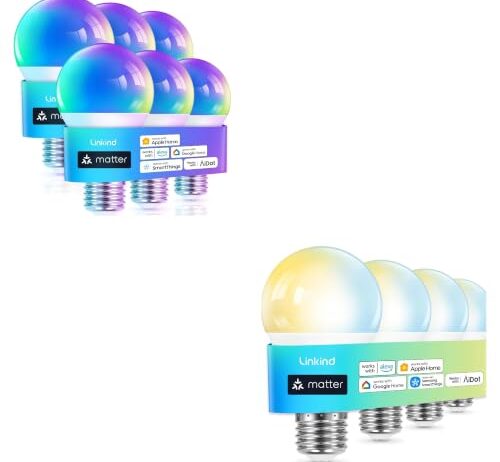
This Linkind bundle puts ten Matter bulbs in the box — six color-changing and four tunable white. Matter runs over your existing Wi-Fi or a Thread border router, and the dimming command travels as a digital packet, not a voltage reduction. The bulb’s internal driver receives full line power and decides how much current to send to the LED array. There’s no phase-cut waveform for the driver to misinterpret, no minimum load to clear, no triac to latch.

The split between color and tunable white lets you wire them to different fixtures in the same room without needing separate apps or hubs — Matter works across Apple Home, Google Home, and Alexa natively. At roughly $5.70 per bulb, you’re paying a premium over non-smart LEDs, but you’re also buying your way out of ever matching a dimmer to a driver again. The constraint is discipline: every wall switch on those circuits needs to stay on, permanently. Dim from the app or don’t dim at all.

When brute-force wattage is the simpler answer

Not every room needs smart control. A garage, a workshop, a utility closet — places where you want a lot of light or no light, and a wall switch is the right interface. The dimmer problem in these spaces is usually that someone installed a dimmer years ago for incandescents and now the single LED replacement flickers because it draws a fraction of the original load.

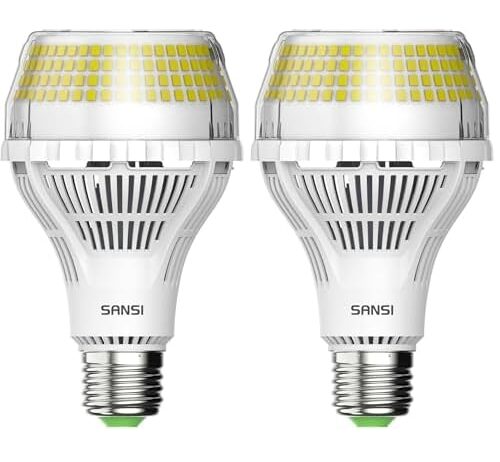
A high-output bulb changes the math. At 6,000 lumens, a single bulb rated at 400W equivalent draws substantially more current than a standard 9-watt LED. Where a typical 100W-equivalent LED produces about 1,600 lumens on roughly 15 watts, a bulb at this output level pulls enough power that it may approach or clear the minimum load threshold on its own — no second bulb needed, no smart protocol, no app.

That’s a narrow use case. You need a fixture that accepts the larger form factor, a socket rated for the heat, and a reason to want that much light in one spot. But when the alternative is rewiring a circuit or replacing a dimmer you can’t identify the model of, one bulb that simply overwhelms the minimum load is the path of least resistance.

Recessed lighting runs into the dimmer problem harder than most fixtures. A typical ceiling has four to eight cans on a single switch, and the original builder spec’d a dimmer for 65-watt incandescent floods in every one. Replace those with 8-watt LED BR30s and the total circuit draw drops from 500 watts to 60 — right at or below most triac minimums. The lights flicker in unison because they share the same chopped waveform.

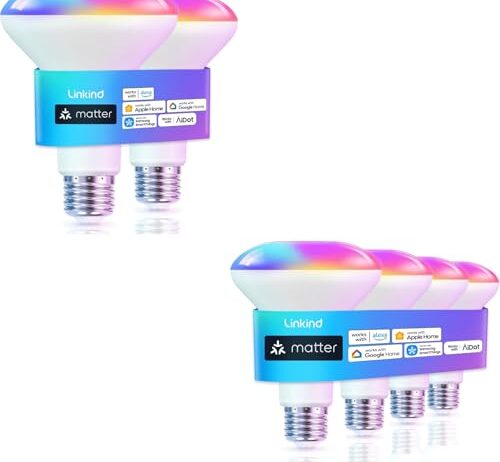
Linkind’s BR30 Matter bundle — a four-pack and a two-pack, six bulbs total — fits standard recessed cans and moves dimming to the protocol layer. Each bulb is a 3.75-inch diameter reflector designed to throw light downward from a ceiling housing, which is where BR30 differs from a standard A19: the built-in reflector directs output into the room instead of scattering it inside the can. At $10.74 per bulb, it’s the most expensive per-unit option here, but for a ceiling with six to eight recessed fixtures that all flicker on the existing dimmer, replacing the bulbs and locking the wall switch to on is less work than pulling the switch out of the wall and wiring in an LED-rated dimmer behind a plate that may not match the rest of the room.

The partial-replacement mistake

You have eight recessed cans. You replace two bulbs with LEDs. They work fine — the six remaining incandescents are carrying the triac load. You replace two more. Still fine. You replace the last four and the whole ceiling starts flickering.

This happens because the minimum load isn’t per-socket. It’s the total draw across every fixture wired to that one dimmer. Each incandescent you remove drops the resistive load that was stabilizing the circuit. The LEDs you add contribute almost nothing in comparison. The tipping point feels sudden because the triac doesn’t degrade gracefully — it either latches or it doesn’t. One bulb below the threshold and the failure appears on every light on the circuit simultaneously.

If you’re going to switch a multi-fixture circuit to LED, do them all at once. Mixing incandescent and LED on the same dimmer isn’t dangerous, but it masks the compatibility problem until the last swap, when you’ve already returned the packaging and lost the receipt.

FAQ

Will my LED bulbs work with my existing dimmer switch?

Only if the dimmer is rated for LED loads and the total wattage across all bulbs on that circuit meets the dimmer’s minimum load. Most dimmers installed before 2015 were designed for incandescent loads of 40-60 watts minimum. A single 9-watt LED won’t meet that threshold. Check the dimmer model for a minimum load rating — if it’s above the combined draw of your LEDs, you’ll get flicker.

Why does my dimmer buzz with LED bulbs but not incandescent?

The buzzing comes from the dimmer’s triac misfiring. An incandescent is a resistive load — steady, predictable current. An LED driver is capacitive, drawing current in sharp bursts that the triac wasn’t designed to handle. Those surges cause the triac and its surrounding components to vibrate at audible frequencies. The bulb isn’t buzzing; the switch is.

Can I use smart bulbs with a dimmer switch?

You shouldn’t. Smart bulbs need constant full power to maintain their wireless connection and handle dimming internally. A wall dimmer chops the power, which can cause the bulb to flicker, lose its connection, or reset. Replace the dimmer with a standard on/off toggle, or install a smart switch that sends wireless commands instead of cutting voltage.

How many LED bulbs do I need on one dimmer to stop flickering?

Enough to meet the dimmer’s minimum load, which is typically 25-60 watts for older triac dimmers. Divide that number by the wattage of each LED bulb. If your dimmer needs 40 watts minimum and each LED draws 9 watts, you need at least five bulbs on the circuit. But because LED drivers aren’t purely resistive, the actual threshold may be higher than the math suggests — some combinations flicker even above the rated minimum.

Do I need to replace all the bulbs on a dimmer at once?

For best results, yes. Replacing bulbs one at a time masks compatibility problems — the remaining incandescents carry the load until the last one comes out, and then the whole circuit flickers. Switching all sockets at once tells you immediately whether the dimmer can handle the new load.