We research every product we recommend. We may earn a commission from the links on this page.
Tools & Home Improvement › Handheld Flashlights

Lumens Sell Flashlights. Candela Is What Reaches the Fence.

We compare published specifications and marketplace data. We do not test these products.

Lumens Sell Flashlights. Candela Is What Reaches the Fence.
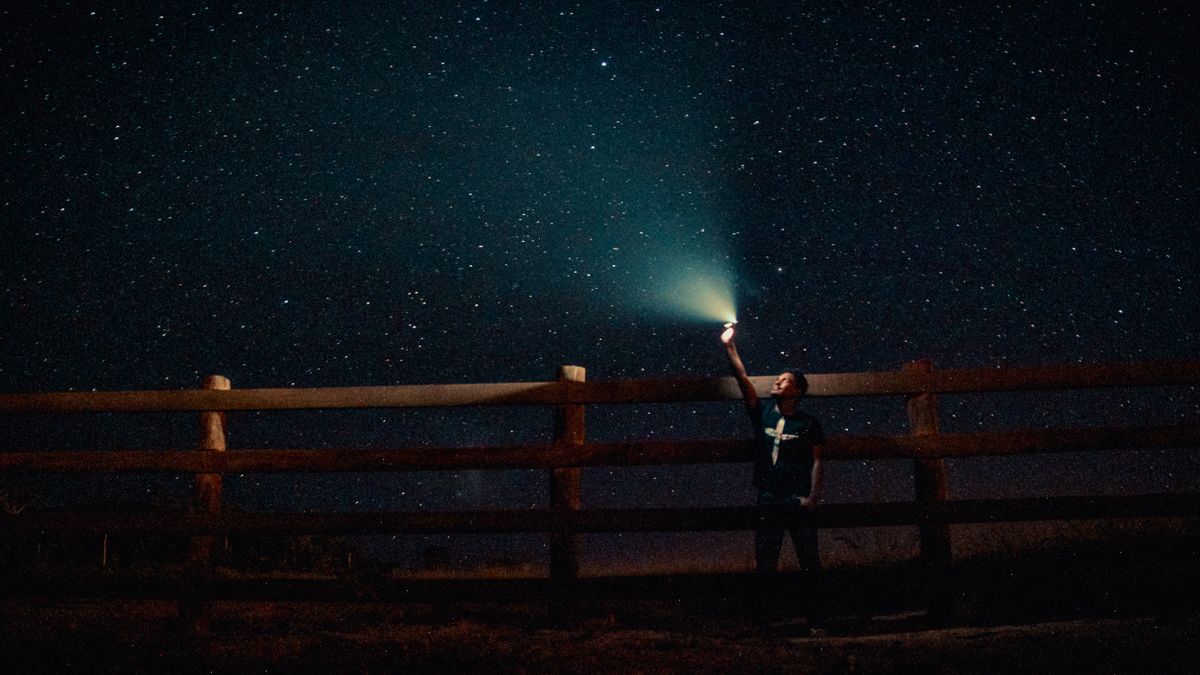
Photo by MELQUIZEDEQUE ALMEIDA on Pexels

A flashlight rated at 1200 lumens sounds three times as bright as one rated at 400. And it is — if you’re lighting up a room. But aim both at a tree 200 feet away and the 400-lumen light might put a brighter spot on the trunk. Lumens count every photon leaving the lens, in every direction. Candela counts only the ones heading where you’re pointing. That difference decides whether your flashlight is a floodlight or a searchlight, and most buyers don’t find out which one they bought until they’re standing in the dark.

Affiliate disclosure: This article contains affiliate links. We may earn a commission if you buy through them, at no extra cost to you.

Everything we looked at
4 picks

How we picked

We do not shine these flashlights at trees. Judgments rest on optical specifications, reflector geometry, and user reports of beam shape at distance.

Candela, not just lumens

Beam intensity at a fixed distance reveals how much light arrives at the target, not how much leaves the lens.

Reflector design over raw output

A shaped reflector focuses light into a throw beam. A smooth one scatters it into a flood. The difference determines reach.

Battery type and replacement cost

Rechargeable cells cost more up front but less over time. Disposable AA batteries reverse that equation. Runtime per charge matters for both.

UV wavelength and LED count

A 365nm UV LED reveals stains a 395nm LED cannot. More LEDs expand the illuminated area but do not change the wavelength.
Every photon counts, but direction counts more

Lumens measure total luminous flux — the complete quantity of visible light a source emits in all directions. A bare bulb and a spotlight can produce identical lumens. The bulb spreads them across an entire room. The spotlight concentrates them into a cone narrow enough to read a sign across a parking lot.

Candela measures that concentration. One candela equals one lumen per steradian, which is a unit of solid angle — think of it as a cone-shaped slice of the sphere surrounding the light source. Squeeze the same lumens into a narrower cone and candela goes up. The total light hasn’t changed. Where it lands has.

This is why beam distance follows candela, not lumens. The ANSI FL1 standard — the one used on most flashlight packaging — calculates throw distance from peak beam intensity: distance in meters equals the square root of candela divided by 0.25. A light producing 10,000 candela reaches about 200 meters. One producing 40,000 candela reaches about 400. You need four times the candela to double the distance, because illuminance drops with the square of distance.

The reflector decides everything

The LED itself doesn’t aim light. That’s the reflector’s job.

A deep, narrow parabolic reflector gathers photons from a wide angle and redirects them into a tight beam. The deeper the reflector and the smaller its opening relative to its depth, the more candela it produces from any given lumen count. A shallow, wide reflector does the opposite — it spreads the beam, lighting up a broad area close to you but sending very little light far ahead.

Two flashlights with the same 1000-lumen LED can produce wildly different throw. Put that LED behind a deep reflector and you might get 40,000 candela — enough to reach 400 meters. Put it behind a shallow one and you get 5,000 candela, good for about 140 meters. Same LED. Same lumens. Three times the distance, just from the reflector geometry.

TIR optics — total internal reflection lenses — take this further. Instead of bouncing light off a reflective surface, they channel it through a shaped piece of clear material that bends photons into an even tighter column. Higher candela per lumen, at the cost of a more expensive optic.

None of this appears in a lumen rating. That single number tells you how much light exists. It tells you nothing about where it goes.

UV doesn’t play by the same rules

Lumens are weighted to human eyesight, which peaks at 555 nanometers — green-yellow light. UV-A light, at 365 to 400 nanometers, sits outside the visible spectrum almost entirely. Measuring a UV flashlight in lumens is like measuring a dog whistle in decibels your ear can hear: the number comes out near zero no matter how powerful the source is.

What matters for UV is irradiance — how much UV energy hits a surface per square centimeter — and wavelength. At 365nm, UV-A causes strong fluorescence in organic compounds like pet urine, certain scorpion proteins, and the optical brighteners in paper and fabric. At 395nm, the fluorescence effect is weaker because more of the emission sits in visible violet rather than true UV. You can still see stains fluoresce under 395nm, but the contrast drops because the flashlight itself now throws a visible purple glow that competes with the fluorescence you’re trying to spot.

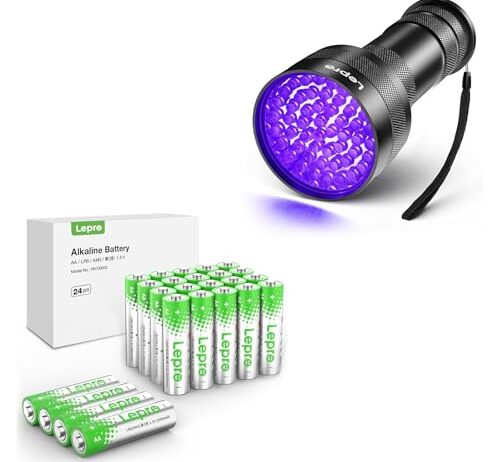
More LEDs don’t fix this. A 51-LED array at 395nm puts out more total UV-A energy than a single LED at 395nm, but it still can’t match the fluorescence contrast of a good 365nm source. The wavelength sets the ceiling. The LED count just moves you closer to it.

What ‘rechargeable’ doesn’t tell you

Three of these four bundles are rechargeable. That word covers a wide range of actual designs.

Some rechargeable flashlights use a built-in lithium cell that charges through a USB-C port on the body. Lose the cable, buy another — any USB-C cable works. Others charge only through a proprietary base or cradle. Lose the base, lose your ability to charge. A few use standard removable cells — 18650s or 21700s — that pop out and go into any compatible charger. Those give you the option of carrying a spare cell for a swap in the field, which is something a sealed internal battery can never do.

The fourth option is disposable alkalines. No charging infrastructure at all. You carry extras or you don’t. A 24-pack of AAs for a 51-LED UV light sounds like a lot until you consider that a UV flashlight drawing from three AAs at a time burns through a set in a few hours of continuous use. That’s eight full battery changes from one pack, and then you’re buying more.

Runtime itself is straightforward physics: battery capacity in watt-hours divided by the LED’s power draw in watts. A 1000-lumen LED typically draws around 10 watts. A single 18650 cell at 3.7 volts and 3000 milliamp-hours holds about 11 watt-hours. After driver efficiency losses of 10 to 20 percent, you get roughly 50 to 60 minutes at full output. Lower modes extend that proportionally.

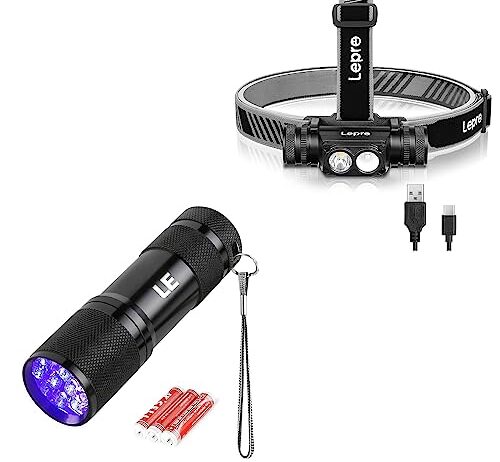
A headlamp frees your hands. That sounds obvious until you’re crouched under a sink with a flashlight clamped between your teeth. The detachable mount on this headlamp means you wear it when you need both hands and pull it off the strap when you don’t — one light, two form factors.

The 1000-lumen white output with a red mode covers the visible-light side. Red preserves dark-adapted vision, which matters if you’re moving between a lit work area and a dark yard. The 395nm UV flashlight handles detection tasks — finding pet stains on carpet, checking for scorpions on a patio wall, verifying ID security features. It won’t match a dedicated 365nm unit for fluorescence contrast, but for occasional UV checks alongside a real working headlamp, the wavelength trade-off is reasonable.

The bundle logic here is that someone who needs a headlamp and a UV light probably doesn’t want to buy them from two different brands with two different battery ecosystems. At $33.30 for both, the price sits below what many standalone 1000-lumen headlamps cost on their own.

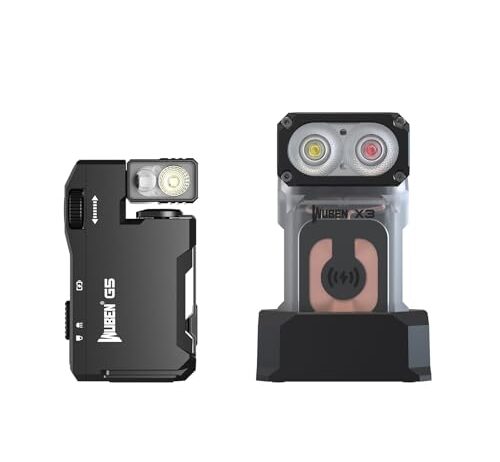
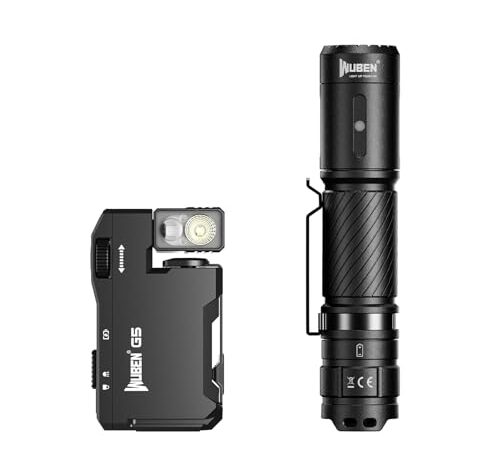
Most flashlights point where their body points. You aim by moving your hand. The G5’s rotating head changes that — tilt it 90 degrees and the light shines straight down while you hold the body horizontally. Tilt it 45 degrees and you split the difference. This matters when you’re holding the light in one hand and working with the other, because you can lock the beam angle and forget about it instead of constantly adjusting your grip.

The dual light sources give you two beam profiles from the same body. At 400 lumens total, this isn’t a throw monster — if you need to light up something 300 feet away, the reflector geometry of a 400-lumen EDC light won’t produce the candela for it. Where it works is task distance: workbenches, engine bays, breaker panels, the inside of a crawl space. Places where controlling where the light falls matters more than how far it reaches.

The charging base means you drop it into a cradle when you walk in the door. No fumbling with cable orientation, no forgetting to plug it in. The companion X3 mini charges from the same base, so both lights stay ready without separate cables. At $64.98, this is the most expensive bundle here — you’re paying for the mechanical flexibility and the charging convenience, not for raw lumen output.

When lumens matter and when they lie

Lumens matter indoors. In a tent, a garage, a power-outage kitchen, total light output determines how well you can see the space around you. A 1200-lumen flashlight bounced off a white ceiling will light a room better than a 400-lumen one every time.

Lumens stop mattering outdoors at distance. On a trail, in a field, scanning a tree line — anywhere you need a beam to reach something far away — candela is the spec that predicts performance. And candela depends on the reflector, not the LED.

A 400-lumen light with a deep, narrow reflector producing 20,000 candela will throw a visible spot farther than a 1200-lumen light with a shallow reflector producing 8,000 candela. The math is direct: 20,000 candela reaches about 283 meters; 8,000 candela reaches about 179 meters. The dimmer light throws 58 percent farther.

This isn’t a defect. It’s a design choice. The 1200-lumen light is probably built for close-range flood — illuminating a campsite, a work area, a path directly ahead. The 400-lumen thrower is built to identify objects at distance. They’re different tools that happen to share a form factor.

FAQ

Can a 400-lumen flashlight really out-throw a 1200-lumen one?

Yes. Throw distance depends on candela, not lumens. Candela measures how tightly the beam is focused, and that’s determined by the reflector or optic geometry. A 400-lumen light with a deep, narrow reflector can concentrate its output into a far tighter beam than a 1200-lumen light with a shallow, wide reflector — producing higher candela and a longer throw despite less total light.

How do I estimate beam distance when only lumens are shown?

You can’t calculate it precisely without candela. But the physical design gives clues: a flashlight with a deep head (long from lens to body) and a small-diameter reflector opening is built for throw. A wide, shallow head is built for flood. If two lights share the same lumen rating, the one with the deeper head will almost certainly throw farther.

Is 395nm UV good enough for finding scorpions?

It works, but 365nm works better. Scorpions fluoresce under UV-A light because of proteins in their exoskeleton. At 365nm, more of the emission is true ultraviolet with very little visible light, so the fluorescence stands out sharply against a dark background. At 395nm, the flashlight itself emits a visible purple glow that reduces contrast, making faint fluorescence harder to spot at distance.

How long will a 1000-lumen rechargeable headlamp run at full brightness?

Roughly 50 to 60 minutes on a typical single 18650 cell (about 11 watt-hours), assuming the LED draws around 10 watts and the driver loses 10 to 20 percent to heat. Lower brightness modes extend runtime proportionally — half the lumens roughly doubles the time. Medium modes on most headlamps land between two and four hours.