We research every product we recommend. We may earn a commission from the links on this page.
Tools & Home Improvement › Desk Lamps

CRI Sells the Lamp. Phosphors Are What You’re Paying For.

We compare published specifications and marketplace data. We do not test these products.

CRI≥91 Lamps Trade Efficiency for Color Accuracy
Photo by tom analogicus on Pexels

A CRI of 80 and a CRI of 97 both make white light. The difference is what happens to red. Standard white LEDs fire blue photons through a yellow phosphor, and the result looks fine — until you hold a swatch of burgundy fabric under it and it reads as muddy brown. That 17-point gap on the CRI scale is the distance between a lamp that skips red wavelengths and one that fills them in, and the fill costs real watts and real money. Four desk lamps across the CRI range show exactly where the trade-off lands.

Affiliate disclosure: This article contains affiliate links. We may earn a commission if you buy through them, at no extra cost to you.

Everything we compared

4 picks

How we picked

We do not measure these lamps with a spectrometer. Judgments rest on published CRI ratings, phosphor specifications, and marketplace review data.

CRI rating, not marketing claims

We compare stated CRI values across the range and note which manufacturers publish spectral data versus those offering vague color-quality language.

Lumen output at rated CRI

High CRI costs flux. We identify which lamps maintain usable brightness at their stated color-rendering index and which dim noticeably.

Phosphor disclosure, not just temperature

Color temperature is not color accuracy. We note which products specify phosphor composition or reference R9 red rendering alongside general CRI.

Price per CRI point above 80

CRI 97 costs more than CRI 80. We calculate the premium per incremental point to show where diminishing returns begin.

What CRI Measures and Why 80 Looks Fine Until It Doesn’t

CRI scores a light source from 0 to 100 by shining it on eight standardized color samples and comparing how they look against a reference illuminant — daylight or incandescent — at the same color temperature. A score of 100 means the colors match perfectly. Incandescent bulbs land there naturally because they emit a continuous spectrum. Standard white LEDs sit around 80 to 85.

At CRI 80, white paper looks white. Black text looks black. You can read, work, cook. Nothing seems off in isolation. The gaps hide in the reds and cyans — wavelengths the blue-plus-yellow-phosphor trick doesn’t produce. Skin tones flatten slightly. A navy shirt and a black shirt look the same. You’d never know unless you walked the same object under a better light and watched the color shift.

That’s the problem with CRI as a buying decision. The deficiency is invisible until you have a reference point. Once you see fabric or paint under CRI 95+, CRI 80 stops looking neutral and starts looking incomplete.

How Phosphors Buy You Those Missing Wavelengths

A white LED is a blue LED wearing a coat. The semiconductor junction emits blue photons at roughly 450 nanometers. A layer of yellow phosphor absorbs some of those photons and re-emits them at longer wavelengths, centered around 560 nanometers. Blue plus yellow reads as white to your three cone types, and the conversion is efficient — you get a lot of lumens per watt.

Push CRI above 90 and the phosphor recipe changes. Red phosphor fills the gap around 620-650 nanometers. Cyan phosphor patches the dip near 490 nanometers. Each added phosphor layer absorbs a blue photon and re-emits it at a lower energy, and that conversion wastes some energy as heat. The result is a fuller spectrum — objects reflecting red or cyan wavelengths now get the light they need to show their actual color — but the lamp produces 15 to 25 percent fewer lumens per watt at the same input power compared to a CRI 80 design.

That’s the core trade-off. Every point of CRI above 80 costs luminous efficacy. A lamp rated at CRI 97 is working harder to produce a given brightness than a CRI 80 lamp drawing the same power.

When CRI Actually Changes What You See

Reading black text on white paper? CRI 80 is fine. The contrast is achromatic — no color rendering involved.

Matching thread colors for a sewing project, checking whether a print proof looks right, painting with oils or watercolors, evaluating your own skin in a mirror while applying makeup — CRI matters here because you’re making decisions based on color. Below CRI 90, reds shift toward brown, light pinks go grayish, and two similar-but-different greens become indistinguishable. Above CRI 95, the shifts shrink to the point where most people can’t detect them without side-by-side comparison under daylight.

The threshold for most color-critical tasks sits around CRI 90. Between 90 and 95, trained eyes notice improvement on saturated reds specifically. Above 95, the gains are real but narrow — measurable on a spectrophotometer, hard to spot unless you’re sorting fabric swatches or grading gemstones.

For general desk work — spreadsheets, writing, video calls — the extra phosphors don’t change your experience enough to justify the price or the efficiency penalty. The lamp on your desk matters most when color accuracy is part of the task.

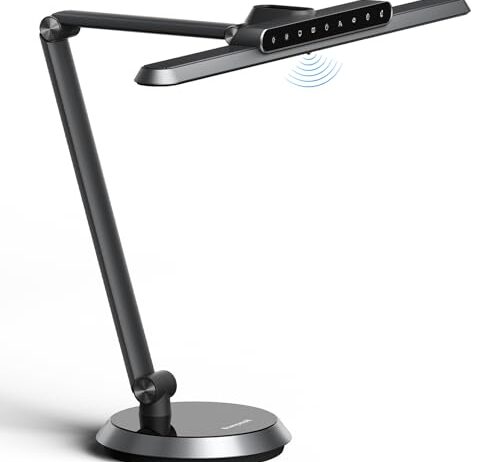
CRI 97 is about as high as phosphor-converted LEDs go in a consumer desk lamp. At that level, the spectral output curve is nearly continuous across the visible range — the red and cyan dips that plague CRI 80 sources are filled to the point where color rendering approaches incandescent quality without the heat or the energy draw of a filament bulb.

The 5,200-lumen output matters here because high-CRI phosphors eat efficiency. A lamp pushing CRI 97 at low brightness would be easy to engineer; doing it at 5,200 lumens means the LED array is compensating for those conversion losses with raw power. That’s enough light to illuminate a full desk surface evenly for fabric work, illustration, or print proofing. The UGR rating under 5 means the luminance distribution won’t produce discomfort glare on glossy paper or reflective surfaces — a different metric from blue-light exposure, solving a different problem. At $145.99, this is the cost of asking your desk lamp to render color the way a window does.

CRI and Blue Light Are Measuring Different Things

A lamp can have CRI 97 and still emit plenty of blue light. A lamp can block blue light aggressively and have CRI 70. The two metrics describe different properties of the same spectrum.

CRI measures spectral completeness — how many wavelengths are present and in what proportions. Blue light hazard measures the intensity of photons in the 400-to-490-nanometer range hitting your retina. One is about color accuracy. The other is about photobiological exposure.

RG0 certification under IEC 62471 means the lamp’s blue-light emission stays below the threshold for retinal hazard over exposures up to 10,000 seconds under normal use. It’s a safety floor, not a comfort guarantee. UGR, by contrast, measures discomfort glare — how bright the lamp appears relative to your surroundings. UGR under 10 is considered glare-free. These are complementary protections, not interchangeable ones.

A high-CRI lamp will have blue content — it has to, because blue is part of the visible spectrum it’s trying to reproduce faithfully. The question isn’t whether blue light is present but whether the intensity at short wavelengths exceeds safety thresholds, and that’s what the certifications quantify.

CRI 91 fills the major spectral gaps — reds and cyans that disappear under standard LEDs come through clearly enough for most color-dependent tasks. It won’t match CRI 97 on saturated reds under direct comparison, but the gap between 91 and 97 is perceptually smaller than the gap between 80 and 91. For desk work that involves some color sensitivity — reviewing photos, sketching, matching paint chips — 91 handles it.

The 2,700K-to-5,000K range means the lamp shifts from warm incandescent tones to cool daylight. That range matters because CRI is measured relative to a reference illuminant at the same color temperature — a lamp with CRI 91 at 5,000K renders colors accurately under cool light, and the same CRI at 2,700K renders them accurately under warm light. You’re not choosing between color accuracy and comfortable warmth; the phosphor design maintains spectral completeness across the range. The RG0 certification means the blue-light component stays within IEC 62471 safety limits even at the 5,000K setting, where blue emission peaks. Stepless dimming lets you drop intensity without jumping between preset levels. At $224.99, the premium over the Homelist buys you the temperature range and the photobiological certification together.

Stepless Dimming Versus Discrete Steps — What Changes

Stepless dimming adjusts brightness continuously. You slide or touch and the light follows your finger. Discrete-step dimming jumps between fixed levels — 11 in one case here, a number of unspecified stops in another.

With 11 brightness steps, each jump is roughly 9 percent of the total range. That’s fine for general task lighting where you want it brighter or dimmer in broad strokes. The jumps become noticeable when you’re adjusting for comfort over long sessions — you want it slightly less bright, and the next step down is too much. Stepless systems eliminate that gap. The cost is a more complex driver circuit, which shows up in price.

Neither approach affects CRI. Dimming a high-CRI lamp doesn’t reduce its color rendering — the phosphor mix stays the same, and the spectral distribution holds. What changes is intensity, not spectrum. A CRI-97 lamp at 30 percent brightness still renders reds better than a CRI-80 lamp at full power.

What You’re Getting When CRI Goes Unmentioned

Two lamps in this set don’t carry a CRI figure. That doesn’t mean they have no CRI — every light source has one. It means the manufacturer chose not to test or disclose it, which usually signals a value in the standard 80-to-85 range that most general-purpose LEDs produce without special phosphor engineering.

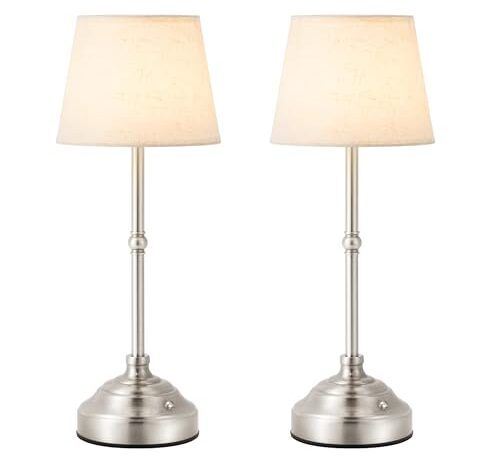
At $27 per lamp, a battery-powered cordless design with a fabric shade is solving a different problem than color rendering. It’s a portable ambient light — something you set on a dinner table or a nightstand where the task is atmosphere, not accuracy. Three color temperature options and stepless dimming give you control over warmth and brightness. Color fidelity under this light will be typical consumer-LED quality: fine for reading, fine for ambiance, inadequate for matching paint colors.

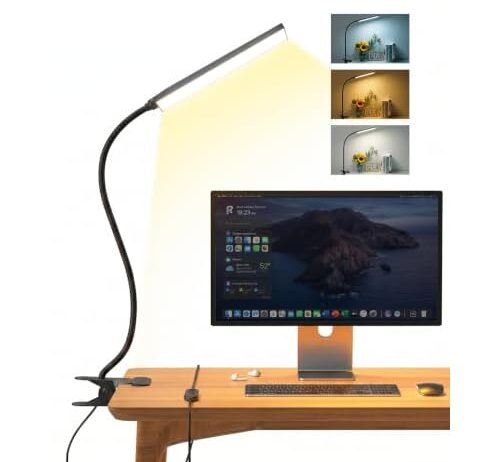
A 48-LED clamp lamp at $19.99 with a flexible neck is a task light pointed at a specific spot. Eleven brightness levels and three color modes cover the functional range for homework, reading, or keyboard illumination. The clamp mount and gooseneck mean you can aim it precisely. For achromatic tasks — text, screens, soldering — the CRI question is academic. For anything involving color judgment, the lack of spectral data means you’re working without a known floor.

FAQ

Does high CRI use more electricity than regular LED bulbs?

Yes. Filling spectral gaps with additional phosphors reduces luminous efficacy by 15 to 25 percent compared to CRI 80 LEDs at the same input power. A CRI 97 lamp drawing 15 watts produces fewer lumens than a CRI 80 lamp drawing 15 watts — the extra energy goes into heat during phosphor conversion. On a desk lamp’s power budget, the difference is a few watts, not a meaningful line item on your electricity bill.

Can you actually see the difference between CRI 90 and CRI 97?

On most surfaces, barely. The improvement concentrates in saturated reds — the wavelengths hardest for phosphor-converted LEDs to produce. If you hold a deep red fabric swatch under both, CRI 97 keeps the red vivid where CRI 90 shifts it slightly toward brown. On pastels, neutrals, and most everyday objects, the two are nearly indistinguishable without side-by-side comparison.

Does CRI matter for computer work and reading?

Not for the screen itself — your monitor produces its own light and renders its own colors regardless of ambient CRI. For reading printed text, CRI is irrelevant because black-on-white contrast is achromatic. CRI matters at a computer desk only if you’re doing color-critical work like photo editing, illustration, or comparing a print proof to the screen.

What is the difference between CRI and color temperature?

Color temperature describes the overall warmth or coolness of the light — 2,700K is warm yellowish, 5,000K is cool bluish-white. CRI describes how completely the light fills the visible spectrum at whatever color temperature it’s set to. A 2,700K lamp can have CRI 97 or CRI 75. High CRI means colors look accurate under that warm light; low CRI means some wavelengths are missing regardless of the warmth setting.

Why do some high-CRI lamps still have blue light warnings?

Because CRI requires blue light. A lamp that reproduces the full visible spectrum accurately must include the blue portion of that spectrum — removing it would lower the CRI. Blue-light certifications like RG0 don’t eliminate blue photons; they confirm that the intensity stays below the threshold for retinal hazard under normal use conditions. High CRI and blue-light safety are compatible because the standard limits exposure intensity, not wavelength presence.