We research every product we recommend. We may earn a commission from the links on this page.
Tools & Home Improvement › Spotlights

Beam Angle Is the Spotlight Spec Nobody Prints

We compare published specifications and marketplace data. We do not test these products.

Landscape Spotlights Lose Brightness with Distance Faster Than You'd Expect
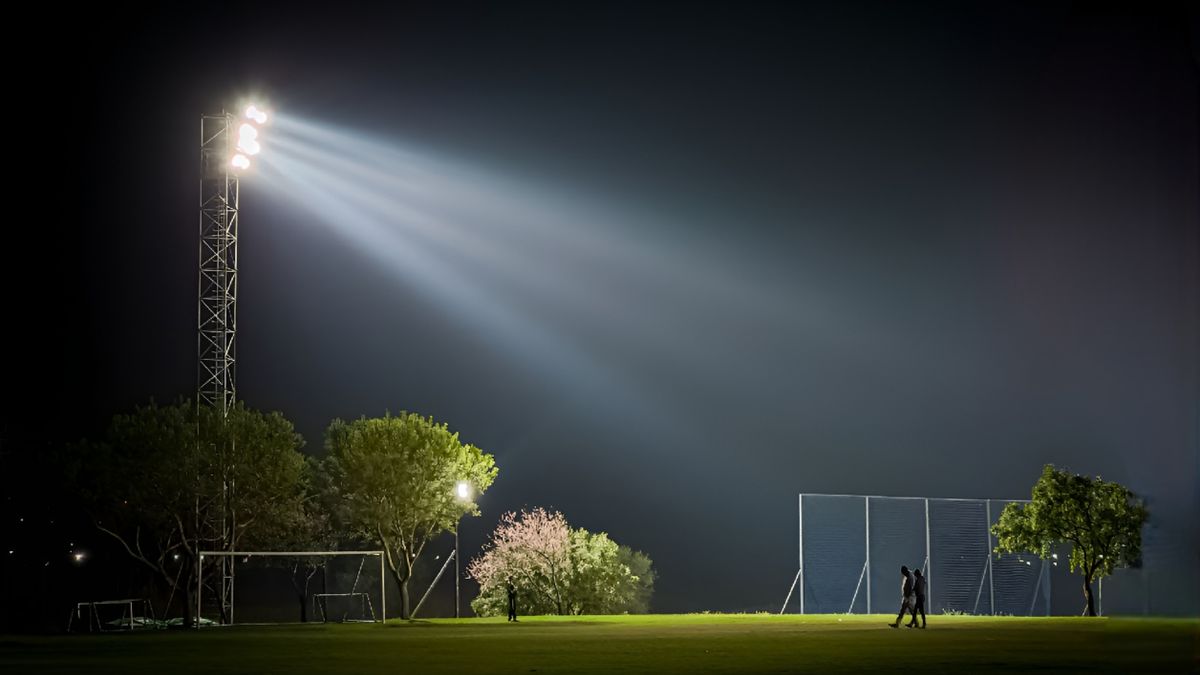
Photo by Linken Van Zyl on Pexels

A 25-degree beam at ten feet lights a circle about four and a half feet wide. A 60-degree beam at the same distance covers nearly twelve feet. That single number — beam angle — decides whether your spotlight hits the tree trunk or washes out half the yard, and it’s the one spec most landscape fixtures never give you. Here’s how to figure out what you’re actually buying.

Affiliate disclosure: This article contains affiliate links. We may earn a commission if you buy through them, at no extra cost to you.

Everything we recommend
4 picks

How we picked

We did not install these fixtures outdoors. Judgements come from published specifications, IP ratings, and owner-reported field data.

Optical data, not wattage

Lumens and beam angle predict brightness at distance. Wattage alone does not.

Weather rating by standard, not label

IP code digits map to specific test conditions — dust chambers, water jets, immersion — not marketing adjectives.

Power architecture, not convenience

Solar, mains, and low-voltage each constrain where you can install and how reliably the fixture runs.

Field failures, not star counts

Owner-described failure modes — moisture ingress, missing gaskets — reveal what a rating number does not.

What beam angle actually controls

Every spotlight has a cone. The beam angle is the width of that cone at the point where intensity drops to half of what it is dead center. A 25-degree fixture concentrates its lumens into a tight column. A 60-degree fixture spreads the same total light across a much wider area.

The math is tangent-based and forgiving enough to do on a phone. Multiply the throw distance by the tangent of half the beam angle, then double it. At ten feet, a 25-degree beam illuminates a circle roughly four and a half feet across. A 60-degree beam at the same distance covers nearly twelve feet. Same fixture power, radically different results on the wall.

This matters because illuminance — the brightness you actually perceive on a surface — drops with the square of distance. Double the throw, quarter the brightness. A wide beam compounds that loss by distributing whatever light survives over a larger circle. The result: a 60-degree fixture aimed at a tree twenty feet away delivers a dim wash. A 25-degree fixture at the same distance puts a visible bright spot on the trunk.

None of the four spotlights here print a beam angle. That’s the norm in this category, not an oversight by these particular brands. You’re buying a light distribution tool with no information about how it distributes light.

Lumens, watts, and the number that’s missing between them

Lumens measure total light leaving the fixture — all of it, in every direction the optic allows. Watts measure electrical power consumed. Neither tells you how bright the spot on your wall will be. That’s the job of candela (luminous intensity in a specific direction) and ultimately lux (illuminance arriving at the surface), and both depend on the beam angle you don’t have.

A 7-watt LED producing 800 lumens is running at about 114 lumens per watt — solidly within the 80-to-150 range typical of contemporary white LEDs, depending on drive current and thermal management. That number tells you the chip and driver are competent. It does not tell you whether those 800 lumens land in a four-foot circle or a twelve-foot wash.

A 5-watt fixture with a tight 15-degree reflector can throw a brighter spot at distance than a 7-watt fixture with a wide 60-degree lens. Wattage is an electricity bill. Lumens are a light budget. Beam angle is the spending plan. Without it, you’re guessing.

Three of these four fixtures give you wattage with no lumen count. One gives you both. None give you the geometry that connects either number to what you’ll see.

Three power architectures, three different installation days

These four fixtures split into three wiring categories, and the category determines more than you’d think.

Low-voltage DC — 12V or 24V — needs a step-down transformer between your mains panel and the fixtures. You’re running dedicated landscape wire, and you need to size it for voltage drop: thin wire on a long daisy-chain dims the last fixture in line, because resistance eats voltage over distance. The upside is genuine safety. Twelve volts through wet soil won’t kill you, and burial-rated cable at that voltage is forgiving to nick with a shovel.

Mains-voltage AC skips the transformer. You plug in and go. The trade-off is that 120V in a wet garden demands GFCI protection and careful routing, and a damaged cable underground is a real hazard rather than a dim bulb.

Solar eliminates wiring entirely. The fixture carries its own panel, battery, and charge controller. No electrician, no trench, no transformer. What it costs you is consistency: a north-facing wall, a shaded garden bed, or three overcast days in a row means a dim or dead light. Solar is the easiest install and the least predictable output.

IP ratings decoded: what water protection actually means

IP54 and IP66 sound like two points on the same scale. They are, but the gap is wider than the numbers suggest.

The first digit is dust. A 5 means dust-protected — some particles may enter, but not enough to interfere with operation. A 6 means dust-tight. Nothing gets in. For an outdoor fixture, the difference matters over years: fine soil dust migrating onto an LED driver board eventually insulates it, trapping heat.

The second digit is water. A 4 means splashing water from any direction won’t cause harm — rain, a sprinkler overshoot, a garden hose at low pressure. A 6 means the fixture withstands powerful water jets from any angle. That’s the difference between tolerating a rainstorm and surviving a pressure washer.

Neither rating means submersible. An IP66 fixture sitting in a puddle after a heavy rain is outside its test conditions. In-ground wells that collect standing water need IP67 (temporary immersion) or IP68 (continuous submersion), and none of these four fixtures carry either rating.

Owners of one IP66-rated fixture here describe a specific failure: moisture condensation forming inside the lens within months. Multiple owners report the same pattern — water droplets behind the glass, eventual electrical failure. One disassembled a failed unit and found no gasket behind the lens, describing it as a wide-open path for water. An IP66 rating describes what the fixture withstood in a lab test. It does not guarantee the gasket is there in the box you receive.

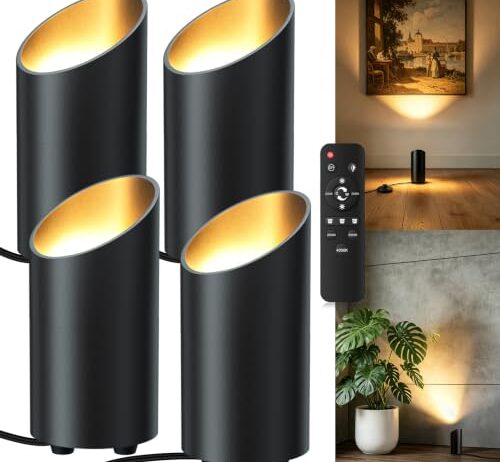
This is the only fixture in the set where you can do real math. 800 lumens at 7 watts puts it at roughly 114 lumens per watt, which means the LED package and driver are pulling their weight. At 12V or 24V, you’re on a low-voltage system that needs a transformer but runs safely through wet soil — a trade-off that makes sense for permanent landscape installations where you’re burying cable.

The 2700K warm white is a single, fixed color temperature — no tunability, no color wash, just the amber-gold that landscape architects default to because it makes foliage look alive and doesn’t fight the dark the way cool white does. That constraint is a feature if you’re lighting a garden. It’s a limitation if you want to change the mood from a phone.

The IP66 rating should mean dust-tight and jet-proof. Owner reports complicate that: multiple buyers describe moisture condensation inside the lens within six months to a year, and one owner who disassembled a failed unit found no gasket behind the lens at all. [R3] [R4] [R5] That’s a meaningful pattern across a large owner base. The light works well when it works. The question is whether the seal holds where you install it.

Color temperature: fixed, tunable, or theatrical

Color temperature isn’t brightness. It’s the tint of white light, measured in Kelvin. Lower numbers are warmer — 2700K is the amber glow of an old incandescent bulb. Higher numbers run cooler and bluer — 5000K looks like noon daylight.

A fixed 2700K fixture does one thing and does it predictably. Every light in a run of ten will match. That consistency matters when you’re lining a path or washing a facade, because a 200K mismatch between two adjacent fixtures is visible and looks like a mistake.

Five selectable color temperatures give you range — probably spanning from around 2700K to 5000K, though the exact Kelvin steps aren’t always documented. You pick one and the fixture stays there. Useful if you’re matching to existing lights or if the space serves different purposes at different times. The catch: if you lose the remote or it ships dead, you’re locked into whatever default the fixture powers on at.

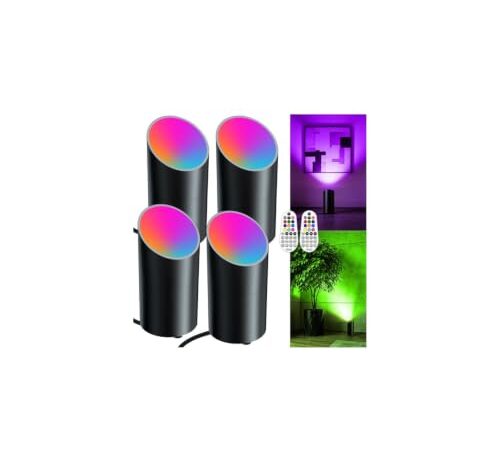
RGBW is a different animal entirely. Red, green, blue, and white LEDs in one housing let you wash a wall in saturated color — purple for a party, green for a holiday, red for drama. The white channel handles normal illumination. It’s theatrical flexibility, and it’s genuinely fun. But the white output from an RGBW fixture is typically dimmer and less clean than a dedicated white LED at the same wattage, because you’re powering four chip colors and only using one.

Owners of one RGBW fixture here report a specific frustration: the unit shipped without a remote, leaving only red available through the on-body button. [R1] If your color control depends on an accessory in the box, check the box before you install.

What to do when beam angle isn’t printed

You have three options, and none of them are great.

First, look at the reflector. A deep, narrow cone behind the LED suggests a tight beam — probably 25 to 35 degrees. A shallow, wide dish suggests flood territory — 45 degrees or wider. Product photos rarely show the reflector depth clearly, but close-ups of the lens face sometimes reveal the optic type.

Second, read owner photos. A picture of the fixture lighting a wall from six feet away tells you more than any spec. If the light pool is a tight circle smaller than the fixture’s throw distance, the beam is narrow. If it washes the entire wall evenly, it’s wide. One owner photo is worth more than a missing data point.

Third, buy knowing you might return. A spotlight is a geometry tool, and you won’t know the geometry until you aim it at your specific tree from your specific distance. Budget for the possibility that the cone is wrong for your application. This isn’t a defect — it’s an inherent mismatch between what’s published and what you need to know.

The deeper problem is industry-wide. Beam angle is a standard photometric measurement. Every LED fixture is tested for it during development. The number exists. It just doesn’t make it onto the retail page, because “800 lumens” sounds impressive and “25-degree beam” requires the buyer to do math. Until that changes, you’re back to reading reflector shapes and owner photos.

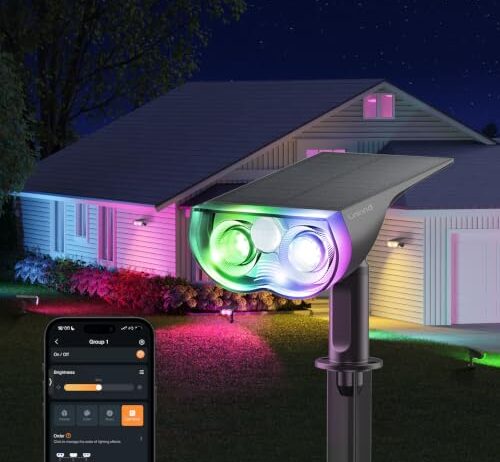
Every other fixture here needs either a mains outlet or a transformer and buried cable. This one needs sun. The panel, battery, and charge controller are integrated, so installation is a stake in the ground and a clear line to the sky. App control replaces the wired switch and the IR remote — no accessory to lose, no receiver to fail.

The trade-off is real: solar storage means output depends on charge, charge depends on exposure, and exposure varies by season, tree cover, and which direction the panel faces. A north-wall installation in a shaded garden will underperform. A south-facing bed with clear sky will run reliably. Your site decides whether this fixture works, not the fixture itself.

Without lumen or beam-angle data, you cannot predict how bright or how focused the output will be. What you can predict is the installation: no electrician, no transformer, no trench, no voltage drop calculation. For accent lighting where consistency matters less than convenience — a path marker, a flag spot, a mailbox wash — that trade is often worth making.

The remote control problem

Two fixtures in this set rely on an IR remote for core functionality — dimming, color temperature selection, timer programming. Both have owners reporting the remote arriving dead or missing entirely.

One owner of the 5CCT fixture describes good light output from the fixture itself but a remote that never worked despite fresh batteries, leaving only on/off capability through the foot switch. [R2] No dimming, no color temperature selection, no timer — every feature beyond basic illumination locked behind a nonfunctional accessory.

An RGBW fixture owner received a unit without a remote at all, limiting output to a single color through the body-mounted button. [R1] The fixture worked. The lights were bright. But the feature that justified the purchase — color selection — was inaccessible.

This is a design vulnerability, not a manufacturing defect. When critical functionality routes through a single accessory with no fallback — no phone app, no wall switch, no onboard controls — the accessory becomes a single point of failure. If it ships broken, you own a fixture that powers on and does nothing else. App-controlled fixtures avoid this by moving the control surface to your phone, which you’re less likely to lose and more likely to update.

FAQ

What beam angle do I need to light a tree 15 feet away?

A narrow beam — 15 to 25 degrees — concentrates enough light to produce a visible bright spot at that distance. At 15 feet, a 25-degree beam illuminates a circle about seven feet wide, which is roughly the canopy width of a small ornamental tree. A 60-degree beam at the same distance spreads the same lumens across nearly 17 feet, dimming the center to a faint wash.

Is 12V safer than 120V for outdoor spotlights?

Yes, in the specific sense that matters outdoors: 12 volts through wet soil or a nicked cable won’t deliver a dangerous shock. Mains voltage can. Low-voltage systems require a step-down transformer and heavier wire gauge on long runs to prevent voltage drop, but the safety margin in a buried, irrigated landscape is real and is why most professional landscape lighting runs at 12V.

Will a 5-watt LED be bright enough for outdoor accent lighting?

It depends entirely on the beam angle, which is the spec most fixtures omit. A 5-watt LED with a tight 15-degree reflector can throw a brighter spot at 10 feet than a 7-watt fixture with a wide 60-degree lens. Wattage tells you the electricity cost, not the brightness on the wall. Without lumens and beam angle, you cannot calculate delivered illuminance from wattage alone.

Can I use an IP54 spotlight in the ground?

Not recommended. IP54 protects against splashing water, not pooling or standing water. An in-ground well collects irrigation runoff and rain. You need IP67 (rated for temporary immersion to one meter) or IP68 (continuous submersion) for a fixture sitting in soil that holds water. IP54 is fine mounted on a stake or wall bracket above grade.

How do I match warm white across different brands?

Look for the Kelvin number, not the word. ‘Warm white’ means anything from 2400K to 3000K depending on the manufacturer. Two fixtures both labeled warm white can look noticeably different side by side if one is 2700K and the other is 3000K. Match by Kelvin rating, and buy from the same brand for the same run of path lights if color consistency matters.