
We research every product we recommend. We may earn a commission from the links on this page.
Tools & Home Improvement › Night Lights

Why Decorative Night Lights Glow Unevenly — and Which Shapes Fix It

We compare published specifications and marketplace data. We do not test these products.

Acrylic Edges Scatter LED Light Into Ambient Wash Instead of Engraving
Photo by Opt Lasers from Poland on Pexels

A translucent egg and a silicone ghost use the same LEDs, but one glows evenly and the other shows bright spots where each diode sits. The difference is geometry: curved surfaces spread light across more material before it exits, while flat or thin sections let photons punch straight through. That single variable — how far light travels inside the shell before it reaches your eye — explains most of what separates a $5 night light from a $33 one, and most of what doesn’t.

Affiliate disclosure: This article contains affiliate links. We may earn a commission if you buy through them, at no extra cost to you.

Everything we recommend
4 picks

How we picked

We did not plug these lights in. Judgements rest on published specs, LED and battery fundamentals, and owner reports.

Diffuser geometry, not decoration

Curved, enclosed shells scatter light more evenly than open or flat designs. Shape determines glow quality.

Battery capacity, not brightness claims

Milliampere-hours set the ceiling on runtime. A bigger cell means more nights between charges at any setting.

Control logic, not control count

A single button cycling eight colors and four modes means forty presses to return to the one you wanted.

Owner complaints, not star averages

Repeated failures — dead charging ports, touch sensors that quit — matter more than aggregate scores.


Light Doesn’t Want to Scatter — You Have to Make It

An LED is a point source. It fires photons in a cone, and if nothing interrupts that cone, you see a bright dot on whatever surface the light hits first. That’s fine inside a flashlight, where the whole point is a directed beam. In a night light, it’s the problem.

Translucent plastic or silicone forces photons to change direction. Every time light crosses from one material density to another — from air into plastic, from plastic back into air, from a smooth internal surface into a rough one — it bends. The technical term is refraction, but the useful concept is simpler: every boundary is a chance to redirect the photon sideways instead of straight ahead. More boundaries, more scatter, more even glow.

This is why shape matters as much as material. A sphere or egg puts a curved wall between every LED and every exit point. Light that enters the wall at the base has to travel through several centimeters of plastic before it can escape near the top, picking up scatter the whole way. A flat panel, or a shape with thin spots, lets some photons cross the wall in under a millimeter. Those photons barely scatter at all. You see the diode.

Wall thickness is the blunt instrument. Below about 3 millimeters in silicone or soft plastic, internal LED positions start showing through as visible bright spots. Above 4 millimeters, the material absorbs enough light that the overall brightness drops noticeably. The sweet spot is narrow, and most inexpensive night lights land on whatever thickness was cheapest to mold rather than whatever thickness scatters best.

Why the Bottom Is Always Brighter Than the Top

LEDs sit at the base. Always. The circuit board lives in the bottom of the housing because that’s where the weight needs to be for stability, and because the charging port and touch sensor need access to the underside or the lower edge. This means the light source is inches from the lower wall and many inches from the upper wall.

Inverse-square law handles the rest. Light intensity drops with the square of the distance from the source. The plastic two centimeters from the LED array receives roughly nine times the energy per square centimeter as the plastic six centimeters away. No diffuser material corrects for that ratio completely — it can soften the gradient, but the base will always glow hotter than the crown.

Curved shapes handle this better than straight-walled ones. An egg tapers as it rises, so the wall curves inward toward the light path. A cylinder keeps the same distance from center to wall all the way up, which means the top really is just farther away with no compensation. The cracked-shell designs add another layer: the irregular edges of the crack act as additional scattering surfaces, breaking up the beam before it reaches the smooth outer wall.

RGB Blending Is a Distance Problem

Three dies sit on one chip — red, green, blue — spaced fractions of a millimeter apart. At close range, they’re three separate colors. At distance, the cones overlap and you see a blended hue. The diffuser’s job is to create that distance artificially, by bouncing each color’s photons through enough material that the three beams overlap before they exit.

Eight-color modes work by mixing these three primaries at different intensities. Pulse-width modulation handles the mixing: each die flicks on and off at hundreds of cycles per second, and the ratio of on-time determines how much of that color reaches your eye. A 50% red, 100% green, 0% blue duty cycle produces a chartreuse. The switching happens above 100 Hz, fast enough that your eye averages it into a steady color — though a phone camera’s rolling shutter may catch banding if you try to photograph it.

The practical consequence: a night light with eight colors but a thin or flat diffuser will show distinct RGB spots in some color modes, especially the lighter pastels where one die is running at low duty cycle and the other two are near full power. The imbalance makes the weaker color visible as a separate dot rather than a tint. Thicker, more curved housings hide this because every photon scatters through more material before it exits.

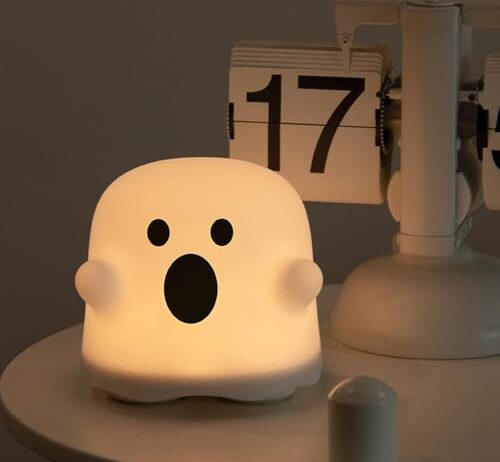
Silicone does something rigid plastic cannot: it absorbs minor impacts without cracking, and it diffuses light through its entire volume rather than just at the surface. A ghost shape — rounded, no flat panels, no sharp edges — puts curved material between every LED and every exit point. That’s the geometry that produces an even glow rather than visible diode positions.

The trade-off is color. This is a white-only light with adjustable brightness, which means no RGB blending artifacts to worry about but also no amber or warm tones for a child’s room. The delay-off function is the right idea for bedtime use — the light fades rather than cutting abruptly — though without a published duration, you won’t know the fade timing until you’ve used it once. One owner in Canada reports the electronics failed after two days, with the unit refusing to charge or light up at all. That’s a single report, not a pattern, but it’s worth noting on a product where the charging port sits inside a soft housing that flexes every time you plug in a cable.

At $16.99, it sits in the middle of this set’s price range and delivers the most uniform light distribution of the four, purely because of what the material and shape do to photons. If you want a single warm glow with no color cycling and no button-mashing, this is the one that does that job.

Battery Capacity Sets the Ceiling — Current Draw Sets the Floor

A 2000mAh battery holds roughly 82% more energy than an 1100mAh cell. That’s straightforward. What’s not straightforward is how long either one actually runs, because the number on the battery assumes a gentle, controlled discharge rate — typically 0.2C, meaning 220mA for the 1100mAh cell — and a night light running eight RGB LEDs at full brightness may draw more than that.

At medium brightness with a single color, a typical small LED night light draws somewhere around 50-100mA. At that rate, 1100mAh gets you 11-22 hours and 2000mAh gets you 20-40 hours. Full RGB at maximum brightness can double the current draw, cutting those numbers in half. None of the four products here publish a measured runtime at a specific brightness, so these are estimates from the battery physics, not tested figures.

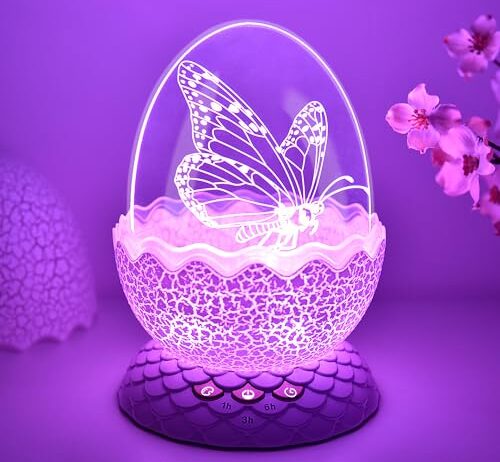
The timer function on the butterfly egg — 1, 3, or 6 hours — is doing real work here. A child’s night light that runs all night on a 1100mAh battery at medium brightness will make it, but just barely. The timer means you can set it to shut off after the child falls asleep, which stretches one charge across two or three nights instead of one. The two products without specified timers drain until you remember to turn them off or the battery hits its protection cutoff voltage around 2.75-3.0V.

The cracked-shell butterfly egg does something optically interesting: the irregular edges of the crack pattern act as additional scattering boundaries. Light hitting a smooth curved wall refracts once and exits. Light hitting a fractured edge refracts, bounces off the opposing crack surface, refracts again, and exits at a wider angle. The crack texture is decorative, but it’s also functional — it broadens the beam spread from the LEDs near the opening.

Five discrete brightness levels and three modes give you fifteen combinations before you add eight colors, which means 120 possible states from a physical button interface. That’s a lot of button presses if you overshoot. But the timer redeems the control scheme for bedtime use: set color, set brightness, set timer to one hour, and walk away. The 1100mAh battery is the smallest here, but with the timer preventing all-night drain, it should stretch across multiple nights at moderate settings.

At $25.99, you’re paying for the control granularity and the sculptural form. The timer alone justifies the price difference over the cheaper egg if this is going in a child’s room where overnight drain means a dead light tomorrow night.

Touch Controls Have a Ground Problem

Capacitive touch works by detecting the electrical capacitance your body adds to a sensor electrode. Your body carries roughly 100-200 picofarads of capacitance to ground, and the sensor’s microcontroller notices when that capacitance appears near the electrode. Tap, and the reading spikes. Hold, and it stays elevated. The controller translates patterns — single tap, double tap, long hold — into commands.

The failure mode is grounding. The sensor needs a reference point, and that reference is usually earth ground through the charging cable or through the surface the light sits on. Unplug the cable and set the light on a wooden shelf, and the ground reference weakens. Set it on a thick rubber mat or inside a fabric sleeve, and the sensor may stop responding entirely because the electric field from your finger can’t reach the electrode through the insulating material.

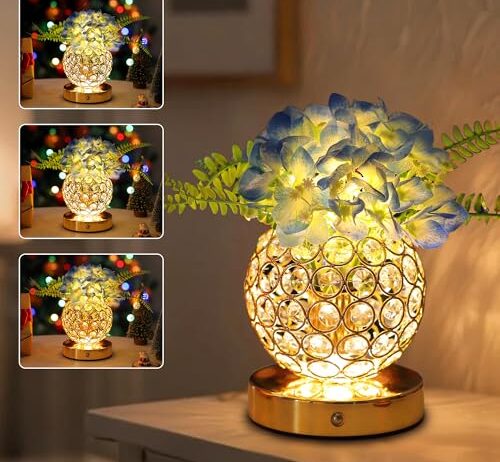
One owner of the hydrangea lamp found the touch sensor’s internal wire — a thin conductor with a flat copper pad — had physically disconnected from the button area after a single press. That’s a mechanical failure, not an electrical one, but it points to how these sensors are assembled in inexpensive decorative lights: the copper pad is pressed or lightly adhered against the inside of the housing rather than soldered to a proper contact point. Another owner of the same product describes the touch button as “uncooperative,” which is consistent with a marginal contact that works when pressed firmly and fails under a light tap.

The Single-Button Trap

One button for everything sounds elegant until you count the presses. The egg lamp with eight colors and four modes uses a single button to cycle through all of them sequentially. Turn it on: random color. Want warm white? Press through seven other colors first. Want to dim it? That’s a different cycle. Overshoot? Start again.

One owner describes this exactly: the lamp doesn’t remember the last color used, so every power-on starts at a random position in the color cycle. That means the minimum interaction to get to a specific color and brightness is unpredictable — sometimes two presses, sometimes twelve. For a bedside light you reach for in the dark, that’s a real problem.

The butterfly egg’s approach — separate brightness levels and timer as distinct controls — is mechanically the same kind of button, but the three-mode structure means fewer total states to cycle through per function. You’re not pressing through colors to get to brightness.

The hydrangea lamp uses touch rather than a physical button, which should allow for different gestures — tap for on/off, hold for dimming — but multiple owners report the touch surface as unreliable, suggesting the gesture recognition is either poorly calibrated or undermined by the grounding issues discussed above.

Leaving It Plugged In Is a Slow Poison

Every rechargeable night light here uses a lithium-ion or lithium-polymer cell. These cells age fastest at full charge. A lithium cell sitting at 4.2 volts — fully topped off — degrades measurably faster than one held at 3.8 volts, which is roughly 40-60% charge. The chemistry is straightforward: at higher voltage, the electrolyte oxidizes faster at the cathode surface, building a resistive layer that permanently reduces capacity.

Leaving a night light plugged in continuously means the charging circuit keeps the cell near 4.2V indefinitely. Some circuits trickle-charge — they let the voltage sag slightly and then top it back up — but even that cycling between 4.0 and 4.2V is harder on the cell than sitting at 3.7V unplugged. Over months, the capacity drops. Over a year or two, a 2000mAh cell might deliver 1400mAh. The light still works; it just dies earlier each night.

One owner of the hydrangea lamp says they keep it plugged in permanently because the charging port feels fragile — “I’d keep it plugged in” — which is a reasonable response to a flimsy connector but an unkind one to the battery. The better practice is to charge it, unplug it, use it until it dims noticeably, and charge it again. The cells in these lights are small enough that a full charge takes an hour or two, not overnight.

FAQ

How long does a rechargeable night light last on one charge?

It depends on brightness and color mode, but a rough rule: divide the battery’s milliampere-hour rating by the LED current draw. At medium brightness with one color, most small night lights draw 50-100mA, so a 2000mAh battery lasts roughly 20-40 hours and an 1100mAh battery lasts 11-22 hours. Full RGB at max brightness can cut those numbers in half.

Why does my night light show red, green, and blue dots instead of a blended color?

The three LED dies sit fractions of a millimeter apart on the chip. If the diffuser is too thin or too flat, the three beams exit before they’ve overlapped enough to blend. Thicker, curved housings force each color’s light through more material, creating the scatter needed for smooth blending.

Can I leave a rechargeable night light plugged in all the time?

It will work, but the battery ages faster. Lithium cells degrade quickest at full charge. Keeping the light topped off at 4.2 volts continuously accelerates capacity fade — over a year or two, you may lose 20-30% of the original runtime. Charge it fully, unplug it, and recharge when it dims.

Do touch controls work when the night light is on a wooden shelf or fabric surface?

Usually yes on wood, which conducts enough to provide a weak ground path. Fabric or rubber can block the electric field between your finger and the sensor electrode, making the touch unresponsive. If the light sits on a thick insulating surface and won’t respond to touch, try placing it on a harder surface or keeping the charging cable connected for a ground reference.

Does the shape of a night light actually affect how evenly it glows?

Significantly. A curved surface — egg, sphere, ghost — puts material between the LED and every exit point, forcing light to scatter through the wall before it escapes. Flat panels or thin sections let photons pass through with almost no scatter, so you see the individual diodes instead of a smooth glow.