We research every product we recommend. We may earn a commission from the links on this page.
Tools & Home Improvement › Spotlights

Why Landscape Lights Fill With Water (And Stop Working)

We compare published specifications and marketplace data. We do not test these products.

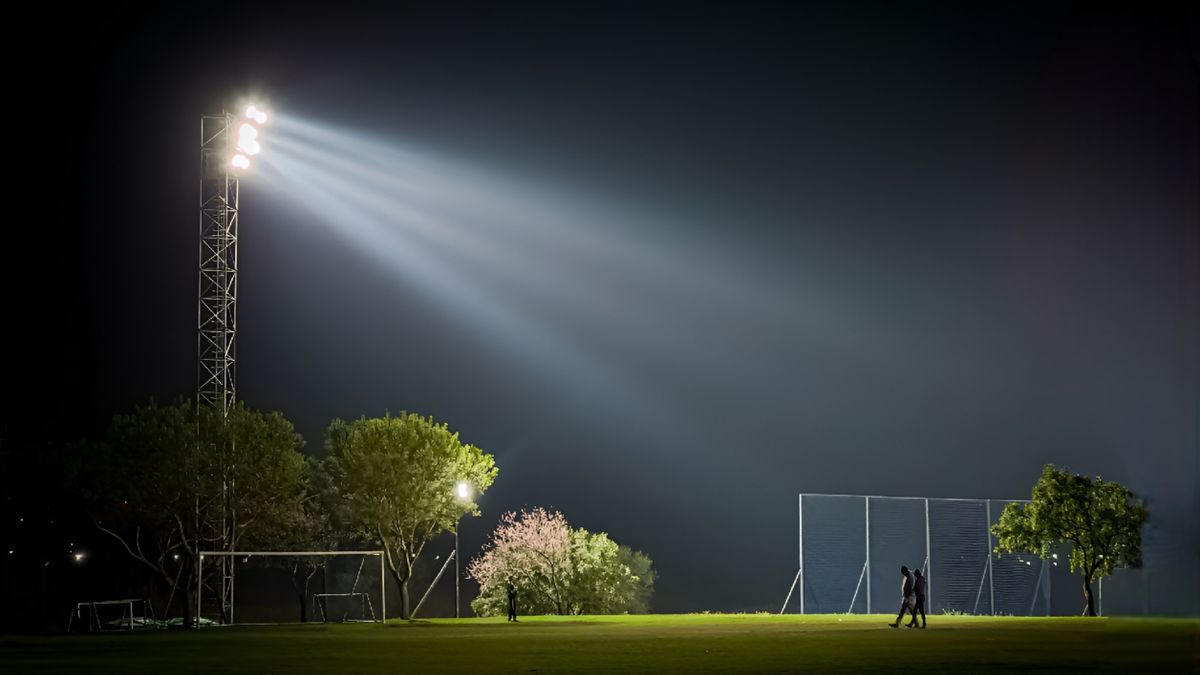
Landscape Spotlights Lose Brightness with Distance Faster Than You'd Expect
Photo by Linken Van Zyl on Pexels

Most landscape spotlights die with their LEDs still working. Water creeps past a seal rated for splash but installed at ground level. A transformer sits at the end of a wire run too long for its gauge. A remote control’s IR receiver fogs over after two seasons. The LED itself is good for 50,000 hours — but the fixture around it rarely makes it to five years without one of these three failures. Understanding where spotlights actually break changes what you look for when buying them.

Affiliate disclosure: This article contains affiliate links. We may earn a commission if you buy through them, at no extra cost to you.

Everything we looked at
4 picks

How we picked

We did not install these spotlights outdoors. Recommendations rest on published IP ratings, wire-gauge limits, and failure patterns in marketplace reviews.

IP rating at install height

Ground-level fixtures need IP66 or higher. IP54 is splash-rated for sheltered mounting, not dirt contact or standing water.

Wire gauge versus run length

Voltage drop matters more than wattage. We checked wire gauge against maximum run distance, not just total fixture count.

Failure point count

Every sensor, remote receiver, and timer adds a component that can fog, corrode, or stop responding before the LED dies.

Beam angle disclosure

Narrow beams concentrate light; wide beams wash a larger area dimmer. Listings that omit beam angle make placement planning impossible.


Water Doesn’t Break the LED — It Breaks the Seal

An LED die is a semiconductor chip on a heat sink. It doesn’t burn out the way a filament does. What kills a landscape fixture is water reaching the driver board or the solder joints behind the diodes, and that’s a function of the enclosure, not the light source.

IP ratings tell you how well the enclosure keeps water out, but the two numbers mean different things. The first digit is solid particle protection — dust. The second is liquid. An IP54 fixture resists dust infiltration and handles water splashing from any direction. An IP66 fixture is fully dust-tight and withstands pressurized water jets.

That distinction matters at ground level. A spotlight mounted on a stake six inches above soil sits in the splash zone of every rainstorm, every sprinkler cycle, every hose drag across the lawn. Splash resistance is not the same as jet resistance. A fixture rated IP54 will handle rain falling on it. It will not handle a sprinkler head three feet away hitting it with a directed stream twice a day for six months.

The failure is slow. Water doesn’t flood the housing — it migrates through a gasket that wasn’t designed for sustained directional pressure. Condensation forms inside the lens. The driver board corrodes at a solder joint. One day the light flickers, then dims, then stops. The LED still works if you test it dry.

This is why fixture placement matters as much as the IP rating on the box. An IP54 light works fine under a soffit, on a shelf, inside a covered patio — anywhere water arrives as mist or drip, not as a stream. Put it in the ground next to irrigation, and you’re running a slow corrosion experiment.

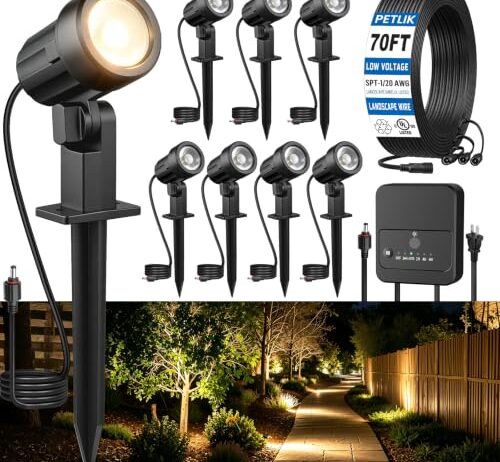
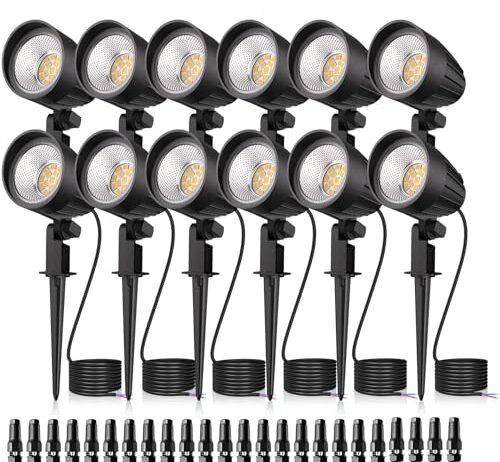
Seven watts per fixture is the highest in this set, and at 2700K warm white, these are single-purpose lights — no color tricks, no remote, no sensor. They do one thing: throw warm light where you aim them.

The IP66 rating means full dust exclusion and resistance to pressurized water. That’s the rating you want for a fixture that sits at ground level near sprinklers or in beds that get direct hose watering. The seal is designed for sustained water contact, not just incidental splash.

Twelve units in a pack changes the math on landscape coverage. Instead of placing four lights and hoping each one reaches far enough, you distribute twelve and let overlap do the work. Three fixtures on a tree from different angles eliminate the harsh single-shadow problem that makes spotlit landscapes look theatrical instead of natural. The trade-off is wiring — twelve fixtures on a low-voltage run means calculating voltage drop across the full length, and you need a transformer sized for the total load. At 7W each, that’s 84 watts minimum before accounting for line loss.

No built-in automation. No dusk-to-dawn sensor, no timer, no remote. You wire them, aim them, and they stay on until you cut power. That’s either a limitation or a feature, depending on whether you want the simplicity of a switch or the convenience of a schedule. What it does mean is fewer components exposed to weather — no sensor window to fog, no battery compartment to corrode, no IR receiver to fail.

The Wire Run Is the Bottleneck You Don’t See

Low-voltage landscape lighting runs at 12 or 24 volts instead of 120V mains. The safety advantage is real — you can nick a 12V wire with a shovel and nothing dangerous happens. But low voltage means high current for the same wattage, and high current over long wire runs means voltage drop.

Voltage drop is physics, not a defect. Every foot of copper wire has resistance. Current flowing through that resistance converts some of the voltage to heat. By the time 12 volts travels 50 feet of undersized wire to the last fixture in a chain, you might have 10.5 volts arriving. The LED dims. Not because the fixture is failing — because it’s starving.

The fix is either heavier wire gauge, shorter runs, a 24V system instead of 12V, or a hub-and-spoke wiring layout instead of a daisy chain. But most buyers don’t think about wiring topology when they’re shopping for lights. They think about how many lumens and what color temperature. The wire is the unglamorous part that determines whether those lumens actually show up at the far end of the yard.

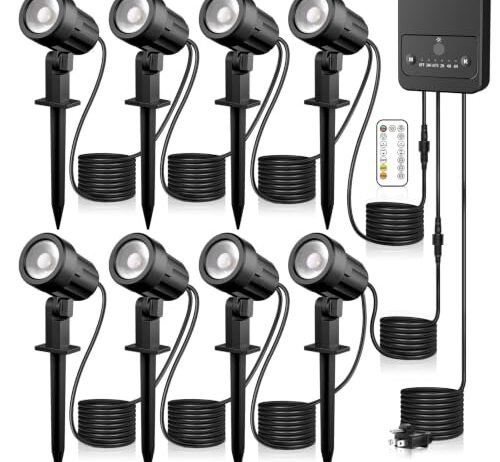
Systems that include a transformer in the box solve the “do I need one?” question but create a different constraint. The bundled transformer is sized for the pack — an 8-pack of 3W fixtures ships with a transformer rated for roughly 24-30 watts. Add four more fixtures from a second box, and you’ve exceeded the transformer’s capacity. It doesn’t blow a fuse dramatically. It sags. Every fixture in the chain gets slightly less voltage, slightly less light, and you don’t notice until you compare them to the neighbor’s setup and wonder why yours looks dim.

Three watts per fixture is modest. At 2700K warm white, these are accent lights, not security floods — they’ll define a path edge or graze a low shrub, not illuminate a two-story oak from the base. That’s a feature if you want soft ambient glow and a limitation if you want dramatic uplighting.

The dusk-to-dawn sensor changes the failure calculus in an interesting way. A photocell sensor is a passive component — no batteries, no wireless signal, no pairing process. It reads ambient light and switches the circuit. The failure mode is specific and predictable: the sensor window clouds over time from UV exposure and condensation, gradually reading ambient light as darker than it is, which means the lights turn on earlier in the afternoon and stay on later in the morning. You lose efficiency slowly, not function suddenly.

The bundled transformer eliminates the most common first-timer mistake — buying fixtures without realizing they need a separate power supply. But the transformer is sized for eight fixtures at 3W each. If you buy a second box to extend the system, you need a second transformer or a larger replacement, not a second set of fixtures daisy-chained onto the first transformer. The IP66 rating on the fixtures themselves handles the water side of outdoor durability. The transformer, typically housed in a plastic enclosure near the outlet, has its own weather tolerance that’s worth checking — it’s the single point of failure for the entire string.

More Controls Mean More Things That Break Outdoors

A landscape light with no controls has one failure mode at the interface: the wire connection. A light with a remote control, timer, memory function, brightness levels, and dynamic modes has five or six. Each one is a circuit, a sensor, or a wireless receiver sitting outside in humidity, temperature swings, UV radiation, and insect intrusion for years.

Remote controls for outdoor fixtures typically use infrared, which requires line of sight between the remote and the receiver. Aim a spotlight up into a tree, and the IR receiver on the fixture housing now faces skyward. You’re standing on the ground, pointing the remote at an angle the receiver can’t see. Range drops. Responsiveness drops. After a season, condensation inside the receiver window drops it further.

Timer drift is a subtler problem. Inexpensive timer circuits use RC oscillators rather than crystal-controlled clocks. They’re accurate enough in a climate-controlled room. Outdoors, temperature affects the oscillator frequency. A timer set for 6 hours might run 6 hours and 15 minutes in July and 5 hours and 40 minutes in January. Over months, the on/off cycle walks away from where you set it. Memory function — the feature that restores your last brightness and color setting after a power interruption — depends on a small capacitor or EEPROM retaining state. Repeated power cycling from storms or breaker trips can exhaust write cycles on cheap EEPROM chips faster than the rated lifespan suggests.

None of this means smart features are bad. It means the reliability question isn’t just “will the LED last?” but “will the controller outlast the light source?” In most cases, the answer is no.

Color Temperature Isn’t Just Warm vs. Cool — It’s a Visibility Trade-Off

Human eyes don’t respond to all wavelengths equally. Peak sensitivity sits at 555 nanometers — green — and falls off toward red and blue. A 6500K light pushes more energy into the blue-green part of the spectrum, closer to that sensitivity peak. A 2700K light pushes more toward yellow-red, further from peak sensitivity.

The result: two fixtures with identical lumen output look different in brightness. The 6500K light appears brighter because more of its spectral energy lands where your eye is most responsive. The 2700K light feels warmer and softer but dimmer, even if a light meter reads them the same.

For landscape lighting, this trade-off is almost always worth accepting in favor of warm white. Outdoor spaces lit at 6500K look institutional — like a parking garage. The blue cast washes out foliage colors and creates harsh shadows that make a garden feel surveilled rather than inviting. At 2700K, green leaves look green, bark looks warm, and the light blends with the ambient glow of windows and porch lights.

Adjustable color temperature — the ability to dial between 2700K and 6500K — sounds like it solves both problems. In practice, most buyers set it once and never touch it again. The value isn’t in daily adjustment; it’s in finding the right point for your specific landscape. A south-facing stone wall might look best at 3000K. A Japanese maple might want 2700K to bring out the red. Having the range means you can match instead of guess.

RGBW Is a Different Animal Entirely

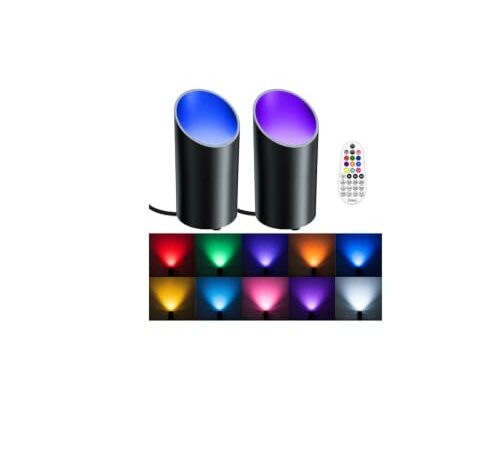
An RGBW LED combines red, green, blue, and white diodes in a single package. The RGB channels mix to produce any color in the visible spectrum. The white channel provides actual white light without the optical inefficiency of mixing three colors to approximate it.

That inefficiency is real. When you mix red, green, and blue to make white, each diode is emitting at its own narrow wavelength. The combination looks white to your eye, but it’s not a continuous spectrum — it’s three spikes with dark gaps between them. Objects illuminated by RGB-mixed white look slightly off because parts of their reflectance spectrum fall into those gaps. A dedicated white LED produces a phosphor-converted broad spectrum that renders colors more naturally.

More importantly, the RGBW diode has to allocate its total wattage across four channels. A 5W RGBW fixture running full white uses only the white channel — say 1.5W of the total die area, with the RGB channels dark. Running a color, you’re using two or three channels at partial power. In either mode, you get fewer lumens per total watt than a fixture that puts all 5W through a single white LED optimized for that one job.

RGBW makes sense for decorative and accent lighting — color-washing a fence for a party, cycling through seasonal colors on a porch column. It does not make sense as your primary landscape lighting if brightness and throw distance matter. A 5W RGBW fixture in white mode produces meaningfully less light than a 5W dedicated warm-white fixture.

What Nobody Publishes: Beam Angle

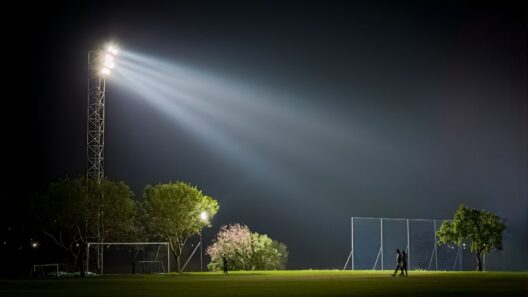
The single most useful specification for aiming a landscape spotlight is the beam angle — the cone within which the fixture delivers at least 50 percent of its peak intensity. A narrow beam, say 15 degrees, concentrates light into a tight column that can reach the top of a tall tree from ground level. A wide beam, 60 degrees, washes a garden bed but can’t project far because the same total light is spread across a much larger area.

Light intensity follows the inverse square law. Double the distance from a fixture and the illuminance at the target drops to one quarter. A narrow beam partially compensates by packing more photons into a smaller solid angle — the fixture isn’t brighter, but more of its output reaches the distant target instead of spilling to the sides.

This is the specification that determines whether a 3W fixture or a 7W fixture actually lights your tree. A 3W LED behind a tight 15-degree optic can throw a visible spot higher than a 7W LED behind a 60-degree flood, because the 3W unit concentrates its output while the 7W unit disperses it. Wattage tells you energy consumption. Beam angle tells you where that energy goes. Neither number alone tells you whether the fixture will do what you need.

And yet beam angle rarely appears in consumer landscape lighting listings. Buyers make decisions on wattage and color temperature — the numbers that are published — and then discover at installation that the light either washes everything flat or barely reaches the target. The fixture isn’t defective. It’s aimed at the wrong job.

FAQ

What’s the difference between IP54 and IP66 for outdoor lights?

IP54 resists dust infiltration and water splashing from any direction — fine for covered patios or indoor use. IP66 is fully dust-tight and withstands pressurized water jets, which is what you need for a fixture sitting at ground level near sprinklers or in soil that stays wet. The second digit is the one that matters most outdoors: 4 means splash-resistant, 6 means jet-resistant.

Do I need a separate transformer for low-voltage landscape lights?

Low-voltage systems run at 12V or 24V and require a step-down transformer from your 120V outlet. Some kits include one sized for the pack — typically just enough for the fixtures in the box. If you expand the system, you need a larger transformer or a second one. Adding more fixtures to an undersized transformer doesn’t blow anything up; it just drops voltage across the line, dimming every fixture in the chain.

How many landscape spotlights do I need for a front yard?

Count the things you want lit — trees, architectural features, path edges, garden beds — and plan one fixture per target. Most residential front yards use 6 to 12 fixtures. Overlapping two or three fixtures on a single tree from different angles eliminates the flat, theatrical look of a single spot. Start with fewer than you think you need; adding fixtures to a low-voltage run is easier than pulling out stakes and rerouting wire.

Will RGBW landscape lights work for security lighting?

Not well. An RGBW fixture splits its wattage across four LED channels — red, green, blue, and white. In white mode, only the white channel is active, producing fewer lumens per watt than a dedicated white LED at the same total power. For security, you want maximum brightness from a purpose-built white fixture, not a color-mixing system running in single-channel mode.

Why do my landscape lights dim at the end of a long wire run?

Voltage drop. Every foot of wire has electrical resistance, and at 12V, even small resistance losses represent a large percentage of the total voltage. A fixture at the end of a 60-foot run on thin wire might receive 10 volts instead of 12, reducing its light output noticeably. Heavier gauge wire, shorter runs, a 24V system, or a hub-and-spoke wiring layout instead of a daisy chain all reduce the problem.