We research every product we recommend. We may earn a commission from the links on this page.

Travel Adapters Don’t Convert Voltage. Here’s What That Costs You.

We compare published specifications and marketplace data. We do not test these products.

Travel Adapters Change the Shape, Not the Voltage
Photo by Castorly Stock on Pexels

A travel adapter changes the shape of your plug. That’s it. The 230 volts behind a European wall socket still reach your device at 230 volts, and if that device expects 120, the adapter won’t save it. Understanding what these tools actually do — reposition metal contacts to complete a circuit — is the difference between charging a laptop safely and melting a hair dryer on the first morning of a trip.

Affiliate disclosure: This article contains affiliate links. We may earn a commission if you buy through them, at no extra cost to you.

Everything we recommend
4 picks

How we picked

We did not plug these adapters into foreign outlets. Selections are based on published specs, port configurations, and plug-type coverage.

Plug geometry, not label

An adapter that claims “universal” but omits Type L or Type J leaves you stranded in specific countries. We checked which socket types each unit physically covers.

USB wattage, not port count

A USB-C port at 20W charges a phone. At 100W it charges a laptop. The number of ports matters less than what each one delivers.

Simultaneous device load

Four AC outlets and four USB ports sounds generous until total wattage caps out. We looked at how many devices can draw power at once without competing.

Honest coverage gaps

A region-specific adapter at half the price beats a universal one if you’re visiting one country. We matched each unit to the trip it actually serves.

230 Volts Through a Different-Shaped Hole

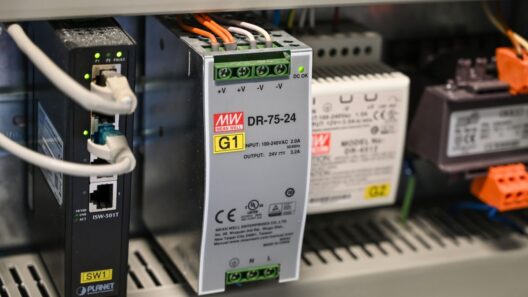
Mains voltage in North America runs at 120V, 60Hz. Most of Europe, Asia, Africa, and Australia runs at 220–240V, 50Hz. A travel adapter does nothing to bridge that gap.

Inside the adapter, brass or copper contacts slide, rotate, or fold to match the pin geometry of the destination socket. Type A uses two flat parallel blades spaced 12.7mm apart. Type C uses two round 4mm pins 19mm apart. Type G — the British standard — arranges three rectangular blades in a triangle. The adapter repositions your plug’s contacts to complete a circuit with whichever geometry the wall provides. The electricity that flows through is unaltered.

This matters because of what sits on the other end of that circuit. A laptop charger with a switching power supply reads the label on the brick: “Input: 100–240V, 50/60Hz.” That charger uses high-frequency transistors to convert whatever AC comes in to the regulated DC your laptop needs, adjusting its duty cycle on the fly. Plug it into 120V in Chicago or 230V in Berlin — it doesn’t care.

A hair dryer doesn’t have a switching power supply. Its heating element is a resistive coil sized for a specific voltage. Plug a 120V hair dryer into 230V mains and the coil draws roughly double its rated current. The element overheats in seconds. The adapter did its job — the plug fit — and the appliance died anyway.

That distinction is the single most important thing to understand before buying any adapter. Every other feature — USB ports, battery banks, outlet counts — sits downstream of this one fact.

Why “Universal” Doesn’t Mean Every Socket

A travel adapter’s contact mechanism is physically specific. One pin geometry cannot fit all sockets, which is why the word “universal” on the box deserves scrutiny.

Type L sockets — used in Italy, Chile, Ethiopia, Libya, Syria, Tunisia, and Uruguay — have three round pins in a row, with the center pin offset for grounding. That geometry shares nothing with Type G’s rectangular triangle or Type C’s two-pin European standard. An adapter built for Type L cannot physically enter a Type G socket, and vice versa. The contacts are different diameters, different spacings, different depths.

Multi-region adapters solve this two ways. Some use a single sliding mechanism where internal contacts shift position to approximate several geometries — compact, but mechanically complex and prone to loose fit in some sockets after repeated use. Others use detachable plug modules: separate snap-on heads for each socket type, swapped by the traveler. The detachable approach is bulkier but makes a tighter mechanical connection, because each module is purpose-built for one geometry.

Switzerland uses Type J. South Africa uses Type M. Israel uses Type H. These three appear constantly in negative reviews of adapters labeled “universal” — the adapter covers the common types and quietly omits the uncommon ones. Check the actual list of supported types against every country on your itinerary, not just the first one.

The UK Socket That Won’t Open

British BS 1363 sockets include spring-loaded shutters over the live and neutral slots. These shutters only open when the longer earth pin — the top pin in the triangular arrangement — is inserted first. The earth pin pushes a mechanical lever that releases the shutters, allowing the lower two pins to enter.

An adapter with Type G prongs needs that top pin to be the correct length and cross-section, or the shutters stay closed. Some adapters use a plastic dummy earth pin — it carries no electrical ground, but it’s long enough to trip the shutter mechanism. Others omit the dummy pin entirely, and the adapter physically cannot enter a UK socket despite having the right prong shape on the lower two pins.

This is a specific, mechanical failure. The prongs are the right geometry. The adapter is labeled for the UK. And it doesn’t work, because a safety mechanism inside the socket requires a component the adapter doesn’t have. It’s worth confirming before you leave, not after you’re standing in a Heathrow hotel room.

What USB-C PD Actually Negotiates

USB Power Delivery is a protocol, not a port shape. When you plug a device into a USB-C PD source, the two sides negotiate over a Communication Channel line. Your device requests a specific voltage — 5V, 9V, 12V, 15V, or 20V — and a current up to the source’s rated wattage. The source grants or denies based on what it can supply.

A 20W USB-C PD port negotiates 9V at roughly 2.2A, or 5V at 3A. That’s enough to fast-charge a phone. It is not enough to charge a laptop. Most laptops with USB-C charging need 45W minimum; many need 65W or more. Plugging a 65W laptop into a 20W PD port won’t damage anything — the laptop simply charges at a crawl, or not at all if it’s running a heavy workload that draws more than the port provides.

A 100W USB-C source negotiates up to 20V at 5A. That charges the laptop at full speed, runs it while charging, and has headroom for accessories. The gap between 20W and 100W isn’t a minor spec difference. It’s the difference between “charges your phone” and “replaces your laptop brick.”

When an adapter lists USB-C without a wattage, assume low. The silicon and thermal management needed for 100W PD costs real money and takes real space inside the housing. If the adapter were delivering it, the number would be on the box.

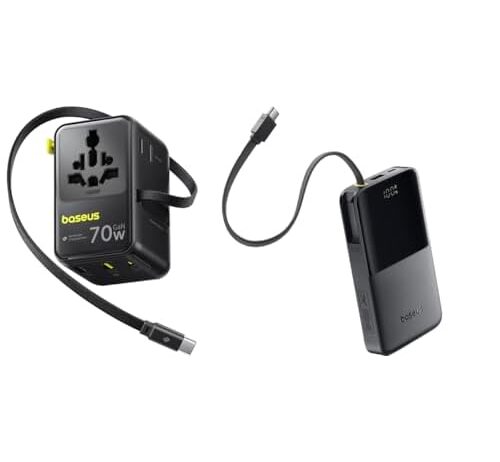
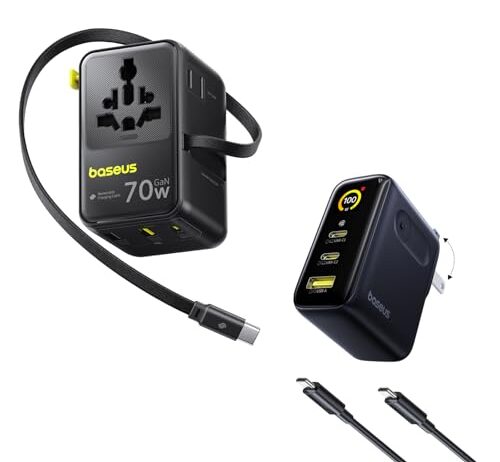
The bundle separates the two problems a traveling laptop user actually has. The adapter repositions your plug to fit the foreign socket and passes through AC at whatever wattage the wall provides, rated to 70W. The standalone 100W USB-C charger plugs into the adapter’s AC pass-through and delivers full-speed Power Delivery to a laptop — 20V at 5A, enough to charge and run simultaneously.

That separation matters because cramming high-wattage PD conversion into the adapter body itself requires heavier components, more heat dissipation, and a larger housing. By splitting the functions, neither device compromises on its own job. You carry two objects instead of one, but the charger also works at home without the adapter, and the adapter also works with a hair dryer or a CPAP machine — any AC device within its rating.

The trade-off is bulk: two units in your bag instead of one. For a trip where you need to charge a laptop at full speed in foreign outlets, that’s a reasonable price. For a phone-only traveler, it’s unnecessary weight.

When a Battery Changes the Equation

A power bank inside a travel adapter does something no pass-through adapter can: it stores energy from the wall and releases it later at regulated voltage through USB. The wall delivers 230V AC in Paris or 120V AC in New York. The adapter’s internal circuitry converts that to DC, charges the lithium-ion cells, and the cells output regulated 5V, 9V, or 12V through USB when you need it.

That matters in two specific situations. Airport layovers where outlets are scarce or contested — you charge the bank at the hotel and carry hours of phone power through the terminal. And unreliable power in rural accommodations, where voltage sags or brief outages interrupt a pass-through adapter’s supply but don’t affect a charged battery.

The charging physics set expectations. Lithium-ion cells charge in constant-current/constant-voltage mode: current flows at maximum rate until the cell reaches 4.2V per cell, then voltage holds steady while current tapers. A bank rated at 22.5W output charges devices at that rate, but its own recharge speed depends on whatever the wall provides through the adapter’s AC circuitry. Don’t expect a full bank by morning if you plugged it in at midnight with three other devices sharing the same adapter.

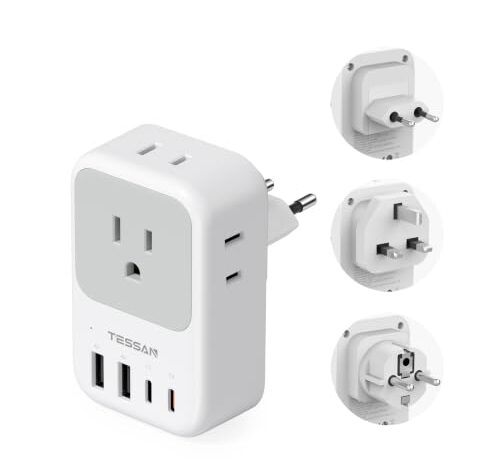
The integrated power bank converts this from a passive pass-through device into something that stores energy. Charge it from a hotel outlet overnight, and the bank provides regulated USB power through the next day’s transit — trains, planes, cafés without available sockets. The built-in USB-C cable eliminates one more thing to forget in a hotel room drawer.

The 22.5W output is enough for phones and earbuds, not for laptops. At that wattage, a modern smartphone with a 5,000mAh battery charges from empty to roughly 50% in about 30 minutes. The bank itself recharges whenever the adapter is plugged into a wall, drawing whatever voltage the local mains provides and converting it internally.

Weight is the cost. A battery adds mass that a pure pass-through adapter doesn’t carry, and you carry it through every airport, every train station, every day of the trip — not just the days you need backup power. If your itinerary keeps you near outlets reliably, the battery is dead weight. If it doesn’t, it’s the most useful feature in the bag.

Simultaneous Load and What Caps It

Four AC outlets and four USB ports on a single adapter sounds like eight independent power sources. They’re not. Every device plugged into that adapter draws from the same circuit, through the same set of internal contacts, limited by the adapter’s total wattage rating and the wall socket’s breaker.

A European residential circuit typically runs on a 16A breaker at 230V — about 3,680W total for everything on that circuit, which may include the room’s lights, the minibar, and the air conditioning. Your adapter sits at the end of that chain. Its internal contacts and wiring have their own thermal limits, typically far below the wall’s capacity.

In practice: charging four phones via USB while running a laptop charger through an AC outlet works fine — total draw might be 120W. Plugging in a 1,500W hair dryer through one AC outlet while three other outlets are occupied is where you hit the adapter’s limits or trip the room’s breaker. The adapter’s housing gets warm because copper contacts carrying high current generate heat through resistance, and that heat has nowhere to go inside a plastic shell.

USB ports sharing an internal power supply face the same constraint at a smaller scale. Four USB ports rated at a combined 20W split that budget among whatever’s connected. Plug in four devices and each gets roughly 5W — enough to trickle-charge, not to fast-charge.

One Region or Five: Matching the Adapter to the Trip

A two-week trip to Italy and only Italy is a different problem from a backpacking route through the UK, France, Spain, and Greece. The adapter you need depends on the geometry you’ll encounter, and paying for coverage you won’t use is money and bag space wasted.

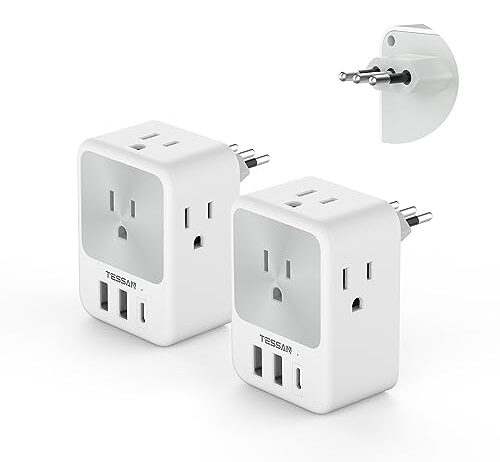
Type L — Italy’s standard, shared with Chile, Ethiopia, and a handful of other countries — uses three round pins in a line. If every outlet you’ll see for the next two weeks uses Type L, a dedicated Type-L adapter is smaller, cheaper, and makes a tighter mechanical connection than a universal unit whose sliding mechanism approximates Type L among a dozen other shapes. A two-pack means one for the hotel room and one for the day bag, or a backup if one fails.

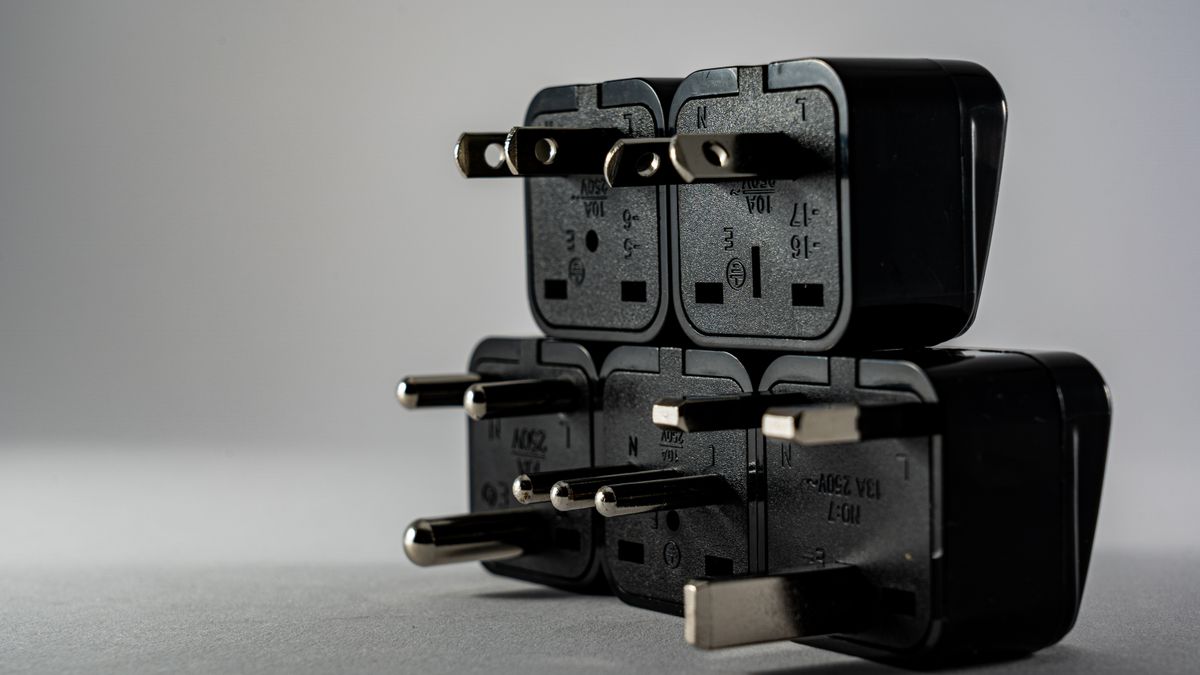
A multi-country itinerary changes the math. Detachable plug modules — separate snap-on heads for Type C, G, E, and F — cover most of Western Europe and the UK with one base unit. You swap the head at each border instead of carrying four single-purpose adapters. The base is bulkier than any one of those singles, but smaller than all four combined.

The gap to watch for: Italy. Type C fits loosely in a Type-L socket but doesn’t engage the ground pin. A multi-region kit covering C, G, E, and F may not include a dedicated Type-L head, leaving you with an ungrounded connection in Italian outlets. Check before you pack.

FAQ

Do I need a voltage converter or just a travel adapter?

Check the label on your charger or appliance. If it says “Input: 100–240V,” it has a switching power supply and only needs an adapter to fit the socket shape. If it says “120V” only — common on hair dryers, curling irons, and some electric razors — you need a voltage converter, which is a separate, heavier device. The adapter changes the plug shape; it never touches the voltage.

Can I plug a hair dryer into a travel adapter in Europe?

Only if the hair dryer is rated for 220–240V or has a voltage switch set to the correct range. Most North American hair dryers are 120V-only. Plugging one into a 230V European socket through an adapter sends double the voltage to the heating element, which will burn out immediately. The adapter fits the plug; it does not protect the device.

Will a universal travel adapter work in Italy and Switzerland?

Check the supported plug types, not the word “universal.” Italy uses Type L (three round pins in a row). Switzerland uses Type J (three round pins in a triangle). Many universal adapters cover Type C, which fits loosely in both but doesn’t engage the ground pin. For a grounded connection, you need adapters that specifically list Type L and Type J.

What does USB-C PD wattage mean on a travel adapter?

USB Power Delivery negotiates voltage and current between the adapter’s port and your device. A 20W PD port fast-charges a phone but cannot charge most laptops, which need 45W or more. A 100W PD port charges a laptop at full speed. The wattage number tells you the maximum power the port can deliver, which determines what devices it can realistically charge.

Why won’t my travel adapter fit into a UK outlet?

UK sockets have spring-loaded shutters that only open when the longer top pin (the earth pin) is inserted first. If your adapter lacks a physical earth pin — or has one that’s too short — the shutters stay closed and the lower two pins can’t enter. Look for an adapter with a full-length Type G earth pin, even if it’s plastic.