
We research every product we recommend. We may earn a commission from the links on this page.
Tools & Home Improvement › Job Site Lighting

LEDs Don’t Dim Because the Battery Died. They Dim Because They Got Hot.

We compare published specifications and marketplace data. We do not test these products.

Work Light Runtime Drops When Brightness Climbs
Photo by Brett Jordan on Pexels

A 6,000 mAh rechargeable work light claims 10,000 lumens for $17. A corded dual-head setup claims 8,800 combined lumens for $75. Both numbers are printed on the box, and neither tells you how bright the light will be twenty minutes into the job. LED work lights dim during use — not because the battery is dying, but because the diode itself loses output as its junction temperature climbs. That thermal behavior, combined with voltage sag in lithium cells and lumen ratings pulled from datasheets rather than measured from fixtures, explains why owners consistently describe rechargeable lights as far dimmer than their specs suggest. Understanding what’s actually happening inside the housing changes which light is worth buying for late-fall garage work, winter job sites, or any situation where you need sustained brightness after sunset.

Affiliate disclosure: This article contains affiliate links. We may earn a commission if you buy through them, at no extra cost to you.

Everything we recommend
4 picks

How we picked

We did not plug these lights in. Selection is based on published specs, battery chemistry, and owner-reported brightness data.

Power source, not just capacity

AC, integrated lithium, solar-supplemented, and tool-battery — each architecture loses brightness differently.

Claimed lumens against owner experience

Specs say one thing. Owners with the light in hand say another. We weight the gap.

Sustained output, not peak

A light that dims 30% in twenty minutes isn’t a 6,000-lumen light. Thermal and voltage behavior matter more than the number.

Total cost to first use

Tool-only means the price tag is incomplete. Solar backup means the recharge math is different. We count everything.


Three things eat your brightness before the battery dies

You paid for lumens. The number is right there. But lumens, as printed, almost never describe what lands on your work surface thirty minutes in. Three mechanisms are running simultaneously, and all of them steal light.

The first is thermal droop. An LED is a semiconductor, and as current flows through it, the junction heats up. Hotter junctions convert less electricity into visible photons and more into waste heat — which makes the junction hotter still. Light output can fall 10–30% from a cold start even while the LED draws the same current. This is not a defect. It is how the physics works in every LED, from a five-dollar flashlight to a stadium floodlight.

The second is voltage sag. A lithium-ion cell starts at 4.2 volts and drops toward 3.0 volts as it discharges. LEDs driven by that declining voltage produce less light progressively. Your eyes adapt, so you don’t notice the first 15% — then suddenly it looks dim, even though the battery meter still reads half full.

The third is the lumen number itself. Manufacturers can report the theoretical maximum from the LED chip’s datasheet, the output of the bare emitter on a test bench, or the actual light leaving the finished fixture through its lens and reflector. There is no universal enforcement of which method a consumer work light uses. A light rated at 6,000 lumens by one method might measure 2,500 lumens by another — and both are technically defensible.

When all three compound — inflated rating, thermal droop from minute one, voltage sag from minute twenty — you get the experience owners describe over and over: a light that looked great for the first quarter hour and then quietly became inadequate.

Why corded lights hold brightness that rechargeable ones lose

Plug a light into a wall outlet and two of the three problems vanish. Voltage is constant — 120V AC rectified to whatever the driver needs, no sag, no decline over time. And because you aren’t constrained by battery weight, the fixture can be larger, with more metal to sink heat away from the LEDs, which reduces thermal droop.

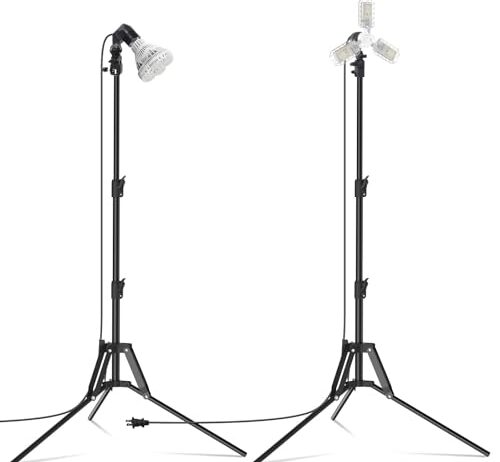
The SANSI dual-head system runs on AC power. One head produces 5,500 lumens, the other 3,300, both at 5,000K daylight color temperature. Those are watt-equivalent ratings — “365-watt equivalent” and “300-watt equivalent” — which means the actual power draw is far lower, probably 40–60 watts per head. But the important part is that the output doesn’t decline over a session. An hour in, the light is the same as it was at minute one. Two hours. Four hours. As long as the cord reaches the outlet, brightness is not a variable.

The trade-off is the cord. You need an outlet, you need an extension cable that can handle the current, and you are tethered to that cable’s radius. On a job site with power, or in a garage, that’s trivial. In a parking lot, a crawl space, or anywhere off-grid after dark, it’s a wall.

The lumen-per-dollar trap

The MASMEJOR claims 10,000 lumens for $17.09. The LETOUR claims 6,000 lumens per unit — 12,000 total for the two-pack — at $79.99. The SANSI claims 8,800 combined lumens at $75.50. If lumens were lumens, the math would be obvious: buy the cheapest one per lumen and move on.

But lumens aren’t lumens. A 6,000 mAh battery at 3.7 volts stores about 22 watt-hours. If the LED array genuinely draws 100 watts — as the MASMEJOR’s rated wattage states — that battery is empty in about 13 minutes at full power. Not hours. Minutes. Either the light is not drawing 100 watts, or the battery is not sustaining 10,000 lumens, or both. The arithmetic forces at least one of the printed specs to be wrong.

Compare that to the LETOUR’s 10,400 mAh cell. At the same 3.7V nominal voltage, that’s about 38 watt-hours — enough to sustain maybe 30–40 watts for an hour at full draw, or a few watts for the claimed 80 hours on the lowest mode. The 80-hour figure almost certainly describes the dimmest setting, where the LED might be running at 10–20% of maximum power.

Owners confirm the math. One verified buyer of the LETOUR, who works with calibrated lighting fixtures, wrote that the 6,000-lumen light on high with a full charge produced roughly what they’d estimate at 1,000 lumens. Another owner compared the larger LETOUR unit directly against a smaller model from the same brand and found the bigger light no brighter despite the higher rating. These are not outliers — they are the predictable result of the three mechanisms described above.

The reason this is the top pick has nothing to do with its lumen rating being higher or lower than the rechargeable options. It’s that the rating stays true. Constant AC voltage means the driver feeds the LEDs at a fixed current indefinitely. The thermal mass of two separate lamp heads, each with its own heat path, keeps junction temperatures lower than a compact rechargeable housing ever manages.

The telescoping tripod stand puts light above the work surface rather than beside it, which matters more than most buyers expect. A light sitting on the ground or clamped at waist height casts your own shadow across whatever you’re working on. Elevating it to six or seven feet turns the pool into a wash. For garage work after dark, for painting a room in November when natural light is gone by five, for any sustained indoor task where you need the space lit rather than a spot illuminated, corded power removes the constraint that makes every rechargeable light a countdown timer.

The limitation is real and worth naming: you need an outlet. No battery backup, no portability beyond the cord’s reach. If the job is under a car hood in a driveway with a garage outlet ten feet away, fine. If it’s a hundred yards from power, this light stays in the truck.

What rechargeable actually gives you — and what it costs

Portability. That’s it. And it’s worth a lot — but only if you understand what you’re trading for it.

You’re trading sustained brightness. Every rechargeable light in this set dims during use. The rate depends on the battery capacity, the LED’s actual power draw, and the thermal design of the housing, but the direction is always the same: down. A rechargeable light that looks great at minute one and adequate at minute forty-five and dim at minute ninety is performing exactly as the physics predicts.

You’re also trading predictability. Owners of the MASMEJOR report the battery failing entirely after a few uses — stopping charging, holding power for only minutes. That’s a cell-quality issue, not a thermal one, and it’s the risk you accept at $17 for a lithium-ion device. Cheap cells use thinner separators, lower-grade electrolyte, and less rigorous quality control. When they fail, they fail fast.

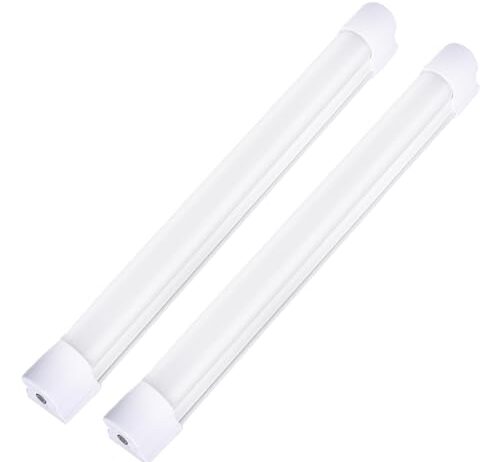
The LETOUR’s 10,400 mAh cell is a different class of battery. Larger capacity means slower discharge rates at a given power draw, which means less heat stress on the cell, which means longer cycle life. The magnets let you stick it to a metal surface and work hands-free — under a hood, inside a breaker panel, on a steel beam. At $40 per unit for the two-pack, the price reflects a real battery with real capacity, not a lumen claim underwritten by a cell that can’t support it.

Buy this knowing the 6,000-lumen number is aspirational. Owners who’ve compared it against calibrated fixtures put actual output closer to 1,000–2,000 lumens on high. That’s still enough to light a work surface at close range — an engine bay, a crawl space, the underside of a sink. It is not enough to illuminate a full garage bay the way a corded floodlight does.

What the LETOUR does well is sustain. The 10,400 mAh cell is nearly double the MASMEJOR’s capacity, and the LED is likely drawing far less than the battery can deliver at peak, which keeps discharge rates low and thermal stress manageable. The 80-hour runtime figure is the lowest mode — maybe a few hundred lumens — but even the high setting should hold for a couple of hours before dimming noticeably. That’s a work session. The magnetic base sticks to any ferrous surface, which frees both hands and puts the light where clamps and hooks can’t reach.

Two lights in the box means you can place them on opposite sides of the work area, eliminating the single-source shadow problem that one light of any brightness cannot solve. Two modest lights from two angles beat one bright light from one angle for anything involving your hands.

Solar charging sounds good until you do the math

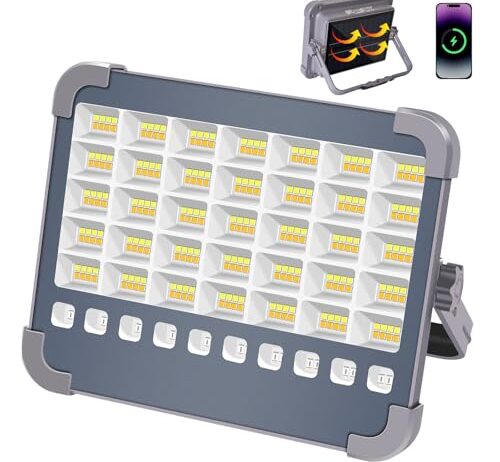
The MASMEJOR includes a solar panel. On paper, that means you can recharge in the field — leave it in the sun, use it at night, never plug it in. In practice, small solar panels on portable devices produce 1–5 watts under ideal direct sunlight. A 6,000 mAh battery at 3.7 volts holds about 22 watt-hours. At 3 watts of solar input, accounting for conversion losses, you need roughly 10–12 hours of direct sun to fill it. That’s a full day of Arizona summer sunlight — no clouds, no shade, no bad angle.

For a light you’d use in a garage after work in November? The days are short, the sun is low, and the panel is probably sitting on a shelf indoors. Solar backup on a work light this size is emergency insurance, not a daily charging strategy. It might keep the light alive during a multi-day power outage if you can get the panel into sun each morning. It will not replace plugging in a USB cable overnight.

The tool-battery question

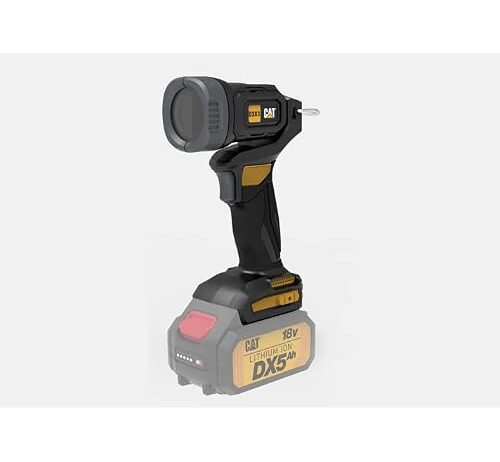
The Cat DX63B takes a different approach entirely. It ships with no battery and no charger — $39.99 buys you the light head alone. You supply an 18V battery from the Cat cordless tool system.

This makes sense exactly when you already own the batteries. An 18V tool battery at 3,000 mAh stores about 54 watt-hours — more than double what the MASMEJOR’s integrated 6,000 mAh cell holds at 3.7V, despite the lower mAh number, because voltage matters as much as capacity when calculating stored energy. If you have three batteries rotating through a drill, a saw, and an impact driver on a job site, adding a work light that shares the same batteries means you carry one charger and one battery format for everything.

If you don’t own Cat 18V tools, the math reverses. A battery and charger add $50–80 to the $39.99 light, and you’ve committed to an ecosystem for the privilege. The light itself publishes no lumen rating, no beam angle, no runtime — you’re trusting the brand and the voltage to deliver adequate light, which is at least an honest omission compared to a 10,000-lumen claim from a $17 device.

When the season changes, the light problem changes with it

In July, you work in the garage until nine and the overhead fluorescents are supplemental. The work light sits on the bench for close-up tasks — soldering, reading part numbers, inspecting a weld. Any of these lights handles that.

In November, sunset hits before five. The garage is dark for the entirety of any evening project, and the task isn’t close-up inspection anymore — it’s illuminating the whole space well enough to work safely for two or three hours. That’s where rechargeable lights consistently disappoint, because the job has changed from spotlight to floodlight and the battery hasn’t grown.

A corded dual-head system on a tripod turns a dark garage into a lit workspace for as long as you need it, no countdown, no dimming. A pair of magnetic rechargeable lights supplements that — under the hood, inside the fuse box, wherever the flood doesn’t reach. The two formats aren’t competing. They answer different questions.

If you only buy one, and you have an outlet within reach, buy the corded light. The portability of a rechargeable is worth nothing when you’re standing next to a wall socket, and the brightness you lose to thermal droop and voltage sag is worth everything when the whole room needs light at 7 PM in December.

FAQ

Is a 10,000-lumen rechargeable work light actually brighter than a 3,000-lumen plug-in light?

Almost certainly not. The rechargeable light’s lumen number likely comes from the LED chip’s theoretical maximum, not a measurement of the finished fixture. A plug-in light at 3,000 measured lumens, sustained by constant voltage, will appear brighter in use — especially after the rechargeable has been running for twenty minutes and thermal droop has cut its output by 20–30%.

How long does an 80-hour runtime work light actually last on the highest setting?

Probably 2–4 hours. Long runtime claims describe the lowest brightness mode, where the LED might draw only 10–20% of its maximum power. On high, the battery drains 5–10 times faster, and thermal throttling may reduce output further before the battery is empty.

Does a bigger battery make a work light brighter or just longer-lasting?

Longer-lasting. Brightness is determined by the LED’s power draw and optical design. A bigger battery lets that LED run longer before voltage sag causes dimming, but the peak output at minute one is the same regardless of battery size. Where capacity helps indirectly is thermal: lower discharge rates produce less heat in the cell, which can slightly reduce overall housing temperature.

Can a solar-powered work light charge fast enough to use every night?

Not practically. Small solar panels produce 1–5 watts in direct sun. A 6,000 mAh battery needs 10–12 hours of ideal sunlight to fully charge through a small panel. In fall and winter, when you most need the light, daylight hours are shortest and sun angles lowest. Solar is emergency backup, not a daily charging method.

Are tool-battery work lights dimmer than lights with built-in batteries?

Not inherently — an 18V tool battery at 3,000 mAh stores about 54 watt-hours, more than double a typical 3.7V 6,000 mAh integrated cell. Higher voltage means the driver can push more current to the LED more efficiently. The variable is the light head’s design and LED quality, not the battery format.