We research every product we recommend. We may earn a commission from the links on this page.
Tools & Home Improvement › Replacement Under-Sink Water Filters

1 Micron, 0.0001 Micron, and No Microns at All

We compare published specifications and marketplace data. We do not test these products.

Sediment Filters Clog Faster When Mineral Hardness Is Low
Photo by Engin Akyurt on Pexels

A 1-micron sediment filter catches particles the width of a bacterium. A reverse osmosis membrane rejects dissolved salt molecules ten thousand times smaller. A scale inhibitor cartridge has no micron rating at all — it doesn’t filter anything. All three sit in standard housings, thread onto standard plumbing, and look roughly identical on a shelf. The number on each one — or the absence of a number — tells you which problem it was built for, and installing the wrong one means paying for a solution to a problem you don’t have.

Affiliate disclosure: This article contains affiliate links. We may earn a commission if you buy through them, at no extra cost to you.

Everything we recommend
4 picks
Budget pick
Same chemistry, lower per-cartridge cost

Same chemistry, lower per-cartridge cost

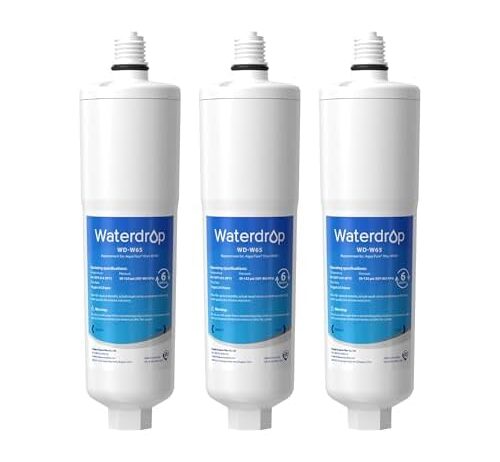
Waterdrop AP431 Replacement Cartridge for Aqua-Pure® AP431, 3 Pack | Water Filter, Replacement Cartridge for Aqua-Pure® AP430SS, Helps Prevent Scale Build Up On Hot Water Heaters and Boilers
★ 4.7 736 reviews

A 3-pack of the same AP431-compatible polyphosphate cartridge. Identical sequestration chemistry at a lower cost per replacement cycle. One owner reported soft threading on installation R11 — hand-tighten carefully.
A micron is a millionth of a meter. A grain of beach sand is about 500 microns across. A human hair, roughly 70. The particles that make tap water visibly cloudy — silt, rust flakes, fine clay — run from about 1 to 50 microns, and a filter rated at 1 micron will physically block anything larger than that threshold from passing through.

That is one kind of water problem. It is the visible kind, the one that turns a white sink orange or leaves sediment in the bottom of a pot. A 1-micron string-wound filter handles it by trapping particles inside layers of wound fiber — depth filtration, where material lodges throughout the media rather than collecting only on the surface.

But dissolved minerals are not particles. Calcium and magnesium ions in hard water are individual molecules in solution, thousands of times smaller than the smallest particle a sediment filter catches. They pass through a 1-micron filter as easily as water itself does. To stop them, you need either a membrane tight enough to reject molecules by size — reverse osmosis, at roughly 0.0001 microns — or a chemical that prevents them from crystallizing onto surfaces without removing them at all.

That is the core confusion in water filtration: three entirely different mechanisms, sold in the same aisle, threaded into the same housings, solving problems that have almost nothing in common.

How we picked

We did not install these filters. Selection is based on published specifications, filtration mechanism, and owner-reported performance.

Filtration mechanism, not brand

Each product represents a distinct separation method — mechanical interception, membrane rejection, or chemical sequestration.

Rated pore size, not marketing tier

A micron rating defines what passes through. We compared rated thresholds against the particle sizes each mechanism actually encounters.

Application match, not versatility claims

Whole-house sediment removal and point-of-use dissolved-solid rejection are different jobs. We grouped by where the cartridge sits in a system.

Owner-reported failure modes, not star averages

What went wrong — bypass defects, thread failures, premature clogging — matters more than aggregate satisfaction scores.


What a Micron Rating Actually Tells You

A string-wound sediment filter is yarn wrapped around a rigid core. The tightness of the wrap sets the micron rating — tighter winds leave smaller gaps, which block smaller particles but also restrict flow more. At 1 micron, you are catching silt fine enough that you might not see it in a glass of water, but your fixtures and appliances would accumulate it over months.

The trade-off is pressure. Every particle that lodges in the media reduces the open space water flows through. Pressure drop across the filter increases as it loads, and a 1-micron filter starts with higher resistance than a 5-micron filter of identical dimensions because those tighter gaps restrict flow even when the media is clean. As particulate accumulates, it reaches its clogging point faster under the same water conditions.

In hard water, something counterintuitive happens upstream of the filter. Calcium and magnesium ions bind to suspended clay and silt particles, causing them to clump together — flocculation. Those larger clumps settle out in pipes and tanks before they ever reach the cartridge. In soft water, below about 60 mg/L hardness, that clumping is reduced. Particles stay finer, stay suspended longer, and more of them make it to the filter surface. The filter does the same job either way, but it sees a different load depending on what else is dissolved in the water.

Membrane Rejection Is a Different Physics

Reverse osmosis does not filter in the mechanical sense. It forces water through a semi-permeable membrane with pores so tight — around 0.0001 microns — that dissolved salt ions cannot pass. The water molecule fits; the calcium ion, surrounded by its hydration shell, does not. What comes through is nearly pure water, with 97 to 99 percent of dissolved solids left behind in the reject stream.

This is a fundamentally different scale of separation. A 1-micron sediment filter and an RO membrane are not doing the same job at different intensities — they are addressing different populations of contaminant entirely. The sediment filter catches what is already solid. The membrane rejects what is still dissolved. In most residential systems, the sediment filter sits upstream of the membrane specifically to protect it: particles that a membrane could stop would also physically damage or foul its surface, so you remove them mechanically first and let the membrane handle only what passes through.

Soft water actually changes the membrane’s working conditions. With fewer dissolved calcium and magnesium ions, there is less osmotic pressure opposing the membrane — the driving force needed to push water through drops slightly. More practically, less calcium in the feed water means less calcium carbonate scaling on the membrane surface itself, which is one of the primary reasons RO membranes degrade over their service life.

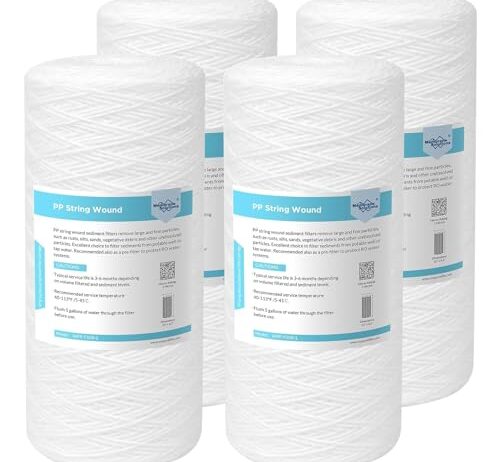
At 10 inches by 4.5 inches, this is the standard large-format cartridge — it threads into any housing built for that footprint without adapters or modifications. The 1-micron rating puts it at the fine end for whole-house sediment duty, which means higher particle capture but also higher initial pressure drop and a shorter interval to clogging compared to a 5-micron cartridge under the same water conditions.

That tighter rating matters most on well water or in regions where seasonal changes — spring snowmelt, heavy rain — push fine silt into the supply. One owner on a high-sediment well reported the filter failing within a week, releasing trapped sediment back into downstream stages rather than simply restricting flow [R7]. That is the failure mode of a depth-filtration cartridge overwhelmed by load: the media saturates and particles migrate through. A 4-pack gives you a year’s worth of replacements at quarterly changes, but actual interval depends entirely on what your water carries.

Scale Inhibitors Don’t Filter — They Intervene

A scale inhibitor cartridge has no micron rating because it is not removing anything from the water. It doses the flow with polyphosphates — sequestering agents that bind to dissolved calcium and magnesium ions and hold them in solution. The ions are still there. Your water still tests hard. But the polyphosphate prevents those ions from precipitating as solid calcium carbonate on heated surfaces — the white crust on heating elements, the mineral buildup inside a water heater tank.

This is chemistry, not filtration. The cartridge releases a controlled amount of sequestrant as water passes through, and that sequestrant remains effective only until it is consumed. Service life depends on flow volume and hardness level, neither of which is typically printed on the cartridge. You know it is exhausted when scale starts appearing again.

The practical question is whether you need one at all. If your water is already soft — below 60 mg/L — there are too few hardness ions to form meaningful scale, and a polyphosphate cartridge is solving a problem that does not exist. Where they earn their place is in variable-hardness situations: homes on well water where mineral content shifts with the water table, or systems with a water softener that occasionally passes hard water during regeneration cycles.

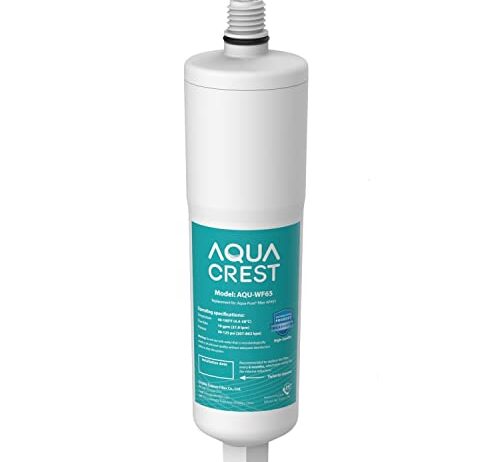
This is a replacement cartridge for the Aqua-Pure AP430SS system, and compatibility matters because the housing determines flow path and contact time with the sequestrant media. Polyphosphate dosing is not adjustable — the cartridge releases at a rate set by its formulation, and the water’s contact time inside the housing determines how much sequestrant dissolves into the stream.

One owner reported the threaded connection breaking during installation, noting the plastic was not strong enough to handle normal torque [R9]. That is worth knowing because this cartridge threads directly into a pressurized housing — a cracked fitting under line pressure is not a minor inconvenience, it is a leak at whatever PSI your supply runs. The single-pack at $22.99 makes sense for a first purchase to confirm compatibility; the Waterdrop 3-pack alternative covers the same chemistry at a lower per-unit cost for ongoing replacement.

Why the RO Membrane Costs 44 Times More

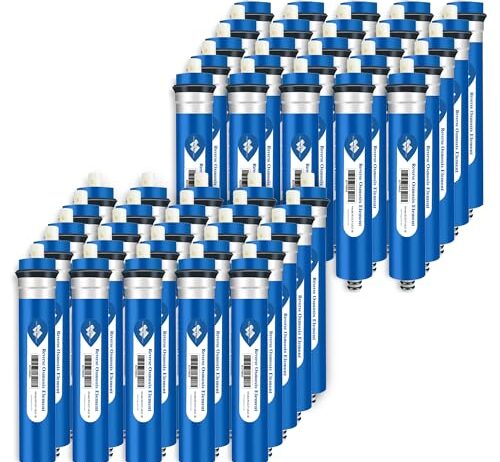
A string-wound sediment cartridge is yarn on a core. Manufacturing it is a winding process — fast, simple, and the materials are commodity polypropylene. An RO membrane is a thin-film composite rolled into a spiral: multiple layers of polyamide film separated by spacers, wrapped around a permeate tube, sealed at the edges, and fitted with end caps that direct flow across the membrane surface rather than through it in a straight line. The precision of the film, the uniformity of its pore structure, and the integrity of every seal determine rejection rate. A single pinhole bypass means contaminated water in the product stream.

Several owners of the Membrane Solutions RO membrane describe exactly that scenario. One measured post-membrane TDS of 150-170 ppm from a 474 ppm feed — well below the 99% rejection that would yield about 5 ppm [R4]. Another found TDS dropping only to 48 from a 260 ppm feed, an 81% rejection rate [R6]. A third discovered a visible defect in the connector seal that allowed water to bypass the membrane entirely [R3]. Whether these represent manufacturing variance or quality control gaps, the pattern across reviews is that actual rejection can fall well short of rated rejection, and the only way to know is to measure TDS after installation.

Matching the Cartridge to the Problem

The decision is not which filter is best. It is which problem you have.

Visible sediment — cloudiness, rust staining, grit in fixtures — is a particle problem. A 1-micron sediment filter addresses it mechanically. If your water is soft, expect the filter to load faster because fewer particles settle out upstream. If your water is hard, flocculation does some of the work for you, but you are also building scale on every heated surface in the house.

Scale on heating elements and inside water heaters is a dissolved-mineral problem. A sediment filter does nothing for it. A scale inhibitor keeps those minerals in solution so they pass through without depositing, but it does not remove them — your water still tests hard, your glasses still spot, and your RO membrane downstream still sees the same mineral load. If your water is consistently soft, a scale inhibitor is doing nothing.

Taste, TDS, and dissolved contaminants in drinking water are a molecular-separation problem. Only the RO membrane addresses them, and it does so at one tap, not whole-house. It needs pre-filtration to protect the membrane surface, and it produces reject water — typically 3 to 4 gallons of waste for every gallon of product, depending on pressure and temperature.

The mistake is stacking these solutions without understanding which problem each one solves. A sediment filter upstream of an RO system is good engineering — it protects the membrane. A scale inhibitor upstream of an RO system is redundant — the membrane already rejects the hardness ions the inhibitor is trying to manage. A scale inhibitor on a water heater fed by a water softener is solving the same problem twice.

FAQ

Do I still need a sediment filter if I have soft water?

Yes — and it may matter more. In hard water, calcium and magnesium ions cause suspended particles to clump together and settle before reaching your filter. In soft water, those particles stay finer and stay suspended longer, so more of them reach the cartridge. Your sediment filter catches the same material either way, but in soft water it sees a heavier load and may need replacement sooner.

Does a scale inhibitor do anything if my water is already soft?

Not meaningfully. Scale inhibitors dose water with polyphosphates that bind to calcium and magnesium ions, preventing them from precipitating on heated surfaces. If your water is below 60 mg/L hardness, there are too few of those ions to form significant scale, and the inhibitor is managing a problem that does not exist. The exception is variable-hardness water — well supplies or softener systems during regeneration — where hardness can spike intermittently.

Why does my whole-house filter clog faster in the spring?

Snowmelt and heavy rain mobilize fine sediment in surface water and shallow wells. That seasonal surge of silt, clay, and organic material increases the particulate load reaching your filter. A 1-micron cartridge sees this more acutely than a 5-micron because it catches finer material that a coarser filter would pass. The clogging is the filter doing its job — the solution is more frequent changes during high-runoff months, not a coarser rating.

Can I use a finer micron rating without losing water pressure?

Not without a trade-off. Finer micron ratings mean tighter gaps in the filter media, which restrict flow even when the cartridge is clean. As the filter loads with trapped particles, pressure drop increases further. Going from 5 microns to 1 micron captures finer sediment but reduces flow rate and shortens the interval before the filter needs replacement. Whether that trade-off is worth it depends on what is in your water — fine silt that stains fixtures justifies it, coarse sand does not.

What is the difference between filtering particles and preventing scale?

A sediment filter physically blocks solid particles — silt, rust, sand — from passing through. Scale prevention does not remove anything. It adds a sequestering chemical, typically polyphosphate, that binds to dissolved calcium and magnesium ions and prevents them from crystallizing on heated surfaces. The minerals stay in the water. One is mechanical separation, the other is chemical intervention. They solve different problems and neither substitutes for the other.