We research every product we recommend. We may earn a commission from the links on this page.
Tools & Home Improvement › Under-Sink & Countertop Filtration

Why Your Filter’s TDS Number Doesn’t Match the Box

We compare published specifications and marketplace data. We do not test these products.

Hard Water Eats Filter Life Faster Than Gallons Do
Photo by cottonbro studio on Pexels

Activated carbon and reverse osmosis remove contaminants through fundamentally different physics. Carbon adsorbs — molecules stick to a porous surface until the binding sites fill up. An RO membrane rejects — water is forced through a barrier with pores roughly 0.0001 microns wide, and anything larger stays behind. That distinction determines what each technology can and can’t remove, how fast water flows, how much gets wasted, and when the filter is actually spent. Here’s what that means for four systems spanning gravity carbon, pressurized carbon block, and two flavors of countertop RO.

Affiliate disclosure: This article contains affiliate links. We may earn a commission if you buy through them, at no extra cost to you.

Everything we looked at
4 picks

How we picked

We do not install or run these filters. Judgement rests on membrane pore ratings, carbon specifications, and replacement-cost data.

Contaminant removal, not general claims

NSF certification numbers, membrane pore size, and activated carbon grade determine what actually comes out of the water.

Total operating cost, not purchase price

Filter lifespan, replacement cartridge cost, and waste ratio define what you pay per gallon over three years.

Flow rate under stated conditions

GPM at specified inlet pressure and TDS level — not theoretical maximums — determines whether the system keeps pace with use.

Installation constraints, not features

Plumbing requirements, power draw, and counter footprint dictate where the system can actually go and what it displaces.


Two Mechanisms, Two Failure Modes

Every home water filter uses one of two basic physical processes, and the process dictates everything downstream — what it catches, what it misses, how fast it works, and how it dies.

Activated carbon works by adsorption. Water passes through a porous carbon structure, and organic molecules, chlorine, and certain dissolved chemicals bond to the carbon surface. The surface area inside a carbon block is enormous — a single gram can have thousands of square meters of internal area — and contaminants stick to it through physical and chemical attraction. When the available bonding sites fill up, the filter stops working. It doesn’t clog. It doesn’t slow down. It just stops catching things. You can’t see it, smell it, or taste it until the chlorine comes back.

Reverse osmosis works by rejection. A pump or line pressure forces water through a semipermeable membrane with pores approximately 0.0001 microns across. Anything larger than those pores — dissolved salts, heavy metals, most organic compounds — stays on the upstream side and gets flushed away as waste water. The membrane doesn’t adsorb anything. It physically blocks it. And when minerals precipitate onto the membrane surface — a process called fouling — the pores narrow, pressure drops, and flow rate falls. You notice an RO membrane failing because the water comes out slower and slower.

That’s the core trade-off. Carbon fails invisibly. RO fails visibly. Carbon wastes no water. RO rejects a portion of every gallon as concentrate. Carbon can’t touch dissolved minerals. RO strips them all.

What Pressure Actually Does

The speed difference between a gravity carbon filter and an under-sink carbon filter isn’t about the carbon. It’s about the pressure pushing water through it.

A gravity system uses atmospheric pressure — about 14.7 psi at sea level. That’s the weight of the air column above the reservoir, and it’s all you get. Water seeps through the carbon slowly, and the flow rate drops further as the filter loads with captured contaminants. A full gravity reservoir can take fifteen or twenty minutes to drip through a pair of carbon elements. That’s not a defect. It’s atmospheric pressure doing everything it can, which isn’t much.

An under-sink system ties into your home’s water line, which runs at 40 to 60 psi — roughly three to four times atmospheric. The same carbon media, hit with three times the pressure, passes water dramatically faster. You open the tap and the flow feels normal because the pressure behind it is the same pressure that feeds every other fixture in your house.

RO systems need even more. The osmotic pressure of the dissolved solids in tap water works against filtration — the membrane has to overcome that natural tendency plus provide enough force to push purified water through 0.0001-micron pores. Countertop RO units typically include a small pump to boost household pressure for this reason. When that pump can’t overcome the combined resistance of a fouled membrane and osmotic backpressure, you get a thin stream. Slow flow from an RO system can mean a membrane that needs replacing, but it can also mean normal operation under high dissolved-solids conditions.

Why “Six Months” and “3,000 Gallons” Aren’t the Same Claim

Manufacturers specify filter life two ways: a time interval or a gallon count. Neither one is lying to you. Neither one applies to your water.

A gallon rating assumes EPA-standard test water — a specific, controlled concentration of contaminants designed to make results comparable across brands. Your water isn’t that water. Hard well water with visible sediment loads carbon media with particulates that fill physical gaps in the block structure before the chemical adsorption sites are anywhere near spent. The filter chokes mechanically at 800 gallons even if it’s rated for 3,000. Meanwhile, lightly treated municipal water with low total dissolved solids might run past the rated gallon count before the carbon is actually saturated.

A time rating — “replace every six months” or “lasts three years” — sidesteps the gallon question entirely. It assumes average household usage and average water quality. If you’re a single person using two gallons a day, the carbon might last far longer. A family of five running fifteen gallons through it daily burns through adsorption capacity in a fraction of the stated time.

Sediment is the hidden variable. Rust flakes, sand, and silt don’t participate in chemical adsorption — they physically clog the media. A carbon block doing double duty as a sediment trap uses its capacity for the wrong job. That’s why many under-sink setups benefit from a cheap sediment pre-filter upstream: it catches the big particulates so the carbon can spend its surface area on chlorine, lead, and organics.

What Carbon Catches and What It Misses

Carbon is excellent at chlorine. The adsorption reaction is fast and reliable — NSF/ANSI Standard 42 specifically covers chlorine, taste, and odor reduction, and it’s the baseline certification most carbon filters carry. Chlorine molecules bond readily to the carbon surface, and the taste improvement is immediate and obvious.

Lead sticks to carbon too, though the mechanism is slower and more dependent on contact time — water needs to sit against the carbon long enough for lead ions to bond. Carbon block filters, which compress the carbon into a solid form, force water through tight channels and increase that contact time compared to loose granular carbon. That’s partly why carbon blocks tend to get lead-reduction certifications while loose granular filters often don’t.

What carbon can’t touch: dissolved minerals. Calcium, magnesium, sodium — the ions that make water “hard” — pass straight through. They’re too small and too chemically inert for the adsorption mechanism. If your water leaves white scale on faucets and showerheads, a carbon filter won’t change that. You need a membrane that physically blocks those ions, which means reverse osmosis.

PFAS compounds — the “forever chemicals” — sit in between. Some carbon blocks are rated for PFAS reduction, but the chemistry is finicky. The molecules are large enough to adsorb but stable enough to resist breakdown, and breakthrough can happen before the filter is spent for chlorine. A filter certified for PFAS reduction under NSF testing has been validated for it. One that isn’t certified may or may not catch them. The absence of a certification isn’t proof it fails, but it’s the only external verification that it works.

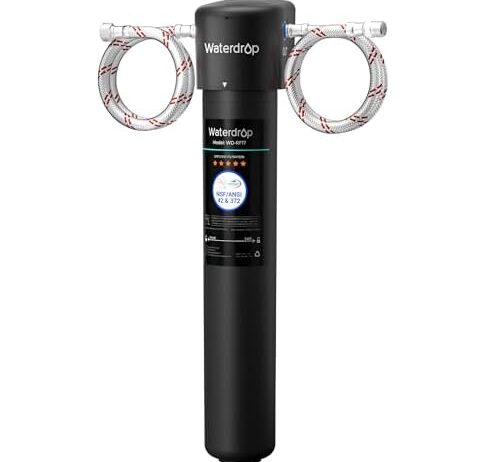
The Waterdrop 17UA connects directly to your cold-water line and delivers filtered water through your existing faucet or a dedicated tap. There’s nothing on your counter, no reservoir to fill, no gravity drip to wait for. You turn the handle and get filtered water at line pressure — the same flow rate you’re used to.

Its carbon block is rated for PFAS, PFOA/PFOS, lead, and chlorine reduction, with NSF/ANSI 42 certification backing the chlorine and taste claims. The three-year stated lifespan is generous compared to pitcher filters that ask for replacement every two months, but that number assumes average municipal water and average household volume. Heavy use or high-sediment well water will shorten it. The upside of a plumbed-in system is that you’ll notice degradation — if chlorine taste creeps back, the carbon is telling you something.

At $69.99, it’s the least expensive system here, but it requires basic plumbing work to install. If you’re comfortable with a wrench and a compression fitting, it’s a twenty-minute job. If the phrase “shut-off valve” makes you nervous, budget for a plumber. Once it’s in, the ongoing cost is one replacement cartridge every few years — meaningfully cheaper per gallon than any countertop or gravity system with shorter filter cycles.

What RO Adds — and What It Costs You

Reverse osmosis does everything carbon does and then removes dissolved solids on top of it. Most RO systems include a carbon pre-filter (to protect the membrane from chlorine, which degrades it) and sometimes a carbon post-filter (to catch anything the membrane misses and polish taste). The membrane itself handles the dissolved minerals, salts, and heavy metals that carbon can’t touch.

The cost is water. Every RO system produces waste — a stream of concentrated contaminants flushed away so the membrane doesn’t foul immediately. The ratio varies by system and water quality, but some reject two or three gallons for every gallon of purified water produced. If your water bill matters or you’re on a well with limited supply, that’s a real consideration, not a footnote.

The second cost is minerals. RO strips calcium and magnesium along with everything else. The resulting water is very pure but tastes flat — slightly acidic, with none of the mineral character that makes good tap water pleasant. That’s why some systems add a remineralization stage after the membrane: a cartridge that dissolves small amounts of calcium and magnesium back into the purified water to raise the pH and improve flavor. It’s an extra filter to eventually replace, but it solves a problem the membrane itself creates.

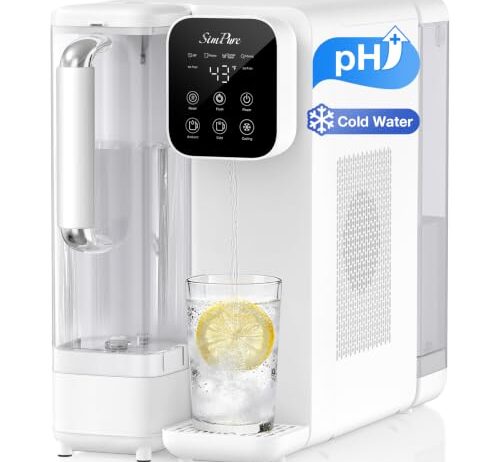
The SimPure Y11C-A stacks two technologies that address different threats. The reverse osmosis membrane handles dissolved solids, heavy metals, and large organic molecules through physical rejection. The UV lamp, emitting light at 254 nanometers, damages microbial DNA so bacteria and viruses can’t reproduce. These are separate problems solved by separate physics — the membrane is a size filter, and the UV is an energy weapon.

UV adds a capability carbon and RO alone don’t reliably provide. Bacteria small enough to pass through even an RO membrane’s pores — or introduced downstream of the membrane through contaminated tubing — get inactivated by the UV stage. The trade-off is complexity: UV lamps degrade over time and lose germicidal effectiveness even while still producing visible light. Most manufacturers recommend annual replacement regardless of water volume. That’s an ongoing cost and a maintenance task that carbon-only systems don’t have.

At $449.99 it’s the most expensive system here, and it dispenses cold water only — no hot option. The price buys you the broadest contaminant coverage of anything in this group, but without independent NSF certification listed for the RO membrane’s specific rejection rates, you’re relying on the manufacturer’s claims for dissolved-solids performance. The UV stage is the real differentiator: if your water source has microbial risk — a private well, a boil-water advisory area, travel use — this addresses it mechanically rather than chemically.

Hot Water from an RO System: Convenience with Consequences

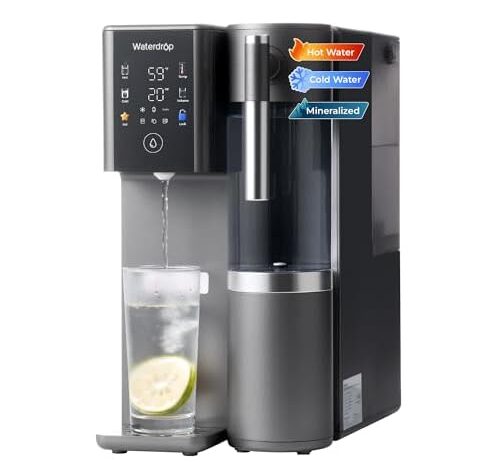
Heating purified water inside the same unit that filters it is a genuine convenience — instant hot water for tea, oatmeal, or rehydrating food without boiling a kettle. But it adds a heating element, a temperature sensor, and thermal insulation to a system that already contains a pump, a membrane, pre-filters, and potentially a remineralization cartridge.

Each component is a future failure point and a maintenance item. The heating element can scale over time if the remineralization stage introduces even small amounts of calcium. The cold-water path has its own reservoir and temperature management. More stages mean more replacement cartridges on different schedules.

None of this means a hot-and-cold RO system is a bad idea. It means the value proposition is different from a pure-filtration system. You’re buying a water appliance — a countertop device that replaces your kettle and your filter pitcher and your Brita — and evaluating it against all three of those things, not against a single-purpose filter alone.

NSF Numbers: What They Cover and What They Don’t

NSF certification numbers aren’t grades. They’re scopes — each standard tests for a specific category of contaminant, and a filter can be certified under one standard and not another without that meaning anything is wrong.

NSF/ANSI 42 covers aesthetic effects: chlorine taste, odor, and particulates. It’s the most common certification because it’s the easiest to achieve — carbon is naturally good at chlorine. Standard 372 isn’t about what the filter removes at all; it certifies that the filter components themselves are lead-free, meaning less than 0.25% weighted average lead content in wetted surfaces. A filter with both 42 and 372 certifications treats chlorine taste and doesn’t leach lead from its own hardware into your water.

Standards 53 (health effects — lead, cysts, specific chemicals), 401 (emerging contaminants — pharmaceuticals, herbicides), and 58 (reverse osmosis systems specifically) each add a layer. A filter without Standard 53 certification might still reduce lead effectively — but nobody independent has verified it under controlled conditions. The certification is the proof, not the capability.

When comparing systems, match the certification to your concern. Chlorine taste? 42 is sufficient. Lead in old plumbing? Look for 53. PFAS? That’s newer testing, and not all standards cover it yet — look for the specific contaminant in the certified claims, not just the standard number.

FAQ

Does a carbon filter remove dissolved minerals from hard water?

No. Carbon works by adsorption — molecules stick to the carbon surface — and dissolved minerals like calcium and magnesium don’t bond to carbon. If your water leaves white scale on fixtures, you need reverse osmosis, which physically blocks those ions with a membrane. Carbon handles chlorine, taste, odor, and certain organic chemicals, but not hardness.

Why does my countertop RO system pour so slowly?

RO membranes have pores roughly 0.0001 microns wide, and water must be forced through them under pressure. Slow flow can mean the membrane is fouled with mineral scale, the pre-filter is clogged with sediment, or the source water has high dissolved solids that increase osmotic backpressure. It can also be normal — RO is inherently slower than carbon filtration. If the flow was faster when new and has gradually declined, that points to fouling or a spent pre-filter.

Should I replace my filter based on the time interval or the gallon count?

Whichever comes first. The gallon rating assumes EPA-standard test water, and the time rating assumes average household use. If you have hard water, high sediment, or heavy daily use, the filter exhausts its capacity before either rating predicts. If chlorine taste returns before the replacement date, the carbon is spent regardless of what the calendar says.

What does NSF/ANSI 42 certification actually mean?

Standard 42 certifies that a filter reduces aesthetic contaminants — primarily chlorine taste and odor, plus certain particulates. It does not cover health-related contaminants like lead (that’s Standard 53), pharmaceuticals (Standard 401), or system-level RO performance (Standard 58). A filter certified under 42 has been independently verified to improve how water tastes and smells, but that certification alone says nothing about heavy metals or dissolved solids.

Do I need a sediment pre-filter before my main water filter?

If your water has visible particulates — rust flakes, sand, or cloudiness — a pre-filter is worth adding. Sediment fills the physical pores in a carbon block without contributing to chemical adsorption, so the filter chokes mechanically before the carbon is chemically exhausted. A cheap sediment pre-filter catches the big particles and lets the main filter spend its capacity on the contaminants it’s actually designed for. If you’re on clear municipal water, it’s usually unnecessary.