
We research every product we recommend. We may earn a commission from the links on this page.
Tools & Home Improvement › Table Lamps

Touch Lamps Click When You Dim Them. Here’s What’s Actually Switching.

We compare published specifications and marketplace data. We do not test these products.

Three-Way Dimmable Table Lamps Click When You Touch Them
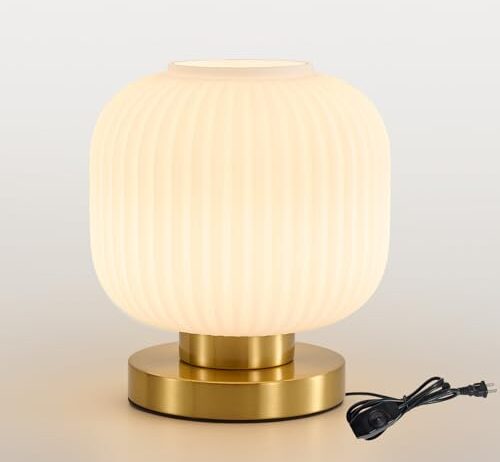
Photo by AI25.Studio Studio on Pexels

Every touch lamp clicks. Tap the base, the brightness changes, and somewhere inside the housing a small, sharp sound marks the transition. That click is a relay snapping closed or a triac firing — the physical event that actually changes how much current reaches the bulb. It is not a defect, not a sign of wear, and not something you can silence without disabling the dimming circuit itself. But the type of click, how loud it is, and whether it happens at all depend on what’s inside the lamp base — and four common bedside lamps handle that switching in meaningfully different ways.

Affiliate disclosure: This article contains affiliate links. We may earn a commission if you buy through them, at no extra cost to you.

Everything we looked at
4 picks

How we picked

We do not disassemble these lamps or measure their switching circuits. Judgments rest on component specifications, dimming-mechanism disclosures, and aggregated user reports.

Switching circuit, not just dimming

Whether the lamp uses a relay, triac, or PWM controller determines the click’s presence and character.

Power source changes the design

Battery-powered models use DC PWM dimming with no relay. Corded models may use either triac or mechanical relay switching.

Bulb compatibility, not just wattage

LED bulbs work with all dimming methods. Incandescent and halogen require specific dimmer types to avoid flicker or damage.

Sensor area, not just sensitivity

Larger conductive surfaces respond to lighter touch. Small sensor zones require deliberate contact and may click louder.


What’s Clicking and Why It Won’t Stop

A touch lamp has no mechanical switch. Your finger never moves a lever or pushes a button. Instead, a capacitive sensor sits beneath the lamp’s surface — usually the metal base or a conductive strip under the finish — and detects the change in electrical field when your skin gets close. The human body carries roughly 100 to 200 picofarads of natural capacitance, enough to shift the sensor’s reference field and trigger the microcontroller behind it.

That microcontroller is the brain, but it’s not the muscle. To actually change the brightness, it has to switch the power circuit — and that’s where the sound comes from.

In a relay-based lamp, the microcontroller energizes an electromagnetic coil. The coil pulls a spring-loaded contact arm (the armature) down against a stationary terminal. Metal hits metal under spring tension. Click. De-energize the coil and the spring pulls the arm back. Click. Each brightness level is a different relay state, and every state change produces that sharp, definite sound.

In a triac-based circuit, there are no moving contacts. The triac is a semiconductor that controls how much of each AC cycle reaches the bulb — what engineers call the conduction angle. But the switching action isn’t silent. When the triac fires, it changes the current flow abruptly, and that abrupt change excites mechanical resonance in nearby inductive components — transformer laminations, inductor cores, even the wire coils in the LED driver. The result is a softer, buzzier click, sometimes more of a tick. Still audible. Still normal.

Neither mechanism wears out from clicking. The relay contacts are rated for hundreds of thousands of cycles. The triac has no moving parts to fatigue at all.

Three-Way Steps Versus Stepless Sweep

Not all touch dimmers click the same number of times or in the same pattern, because not all of them switch the same way.

A three-way touch lamp has three discrete brightness levels — low, medium, high — plus off. Each tap advances to the next state. Four taps cycle you back to the start. Every transition is a full switching event: the relay opens one circuit and closes another, or the triac jumps to a new conduction angle. You get one click per tap, always the same volume, because the switching action is the same size every time.

Stepless dimming works differently. Instead of jumping between three fixed states, the circuit sweeps through a continuous range. You touch and hold, and the brightness rises or falls smoothly. The triac adjusts its conduction angle in small increments — many tiny switching events instead of a few large ones. The individual clicks may be quieter or may blur into a faint buzz during the sweep, then resolve into a single click when you lift your finger and the circuit locks into its new state.

This is why two lamps that both say “touch dimming” can sound completely different in use. The three-way lamp clicks distinctly at each level. The stepless lamp may barely click during adjustment but produces a clear sound when it settles.

Battery Power Changes the Switching Circuit

Most touch lamps run on AC mains — 120 volts from a wall outlet, alternating current, with the triac or relay switching that AC signal directly. But a battery-powered touch lamp runs on DC from its internal cell, and that changes the electronics entirely.

A triac only works with alternating current. It relies on the AC waveform crossing zero volts twice per cycle to reset itself. DC never crosses zero, so a triac-based dimmer simply cannot function on battery power. A battery lamp uses a DC-DC converter or a PWM (pulse-width modulation) controller instead, rapidly switching the LED on and off thousands of times per second and varying the ratio of on-time to off-time to control perceived brightness.

The click in a battery lamp comes from the relay that selects between brightness modes or color temperatures — a small mechanical switch actuated by the same capacitive touch sensor, but switching DC at low voltage rather than AC at mains voltage. The relay is typically smaller, the spring tension lighter, and the resulting click quieter than in a mains-powered lamp. But it’s the same fundamental mechanism: metal contacts meeting under spring force.

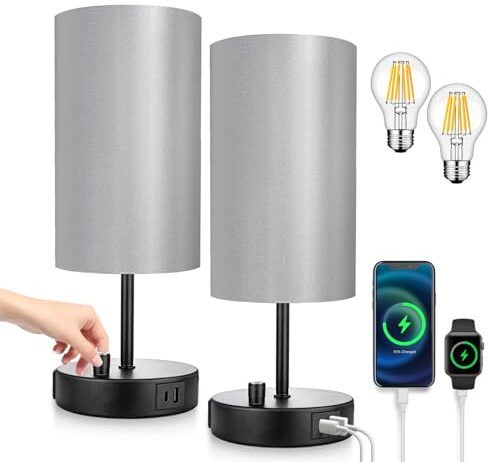
This is a two-pack, which already tells you something about the intended use: flanking a bed, matching on both nightstands. Each lamp ships with an 800-lumen E26 bulb — bright enough to read by at full power, dim enough at the bottom of the stepless range for a night light. You don’t have to guess at brightness or buy a bulb separately.

The built-in USB port and AC outlet turn the base into a charging station. That matters on a nightstand where outlet access is usually behind the headboard or across the room. The round parchment shade and matte gray finish keep the look neutral enough that the integrated outlets don’t make it look like a power strip wearing a hat.

Touch the base and the capacitive sensor fires the dimming circuit. Because this is a mains-powered stepless design, the triac adjusts conduction angle in fine increments — so the click you hear is a single event when you tap, not a staircase of discrete steps. Hold your finger and the brightness sweeps. Lift, and it locks. One click per gesture.

When the Sensor Can’t Feel You

The capacitive sensor in a touch lamp is calibrated for a specific material between your finger and the conductive element. On a bare metal base, the sensitivity threshold is low — your finger changes the field easily, and the lamp responds on the first tap every time.

Put a thick fabric shade or a wooden housing between your skin and the sensor, and the field change is smaller. The sensor has to be tuned to a higher sensitivity to detect you through that material. If the manufacturer calibrated for metal and the lamp body is mostly wood or fabric, you get missed taps. You press harder, which doesn’t help — capacitive sensors respond to proximity, not pressure. Dry skin reduces your body’s effective capacitance further. Callused fingertips are even worse.

This is not a quality defect in the sensor. It’s a physics constraint. A lamp with an exposed metal base will always trigger more reliably than one where the sensor sits behind a non-conductive layer. If you find yourself tapping three or four times before the lamp responds, the issue is almost certainly the material path between your skin and the sensor, not the circuit behind it.

The entire point of a battery-powered lamp is placement freedom, and the trade-off is recharging. A 5400mAh cell is a reasonable size for an LED table lamp — enough for several evenings of use at moderate brightness before it needs a cable again. The three color temperature options let you shift from warm to cool depending on whether you want atmosphere or visibility, which is unusual at this price.

Because this runs on DC, the dimming circuit is fundamentally different from the mains-powered lamps here. The relay inside is switching low-voltage direct current, not 120V AC. The click is still there — still a spring-loaded contact snapping closed — but typically softer and shorter than what you hear from an AC relay handling mains power. Stepless dimming on DC usually means PWM control behind the relay, adjusting perceived brightness by flickering the LED faster than your eye can track.

The cordless form factor means no outlet competition and no cord management. It also means no built-in USB or AC passthrough — there’s no mains power to share. You gain flexibility in where the lamp lives; you lose the ability to charge a phone from its base.

No Dimmer, No Click

A lamp with a simple on/off switch has no multi-level switching circuit. The switch completes or breaks the circuit once, in one direction. There’s no relay cycling through states, no triac adjusting conduction angle, no microcontroller stepping through brightness levels. The switch itself may make a small sound — the tactile feedback of a toggle or rocker — but it’s a different kind of sound from the touch-dimmer click. It’s the feel of a mechanical lever, not the snap of an electromagnetic contact.

This matters if the click bothers you. A non-dimming lamp eliminates it entirely. You lose brightness control — the bulb is either on at full power or off — but you gain a completely silent switching action. If you want adjustable brightness without the click, the only option is to move the dimming function outside the lamp to a wall dimmer switch, which relocates the triac or relay to the wall box instead of the lamp base. The click still happens; it just happens across the room instead of on your nightstand.

The EDISHINE on this list is exactly that baseline. A four-legged wooden base, a beige linen shade, an E26 socket, and an on/off switch. No touch sensor, no dimming circuit, no click. It sits fourteen inches tall and looks like furniture, not electronics. If the clicking sound from a touch lamp is the specific problem you’re trying to solve, this is the structural answer: remove the circuit that makes the sound.

The Bulb Matters More Than You’d Think

A touch-dimming circuit expects a certain type of load. An incandescent bulb is a simple resistive load — the filament heats up, the current flows proportionally, and the triac or relay handles it cleanly. An LED bulb has a driver circuit inside its base, and that driver has its own electronics: capacitors, inductors, sometimes a small transformer. When the touch dimmer changes the power delivery, the LED driver has to respond, and not all drivers respond well.

A non-dimmable LED bulb in a touch-dimming lamp can flicker, buzz, refuse to dim below a certain level, or simply not turn off completely — glowing faintly even at the lowest setting. The LED driver’s minimum operating threshold may sit above the dimmer’s lowest output, so the bulb never fully extinguishes.

A dimmable LED bulb is designed to work with varying input, but compatibility isn’t universal. Some dimmable LEDs work with leading-edge triac dimmers but not trailing-edge. Some work at the top and bottom of the range but flicker in the middle. The click from the lamp is the same regardless — the switching circuit doesn’t care what’s screwed into the socket — but the visible result changes dramatically depending on the bulb’s driver electronics.

If your touch lamp clicks and the light flickers, the problem is almost certainly the bulb, not the lamp. Swap in a bulb specifically labeled as compatible with touch dimmers, and the flicker disappears while the click stays exactly the same.

What a Louder Click Actually Means

Volume varies. A new lamp might click quietly. The same lamp a year later might click louder. This is not necessarily failure.

Relay contacts develop a thin oxide layer over time. The oxide increases the contact resistance slightly, which means the electromagnetic coil has to pull the armature harder to make a solid connection. Harder pull, more forceful impact, louder click. The relay still functions — it’s just noisier. This is normal aging, not imminent breakdown.

Temperature matters too. A relay in a cold room has stiffer spring steel and more viscous lubricant on the contact surfaces. Both increase the snap force. The same relay in a warm room clicks softer. If your lamp seems louder in winter, that’s why.

A click that changes character — from a clean snap to a scratchy buzz, or from a single click to a rapid chatter — is different. Chattering means the relay is bouncing: closing, opening from the rebound, closing again, all in milliseconds. That can mean weakened spring tension or contaminated contacts, and it will shorten the relay’s life. A single louder click is physics. A chattering click is a repair signal.

FAQ

Is the clicking sound from a touch lamp normal?

Yes. The click is a relay closing or a triac firing inside the lamp base — the physical event that switches between brightness levels. It happens every time the circuit changes state and is part of normal operation, not a sign of damage.

Can I make my touch lamp stop clicking?

Not without disabling the dimming circuit. The click is the switching event itself. You can move the dimming function to a wall dimmer, which relocates the click away from the nightstand, or switch to a non-dimming lamp, which eliminates the circuit entirely.

Does a louder click mean my touch lamp is breaking?

Usually not. Relay contacts develop a thin oxide layer over time, which increases snap force and volume. A louder but clean click is normal aging. A chattering or buzzing click — rapid repeated contact — can indicate weakened springs or contaminated contacts and may need attention.

Why does my touch lamp flicker when I dim it?

The bulb is almost certainly the issue, not the lamp. Non-dimmable LED bulbs or LEDs incompatible with the lamp’s dimmer type will flicker, buzz, or refuse to dim properly. Replace with a bulb labeled as compatible with touch dimmers.

Is the click coming from the bulb or the lamp base?

The base. The relay or triac that controls brightness is housed in the lamp base, near the touch sensor and microcontroller. The bulb receives the resulting current passively. LED driver buzz is a separate, higher-pitched sound that comes from the bulb itself, and it’s continuous rather than a single click.