UHF radio waves at 462 MHz travel in straight lines, but they need more than a clear sightline to arrive intact. The signal occupies a football-shaped volume called the Fresnel zone — an ellipsoid stretching between the two antennas — and anything that intrudes into that volume, even off to the side, scatters energy and weakens reception. Dense tree cover is the worst offender: the NTIA’s own propagation studies show foliage absorbing enough UHF energy to cut effective range to half or less of what the same signal covers over open water. That gap between printed range and actual range isn’t a defect. It’s physics, and it determines which walkie-talkie features matter and which ones are decorative.
Affiliate disclosure: This article contains affiliate links. We may earn a commission if you buy through them, at no extra cost to you.
Everything we recommend
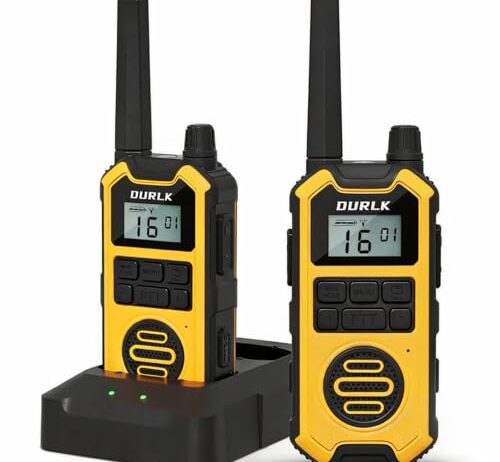
The wattage you can verify
Walkie Talkies Long Range for Adults, IP67 Waterproof FRS Walky Talky | 2 Watts Rechargeable Heavy Duty Two Way Radio, Double PTT, NOAA, 24hr life, Emergency Communication, Outdoor (2 Pack Y2 watts at the antenna, IP67 sealing, and a 24-hour runtime claim — the one radio here where the numbers that matter for Fresnel-zone penetration are on the table.
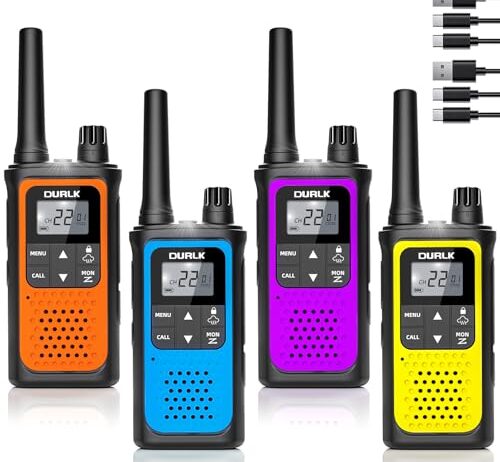
Four radios, one charge cable
Rechargeable Walkie Talkies Long Range, 4 Pack Walkie Talkies for Adults NOAA Weather Alert, 2 Way Radio 22 FRS Channel with 1800mAh Li-ion Battery Charger USB-C Cable VOX for Hiking Cruises1800mAh cells, VOX for hands-free use, and NOAA weather — covers a four-person group at a lower per-unit cost than buying two 2-packs.
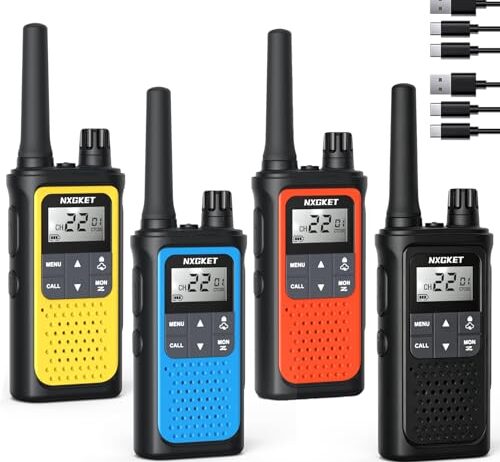
Range on paper, radios in hand
NXGKET Walkie Talkies Long Rang 5 Miles, Adults, Rechargeable, NOAA, | Walkie Talkie 2 Way Radio 22 FRS Channel with 1800mAh Li-ion Battery USB-C Cable Outdoor Cruises Camping, 4 PackA 4-pack with NOAA and USB-C charging at the lowest entry price — but volume knobs loosen within days according to multiple owners, and build quality is a gamble. R4 R5
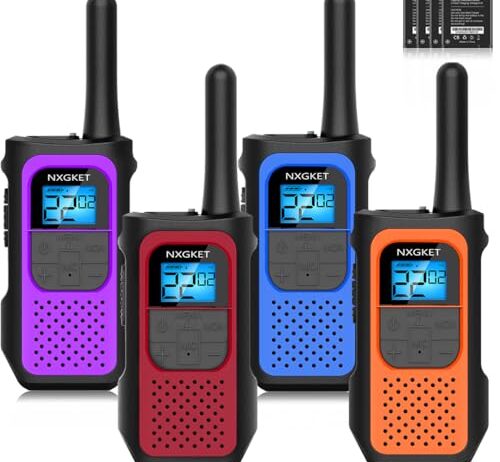
Short range, low stakes
NXGKET Walkie Talkies Long Rnage for Adults NOAA Wether Alert, Rechargeable Walkie Talkie 2 Way Radios 22 Channels VOX Scan with Li-ion Battery USB-C Cable Family Camping HikingVOX and scan across 22 channels for room-to-room or yard-to-garage use where Fresnel-zone clearance isn't a factor — but multiple owners report button defects out of the box. R13 R14
A walkie-talkie’s range claim is a number measured over flat water or open desert with nothing between the two antennas. The moment you add terrain — trees, a hillside, even the steel hull of a cruise ship — that number stops meaning what it looks like it means.
The reason is the Fresnel zone. Radio waves between two antennas don’t travel along a single thread. They propagate through an ellipsoid volume, widest at the midpoint, tapering to each antenna. For a half-mile UHF link at 462 MHz, the first Fresnel zone bulges about eight feet wide at center. Anything that intrudes into that volume — a tree trunk, a ridgeline, the corner of a building — reflects and diffracts energy away from the receiving antenna. For reliable signal, at least sixty percent of that zone needs to stay clear.
This is why antenna height matters more than most buyers expect. Raising both radios a few feet — clipping one higher on a pack, holding the other above your head — lifts the Fresnel zone above ground-level brush. That change in geometry can recover more range than any increase in transmit power, because power follows an inverse-square relationship with distance: doubling your wattage extends range by only about forty percent, a consequence of the signal spreading across four times the area at twice the distance. A tree you can walk under does more damage to your signal than halving your battery.
How we picked
We did not carry these radios into the field. Judgements rest on published specifications, FCC power-limit data, and patterns in verified owner reports.
Range claims assume flat, open terrain. We weighted transmit power and owner-reported real-world distance instead.
Battery life depends on how often you transmit. A stated mAh without a runtime tells you less than an owner saying it lasted a full day.
An IP67 rating means tested submersion. No rating means you’re guessing about rain.
Recurring owner complaints about the same component — buttons, clips, antennas — signal a design weakness a rating average hides.