
We research every product we recommend. We may earn a commission from the links on this page.
Electronics › Earbud Headphones

Earbud Drivers Don’t All Move Air the Same Way

We compare published specifications and marketplace data. We do not test these products.

Driver Diameter Sets the Lowest Note an Earbud Can Move
Photo by Karl Solano on Pexels

A 6mm earbud driver and a 13mm driver playing the same 60 Hz bass note need to move the same volume of air per cycle. The smaller one has to push its diaphragm roughly four times farther to keep up — and when it runs out of travel, it distorts instead. Driver size, type, and the physics of diaphragm motion determine how much bass an earbud can actually reproduce before it starts faking it with harmonic distortion. Here’s how that works across three fundamentally different driver technologies, and what it means for the four models worth comparing.

Affiliate disclosure: This article contains affiliate links. We may earn a commission if you buy through them, at no extra cost to you.

Everything we recommend
4 picks

How we picked

We do not insert these earbuds or measure their output. Judgments rest on driver specifications, diaphragm physics, and aggregated marketplace review patterns.

Driver size and excursion limits

A smaller diaphragm must travel farther to move the same air volume at low frequencies. We compare rated driver diameter and published excursion headroom.

Driver type, not feature count

Dynamic, balanced armature, and planar magnetic drivers produce bass through fundamentally different mechanisms. We assess which technology matches the stated use case.

Magnet flux density

Higher magnetic field strength improves diaphragm control and reduces distortion at maximum excursion. We evaluate stated magnet configuration and material where disclosed.

Housing volume and seal design

The chamber behind the driver sets the lower frequency limit, and seal integrity determines whether that bass reaches the ear. We compare stated IP ratings and fit geometry.


Why Bass Is a Size Problem

Sound is air moving back and forth. A 50 Hz bass note has a wavelength of about 6.9 meters — the diaphragm in your earbud has to shove enough air per cycle to reproduce that wave in the tiny sealed volume of your ear canal. Higher frequencies need less displacement because the wavelength is shorter. A 5 kHz tone, wavelength around 6.9 centimeters, barely asks the diaphragm to move at all.

This is where driver diameter matters. The area of a circle scales with the square of its radius. A 13mm driver has roughly 4.7 times the surface area of a 6mm driver. To move the same volume of air, the smaller driver needs 4.7 times the excursion — the physical distance the diaphragm travels forward and back. Every driver has a limit to that travel, called Xmax, the point where the voice coil leaves the magnetic gap or the diaphragm itself starts deforming. Past Xmax, you don’t get louder bass. You get distortion — harmonic overtones that your brain might read as “bass” but aren’t the fundamental frequency anymore.

This is why cranking a bass boost EQ on small earbuds makes things worse, not better. The DSP is telling the driver to move farther at low frequencies. The driver obliges until it hits its mechanical wall, then clips. You hear it as buzzing or fuzziness on kick drums, or a sudden flattening where the sub-bass should drop and instead just stops.

Three Driver Technologies, Three Trade-Offs

Not all earbud drivers work the same way, and the differences matter most at the frequency extremes.

Dynamic drivers are the most common. A voice coil glued to a cone-shaped diaphragm sits in a magnetic field. Current flows through the coil, the coil moves, the diaphragm pushes air. Simple. The size of the cone and the strength of the magnets determine how much air gets moved and how cleanly. A stronger magnet accelerates and decelerates the diaphragm faster, which means tighter transient response — the driver stops when the signal stops, instead of overshooting and smearing the note.

Balanced armature drivers work completely differently. A tiny magnetized reed pivots inside a coil, driving a diaphragm that’s a fraction of the size — typically 1 to 3 square millimeters of surface area, compared to 30 to 130 square millimeters for a dynamic driver in the 6mm to 13mm range. They’re precise at mid and high frequencies because the moving mass is so small. But they physically cannot move enough air for bass. The diaphragm is too small and the excursion too short. A balanced armature trying to reproduce 60 Hz is like trying to fan yourself with a postage stamp.

Planar magnetic drivers take a third approach. Instead of a coil pushing from the center, conductive traces are printed across a thin film membrane, sandwiched between two arrays of magnets. Force is applied across the entire surface simultaneously. The diaphragm is larger and thinner than a dynamic driver’s cone, and because the force is distributed, it moves more uniformly — less breakup, less distortion at excursion limits. The trade-off is efficiency: planar drivers need more power to achieve the same output, which matters for battery life in wireless earbuds.

Why Hybrid Designs Exist

If balanced armatures can’t do bass, why are they in earbuds at all? Because they’re exceptional at everything above about 1 kHz. The tiny moving mass means faster response, less distortion in the presence range where vocals and instrument detail live, and the ability to stack multiple armatures tuned to different frequency bands inside one housing.

The solution is a hybrid: multiple balanced armatures handling mids and highs, with one dedicated dynamic driver handling everything below a few hundred hertz. A crossover network splits the signal so each driver type only gets the frequencies it’s good at. It’s the same principle as a two-way speaker with a woofer and a tweeter, miniaturized into something that fits in your ear canal.

The engineering problem is the crossover itself. A sloppy crossover creates a gap or a bump where one driver hands off to the other, and your ear hears it as a hollow spot in the midrange or a honky peak around 1-2 kHz. The more drivers you stack, the more crossover points you have, and the more places things can go wrong. Seven balanced armatures plus one dynamic driver means the signal is being split seven or eight ways. When it works, you get separation and detail that a single driver can’t touch. When it doesn’t, you get an expensive mess.

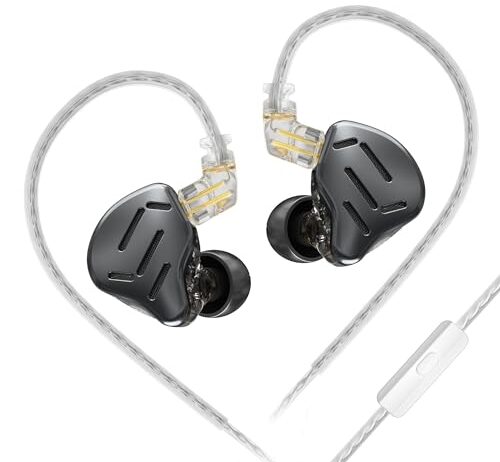
The KZ Zax stacks seven balanced armature drivers alongside a single dynamic driver in a zinc alloy shell. That’s not redundancy — each armature is tuned to a slice of the frequency range where its small, fast diaphragm excels, while the dynamic driver handles everything below the crossover point where armature diaphragms simply run out of surface area to move air.

Because it’s wired with a 3.5mm connection, there’s no codec bottleneck between the source and the drivers. A Bluetooth link compresses the signal — even LDAC at its highest bitrate is lossy — and that compression can soften low-frequency transients. A wired connection passes whatever the source sends, including the full dynamic range of a bass note’s attack and decay. The trade-off is obvious: you’re tethered to your device. The detachable cable means you can replace it if it fails, but you’re still running a wire to your phone or DAP.

The metal shell adds mass, which means better passive isolation — more of the seal stays put because the housing doesn’t flex. Better isolation means less ambient noise leaking in and masking the low end, so the bass the dynamic driver produces actually reaches your eardrum without competing with environmental sound. It also means these are not comfortable for side sleeping, or for forgetting they’re in your ears. You know they’re there.

What a Bigger Magnet Actually Does

Driver size gets the attention, but magnet strength determines how well a driver uses its size. A triple-magnet array on a 13mm driver doesn’t just make it louder. Stronger magnets mean higher acceleration and deceleration of the diaphragm — the cone moves faster to where the signal tells it to go, and stops faster when the signal changes.

In practical terms, this is the difference between bass that sounds tight and bass that sounds bloated. A weak magnet lets the diaphragm overshoot its target position, and the extra motion smears the transient. A kick drum sounds like a kick drum with strong magnets — sharp attack, fast decay. With weak magnets, same driver size, same tuning, the kick turns into a soft thud with a tail.

This matters more at low frequencies because the diaphragm is making its biggest movements there. Overshoot at 5 kHz is tiny in absolute terms because the excursion is tiny. Overshoot at 80 Hz, where the diaphragm is traveling millimeters, produces audible hangover — a muddiness that people often blame on “too much bass” when it’s really too little magnet control.

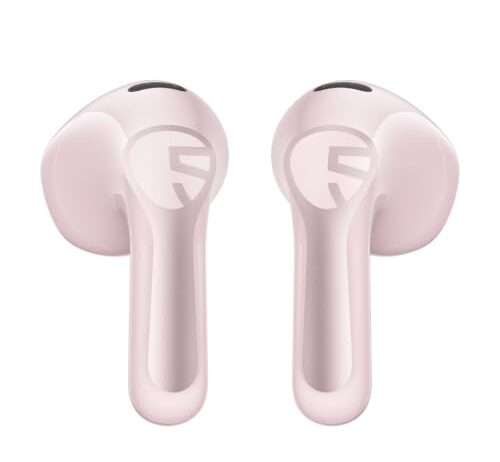
The SoundPEATS Air6 HS pairs a 13mm driver — large for a true wireless earbud — with a triple-magnet motor. The size gives it raw surface area for air displacement; the magnet count gives it control over that large diaphragm’s motion. That combination addresses both halves of the bass problem: enough cone to move the air, enough magnetic force to stop the cone when the signal says stop.

LDAC certification means the Bluetooth link can transmit up to 24-bit audio at 96 kHz with a peak bitrate of 990 kbps — roughly three times what standard SBC codec manages. Whether that bandwidth translates to audible improvement depends on the source material and your ears, but for bass specifically, the higher bitrate preserves more of the dynamic range in low-frequency transients. Bluetooth 6.0 improves connection stability and latency, which matters more for video sync than for music.

At $39.99 with 45 hours of total case battery life and IPX5 sweat resistance, this is the utilitarian option. It does one thing — single large dynamic driver, well-powered — and doesn’t try to solve problems it wasn’t designed for. No noise cancellation, no gimmick modes. If you want deep bass from a wireless earbud without spending audiophile money, the physics favor a large, well-controlled single driver over almost anything else at this price.

Planar Magnetic: Different Bass, Not Necessarily More

Planar magnetic drivers get described as “better” in audiophile circles, but the advantage is specific: uniformity of motion. A dynamic driver pushes from the center and the edges of the cone follow, which means the cone can flex and deform at high excursion — the center is moving farther than the edges, and the cone shape distorts. A planar driver’s thin film membrane gets pushed across its entire surface simultaneously, so it moves more like a piston. Less deformation means less distortion at the same excursion level.

The bass character is different, though. Planar bass tends to sound faster and drier — the membrane stops quickly because force is distributed and there’s less stored energy to dissipate. Dynamic driver bass, especially from a large cone with a heavy surround, can sound warmer and fuller because the diaphragm’s inertia adds a slight sustain to the decay. Neither is objectively better. They’re different textures.

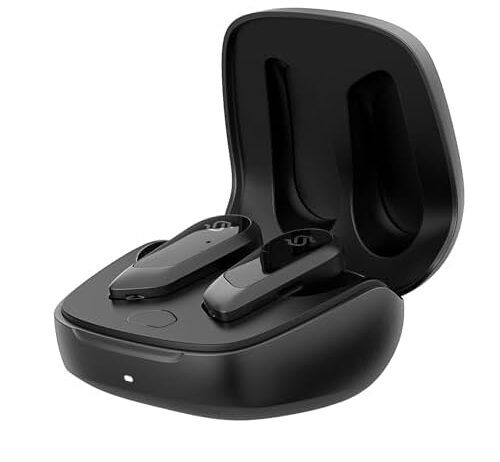
Active noise cancellation adds another layer. ANC works by generating an inverted phase signal to cancel incoming sound, and it’s most effective at low frequencies because those wavelengths are long enough for the processing delay to still produce useful cancellation. When ANC is active, it’s attenuating environmental bass — traffic rumble, HVAC hum, airplane drone — which can change how you perceive the music’s bass. Some listeners report that ANC makes bass feel more present because the noise floor drops. Others find it creates a pressurized sensation that makes low frequencies feel unnatural, like your ears are being squeezed.

The Miniaturization Wall

There’s a floor to how small you can make an earbud and still get meaningful bass out of it.

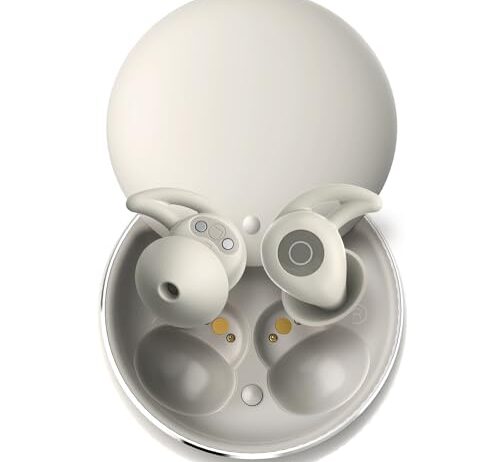
Sleep earbuds exist because standard earbuds hurt when you lie on them. The housing presses into the tragus or the concha, the ear canal opening gets pushed at an angle, and within twenty minutes you’re awake adjusting the thing. Making the housing smaller solves the comfort problem. But a smaller housing means a smaller driver, and a smaller driver means less diaphragm area, and less diaphragm area means the low end rolls off earlier.

A micro-format sleep earbud with a sub-6mm driver can reproduce midrange and highs cleanly enough for podcasts, audiobooks, and ambient sound. But ask it for a bass line at 60 Hz and the driver is hitting its excursion limit before it generates meaningful output at that frequency. The sound isn’t distorted — there just isn’t much there. People describe it as “tinny,” which is accurate: the frequency balance tilts toward the upper frequencies because the low ones physically aren’t being produced.

That’s not a flaw. It’s the trade-off the design chose. Comfort for side sleeping requires a housing small enough to sit inside the ear canal opening without protruding. A driver that fits in that housing will not reproduce deep bass. Those two facts are not in tension — they’re the same constraint seen from two directions.

Seal Matters as Much as the Driver

Everything above assumes a good seal between the earbud tip and your ear canal. Lose the seal, lose the bass.

An earbud driver works against a small sealed volume of air trapped between the diaphragm and your eardrum. That trapped air acts as a spring — the driver pushes it, it pushes back. The compliance of that air spring, combined with the mass and stiffness of the diaphragm, sets the system’s resonant frequency. Below resonance, output falls off steeply.

When the seal breaks — wrong tip size, jaw movement, sweat loosening the fit — that trapped volume is no longer sealed. Air leaks around the tip, and the acoustic load on the driver changes. The resonant frequency shifts upward, and bass extension drops. This is why the same earbud can sound bass-heavy with foam tips (which conform tightly) and thin with silicone tips (which may not seal as well in a particular ear shape).

Venting is the intentional version of this. Some earbuds have a small port in the housing that lets a controlled amount of air pass, reducing the pressure buildup that causes the plugged-ear feeling. The trade-off is real: a vent sacrifices some bass extension and some isolation in exchange for comfort and a more natural sense of space. It’s not a defect. It’s a design choice with a predictable acoustic cost.

FAQ

Do bigger earbud drivers always mean better bass?

Bigger drivers can move more air per cycle, which is what bass requires. But “better” depends on magnet strength and diaphragm control too — a large, weakly controlled driver produces muddy bass because the diaphragm overshoots its target. A well-controlled 10mm driver can sound tighter than a sloppy 13mm one. Size sets the ceiling; magnet quality determines how close you get to it.

Why do my earbuds distort on bass-heavy songs at high volume?

The driver’s diaphragm is hitting its maximum excursion — the farthest it can physically travel. Past that point, the voice coil leaves the magnetic gap or the diaphragm deforms, producing harmonic distortion instead of the fundamental bass note. Turning up a bass boost EQ makes this worse by telling the driver to move even farther at the frequencies where it’s already at its limit.

What’s the difference between balanced armature and dynamic drivers for bass?

Dynamic drivers use a relatively large cone pushed by a voice coil, with enough surface area to displace air at low frequencies. Balanced armature drivers use a tiny vibrating reed driving a diaphragm roughly 1-3 square millimeters — fine for mids and highs, but physically unable to move enough air for meaningful bass. Hybrid designs solve this by pairing balanced armatures with a dynamic driver dedicated to the low end.

Does active noise cancellation affect bass quality?

ANC attenuates low-frequency environmental noise most effectively, which can make music’s bass feel more present because the background rumble competing with it is reduced. Some listeners find this enhances bass; others report an artificial pressurized sensation at low frequencies. The effect varies by implementation and ear anatomy — it changes bass perception rather than bass output.

Can tiny sleep earbuds produce real bass?

Not deep bass, no. A micro-format earbud housing limits driver size to well under 6mm, and a driver that small cannot displace enough air to reproduce frequencies below about 100-150 Hz at meaningful volume. The result sounds thin or tinny on bass-heavy music. That’s the deliberate trade-off for a housing small enough to wear while lying on your side without discomfort.