We research every product we recommend. We may earn a commission from the links on this page.
Electronics › Video Projectors

LEDs Don’t Burn Out. They Fade.

We compare published specifications and marketplace data. We do not test these products.

Projector Lamps Fade as the Filament Evaporates
Photo by Delfina Baj on Pexels

A traditional projector bulb doesn’t warn you. One evening the image looks washed out, and the next week it won’t strike at all. LED and laser light sources changed that equation entirely — they don’t fail suddenly, they dim gradually over 20,000 to 30,000 hours. But “30,000 hours” doesn’t mean what most buyers think it means, and the gap between a 150-lumen portable and a 3,500-lumen laser matters more for how you’ll actually experience that decline than any rated lifespan printed on a box.

Affiliate disclosure: This article contains affiliate links. We may earn a commission if you buy through them, at no extra cost to you.

Everything we recommend
4 picks

How we picked

We do not install or measure these projectors. Conclusions rest on published lumens ratings, light-engine longevity data, and marketplace review patterns.

Starting lumens, not rated hours

Higher initial brightness pushes the visible-fade threshold years farther into a projector’s life regardless of the claimed lifespan number.

Light engine, not brand

Laser phosphor, LED, and DLP sources age differently. The mechanism determines how brightness declines and whether color shifts accompany it.

Thermal design, not size

Adequate heat dissipation keeps the light source below accelerated-aging temperatures. Compact portables face tighter thermal margins than stationary units.

Real contrast, not marketing ratio

ANSI contrast measured on-off within the same frame matters more than sequential ratios. Fading reduces both, but ANSI contrast predicts visible detail.
Why Old Projector Bulbs Died and New Ones Don’t

Metal-halide and UHP bulbs work by arcing electricity between two electrodes inside a sealed quartz envelope filled with mercury vapor. The arc is hot — thousands of degrees — and it vaporizes microscopic amounts of electrode material with every hour of use. That vaporized metal deposits on the inside of the quartz, darkening it. The bulb gets dimmer. The electrodes get thinner. Eventually the arc gap widens enough that the bulb can’t sustain ignition, and it’s done.

The “rated life” on those bulbs — typically 2,000 to 5,000 hours — isn’t when they stop working. It’s the point where output has dropped by thirty percent. The bulb keeps going past that, just progressively worse.

LED and laser sources skip this entire failure chain. An LED emits photons when current passes through a semiconductor junction. Nothing vaporizes. Nothing deposits. No filament thins. A laser projector focuses diode energy onto a phosphor wheel or uses discrete red, green, and blue laser modules — again, no consumable element in the light path. The physics that killed old bulbs simply doesn’t apply.

What “20,000 Hours” Actually Measures

When a manufacturer prints 20,000 or 30,000 hours on an LED or laser projector, they’re citing the L50 threshold — the estimated point at which the light source produces fifty percent of its original brightness. Not the point where it fails. Not even the point where most people would notice a problem.

This is a fundamentally different number from the old lamp-life rating, but it’s presented the same way, and buyers read it the same way. A 3,000-hour UHP bulb meant you’d probably replace it every two to three years of regular use. A 20,000-hour LED rating means you’d hit the half-brightness mark after roughly a decade of four-hour daily use. The projector still works at hour 20,001. It’s just noticeably dimmer than it was new.

The decline isn’t linear, either. LED output drops fastest in the first few hundred hours as the junction stabilizes, then settles into a slow, nearly invisible curve. You won’t see it week to week. You might notice it year to year — the way you notice a wall needs repainting only when you move the bookshelf.

Brightness Determines How Much the Fade Matters

A projector rated at 3,500 ANSI lumens has room to lose brightness. Drop thirty percent over five years of heavy use and you’re still at roughly 2,450 lumens — enough to fill a 120-inch screen in a room with some ambient light. The image shifted, but it’s still usable for what you bought it for.

A portable projector putting out 200 lumens doesn’t have that margin. Thirty percent off 200 is 140. That’s the difference between a watchable picture in a dark room and a picture you’re squinting at. The same physics, the same gradual curve, but the starting point makes the outcome completely different.

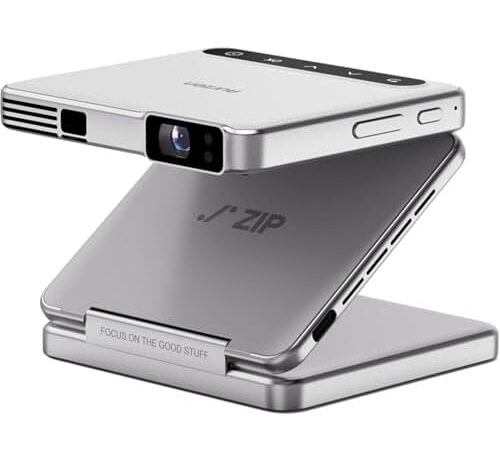
This is why the absence of a lumen rating on a portable projector matters more than the presence of one on a high-end unit. When a projector omits ANSI lumens entirely, it’s typically operating below 300 lumens — a range where even modest age-related decline pushes you past the threshold of comfortable viewing faster than you’d expect from the rated hour count.

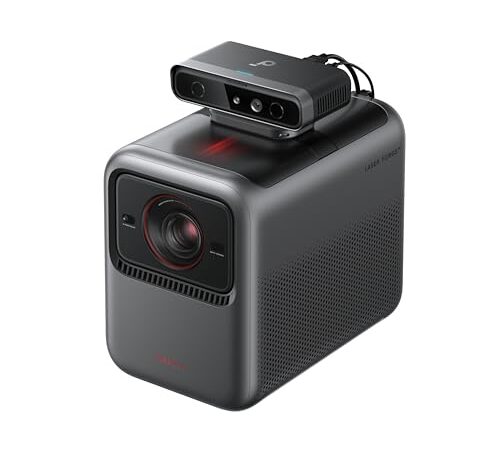
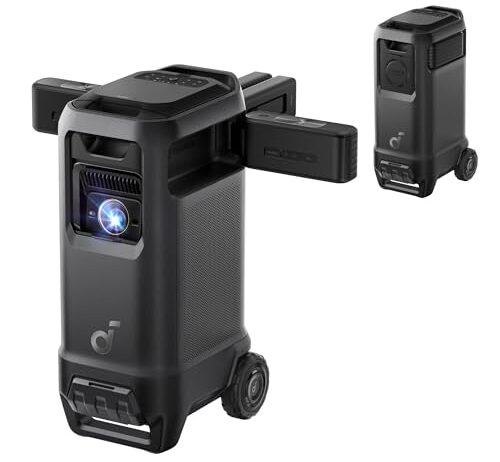
The soundcore Nebula X1 Pro runs a 4K laser engine at 3,500 ANSI lumens with a 56,000:1 contrast ratio. Those numbers matter here because they define how far the projector can travel down the dimming curve before you care. Lose twenty percent over several thousand hours and you’re still above 2,800 lumens — brighter than most mid-range projectors are on day one.

Laser phosphor sources avoid the electrode erosion that killed traditional bulbs entirely. The diode pumps energy onto a phosphor wheel; no material vaporizes, no vapor deposits on the optics. The contrast ratio stays intact because the optical path isn’t slowly fogging from the inside out the way a quartz envelope does in a UHP lamp.

The spatial sound system with Dolby Atmos and optical zoom are the other side of this being a stationary, AC-powered unit. It’s built for a room where it stays, not a backyard where it visits — and that permanence is exactly the scenario where long-term brightness stability pays off.

DLP, LCD, and Laser: The Light Engine Shapes the Decline

The light source is only half the story. How the projector turns that light into an image affects what aging looks and feels like.

DLP chips use an array of microscopic mirrors — one per pixel — that tilt thousands of times per second to modulate brightness. The mirrors themselves don’t degrade meaningfully over the product’s life. What ages is the LED or laser feeding them light. So a DLP projector’s decline is almost entirely a function of its light source, not its imaging element.

LCD projectors pass light through liquid-crystal panels. Those panels can yellow or lose transmission efficiency over time, independent of the light source. A laser-LCD projector might have a light engine good for 25,000 hours, but LCD panel degradation can introduce color shift before the laser itself dims noticeably. It’s a second clock running alongside the first.

Laser projectors using discrete RGB modules — three separate diodes for red, green, and blue — avoid the phosphor wheel entirely. Each color ages at its own rate, but the solid-state nature of all three means the overall decline stays gradual and predictable. No single component fails catastrophically the way an electrode gap does.

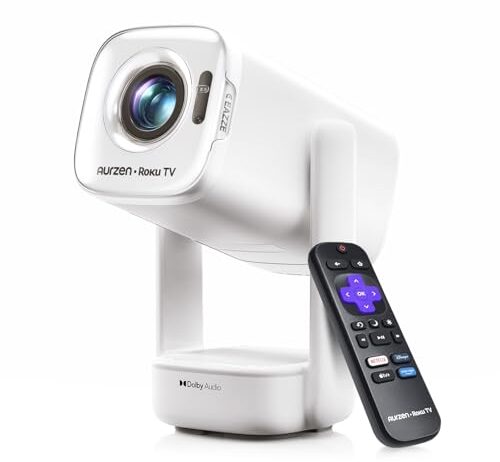
The Aurzen D1R draws power through USB-C, including from an external battery bank. That power architecture tells you something about the light engine: USB-C Power Delivery tops out at 100 watts under the PD 3.0 specification. That’s enough for a low-power LED source, not a high-lumen laser. The trade-off is brightness for portability — and the LED diode inside has no filament to vaporize, no electrode to erode, no quartz to cloud.

Native 1080P resolution and Dolby Audio put this in the category of a projector you’d take to a backyard, a hotel room, a campsite. In those settings — always a darkened space, always a modest screen size — the brightness you start with is the brightness that matters, and that brightness holds steady across the diode’s service life without the thirty-percent falloff curve that defines traditional lamp ratings.

Battery-Powered Models: Same Physics, Tighter Margins

A projector running on a 5,000mAh internal battery faces a constraint that wall-powered units don’t: every lumen costs milliamp-hours. Manufacturers tune these units for efficiency, which means low brightness — often sub-300 lumens — and eco modes that drop output further to stretch runtime.

The LED source in a battery projector follows the same slow decline as one in a plug-in model. It doesn’t dim faster because it’s on battery power. But the margin is thinner. If a 200-lumen portable loses fifteen percent of its output over several thousand hours, you’re now at 170 lumens. In a fully dark room on a 60-inch throw, that’s still watchable. Add any ambient light — a hallway, a window with curtains that don’t fully block — and you’ve crossed below the threshold where the image holds together.

The practical limit of a battery projector’s useful life often isn’t the LED at all. It’s the battery’s own cycle count. Lithium cells lose capacity with every charge-discharge cycle. After a few hundred full cycles, runtime drops noticeably. The light source is fine; you just can’t power it long enough to watch a movie.

How to Tell Your Projector Is Fading

You won’t notice it on a Tuesday. You’ll notice it when something changes — a new screen surface that looks dimmer than the old wall, a room rearrangement that adds ambient light, a friend’s newer projector side by side. The decline is real but slow enough that your eyes adapt continuously.

The most reliable check is a white-field test. Project a full white screen in a room you can fully darken and compare the brightness to a reference you set early in the projector’s life — a phone photo of the screen taken at fixed exposure settings works. If the white field looks noticeably yellow or grey compared to the reference, the source has shifted.

Color accuracy often drifts before brightness drops enough to measure with your eyes. Whites go warm. Blues lose intensity. This is especially true of phosphor-wheel laser designs, where the phosphor itself ages slightly faster than the blue pump diode. Discrete RGB laser designs age more evenly across channels because each color is its own independent source.

FAQ

Do LED projectors get dimmer over time?

Yes, but slowly. LED sources lose brightness gradually over tens of thousands of hours — there’s no sudden failure like a traditional bulb. The rated lifespan (often 20,000–30,000 hours) marks the point where output has dropped to about half of original brightness, not when the LED stops working. In practice, most people replace the projector for other reasons — better resolution, a dead HDMI port, a worn-out fan — before the LED dims enough to notice.

Will a 3,500-lumen laser projector stay that bright for its whole life?

No. It will dim gradually, same as any solid-state light source. But 3,500 lumens gives you significant margin — even after losing twenty or thirty percent over thousands of hours of use, you’re still above 2,400 lumens, which is brighter than most mid-range projectors are brand new. The higher the starting brightness, the longer before the decline actually affects your viewing experience.

What does 20,000-hour lamp life actually mean for a projector?

It’s an L50 rating — the estimated number of hours until the light source produces fifty percent of its original brightness. At four hours of daily use, that’s roughly 13 to 14 years. The projector doesn’t stop working at that mark; it just crosses a defined threshold of dimness. Traditional bulb ratings measured a similar decline point (thirty percent loss), but those bulbs also risked sudden failure, which LED and laser sources don’t.

Do battery-powered projectors dim faster than plug-in models?

The LED source itself dims at the same rate regardless of power source. But battery projectors start at much lower brightness — often under 300 lumens — so the same percentage of decline has a bigger impact on usability. The more common limit is the battery itself: lithium cells lose capacity with charge cycles, shortening runtime well before the LED shows any meaningful brightness drop.

Is a projector with no listed lumen rating bright enough for daytime use?

Almost certainly not. When a projector omits an ANSI lumen rating, it typically outputs fewer than 300 lumens. That’s enough for a fully darkened room with a small screen — maybe 60 to 80 inches — but any ambient light from windows, hallway spill, or even a nightlight will wash out the image. Daytime use without blackout conditions requires at least 1,500 to 2,000 lumens, and ideally more.