
We research every product we recommend. We may earn a commission from the links on this page.
Electronics › Open-Ear Headphones

Open-Ear Headphones Leak Sound. Here’s How Much and Why.

We compare published specifications and marketplace data. We do not test these products.

Bone Conduction Leaks Sound Because Vibration Couples to Air
Photo by Atlantic Ambience on Pexels

Open-ear headphones don’t seal your ear canal, which means the sound goes two directions: toward your eardrum and outward into the room. At moderate volume in a quiet office, a person sitting three feet away can usually make out enough to identify what you’re listening to. That’s not a defect — it’s the physics of an unsealed driver. The question is how much leakage you’ll tolerate and which design minimizes it for the way you actually use headphones.

Affiliate disclosure: This article contains affiliate links. We may earn a commission if you buy through them, at no extra cost to you.

Everything we recommend
4 picks
Top pick
LDAC and titanium for lower-volume listening

LDAC and titanium for lower-volume listening

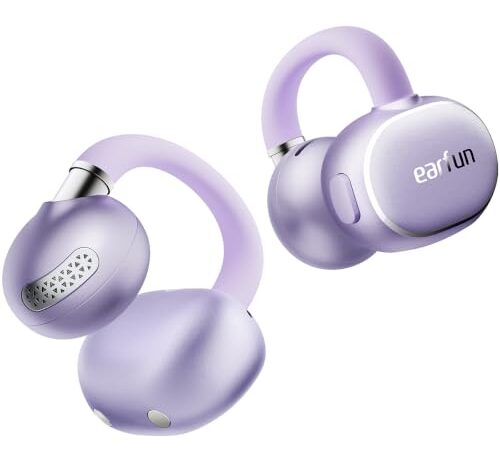
EarFun Clip 2 Open Ear Earbuds, Clip On Headphones, AI Translation Earbuds | LDAC, Hi-Res Audio, Bluetooth 6.0 for Running, Workout, 12mm Titanium Driver, 4 Mics AI Clear Call, Secure Fit, 4
★ 4.6 266 reviews

Higher codec bitrate and a stiff 12mm titanium diaphragm let you hear detail at lower volumes, which is the only real lever against leakage. Bluetooth 6.0 keeps the connection stable enough that you're not compensating for dropouts with volume.
Also great · spatial audio
Dolby Audio and head tracking for immersive listening

Dolby Audio and head tracking for immersive listening

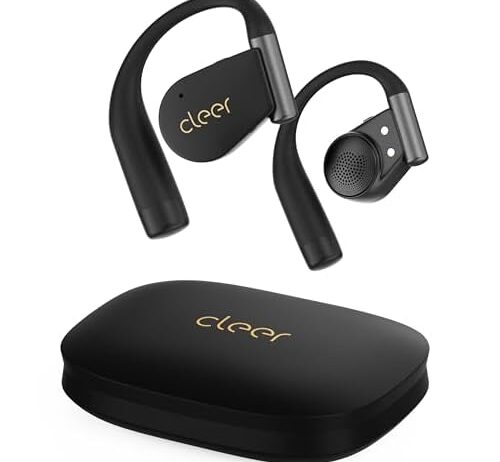
Cleer ARC 4 Plus Open Ear Earbuds with Dolby Audio,Black | True wireless Bluetooth with head tracking, IPX7 waterproof earhook,34H playtime, custom EQ,for sports, running & workout
★ 4.2 156 reviews

The Cleer ARC 4 Plus adds spatial audio processing and head tracking to the open-ear format, with IPX7 waterproofing and 34 hours of battery. The earhook design keeps the driver close to the ear canal, which helps aim sound inward rather than outward.

How we picked

We do not wear or measure these headphones. Judgments rest on driver specifications, codec support, battery ratings, and aggregated marketplace feedback.

Driver size and codec, not brand

Larger drivers and lossless codecs let you hear detail at lower volumes, which reduces leakage more than any claimed noise isolation.

Battery life, not charge speed

Longer runtime between charges matters more for daily carry than how fast the battery refills during a break.

IP rating, not splash claims

IP67 or IPX7 certification defines real immersion and dust resistance. Marketing terms like water-resistant do not.

Earhook fit, not comfort promises

A mechanical hook or clip keeps the driver positioned near the ear canal, aiming sound inward rather than scattering it.


Why Every Open-Ear Design Leaks

A sealed earbud traps sound between the driver and your eardrum. The silicone tip acts as a wall — sound pressure builds inside the canal and almost nothing escapes outward. Remove that seal, and the driver is just a tiny speaker sitting near your ear, firing into open air.

Air-conduction drivers work by pushing a diaphragm back and forth, compressing air into pressure waves. Those waves radiate in every direction. The ear catches some of them. The rest keep going — toward the person next to you, toward the ceiling, toward anyone within a few feet.

Bone-conduction models bypass the ear canal entirely, vibrating the temporal bone so sound reaches the cochlea through your skull. But the transducer still shakes the air around it as a byproduct, especially at higher volumes. The leakage mechanism is different — mechanical vibration radiating off skin and plastic rather than a diaphragm pumping air — but the result is the same: people nearby hear something.

The inverse-square law governs how fast that leakage fades. Sound pressure drops roughly 6 dB every time you double the distance from the source. At arm’s length, leakage from a small driver is faint. At shoulder-to-shoulder distance on a bus seat, it’s clearly audible. Volume is the multiplier: every few decibels you add to hear over traffic or gym noise extends the radius where someone else picks it up.

Air Conduction vs. Bone Conduction: Different Path, Same Problem

The terminology trips people up. “Open-ear” usually means air conduction — a conventional speaker driver positioned outside the ear canal instead of inside it. “Bone conduction” is a separate technology that vibrates your skull. Both leave the ear canal open. Both leak. But they leak differently, and the difference matters in practice.

An air-conduction open-ear earbud radiates sound the way any small speaker does. Higher frequencies carry further in a perceptible way because they contain the consonants and vocal detail that make speech intelligible. Music with vocals or sharp percussion leaks more noticeably than a low bass drone, even at the same volume.

Bone-conduction leakage tends to sound buzzier and thinner to bystanders, because the vibration reaching the air is filtered through plastic housing and skin rather than projected by a diaphragm designed to reproduce the full frequency range. It’s less recognizable as music, more like a tinny rattle — but it’s still audible in a quiet room.

Neither type is “leak-proof.” The question is which kind of leakage bothers the people around you less, and that depends on environment more than technology.

The Volume Trap

Open-ear headphones have a feedback loop built into their design. You’re wearing them precisely because you want to hear your surroundings — traffic, a doorbell, a coworker calling your name. But when those surroundings get loud, you turn the volume up to hear your audio over the ambient noise. And every decibel you add goes outward as well as inward.

This is the scenario where leakage goes from theoretical to embarrassing. A quiet home office at 40 percent volume? Minimal leakage — someone across the room might hear a faint murmur. A busy gym at 70 percent? The person on the next treadmill gets a free concert.

In-ear buds with a proper seal give you 15 to 30 dB of passive noise isolation before the music even starts. That means you can listen at lower volumes in noisy places because the seal blocks the competing sound. Open-ear designs offer zero passive isolation. Every decibel of ambient noise you want to overcome comes directly out of the volume slider, and out of the driver in both directions.

There’s no setting or codec that fixes this. It’s geometry.

Where Leakage Matters and Where It Doesn’t

Running on a sidewalk: nobody cares. You’re passing people for two seconds at most, wind noise covers the rest, and the ambient sound awareness is genuinely useful for hearing cars. This is the scenario open-ear designs are built for, and leakage is irrelevant.

A shared office with people three to five feet away: it depends on volume. Spoken-word content at moderate levels is usually fine — the inverse-square falloff means a driver putting out conversational volume drops to near-inaudible within a few feet. Music with strong high-frequency content carries further and is more identifiable. If the office is quiet, even moderate volume may be too much.

Public transit, shoulder to shoulder: the worst case. The person next to you is six inches from the driver. At that distance, even low volume produces clearly audible leakage. You’ll turn the volume up because the train is loud, and the leakage scales with it. This is where open-ear headphones genuinely don’t work for most people.

Shared bedroom while a partner sleeps: surprisingly workable at very low volume, because the room is silent and you need less output to hear your audio clearly. But any content with sudden volume spikes — action movies, dynamic podcasts — risks a burst of leakage right when the room is quietest.

The EarFun Clip 2 clips onto your ear and fires a 12mm titanium driver toward the canal opening. Titanium diaphragms are stiffer than typical plastic or paper cones, which means less distortion at the same volume — and less distortion means you’re less likely to crank the volume to compensate for muddy sound.

LDAC transmits audio at up to 990 kbps, roughly three times the bitrate of standard SBC Bluetooth. More data means more detail preserved in the signal, which again means you can hear what you need at a lower volume setting. That’s the only lever you have against leakage: keeping the driver output low enough that the inverse-square falloff drops it below audibility before it reaches the next person.

Bluetooth 6.0 improves connection stability, which prevents the dropouts that make people instinctively reach for the volume button. The four-mic array handles calls without requiring you to raise your voice, which is its own form of leakage reduction — just not the acoustic kind.

Driver Size and What It Actually Changes

Larger drivers move more air. An 11mm diaphragm has about 19 percent less surface area than a 12mm one — a small difference, but in a design where every fraction of a decibel of efficiency matters, it’s not nothing. A more efficient driver reaches the same perceived loudness with less excursion, which means less energy wasted radiating outward.

But driver size is a blunt instrument for predicting leakage. Housing design, driver angle, and the distance between the driver and your ear canal all matter more. A well-aimed 11mm driver positioned close to the canal opening can deliver more volume to your ear per unit of leakage than a 12mm driver mounted further away and angled poorly.

What driver size does predict reliably is bass response. Larger diaphragms move more air volume per stroke, which translates to stronger low-frequency output. Bass frequencies are less directional than treble — they wrap around obstacles and spread more evenly — but they’re also less identifiable as “someone else’s music” to a bystander. The high-hat leaks more noticeably than the kick drum.

The Baseus Bowie MC2 is an outdoor and gym headphone, which is where the sound-leakage question mostly answers itself. Nobody on a running trail or a gym floor is close enough, long enough, to care what your 11mm drivers are projecting. IP67 means dust-tight and rated for temporary immersion — sweat and rain won’t reach the internals.

Forty hours of playtime is the longest in this group. That’s a practical difference for people who charge devices when they remember to, not on a schedule. A headphone that dies mid-run because you forgot to charge it last night is a headphone that goes back in the drawer. One that lasts a full week of daily hour-long workouts stays in the rotation.

The clip-on form factor hooks over the ear rather than sitting on it or pressing against the skull. During movement — running, burpees, box jumps — a clip is mechanically more secure than a loose earhook because it grips from two sides. The trade-off is comfort over very long sessions: any clip exerts some clamping force, and ears vary.

The Headband Exception

Not every open-ear design clips to your ear. The LC-dolida is a fabric headband with thin speakers sewn in, positioned roughly over your temples. It’s designed for sleeping — keeping audio close to your ears while you lie on a pillow, without anything hard pressing into your ear canal or hooking over your outer ear.

The leakage profile of a headband is different from a clip-on or earhook. The drivers sit further from the ear canal and are partially muffled by the fabric layer, which absorbs some high-frequency energy before it reaches the air. But the drivers are also less efficient at delivering sound to your ear for the same reason, so you end up raising the volume to compensate. At $16.96, this is a fundamentally different product from the three open-ear sport designs — it’s a sleep accessory that happens to use Bluetooth, not a daily-driver headphone competing on audio fidelity.

For a partner sleeping next to you, leakage from a headband at low volume is roughly comparable to a phone speaker under a pillow — present but manageable. At any volume high enough to hear over a fan or white noise machine, it becomes clearly audible to the other side of the bed.

How to Actually Reduce Leakage

There is no setting labeled “reduce leakage.” The only real controls are volume, content choice, and environment selection.

Keep volume as low as you can tolerate. Every 3 dB reduction roughly halves the sound power reaching a bystander. If your headphones support a higher-quality codec like LDAC, enable it — better signal fidelity means you hear more detail at the same volume, which means you need less volume to get the same experience.

Spoken-word content at moderate volume leaks less noticeably than music, because speech has more pauses and lower average energy. Podcasts on a bus are more socially survivable than pop music on a bus.

Accept the design’s intended use case. Open-ear headphones are built for situations where awareness matters and isolation doesn’t: running outdoors, cycling, working in a home office alone, walking through a city. They are not built for shared quiet spaces where other people are trying to concentrate. Using them on a quiet train is like using a speaker instead of headphones — technically possible, socially costly.

If you need both awareness and zero leakage, that product doesn’t exist yet. Transparency mode on sealed earbuds is the closest compromise: a microphone picks up ambient sound and plays it through the sealed driver, giving you artificial awareness without opening the acoustic seal. It’s not the same as truly open ears — there’s latency, and the mic clips loud transients — but it’s the only option that doesn’t radiate your audio outward.

FAQ

Can people hear my music with open-ear headphones?

Yes. Open-ear drivers radiate sound outward as well as toward your ear. At moderate volume in a quiet room, someone three to five feet away can usually tell what you’re listening to. The louder you go, the further the leakage carries.

Do bone conduction headphones leak less than open-ear air conduction?

They leak differently, not necessarily less. Bone conduction transducers vibrate the air around them as a byproduct of vibrating your skull, producing a thinner, buzzier leakage that’s less recognizable as music but still audible in quiet environments.

Are open-ear headphones okay for an office?

It depends on distance and volume. In a private office or a desk far from coworkers, moderate volume is usually fine. In an open-plan layout with people within arm’s reach, leakage becomes audible and potentially distracting, especially with music.

How do I reduce sound leakage on open-ear earbuds?

Lower your volume — every 3 dB reduction roughly halves the sound power reaching a bystander. Use a high-quality codec like LDAC if your headphones support it, since better fidelity lets you hear detail at lower volumes. Choose spoken-word content over music in quiet spaces, and accept that these headphones work best outdoors or alone.

Can I use open-ear headphones on a bus without bothering people?

Not well. The person in the next seat is inches from the driver, and you’ll raise the volume to hear over engine and road noise, which makes leakage worse. Public transit at rush hour is the worst-case scenario for open-ear designs.