We research every product we recommend. We may earn a commission from the links on this page.
Health & Household › Heating Pads

Heating Pads Heat the Element Fast — Getting That Heat to Your Skin Is the Slow Part

We compare published specifications and marketplace data. We do not test these products.

Thick Heating Pads Take Longer to Feel Warm
Photo by https://kaboompics.com/ on Pexels

A heating pad that claims 30-second heat-up is telling you how fast the wire inside reaches temperature. The wire is not touching your skin. Between it and you sits fabric, fill, sometimes glass beads, and a layer of trapped air that changes thickness every time you shift position. That stack of material is doing most of the work your body eventually feels — and it is also the reason two pads with identical heat-up claims can feel completely different against your back.

Affiliate disclosure: This article contains affiliate links. We may earn a commission if you buy through them, at no extra cost to you.

Everything we recommend
4 picks

How we picked

We have not used these heating pads. Judgements come from published specifications, thermal-transfer principles, and owner-reported measurements.

Insulation path, not wattage

What sits between element and skin — fill weight, fabric layers, air gaps — determines when you feel heat, not how fast the wire warms.

Controls that match the use

A 2-hour auto-off and a 16-option timer serve different sessions. We matched shutoff design to likely duration.

Form factor by body part, not size alone

A leg wrap and a full-back pad solve different contact problems. Dimensions matter less than whether the shape holds heat against curved surfaces.

Owner-reported temperatures, not rated maximums

When owners measure surface heat with thermometers, those numbers reveal what the fabric stack actually delivers.


The element is fast. The path to your skin is not.

Resistive heating elements — carbon fiber threads or thin wire coils sewn into fabric — convert electricity into heat the same way a toaster wire does. Current meets resistance, resistance releases energy. A carbon fiber element can reach its set temperature in seconds because carbon fiber has low thermal inertia: it heats and cools quickly in response to power changes.

That is step one. Step two is conduction: heat moving molecule to molecule through every layer between the element and your body. Fabric conducts heat slowly — around 0.04 to 0.06 watts per meter-kelvin, depending on weave density and fiber type. Air is worse, at roughly 0.026 W/m·K. Double the thickness of the insulation stack between element and skin and you roughly halve the rate heat arrives.

So when a pad says “30-second heat-up,” it is telling you how fast the wire gets hot. How fast you feel it depends on what is sitting on top of that wire. A thin, tightly woven polyester cover pressed flat against your back conducts heat faster than a thick quilted pad with weighted fill. Both can use the same element. Both can hit element temperature in 30 seconds. You will feel them at different times.

Why weighted pads take longer and then hold heat longer

Weighted fill — typically glass beads or dense synthetic granules — adds thermal mass. Thermal mass is the amount of energy a material has to absorb before its temperature rises. A pad stuffed with beads has to heat those beads before the outer surface reaches steady state. That is the trade: slower to start, but once the fill is warm, it holds temperature more evenly and releases it more gradually when power cycles off.

This catches people off guard. You set a weighted pad to high, wait two minutes, touch the surface, and it feels barely warm. The element has been at temperature for ninety seconds. The beads are still absorbing. Give it another five minutes and the surface catches up — and then stays warm between heating cycles in a way an unweighted pad does not.

The same physics explains why folding or bunching a pad creates hot spots. Resistive elements generate heat uniformly along their length when current is constant. But compress the fabric in one area and you shorten the conduction path there while leaving it long everywhere else. The compressed spot feels hotter, not because the element is hotter there, but because less insulation stands between it and your skin.

Cordless heat has a clock the wire cannot see

A corded heating pad draws continuous power from the wall. The element stays at its set temperature as long as the thermostat allows. A cordless pad runs on a battery, and batteries do not deliver constant voltage. A 7.4V lithium-ion cell puts out around 8.4V when fully charged and drops toward 6.0V as it depletes. Less voltage means less current through the element, which means less heat.

You will not notice this as a sudden drop. It is a slow fade — the pad feels the same at minute five as at minute one, slightly less warm at minute twenty, and noticeably cooler near the end of the battery’s cycle. The thermostat cannot compensate because there is not enough power coming in to maintain the target temperature.

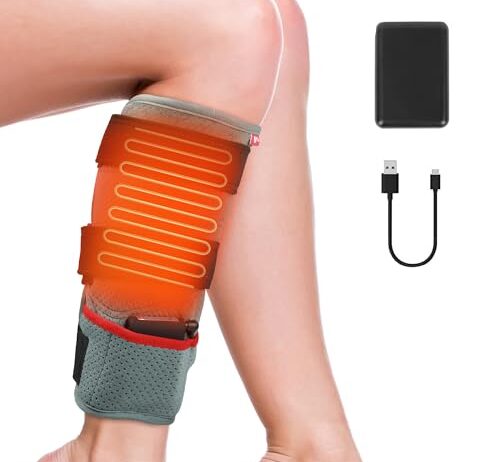
One owner of the cordless VOFUOTI MAX reported getting two half-hour sessions on a charge, with usable heat both times. Another returned it after two uses, saying the battery life fell well short of a competing brand with a smaller battery pack. The difference may come down to heat setting — higher settings draw more current and drain the battery faster, compressing both runtime and the window of consistent heat output.

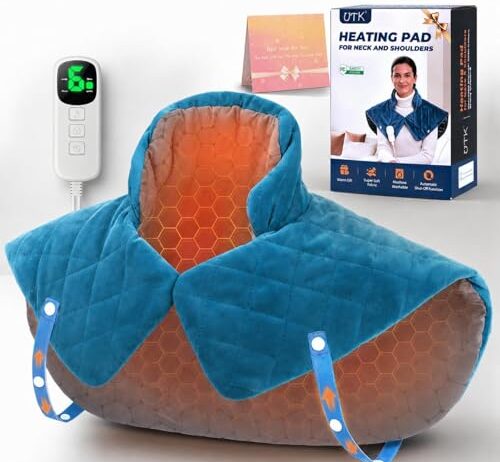
The Nalax B0FKBD28PW puts more decisions in your hands than anything else here. Eight heat levels let you dial in smaller increments between low and maximum, which matters when the difference between comfortable and too hot is a narrow band. Sixteen auto timer settings mean you can set a shutoff that matches your actual session — thirty minutes for a quick loosening, two hours for a long evening — rather than working around a single fixed interval.

It heats the element in 30 seconds and reaches a rated maximum of 159°F, though what arrives at the surface is a different number. One owner measured the hottest point at 101.5°F after twenty minutes on the highest setting. That gap — 159°F at the element, 101.5°F at the surface — is the insulation stack doing its job, and it is also the reason a rated maximum without a surface-temperature figure does not tell you how the pad will actually feel. The adjustable strap helps here: pulling the pad snug against your body compresses the fabric layers, shortens the conduction path, and gets more of that element heat to your skin faster than draping the same pad loosely.

Surface temperature is not element temperature

Human skin sits around 91–95°F at rest. You start to feel warmth from a heating pad when its surface exceeds that range by a few degrees. Therapeutic heat — the kind that loosens a tight muscle — usually needs the pad surface above 110°F. Sustained contact above 118°F increases the risk of a low-temperature burn, the kind that does not hurt immediately but damages tissue over hours.

When a pad rates its maximum at 159°F, that number almost certainly describes the element, not the fabric touching your skin. The layers between absorb and redistribute that heat. An owner of the Nalax B0FKBD28PW measured 101.5°F at the surface on the highest setting after twenty minutes — roughly 57 degrees cooler than the rated maximum. That is not a defect. That is conduction through fabric working exactly as it should.

The problem is that no pad here publishes a surface temperature at each setting. You get a heat-level count — six or eight — and sometimes a maximum element temperature. Translating those into what you will actually feel requires knowing the insulation thickness, fabric density, and how tightly the pad is pressed against your body. All of which vary by pad and by use.

Shape decides contact area, and contact area decides everything

A flat rectangular pad draped over your shoulders touches skin at the peaks and lifts away in the valleys — the hollow of your neck, the channel along your spine. Those air gaps are worse insulators than the fabric itself. Air at 0.026 W/m·K conducts heat about 40 percent slower than even a loose-weave fabric. Everywhere the pad lifts off your body, heat transfer drops.

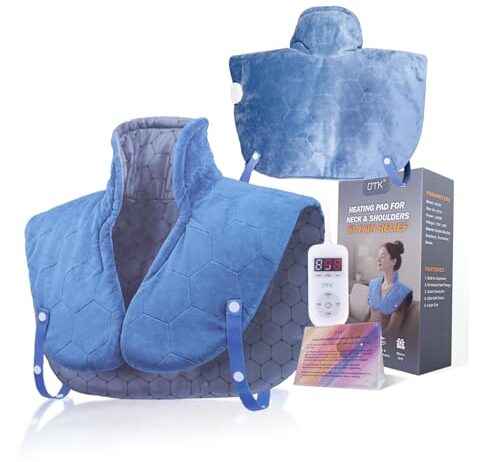
A shaped wrap — the kind that curves around your neck or straps around your leg — solves this by maintaining contact across a curved surface. The Nalax neck wrap at 19 × 24 inches is designed to drape over the shoulders and meet behind the neck, eliminating the worst air gaps in that area. The VOFUOTI MAX takes the same approach for legs, wrapping a heating surface around a calf rather than sitting flat on top of it.

But wrapping introduces its own variable: strap tension. Pull a wrap tight and you compress the insulation, shortening the conduction path and speeding heat transfer. Leave it loose and the pad sags away from the body, reintroducing the air gaps the shape was supposed to eliminate. An owner of the VOFUOTI MAX noted the Velcro straps only stick to each other, not to the pad material, making it hard to get consistent pressure around a calf — and inconsistent pressure means inconsistent heat.

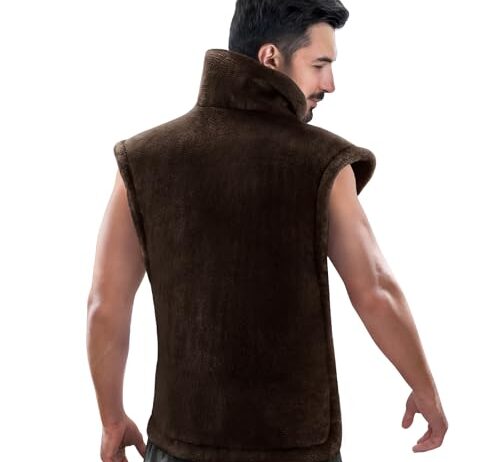
The RENPHO measures 24 × 37 inches — large enough to cover from shoulders to lower back without repositioning. That matters because every time you shift a heating pad, you reset the conduction clock. The fabric cools the moment it loses skin contact, and the area you just uncovered starts dissipating heat into the air. A pad big enough to stay put lets the entire insulation stack reach steady state and stay there.

Weighted fill adds to the wait. The beads or granules inside have to absorb energy before the surface warms, so the first ten minutes feel slower than an unweighted pad of the same size. One owner reported that heat did not maintain through the set timer — the pad felt hot for ten minutes, then seemed to stop. That pattern is consistent with a thermostat cycling: the element heats to target, the thermostat cuts power, and the weighted fill radiates stored heat for a while before the surface cools enough to trigger another heating cycle. On a large weighted pad, the cool phase of that cycle can feel like a malfunction.

Auto-shutoff is a safety floor, not a feature ceiling

Every auto-off timer exists for the same reason: sustained contact above 118°F damages tissue, and a sleeping person cannot feel it happening until the damage is done. A 2-hour shutoff is a conservative default. Sixteen timer options let you choose shorter intervals for targeted sessions or longer ones when you are awake and monitoring.

The absence of a published auto-off — as with the VOFUOTI MAX and RENPHO — does not mean the pad runs indefinitely. Most UL- or ETL-certified heating pads have an internal thermal cutoff that kills power if the element exceeds a safe temperature. But that is a last-resort safety switch, not a session timer. Without a user-facing timer, you are responsible for turning the pad off.

Owners who want to use a heating pad overnight are working against the design. Even with a long timer, sleeping on a pad compresses the insulation unevenly, creating hot spots where your weight concentrates. The element temperature stays constant, but the surface temperature under your hip or shoulder can climb well above the average because you have squeezed out the insulation that was moderating it.

What washing actually changes

Water does not damage a resistive heating element — the wires or carbon fiber threads are sealed. What washing changes is the fill and fabric around them. Weighted fill can shift inside its baffles during a machine cycle, leaving some zones thicker and others thinner. Thicker zones slow heat transfer further. Thinner zones speed it up. The pad heats unevenly afterward — not because the element changed, but because the insulation redistributed.

Fabric itself changes too. A tighter weave conducts heat slightly better than a loose one, and washing loosens weave over time, particularly in natural fibers. Synthetic fabrics hold up better but can pill, and a pilled surface traps a thin layer of air against your skin that was not there when the pad was new. These are small effects individually. Over dozens of wash cycles, they accumulate into a pad that feels noticeably different from the one you bought — usually slightly slower to warm, slightly less even.

FAQ

Why does my heating pad take longer to feel warm than the box says?

The advertised heat-up time measures how fast the resistive element reaches its target temperature. You feel warmth only after heat conducts through every layer of fabric, fill, and trapped air between the element and your skin. Thicker pads, weighted fill, and loose draping all extend that delay.

Does a weighted heating pad heat up slower than a regular one?

Yes. Weighted fill — glass beads, dense granules — adds thermal mass that must absorb energy before the surface warms. Once the fill reaches temperature it holds heat more evenly between thermostat cycles, but the initial warm-up takes noticeably longer than an unweighted pad with the same element.

Will a cordless heating pad lose heat as the battery drains?

Gradually. Lithium-ion voltage drops as charge depletes — a 7.4V nominal cell may deliver 8.4V fully charged and 6.0V near empty. Less voltage means less current through the element, which means less heat output. The fade is slow, not sudden, but sessions near the end of a charge will feel cooler than sessions at the start.

How hot does a heating pad actually get at the surface?

Substantially cooler than the rated element maximum. One owner measured 101.5°F at the surface of a pad rated at 159°F after twenty minutes on the highest setting. The insulation between element and surface absorbs and redistributes heat, so surface temperature depends on fabric thickness, fill density, and how tightly the pad is pressed against your body.

Can I leave a heating pad on overnight?

Most heating pads are not designed for overnight use. Sleeping on a pad compresses the insulation unevenly, creating hot spots under weight-bearing areas. Sustained skin contact above 118°F can cause low-temperature burns that are not immediately painful. Auto-shutoff timers exist specifically to prevent this — pads without timers require you to manage shutoff yourself.

Does washing a heating pad change how it heats?

It can. Machine washing shifts weighted fill inside its baffles, creating thicker and thinner zones that change local heat transfer rates. Fabric weave loosens over repeated cycles, slightly reducing conductivity. The element itself is sealed and unaffected, but the insulation around it redistributes, and after many washes the pad may warm more slowly and less evenly.