We research every product we recommend. We may earn a commission from the links on this page.
Health & Household › Sleeping Masks

The Gap Beside Your Nose Is Where Sleep Masks Leak Light

We compare published specifications and marketplace data. We do not test these products.

The Gap Beside Your Nose Is Where Sleep Masks Leak
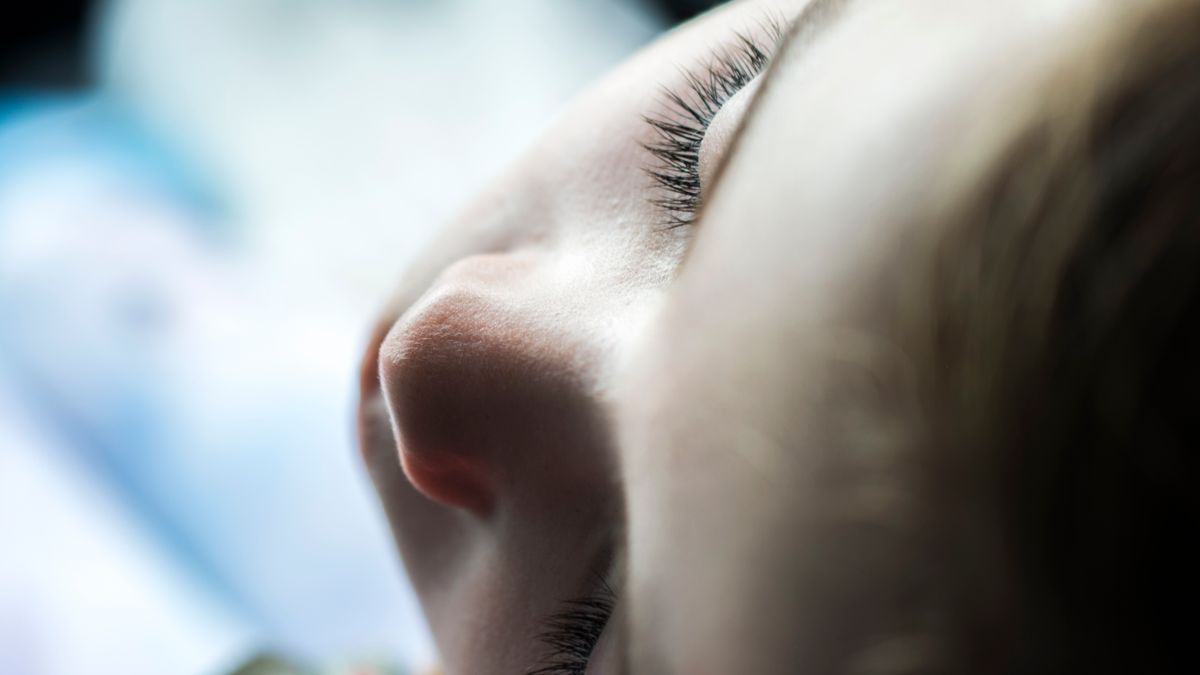
Photo by Snapwire on Pexels

The bridge of your nose sits roughly 8mm lower than your cheekbones. A flat sleep mask spans that drop like a bridge over a valley, and light pours through the gap on both sides. Contoured masks solve this by moving the seal line outward — pressing against the orbital bone where your face is convex — so the nose hollow never factors in. Three masks take different approaches to that same geometry: one strips everything back to the cup and the fabric, one adds Bluetooth audio and ice-fiber cooling, and one reshapes the cup for the specific pressure of sleeping on your side.

Affiliate disclosure: This article contains affiliate links. We may earn a commission if you buy through them, at no extra cost to you.

Everything we recommend
3 picks

How we picked

We do not wear these masks overnight. Judgments rest on cup geometry, fabric thermal properties, and aggregated fit feedback.

Cup contour, not cup presence

The seal must move outward to the orbital bone where the face curves away from the nose hollow.

Fabric conductivity, not brand claims

Ice fiber’s thermal diffusivity is measurable; modal’s moisture wicking relies on capillary structure, not marketing.

Lateral cup stability, not static fit

Side-sleeping pressure collapses a cup that holds shape upright unless the material resists compression from the pillow.

Bluetooth version for range, not audio quality

Version 5.4 maintains connection stability in interference; codec and driver size determine sound, not the protocol number.

Why flat masks leak at the nose

Your face isn’t flat. The cheekbones jut outward, the brow ridge projects forward, and between them the surface dives inward sharply at the temple-to-nose transition. That leaves a pronounced hollow on each side of the nose bridge — two concave channels running from the inner corner of your eye down toward your nostrils.

A flat mask tries to span all of this in one plane. It contacts the cheekbones and forehead fine, because those are convex surfaces that press into fabric naturally. But across the nose it’s bridging a gap, held away from skin by the very bone structure it’s supposed to seal against. Light enters through the resulting crescent on each side.

This matters more than you’d expect. The nasal side of your retina is more sensitive to light intrusion than the temple side. A small gap at the outer edge of a mask is annoying. The same size gap beside your nose hits the part of your eye that responds most strongly to stray photons. You notice it faster, and it’s harder to ignore.

This is the problem contoured masks exist to solve. Not comfort, not lash protection — those are side effects. The primary job is moving the seal line away from a surface it can’t follow.

How a contoured cup relocates the seal

A contoured cup projects forward from the face plane by roughly 8 to 12mm. That projection creates a chamber around each eye socket, and the edges of that chamber land on the orbital bone — the bony ridge that circles your eye socket entirely.

The orbital bone is where soft tissue is thinnest over the skull. Press your fingertip along the ridge above your eye and below your brow, then trace it down the outer edge and under your eye. That’s the seal line. Because the bone is convex and the tissue is thin, a mask pressing there compresses very little flesh and creates consistent contact all the way around.

The nose bridge is no longer part of the equation. The cup’s inner edge lands on the narrow strip of orbital bone between your eye and your nose — not across the nose itself. The valley is inside the chamber now, not under the seal.

This is why contoured masks that still leak at the nose are usually a fit problem, not a design flaw. If the cup is too wide for your face, its inner edge overshoots the orbital bone and lands back in the hollow. The geometry works, but only when the cup dimensions match the distance between your eyes.

The side-sleeper problem is a different failure

A contoured cup that seals perfectly when you’re on your back can fail completely when you roll onto your side. The pillow pushes against the mask from one direction, and several pounds of head weight compress the cup laterally. Two things break.

First, the cup itself can collapse. If the cup wall doesn’t have enough structural rigidity, the pillow crushes it inward until it contacts your eyelid. You’ve lost the chamber. Second — and this is the one people notice — the bottom edge of the cup on the pillow side lifts away from the cheekbone. The seal opens, and you’re back to a light gap, just at the cheek instead of the nose.

A mask designed for side sleeping needs a cup that resists lateral crush without being so rigid it creates pressure points. It also needs a strap system that holds the mask’s vertical position when force comes from the side rather than straight back. Most adjustable straps are set for back-sleeping tension; side sleeping pulls the mask in a direction the strap wasn’t tightened for.

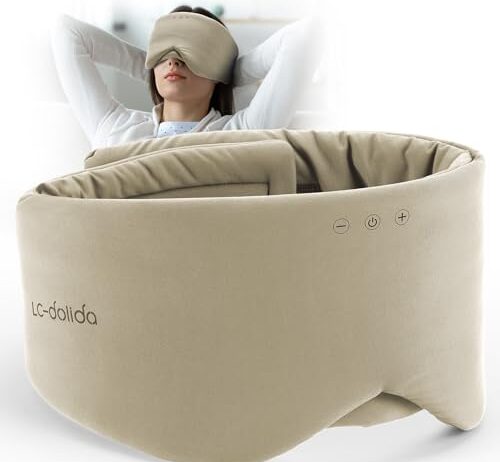
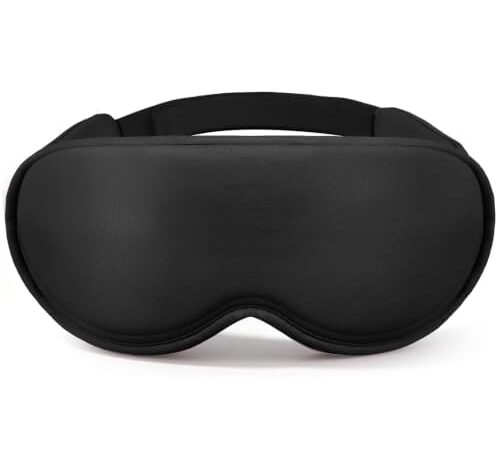
This is the mask in the set that isolates the core mechanism. Modal fabric, a removable contoured cup, and a claim of 100% blackout. No Bluetooth, no cooling technology, no side-sleeper-specific shaping. At $19.95, it’s half the price of the other two, and what you’re paying for is the cup and the material around it.

Modal is a semi-synthetic fiber made from beech tree cellulose. It absorbs moisture at roughly 50% higher capacity than cotton, which matters against your face during eight hours of contact. Sweat doesn’t pool at the seal line the way it does with polyester-blend masks, and the fabric drapes rather than stretches, so it follows facial contours without elastic tension pulling the cup out of position.

The removable cup is worth noting for maintenance. The seal edge accumulates skin oil and makeup residue, and a cup you can detach washes more thoroughly than a fixed one. Hand-wash the cup separately — machine washing risks deforming the cup structure, and a deformed cup is a cup that no longer matches the orbital bone contour it was molded to follow.

Modal versus ice fiber: what the fabric is actually doing

Modal and ice fiber solve different problems at the same contact point — the strip of skin where the mask presses against your face for hours.

Modal breathes. It pulls moisture away from skin through absorption, the way cotton does but faster. The fabric itself doesn’t feel cool to the touch; it feels soft and slightly substantial, like a broken-in t-shirt. Its thermal behavior is passive: it doesn’t trap heat the way synthetics do, but it doesn’t actively draw heat away either. Over a full night, it stays close to your skin temperature.

Ice fiber — typically a polyethylene-based textile — works differently. It has higher thermal conductivity than standard polyester, meaning it transfers heat away from your skin faster on contact. You feel a distinct cooling sensation when you first put it on. But this is conduction, not refrigeration. The fabric reaches thermal equilibrium with your face within 20 to 30 minutes. After that, it feels like fabric. If you sleep hot and the initial cooldown helps you fall asleep, that window may be enough. If you’re expecting all-night cooling, the physics won’t support it.

Neither fabric is better in absolute terms. Modal manages moisture. Ice fiber manages the falling-asleep transition. Pick based on whether your problem is sweating through the night or overheating while you’re trying to drift off.

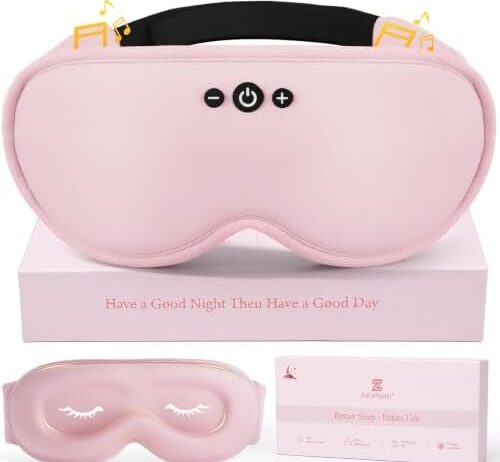
This mask shares the same removable 3D cup concept as the basic ZHENYEMEI, but it’s explicitly designed for side sleepers. That’s a structural claim, not just a marketing position — it means the cup geometry and strap routing are intended to maintain the orbital-bone seal when force comes from the side rather than straight back.

It also adds Bluetooth headphones, which introduces a question side sleepers should think about: speaker placement. Flat speakers embedded in a sleep mask sit between your ear and the pillow. In most Bluetooth masks, they’re thin enough that back sleepers don’t notice them. Side sleepers compress them directly. The speaker becomes a pressure point against the ear, and the audio quality changes because the driver is being loaded by pillow pressure instead of sitting in its designed air gap.

The modal premium fabric here is a step up from standard modal in weave density, which typically means slightly more structure in the mask body. That extra rigidity helps the cup maintain its shape under lateral load — the same property that makes it slightly less drapey when you first put it on. At $39.95, you’re paying for the side-sleeper engineering and the Bluetooth integration together. If you don’t sleep on your side and don’t want audio, the basic model does the same blackout job for half.

Bluetooth in a sleep mask: what version means and what doesn’t

The LC-dolida specifies Bluetooth 5.4. The ZHENYEMEI with audio says Bluetooth headphones without naming a version. That gap matters, but not for the reason most people assume.

Bluetooth 5.4 offers roughly double the data throughput of Bluetooth 5.0, with lower latency and better power management. In theory, that means cleaner audio and longer battery life. In practice, audio quality in a sleep mask depends far more on the speaker driver — its size, its enclosure, its digital signal processing — than on the Bluetooth version carrying the signal. A 14mm driver on Bluetooth 5.4 and a 14mm driver on Bluetooth 5.0 will sound nearly identical to a person falling asleep to white noise or a podcast.

Where the version does matter is connection stability. If you’re in an apartment with twenty Bluetooth devices within range — phones, watches, laptops, smart bulbs — a newer protocol handles the crowded radio environment better. Fewer dropouts, fewer moments where the audio stutters and you’re suddenly awake again.

Battery life claims on sleep masks almost always assume low to moderate volume. At higher volumes, runtime drops measurably. If you rely on audio to mask a snoring partner, you’re running the speakers harder than the spec anticipated.

How to check a mask’s fit before you commit

You can’t tell if a contoured mask seals properly in a lit room. The gaps are too small to see without contrast.

Put the mask on, adjust the strap so it’s snug without pulling the cup edges into your skin, and stand in the darkest room you have — a bathroom with the door closed and the light off works. Wait 30 seconds for your eyes to adjust. Now look for crescents of light. Check the nose bridge first, then the lower cheek, then the temples.

If light enters at the nose, the cup’s inner edge isn’t reaching your orbital bone. The mask is either too wide for your face or the cup depth is insufficient to clear the nasal hollow. If it leaks at the cheek, the strap tension is wrong or the cup’s lower rim isn’t following your cheekbone’s curve.

Human faces average 2 to 3mm of side-to-side asymmetry in the orbital region. A rigid cup may seal well on your left side and gap on your right. If you find an asymmetric leak, it’s your face, not the mask — and the fix is a mask with softer cup edges that conform rather than a stiffer one that holds its shape.

FAQ

Do contoured sleep masks block light at the nose better than flat masks?

Yes. A flat mask bridges the gap between your cheekbones and crosses the nose valley, leaving crescent-shaped light leaks on each side. A contoured cup moves the seal outward to the orbital bone — the bony ridge around your eye socket — where the face is convex and a seal can hold. The nose hollow stays inside the cup chamber, not under the seal edge.

Do cooling sleep masks stay cool all night?

No. Ice fiber and similar cooling fabrics work through thermal conduction — they transfer heat away from your skin faster than standard polyester on first contact. But conduction requires a temperature difference. Within 20 to 30 minutes, the fabric reaches equilibrium with your face and feels like regular material. The cooling helps you fall asleep, not stay cool through the night.

Can you wash a sleep mask with removable cups?

You can, and you should separate them. Hand-wash the cups individually to maintain their molded shape — machine washing risks deforming the cup walls, which changes the seal geometry. The fabric body of the mask is typically safe for a gentle machine cycle in a mesh bag.

Will a contoured sleep mask work for side sleepers?

A standard contoured mask often fails on your side. The pillow pushes the cup laterally, and the bottom edge lifts off the cheekbone, reopening a light gap. Masks designed for side sleeping use stiffer cup walls to resist crush and different strap routing to hold position under lateral force. If you sleep on your side, look for a mask that specifically addresses lateral pressure, not just contouring.

What is the difference between modal and ice fiber in a sleep mask?

Modal is a cellulose-based fabric that absorbs moisture well and drapes softly against skin — it manages sweat over a full night. Ice fiber is a polyethylene-based textile with higher thermal conductivity that feels cool on contact but reaches skin temperature within half an hour. Modal handles overnight moisture; ice fiber handles the falling-asleep window.