We research every product we recommend. We may earn a commission from the links on this page.
Tools & Home Improvement › Wall Lamps & Sconces

Battery Wall Sconces Dim Before They Die — Here’s Why

We compare published specifications and marketplace data. We do not test these products.

Battery-Powered Sconces Dim as the Cell Voltage Sags
Photo by Hilary Halliwell on Pexels

A 5,300mAh battery sounds like it should keep a wall sconce lit for hours. It might — but not at the brightness you started with. LEDs are current-driven devices, and in a battery-powered fixture without voltage regulation, their output tracks the battery’s declining voltage curve. That means a sconce that looks perfect at 8 PM looks noticeably weaker by 9:30, even though the battery indicator still shows charge. Hardwired sconces don’t have this problem at all. Understanding why one type fades and the other doesn’t changes which fixture actually belongs on your wall.

Affiliate disclosure: This article contains affiliate links. We may earn a commission if you buy through them, at no extra cost to you.

Everything we recommend
4 picks

How we picked

We did not mount these sconces on a wall. Judgements come from published specifications, circuit design principles, and owner feedback.

Power architecture, not power source

Battery or hardwired matters less than whether the circuit regulates voltage to the LED. That determines if brightness holds or fades.

Shade material, not shade shape

Glass diffuses and blocks differently from fabric. The shade changes how much light reaches the room more than wattage does.

Cost per sconce, not set price

Sets of two at different price points hide a 3.8x spread. Per-unit cost reveals what you’re paying for finish and engineering.

Owner-reported problems, not ratings

What breaks, sticks, or flickers in real use tells you more than an average star count across nine reviews.
Why a Battery Sconce Gets Dimmer While It’s Still “On”

A lithium-ion cell starts at roughly 4.2 volts when fully charged and drops to about 3.0 volts when depleted. That decline isn’t linear — it holds relatively steady through the middle of the discharge, then falls steeply in the last 20 percent of capacity. A white LED needs somewhere between 2.7 and 3.3 volts to produce light at all. Above that threshold, more voltage means more current, and more current means more brightness.

Without a boost converter between the battery and the LED, the light tracks that voltage curve directly. Full charge: bright. Half charge: slightly less bright. Quarter charge: noticeably dimmer, even though the battery has power left to give. The light doesn’t snap off. It fades, gradually enough that you might not notice for thirty minutes, then obviously enough that you do.

A boost converter fixes this. It’s a small DC-DC circuit that steps up a declining input voltage to a constant output, drawing more current from the battery as the voltage drops to keep the LED fed at a stable level. With one, a sconce stays at full brightness until the battery hits the converter’s minimum input threshold — then it shuts off cleanly instead of dimming into irrelevance. Without one, you get that slow fade owners describe.

Hardwired Fixtures Don’t Have This Problem

A sconce wired into your home’s electrical system receives 120 volts AC, constant. The LED driver inside converts that to the precise DC voltage and current the diode needs, and it does it the same way at 2 PM and 2 AM. There’s no discharge curve. No declining input. The light you get on day one is the light you get on day three hundred.

That stability is the actual trade-off when you choose between battery and hardwired — not convenience versus quality, but consistent output versus portable installation. If you have a junction box where you want light, a hardwired sconce will never fade on you. If you don’t, you’re choosing between hiring an electrician or accepting that battery-powered brightness has a shelf life measured in hours, not years.

What the Shade Does to the Light That Reaches You

The shade on a wall sconce isn’t decoration — it’s the last thing between the LED and the room, and it determines whether you get a sharp point of light or a soft wash across the wall.

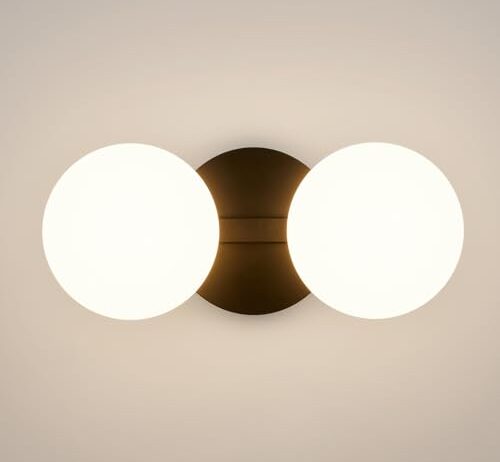
Milk glass is dense. It scatters light in every direction, hiding the bulb’s filament or LED chip completely. You get an even, diffused glow with no visible hot spot, but you lose intensity. Some of that light bounces back into the shade and never reaches the room. For a hallway or bathroom vanity, where you want even illumination without glare, that’s the right trade.

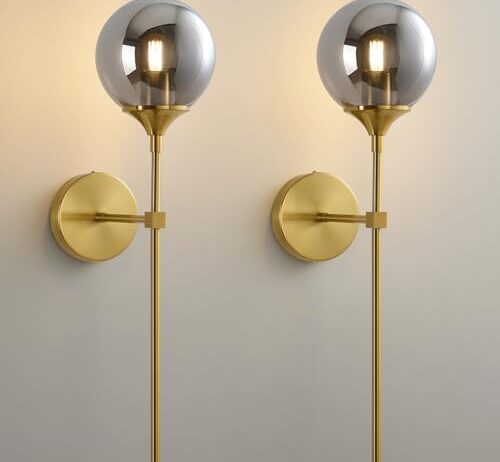
Smoke gray glass does something slightly different. It’s tinted, so it absorbs some wavelengths and lets others through, giving the light a warmer, moodier quality. You can still see the shape of the bulb through it, which is part of the aesthetic — a visible filament behind gray glass reads as intentional in a way it doesn’t behind clear glass.

Fabric absorbs more light than either glass type. It’s the softest diffusion of the three — no hot spots, no visible bulb, just a warm haze. But in a battery-powered sconce that’s already losing brightness to voltage sag, a fabric shade compounds the problem. You’re starting with less light and filtering more of it away.

The Dimming Question Most People Get Wrong

“Dimmable” on a wall sconce can mean three completely different things, and the wrong assumption leads to flicker, buzzing, or a dimmer switch that does nothing.

First: the bulb itself can be dimmable. An E26-base LED bulb with an integrated driver that responds to phase-cut dimming — the kind a standard wall dimmer switch produces — will dim smoothly when paired with a compatible switch. But the sconce fixture has nothing to do with it. The fixture is a socket and a wire. The intelligence is in the bulb.

Second: a battery-powered sconce can include its own dimming circuit, typically controlled by a remote. This is pulse-width modulation — the LED switches on and off thousands of times per second, and the ratio of on-time to off-time controls perceived brightness. It works independently of any wall switch because the wall switch isn’t involved.

Third: a fixture can include a dimmable bulb in the box, which means the manufacturer chose a bulb that responds to dimming signals — but whether your wall switch sends the right signal is still on you. A toggle switch doesn’t dim anything. A cheap dimmer switch designed for incandescent bulbs may cause LED flicker. Matching the dimmer to the bulb’s driver type is the step most people skip, and it’s where the complaints about buzzing and strobing come from.

The smoke gray glass on this sconce does two things at once. It diffuses the bulb enough to eliminate glare at eye level — important for a stairway or hallway mount where you’re looking at it straight on — while still letting enough light through to actually illuminate the space. Clear glass would be brighter but harsher. Milk glass would be softer but dimmer. Gray glass splits the difference, and the tint adds warmth that pairs well with the brushed brass gold finish.

Including a dimmable bulb matters because it removes the most common installation mistake: buying a dimmable fixture and pairing it with the wrong bulb, or the wrong wall switch, or both. The bulb here is matched to the fixture. If you have a compatible dimmer switch on the wall, it works out of the box. If you have a standard toggle, you still get full brightness — you just can’t dim it without swapping the switch. Either way, you’re starting from a working combination rather than assembling one yourself.

At $35 per sconce, this is less than half the price of the gold brass pair, and it ships with more: a bulb, a shade, and a dimming-ready circuit. The brushed brass gold finish reads warmer than polished brass without the maintenance — brushed finishes hide fingerprints and minor scratches that polished brass shows immediately.

What 5,300mAh Actually Gets You

Milliampere-hours measure total charge, not runtime. A 5,300mAh battery powering an LED array that draws 530 milliamps would last ten hours in theory. In practice, it’s less — always less.

Three things eat into that number. First, conversion loss: if there’s a boost converter maintaining stable brightness (which is the thing you want), it draws extra current from the battery to step up the voltage, burning some energy as heat. Second, the usable voltage window: the battery’s nominal 3.7 volts drops to 3.0 before the circuit cuts off, and that last stretch of discharge happens fast — the capacity below the cutoff threshold is charge you paid for but can’t use. Third, temperature: lithium cells deliver less current in cold rooms, and a sconce on an exterior-facing wall in winter may lose 10 to 20 percent of its effective capacity to ambient temperature alone.

None of this means 5,300mAh is a lie. It means the number describes the battery, not the sconce. How long your light stays bright depends on the LED’s current draw, the efficiency of the regulation circuit (if one exists), and the temperature of the wall it’s mounted on. Without those numbers, the capacity figure is a starting point for a calculation you can’t finish.

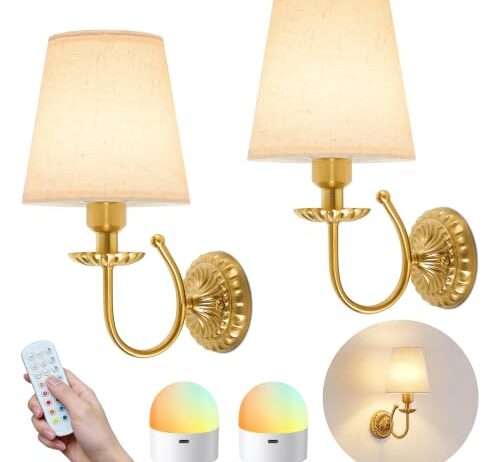
This is the sconce you buy when there’s no wiring where you want light. No junction box, no electrician, no cutting into drywall. You mount the bracket, hang the sconce, and control it from across the room. For a renter, or for a hallway in a house built before anyone planned for sconce wiring, that’s not a compromise — it’s the only realistic option short of a renovation.

The 15 color options via remote give this fixture a range the hardwired models can’t match without swapping bulbs. Warm white for evening, cool white for a bathroom mirror, amber for a hallway nightlight — the same fixture adapts to different times and uses. Dimming through the remote uses pulse-width modulation rather than a wall switch, which means no compatibility issues with your home’s wiring.

The trade-off is the one this entire article is about. A 5,300mAh lithium cell will not deliver the same brightness at hour three that it delivered at hour one unless the internal circuit includes voltage regulation — and that detail isn’t something you can determine before buying. The fabric shade compounds this: fabric absorbs more light than glass, so any brightness loss from voltage sag is more visible. If consistent brightness matters to you, this sconce may frustrate you. If color flexibility and installation freedom matter more, nothing else here does what this does.

When the Socket Matters More Than the Fixture

An E26 socket is a 26-millimeter Edison screw base — the same threading as a standard household bulb. A sconce with an E26 socket is, electrically speaking, a fancy holder. The fixture provides power and a place to mount. Everything else — color temperature, dimming behavior, driver quality, brightness stability — lives inside the bulb you choose.

That’s a strength if you know what you’re doing. You can install a high-CRI bulb for accurate color in a bathroom, a vintage filament bulb for a warm hallway glow, or a smart bulb with app-controlled dimming. The fixture doesn’t care. It passes current and holds the weight.

It’s a weakness if you don’t. A milk glass shade paired with a bulb that runs too warm will look yellow, not creamy. A bulb with a visible LED chip array behind clear glass looks clinical rather than decorative. And if the glass shade grips the socket tightly — a friction fit rather than a threaded one — swapping bulbs means wrestling with a globe that wasn’t designed for frequent removal. One owner of a milk glass set reported the glass being extremely difficult to remove, and the fittings feeling cheap under pressure. Another found the fixture intermittently cutting out, running through bulbs trying to fix a problem that was likely in the socket contact, not the bulb. [R1] [R2]

Finish and What It Costs You

The per-unit price spread here runs from $23.50 to $90. That’s a 3.8x multiplier, and almost none of it tracks to light output — because light output figures are absent across the board. What changes is the metal finish and the installation type.

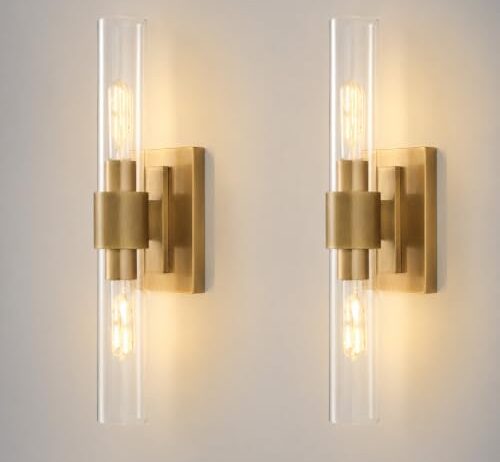
Gold brass — polished, reflective, and warm — is a statement finish. It reads formal, pairs with marble and white tile, and shows every fingerprint and water spot in a bathroom. Brushed brass is the same base metal with a matte texture scratched into the surface, hiding wear and giving it a more casual, modern look. The difference in material cost is marginal. The difference in maintenance is not.

The battery-powered sconce at $23.50 per unit uses a brushed finish over what is likely a lighter-gauge metal or a coated surface rather than solid brass. At that price point, the housing is a means to an end — it holds the battery and the shade. The $90 gold brass sconce is selling you the fixture as a visible object: the arm, the canopy, the tube shape are the product, and the light it produces is secondary to how it looks while doing it.

Neither price is wrong. But they’re buying different things, and conflating them — comparing a $23.50 battery sconce to a $90 brass fixture as if both are competing to light the same hallway — misses the point. One is a light source. The other is furniture that happens to glow.

FAQ

Do battery wall sconces stay bright until the battery dies?

Usually not. Without a boost converter inside the sconce, the LED’s brightness tracks the battery’s declining voltage — so the light fades gradually over hours rather than staying constant and then shutting off. A boost converter can maintain steady brightness until the battery hits its minimum threshold, but most budget battery sconces don’t disclose whether they include one.

Can I put a dimmable bulb in any hardwired wall sconce?

You can screw a dimmable bulb into any E26 socket, but it will only dim if your wall switch is a compatible dimmer. A standard toggle switch gives you on or off, nothing in between. And the dimmer itself needs to match the bulb’s driver type — a dimmer designed for incandescent loads may cause an LED bulb to flicker or buzz. The fixture doesn’t control dimming; the bulb and the switch do.

Why does my battery sconce get dimmer after thirty minutes?

The lithium-ion cell inside starts at about 4.2 volts and declines as it discharges. If the sconce’s circuit doesn’t regulate that declining voltage, the LED receives less current as the battery drains, and less current means less light. The battery still has charge — the voltage is just lower than it was, and the LED responds proportionally.

What’s the difference between milk glass and clear glass on a wall sconce?

Milk glass is opaque white and scatters light in all directions, hiding the bulb completely and producing soft, even illumination with no visible hot spot. Clear glass lets you see the bulb and produces sharper, more directional light. Smoke or tinted glass falls between the two — some diffusion, some bulb visibility, and a color shift that warms the output.

How long does a 5300mAh battery wall sconce actually last at full brightness?

There’s no way to answer that from the battery capacity alone. Runtime depends on the LED’s current draw, whether the circuit includes voltage regulation, and the ambient temperature. A 5,300mAh cell powering a 500mA LED would last about 10 hours in theory, less in practice after conversion losses and the unusable portion of the discharge curve. Without the LED’s actual power draw, the capacity is a starting point for a calculation you can’t complete.