We research every product we recommend. We may earn a commission from the links on this page.

Higher GPD Doesn’t Mean Faster Water — What Actually Controls Flow from Your RO System

We compare published specifications and marketplace data. We do not test these products.

The Finer Your Water Filter, the Weaker Your Tap
Photo by cottonbro studio on Pexels

A 600 GPD reverse osmosis system sounds like it should fill a glass noticeably faster than a 400 GPD model. It doesn’t. GPD measures how many gallons the membrane can process in 24 hours under ideal lab conditions — 77°F water, full rated pressure, a fresh membrane. Your kitchen has none of those things most of the year. What actually controls the speed water reaches your glass is a shorter list: line pressure, membrane surface area, how many filter stages the water passes through before it gets to you, and whether the system stores filtered water or makes it on demand. Here’s how those factors play out across four very different systems.

Affiliate disclosure: This article contains affiliate links. We may earn a commission if you buy through them, at no extra cost to you.

Everything we recommend
4 picks

How we picked

We did not install these systems. Picks reflect membrane ratings, plumbing requirements, component specs, and aggregate user reports.

Membrane GPD and surface area

Rated daily output under lab conditions establishes the ceiling; surface area determines how close real-world flow gets to that ceiling.

Minimum inlet pressure requirement

Undersink systems need 40-60 PSI to reach rated flow. Countertop and gravity designs eliminate the pressure dependency entirely.

Tankless vs. stored water

On-demand filtration responds to line pressure in real time. Storage tanks mask slow membranes but introduce stagnation risk.

Post-filter stage count

UV, remineralization, and carbon polishing each add flow resistance. More stages usually mean slower delivery, not better water.


What GPD Actually Measures (and What It Doesn’t)

Gallons per day is a membrane spec. It tells you the theoretical throughput of the reverse osmosis membrane itself — how much water it can push through its roughly 0.0001-micron pores over 24 continuous hours at a standard test temperature and pressure. That number matters for sizing: a household of four using 50 gallons a day of drinking and cooking water needs a membrane that can keep up. But it has almost nothing to do with how fast water comes out of the tap at any given moment.

The reason is temperature. RO flow rates are tested at 77°F. Cold inlet water — and in most of the country, the cold line runs 45–55°F in winter — can cut actual output by half or more. A 600 GPD system running on 50°F water might deliver 300 GPD of actual throughput. A 400 GPD system on the same water delivers around 200. Both still fill a drinking glass in seconds.

The second reason is that you’re not running the system for 24 hours. You’re running it for 8 seconds while you fill a bottle. At that timescale, what matters is instantaneous flow rate at the faucet — and that depends on pressure, not membrane rating.

Pressure Is the Real Bottleneck

Reverse osmosis works by forcing water through a membrane against its natural tendency to equalize dissolved-solid concentration on both sides. That takes pressure — typically 40 to 80 psi from your municipal water line for undersink systems. Drop below 40 psi and the membrane still works, but slower. Drop below 30 and you’ll notice it at the tap.

This is where installation type splits the field. An undersink RO system taps directly into your cold-water line and uses whatever pressure your house delivers. A countertop system with its own pump can maintain consistent pressure regardless of your plumbing. And a gravity filter has no pressure source at all — it relies on the weight of the water sitting above the filter element, which at a typical 12-inch elevation difference produces roughly 0.43 psi. That’s not a rounding error away from 40 psi. It’s a different universe.

So the first question isn’t “what GPD do I need?” It’s “where is the pressure coming from?”

Countertop vs. Undersink vs. Gravity: Three Different Physics Problems

An undersink tankless RO system lives on your cold-water line and filters on demand. No storage tank, no reservoir to refill. You turn the dedicated faucet and water passes through the prefilters, across the membrane, and out. The flow rate you feel is the flow rate the membrane produces at whatever pressure and temperature your plumbing delivers that moment. In summer, it’s brisk. In January, it slows.

A countertop RO unit sits on your counter and typically draws from a built-in reservoir you fill manually — or connects to the cold line via an adapter. The advantage is that many countertop systems include their own pump, which means they control the pressure hitting the membrane rather than depending on your house plumbing. If your home has low water pressure, this distinction matters more than any GPD number.

A gravity filter throws out the pressure question entirely. Water drips through the filter element under its own weight. There’s no membrane in the RO sense — instead, filter cartridges use combinations of activated carbon, ceramic, or proprietary media to remove contaminants at far lower pressure. The trade-off is speed. Where an RO system fills a glass in seconds, a gravity system might take 30 minutes to filter a full reservoir. You’re not waiting at the tap; you’re filtering a batch and pouring from the bottom chamber later.

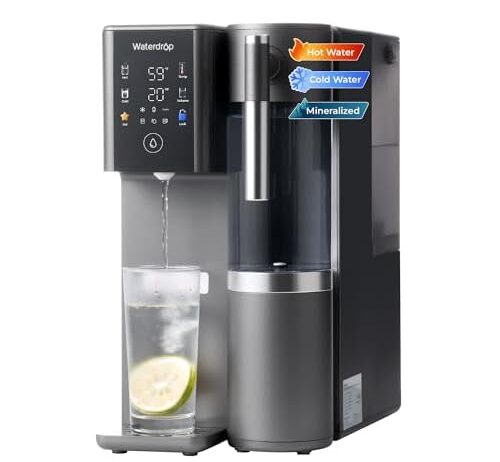
The Waterdrop A2G sits on your counter and runs mineral reverse osmosis through a self-contained unit with instant hot and cold dispensing. That hot-water loop is doing something undersink systems can’t: heating filtered water to brewing temperature without a separate kettle, which means you’re not waiting twice — once for filtration, once for heating.

The countertop form factor also means the unit controls its own filtration pressure rather than depending on your house plumbing. If you’ve ever lived in a building where the cold-water pressure drops when someone flushes upstairs, you know why that matters. An undersink RO system rated at 400 or 600 GPD will deliver less than its rating whenever line pressure dips. A countertop unit with its own pump doesn’t have that problem.

The trade-off is counter space and the continuous power draw from the heating and chilling elements. This isn’t a passive filter you forget about — it’s an appliance. But if your actual use case is filling a mug of tea or a cold glass of water repeatedly throughout the day, the instant dispensing eliminates the micro-waits that make people reach for the unfiltered tap instead.

Remineralization: Necessary or Marketing?

Standard reverse osmosis strips nearly everything from water — dissolved solids, minerals, contaminants. What comes out the other side is close to pure H₂O, with a pH typically between 5.5 and 6.5. Slightly acidic. Not dangerous, but flat-tasting and, to some people, vaguely metallic.

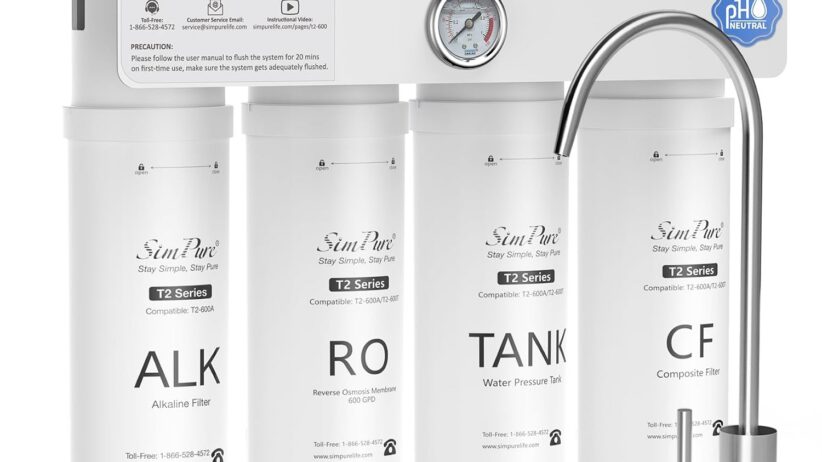
Remineralization stages add calcium and magnesium back into the water after filtration, usually through a calcite cartridge that dissolves slowly as water passes through it. This raises the pH toward neutral or slightly alkaline — 7.0 to 8.5 — and puts hardness back in the range of 20 to 80 parts per million. The result tastes more like the water you’re used to drinking.

Is it necessary? Not for safety. RO water without remineralization is safe to drink. The minerals you’d get from a glass of water are a fraction of what you get from food. But taste is a real variable, and if purified water tastes wrong to you, you’ll stop drinking it and go back to the tap — which defeats the purpose of buying a filtration system.

Two of the four systems here add minerals back. If taste is a priority and you’re already spending on filtration, the remineralization stage costs you nothing in flow rate and changes the experience of the water in your mouth. Mechanism, not marketing — calcite dissolves, pH rises, taste changes. Whether that matters to you is preference, not science.

UV After RO: Belt and Suspenders, or Redundancy?

RO membranes with 0.0001-micron pores physically block bacteria and viruses. They’re too large to pass through. A UV sterilization stage after the membrane hits whatever gets through with 254-nanometer ultraviolet light, damaging microbial DNA so organisms can’t reproduce.

On paper, that’s redundant. If the membrane blocks microbes, the UV stage has nothing to kill. In practice, membranes degrade. O-ring seals around the membrane housing can develop micro-leaks over months of use. If untreated water bypasses the membrane through a compromised seal, the UV stage catches what the membrane missed.

It’s an insurance policy. You probably won’t need it. But the cost is minimal — a UV bulb draws a few watts and lasts 12 months — and the failure mode it protects against (a compromised membrane seal that you can’t see or taste) is exactly the kind of thing that goes undetected until a test reveals it.

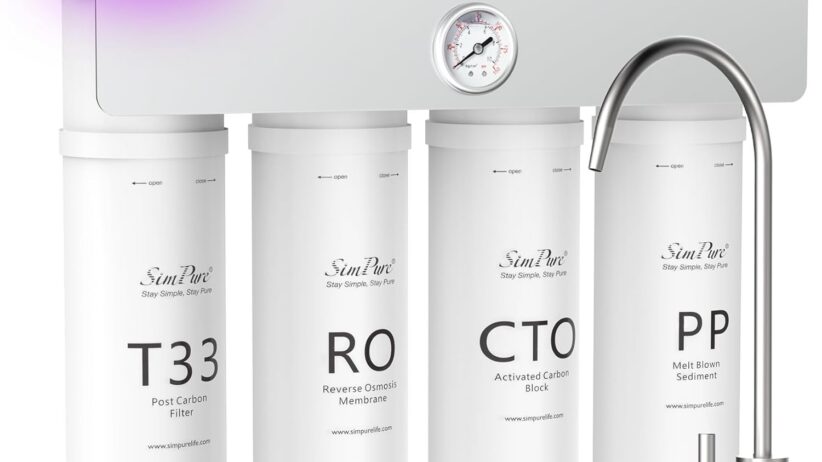
The SimPure T1-400 is a tankless undersink RO system rated at 400 GPD. It connects to your cold-water line, filters on demand, and delivers water through a dedicated faucet. No storage tank means less space consumed under the sink and no stale tank water to worry about. No remineralization means the water comes out on the acidic side — 5.5 to 6.5 pH — which some people notice as a flat taste and others don’t register at all.

The 400 GPD rating will produce less than that in real-world conditions — cold inlet water in winter can halve the output. But for actual drinking and cooking use, even 200 GPD is roughly 8 gallons per hour. You’re filling glasses and pots, not swimming pools. The flow rate at the dedicated faucet will feel slower than your main tap — that’s inherent to any on-demand RO system — but the wait is seconds, not minutes.

At its price point, this is the entry into undersink RO without the extras. No UV backup, no mineral cartridge, no hot-water dispensing. If you want clean water and your house pressure sits above 40 psi, the membrane does the work and nothing else gets in the way.

The Gravity Filter Question

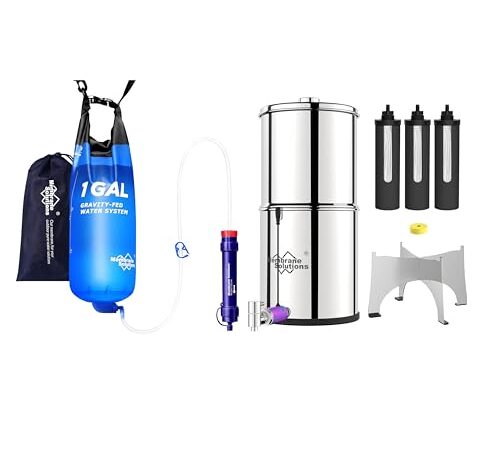
A gravity water filter isn’t competing with RO systems on the same axis. It’s not trying to produce the same volume at the same speed. It exists because some situations don’t have plumbing — a rental where you can’t modify anything, a cabin, a second location you visit on weekends.

The physics are straightforward: water sits in an upper reservoir and drips through filter elements into a lower chamber under gravity alone. At a 12-inch height difference, that’s roughly 0.43 psi — compared to 40-80 psi from a water line. Flow rate is proportional to pressure, and the pressure here is nearly nothing. Filtration takes time. Filling the lower chamber can take 30 minutes to an hour depending on the filter medium and how full the upper reservoir is (as it empties, the water column drops and pressure drops further, slowing the drip).

That’s not a flaw. It’s a constraint you either accept or don’t. If you fill the upper chamber before bed and pour from the lower one in the morning, the speed is irrelevant. If you want filtered water on demand, this isn’t your category.

Choosing by Use Pattern, Not by Spec

The GPD number, the filter type, the installation method — none of these mean much until you answer one question: how do you actually use water at home?

If you fill a glass or a bottle a dozen times a day and occasionally fill a pot for cooking, any RO system rated 400 GPD or above will keep up without you ever noticing a delay. The difference between 400 and 600 GPD disappears entirely at that usage level. Pick based on installation preference and whether you want remineralized water, not on throughput.

If you want hot water for tea without a kettle, the field narrows to systems with a heating loop — and that currently means a countertop unit with its own power supply.

If you can’t or won’t modify plumbing, the choice is between a countertop RO system and a gravity filter. The countertop unit is faster and produces cleaner water. The gravity filter is cheaper, needs no electricity, and works anywhere you can set two stacked containers.

If you want the maximum possible filtration with a safety margin, an undersink RO system with UV sterilization covers the widest range of contaminants and failure modes. You’ll pay for the extra stage in purchase price but not in daily inconvenience — the UV bulb runs silently and lasts about a year.

FAQ

Will I notice the difference between a 400 GPD and 600 GPD reverse osmosis system when filling a glass?

No. Both ratings describe 24-hour membrane capacity under lab conditions. At the point-of-use scale — filling a 16-ounce glass — the difference in flow rate is negligible. What you will notice is your home’s water pressure and inlet temperature, which affect actual output far more than the GPD rating.

Is remineralized RO water healthier than plain RO water?

Plain RO water is safe to drink. The minerals a remineralization stage adds — calcium and magnesium — are a small fraction of your daily intake from food. The real difference is taste: remineralized water has a pH closer to neutral and tastes more like tap water, while plain RO water tends toward flat and slightly acidic. It’s a preference, not a health requirement.

Do I need a booster pump for an undersink RO system?

If your home water pressure is above 40 psi, most undersink RO systems will operate at or near their rated output without a booster pump. Below 40 psi, flow rate drops noticeably and the system produces less filtered water per day. You can check your pressure with a gauge that threads onto a hose bib — they cost a few dollars at any hardware store.

How long does a gravity water filter take to filter a full batch?

Typically 30 minutes to an hour for a full upper reservoir, depending on filter resistance and water column height. As the upper chamber empties, pressure drops and filtration slows further. Gravity filters are designed for batch use — fill the top, wait, pour from the bottom — not for on-demand water.

Does UV sterilization after reverse osmosis actually do anything useful?

Under normal conditions, the RO membrane blocks bacteria and viruses physically — they’re too large to pass through 0.0001-micron pores. UV sterilization serves as a backup for membrane seal degradation, which can develop over months of use and allow untreated water to bypass the membrane. It’s a low-cost insurance policy against a failure you can’t detect by taste or appearance.