
We research every product we recommend. We may earn a commission from the links on this page.
Toys & Games › Electric Vehicles

12V vs 36V: The Voltage Gap That Decides How Fast Kids Actually Ride

We compare published specifications and marketplace data. We do not test these products.

Ride-On Toy Speed Claims Assume a Flat Driveway and a Light Child
Photo by Franco Monsalvo on Pexels

A 12V ride-on car on a paved driveway moves at one speed. Put the same car on grass, add ten pounds of child, aim it at a gentle slope, and it moves at a different speed — noticeably slower, sometimes half. That’s not a defect. It’s a brushed DC motor doing exactly what physics requires: trading speed for torque the moment resistance climbs. The gap between the number printed on the box and the speed a real kid gets on real ground comes down to three variables — voltage, motor wattage, and how many wheels are dragging across the surface. Here’s how those variables interact across four very different electric ride-ons, from a 12V Lamborghini replica to a 36V dirt bike.

Affiliate disclosure: This article contains affiliate links. We may earn a commission if you buy through them, at no extra cost to you.

Everything we recommend
4 picks

How we picked

We did not ride these vehicles. Judgements rest on published specifications, motor physics, and owner-reported behavior.

Voltage headroom, not sticker speed

Higher voltage means more room before the controller must cut power on a hill. A 36V system losing 30% still moves; a 12V system losing 30% barely crawls.

Watts under load, not watts on paper

Peak wattage matters less than how much torque the motor sustains before the controller intervenes. We compared rated power against the resistance each form factor creates.

Rolling resistance by design

Six wheels on dirt demand more torque than two wheels on pavement. The vehicle’s own shape dictates how hard the motor works at any speed.

Owner-reported speed loss, not rated top speed

Owners describe what happens on grass, slopes, and with heavier children. That real-world gap tells you more than the printed number.


The motor is always doing subtraction

A brushed DC motor has a simple relationship between voltage and speed: double the voltage, double the no-load speed. But no kid rides at no load. The moment a child sits on the vehicle, the motor draws current to produce torque — the rotational force that turns wheels against resistance. More resistance means more current. More current means more heat in the copper windings. And the motor controller’s primary job is preventing that heat from destroying the motor.

So it cuts voltage.

That’s the entire mechanism behind every complaint about a ride-on slowing down on grass, struggling up a driveway, or crawling with a heavier child. The controller reduces voltage to limit current, and reduced voltage means reduced speed. It’s proportional, predictable, and identical across every battery-powered ride-on ever made. The difference between vehicles is how much voltage they started with — and therefore how much they have left after the subtraction.

What voltage actually buys you

A 12V system and a 36V system both lose speed under load. The difference is where they end up. If a hill demands enough extra torque that the controller cuts voltage by 40%, a 36V motor is still running at roughly 21.6V — well above the threshold where wheels turn at a useful pace. A 12V motor at the same 40% reduction is down to 7.2V, which in practical terms means the vehicle is barely moving or has stalled entirely.

This is why voltage matters more than any other number on the box. It’s not about top speed on a flat driveway. It’s about the floor — the lowest speed the vehicle can sustain before the motor simply can’t produce enough torque to keep moving. Higher voltage raises that floor.

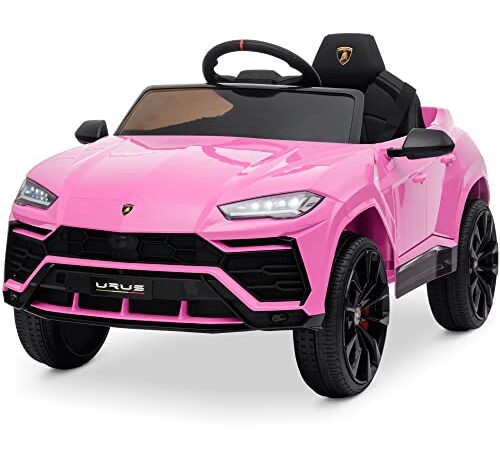
The relationship isn’t subtle. Owners of the Kidzone Lamborghini — a 12V system — describe behavior that maps directly onto this physics. One owner reports that neither the low nor high speed mode produced any noticeable difference on pavement, and the car was “super slow on the sidewalk” even with a full charge. Another describes it as moving at a “snail pace” that made it hard to walk alongside. That’s a 12V motor hitting its voltage floor under normal outdoor conditions with a real child aboard.

Watts set the ceiling, wheels set the demand

Motor power — measured in watts — determines how much total work the motor can do at any moment. Power is torque multiplied by rotational speed. For a fixed wattage, more torque demand means less speed. A 150W motor and a 350W motor both obey this rule, but the 350W motor can sustain more torque before speed collapses.

Now look at what each vehicle asks its motor to do. A two-wheeled scooter on pavement has two narrow contact patches and minimal rolling resistance. A six-wheeled UTV on dirt has six contact patches, each one deforming soft ground, each one draining torque. The UTV’s motor works harder at walking speed than the scooter’s motor works at ten miles per hour.

Add a slope. Gravitational resistance on an incline is proportional to the total mass — vehicle plus rider — and the sine of the angle. Even a gentle grade, something you’d barely notice on foot, adds roughly 17% of the total weight as resistive force at about ten degrees. For a 24V UTV carrying two kids, that’s a significant torque demand on top of the six-wheel rolling resistance that’s already eating into the power budget.

This is why form factor isn’t cosmetic. A dirt bike and a UTV with similar voltage ratings will perform very differently, because the dirt bike’s two wheels and single rider present a fraction of the resistance.

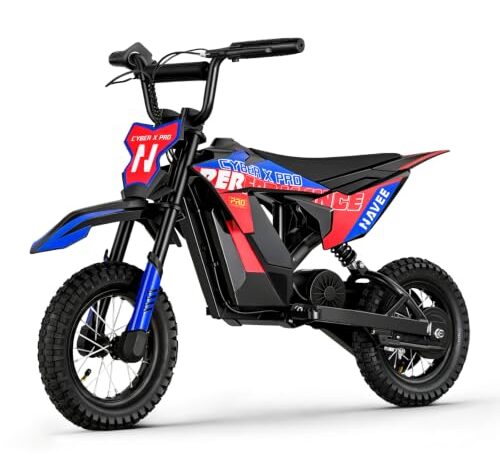
The NAVEE Cyber X Pro runs a 36V system with 350W peak power. That’s three times the voltage of the Lamborghini and more than double the wattage of the scooter. On a dirt bike chassis — two wheels, single rider, upright riding position — the motor faces less rolling resistance than any four-wheeled or six-wheeled alternative in this set.

The rated top speed is 15.5 MPH with a 132-pound maximum load, and the three speed modes let a parent cap the vehicle well below that ceiling. What matters more than the top number is what happens underneath it: 36 volts means the controller can cut aggressively on a hill and still leave enough voltage for the motor to push through. A 40% reduction still leaves 21.6V driving a 350W motor through two contact patches. That’s the physics of a vehicle that holds speed on dirt trails rather than crawling up a driveway lip.

The 9-mile range rating follows the same voltage logic in reverse — higher voltage at lower current draw per unit of speed means the battery sustains output longer before the cells sag. Range will drop on hills and with heavier riders, but it drops from a higher starting point.

Speed modes aren’t what you think

Both the NAVEE dirt bike and the ECOROAD scooter offer three speed settings. Parents tend to read these as safety limiters — lock the vehicle to a low speed until the child is ready. That’s true, but the mechanism is worth understanding because it changes how you think about battery life.

A speed mode caps the maximum voltage the controller delivers to the motor. At a lower setting, the motor spins slower and draws less current for any given resistance level. Less current means less heat in the windings, less drain on the battery, and a longer ride before the cells can’t sustain output. It’s not just slower — it’s more efficient.

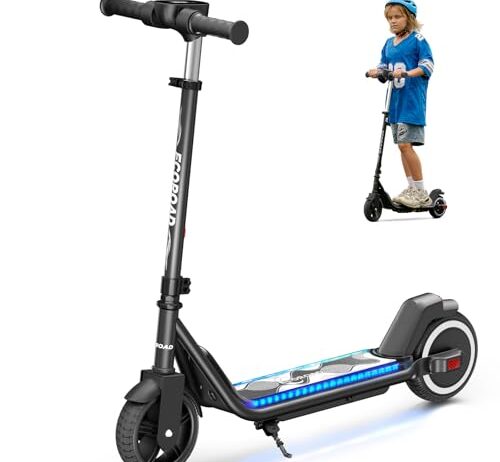
But here’s the trade-off. A capped voltage also means a lower torque ceiling. If a child on the ECOROAD scooter hits a gentle uphill in the 3 MPH mode, the controller has almost no headroom to maintain speed — it’s already running at low voltage, and the hill demands more current. The motor stalls sooner than it would in the 10 MPH mode, where the higher voltage gives the controller room to sacrifice speed for torque without hitting zero. One owner notes the scooter is slow even on flat ground, and another reports it performs poorly on even slight inclines. At 150W, the motor’s total power budget is thin, and a low speed mode makes the budget thinner.

The NAVEE’s three modes operate on the same principle but at a much higher absolute scale. Even its lowest setting delivers more voltage than the scooter’s highest, because the battery pack holds three times the electrical potential.

Surface changes everything, and six wheels make it worse

Rolling resistance is the force you have to overcome just to keep wheels turning at constant speed on level ground. On hard pavement, it’s low — the tire barely deforms, the surface doesn’t give, and the motor’s torque goes almost entirely into forward motion. On grass, the surface compresses under each wheel. On gravel, each wheel constantly climbs micro-obstacles. On soft dirt, the tire sinks and has to climb out of its own rut with every rotation.

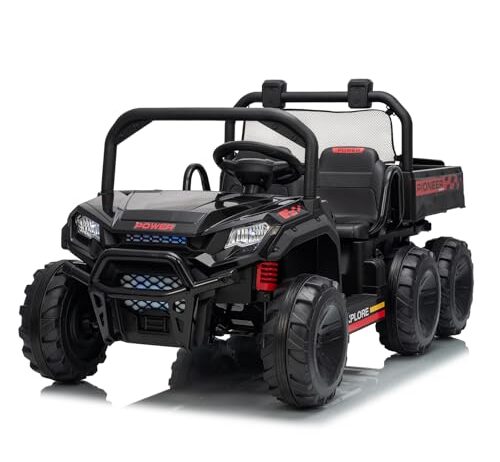
Now count the wheels. The ECOROAD scooter has two. The NAVEE dirt bike has two. The Kidzone Lamborghini has four. The Garvee UTV has six. Every additional contact patch multiplies the surface interaction. Six wheels on soft ground means six patches deforming turf, six patches the motor has to drag forward, six sources of resistance all feeding into the same torque demand.

The Garvee UTV compounds this with its intended use case: two riders, ages 3-8, on a 24V 4WD system. Two children weigh more than one. More weight means more gravitational resistance on any slope and more deformation of each tire-to-ground contact. The 4WD system distributes torque across four driven wheels, which helps with traction but doesn’t reduce the total energy required — it just spreads the current draw across multiple motor paths. The torque demand at the axles is the same regardless of how many wheels share the load.

The ECOROAD EK6 runs a 150W motor with three discrete speed modes: 3, 6, and 10 MPH. That’s the lowest power in this set by a wide margin — less than half the NAVEE’s peak wattage. On flat pavement with a lighter child, it moves fine. The moment conditions change, you see the motor’s limits clearly.

That clarity is actually useful. Switch between the 3 MPH and 10 MPH settings on the same gentle slope and you can watch the voltage-torque relationship play out in real time. At 3 MPH the scooter stalls on rises that the 10 MPH mode crawls through, because the higher mode gives the controller more voltage to trade for torque. For a child aged 6-12 learning to ride, the low modes on flat ground are genuinely appropriate — the scooter doesn’t need to climb hills to be worthwhile on a sidewalk or bike path.

The build quality draws real concern from owners. Multiple reports describe the rear fender breaking within a month, the charging port placed on the underside where debris collects, and a charger that severed inside the port. Those are durability problems unrelated to motor physics, but they determine whether the scooter lasts long enough for the child to outgrow it.

Battery life drops on hills for the same reason speed does

When a motor draws more current to produce more torque, it drains the battery faster. But it also wastes more of that energy as heat. Brushed DC motors lose efficiency at higher currents because resistive heating in the armature windings scales with the square of the current — double the current, quadruple the heat loss. The battery is delivering more energy per second, and a larger fraction of that energy never reaches the wheels.

This is why owners consistently report battery life dropping to half the rated duration on hilly terrain or with heavier riders. The motor isn’t just working harder — it’s working less efficiently while working harder. Both effects compound. A Kidzone owner reports the battery dying after three hours of indoor driving on tile floors, which present almost no rolling resistance. Outdoors on pavement — still flat, just a harder surface for small plastic wheels — the car was “super slow” and the battery died again after a similar period despite a longer charge. That’s a 12V system where even modest outdoor resistance pushes current high enough to trigger both speed reduction and accelerated drain.

The NAVEE’s 9-mile range rating will follow the same pattern. Nine miles on flat pavement with a light rider. Fewer miles on dirt trails with a heavier child. The advantage of 36V is that the current stays lower for any given speed, so the efficiency loss is smaller — but it never disappears.

Match the motor to the ground, not the child to the vehicle

The instinct is to shop by age range and price. A three-year-old gets a 12V car. A ten-year-old gets a scooter. But the physics doesn’t care about age. It cares about mass, surface, and slope.

A light five-year-old on flat pavement will get more out of a 12V car than a heavy three-year-old on grass. A 150W scooter on a bike path will hold speed better than a 350W dirt bike on loose sand — because the scooter’s two narrow wheels on hard ground face less resistance than knobby tires churning through granular surface, even though the dirt bike has more than double the power.

The real decision is about where the child rides. Flat sidewalks and driveways: voltage matters less, and a 12V system works until the child outgrows it physically. Grass, dirt, gravel, any slope at all: voltage matters enormously, because every surface change and every degree of incline eats into the motor’s speed budget. A 24V system on six wheels in dirt may deliver the same real-world speed as a 12V system on four wheels on pavement — the extra voltage gets consumed by the extra resistance, and the child sees no difference.

FAQ

Why does my kid’s ride-on slow down on hills even though the battery is full?

The motor controller is cutting voltage to limit current. Climbing a hill requires more torque, which draws more current through the motor windings. To prevent overheating, the controller reduces voltage — and since speed is proportional to voltage, the vehicle slows down. A full battery means the energy is there; the controller just won’t release it all at once to protect the motor.

Does 12V vs 24V vs 36V affect range or just speed?

Both, but through the same mechanism. Higher voltage means less current draw for any given speed, which means less resistive heat loss in the motor windings. The motor runs more efficiently, so the battery lasts longer per mile. A 36V system going the same speed as a 12V system uses less of its stored energy as waste heat — so it goes both faster under load and farther on a charge.

Is it normal for an electric ride-on to be slower on grass than pavement?

Completely normal. Grass deforms under each wheel, creating rolling resistance that doesn’t exist on hard pavement. The motor has to produce more torque to maintain the same speed, which draws more current, which triggers the controller to reduce voltage. The softer the surface and the more wheels touching it, the greater the effect. A six-wheeled vehicle on grass faces dramatically more resistance than a two-wheeled scooter on a sidewalk.

Will keeping a ride-on in low speed mode make the battery last longer?

Yes. A lower speed mode caps the voltage delivered to the motor, which means less current at any given resistance level and less heat wasted in the windings. The motor runs more efficiently at lower speeds. The trade-off is reduced ability to handle hills — less starting voltage means less headroom for the controller to maintain torque on an incline before the motor stalls.

How much does rider weight affect the speed of a kids’ electric vehicle?

Directly and proportionally. A heavier rider increases the torque required to maintain speed on any surface, and on inclines the gravitational resistance scales with total mass. The motor draws more current, the controller cuts voltage to compensate, and speed drops. This is why top speed ratings assume a light test weight on flat ground — add a real child and real terrain, and the number falls.