We research every product we recommend. We may earn a commission from the links on this page.
Automotive › Water Hoses & Fittings

Where Heated RV Water Hoses Fail First — and Why Length Matters

We compare published specifications and marketplace data. We do not test these products.

Heated Hoses Crack Where They Flex
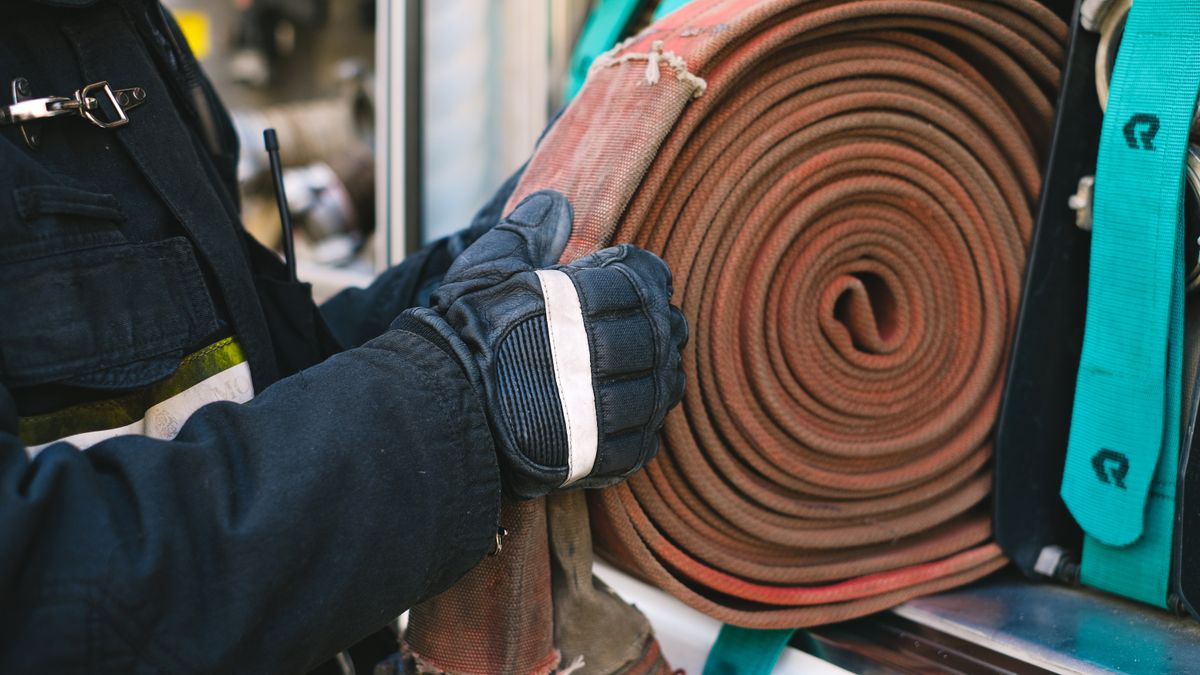
Photo by Anna Shvets on Pexels

Heated RV water hoses don’t fail in the middle. They fail at the ends — where the heating element meets a brass fitting and thermal expansion has nowhere to go — and at every point you coiled the hose for storage. The temperature rating on the label tells you when water freezes inside. It tells you nothing about when the jacket cracks, the element breaks contact, or a fitting leaks. Here’s where these hoses actually give out, why length and storage habits determine lifespan more than cold ratings do, and what separates the four most common options on the market right now.

Affiliate disclosure: This article contains affiliate links. We may earn a commission if you buy through them, at no extra cost to you.

Everything we recommend
4 picks

How we picked

We do not run heated water lines in winter conditions. Judgement is based on component specifications, temperature ratings, and marketplace review patterns.

Temperature rating, not headline number

We looked at the lowest rated operating temperature and whether the heating element is self-regulating or fixed-resistance.

Length against storage stress

Shorter hoses create fewer coil points. Longer hoses force tighter bends unless you have wall space to hang them loose.

Cost per foot, not total price

We divided sticker price by length to see which hose delivers the most coverage for the least money per linear foot.

Review count, not star average

We weighted hoses with higher review totals more heavily, since a larger sample reveals failure modes a dozen five-star ratings cannot.
Two Materials, Two Expansion Rates, One Joint

Every heated RV water hose is a sandwich: a water path, a resistive heating element running alongside it, and an insulation jacket holding heat in. At the ends, all three layers terminate against a metal fitting — brass on most models, sometimes stainless. That junction is where failure starts.

PVC expands at roughly 50 to 60 millionths per degree Celsius. Brass expands at about 19. When a hose cycles from -40°F overnight to 50°F by afternoon — a 90-degree-Fahrenheit swing that’s routine in a Colorado February — the PVC jacket is growing and shrinking nearly three times as much as the brass fitting it’s bonded to. Every cycle works the seal. Every cycle is a tiny fatigue event at the boundary between two materials that refuse to move together.

This is why heated hoses leak at the ends first. Not because the ends are poorly made, but because the ends are where dissimilar materials meet and thermal cycling has the greatest mechanical consequence.

Bends Concentrate Stress the Same Way Ends Do

The second failure point is every bend. Not because bending is rough on a hose — it is, but that’s not the main issue. The problem is that a bend forces the heating element, the water path, and the jacket into different radii. The element on the outside of a curve stretches slightly. The jacket on the inside compresses. Do that once and nothing happens. Do it through a thousand thermal cycles and you’ve created a fatigue zone.

Storage makes this worse. A 50-foot hose coiled in a compartment has the same six or eight bend points every time it’s stored. Those aren’t random bends — they’re permanent stress risers, and each one gets every heating-cooling cycle the hose goes through, even in storage if the compartment isn’t climate-controlled. A hose stored loosely in large loops puts less curvature at each bend. A hose jammed into a tight compartment concentrates curvature into fewer, sharper points.

The longer the hose, the more coil points it has. A 75-foot hose necessarily bends in more places than a 25-foot one, and each of those bends is a potential failure site that accumulates fatigue independently.

What the Cold Rating Actually Tells You

A -45°F or -47°F rating means the heating element can keep water above 32°F when the air is that cold — assuming the hose is powered, fully extended, and not losing heat faster than the element produces it. It does not mean the jacket, the fittings, or the element itself survive that temperature indefinitely.

PVC gets brittle below 0°F. Not unusable, but measurably less flexible. At -40°F it’s stiff enough that bending the hose to route it around a corner creates real stress on the jacket material. The cold rating and the jacket’s mechanical limits are two different numbers answering two different questions, and the rating on the label only answers one of them.

The practical difference between -40°F and -47°F protection is smaller than it looks. Seven degrees of additional margin matters in a sustained cold snap, but the thermal cycling — the daily swing from nighttime lows to daytime highs — is what drives fatigue. A hose rated to -47°F that sees 30-degree daily swings is under more mechanical stress per cycle than a -40°F hose in a climate where temperatures hold steady at -20°F.

Self-Regulating vs. Fixed-Resistance Elements

A self-regulating heating element uses a conductive polymer whose resistance rises as it warms. Warmer sections draw less current automatically; colder sections draw more. This does two useful things: it reduces total power consumption, and it prevents hot spots where a section of hose is insulated by contact with another object — a wall, a tire, another coil of hose.

A fixed-resistance element puts the same wattage per foot everywhere, regardless of local temperature. If one section is already warm and another is exposed to wind, they both get the same heat input. The warm section wastes energy. The cold section might not get enough.

For failure modes, the difference matters most in coiled storage. A coiled hose with a fixed-resistance element heats the inner coils more than they need — each layer insulates the one below it, trapping heat. That accelerates thermal aging of the jacket material at the coil points, which are already the highest-stress locations. A self-regulating element backs off power in those warm inner coils, reducing the thermal stress at exactly the points that are most vulnerable to fatigue.

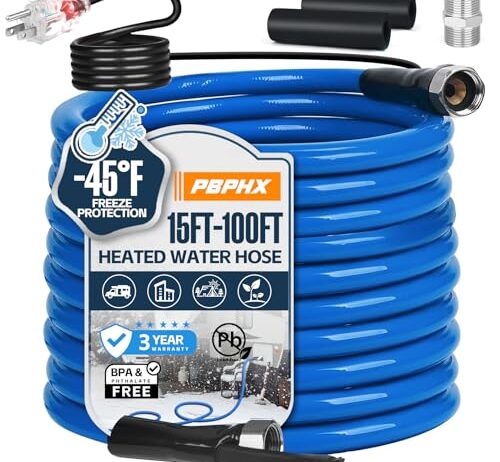
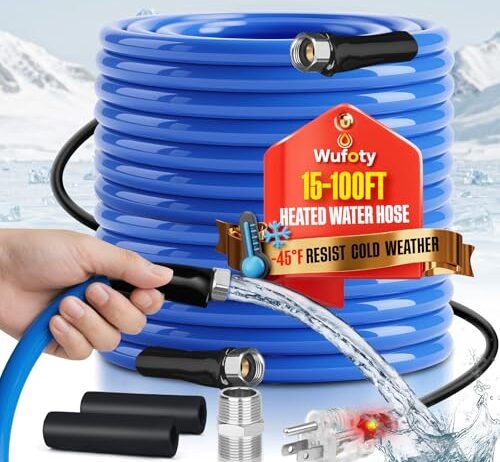
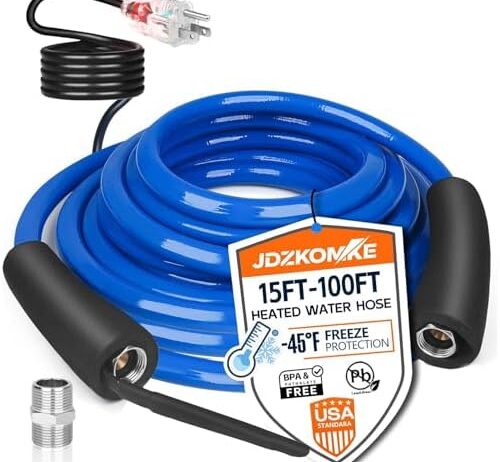
The Wufoty’s -47°F rating gives it the widest margin before freeze-through of any hose here. That matters less for a single cold night and more for a sustained cold snap where temperatures stay below -35°F for days — the scenario where a -40°F-rated hose is running at the edge of its capacity and a -47°F hose still has headroom.

At 25 feet, this is a short hose. That’s a limitation if your hookup is far from the spigot, but it’s an advantage for longevity: fewer coil points in storage, less total length where the heating element can develop a fatigue break, and easier to store in large, gentle loops rather than tight coils. The 1/2-inch inner diameter is standard across every hose in this comparison — flow rate differences, if any, come from fitting design and connection quality, not bore size.

At $78.99, it costs more per foot than the 50-foot option but less than the other 25-foot hose here. The per-foot price is less important than whether 25 feet actually reaches your connection point — a hose that’s too short means adding a non-heated section, and that unheated joint is exactly the kind of stress point where failures start.

How Length Changes the Failure Math

A 25-foot hose stored in a single large coil might have four or five bend points. A 75-foot hose stored in the same compartment has twelve to fifteen. Each bend point is an independent fatigue site. More bend points means more places where the jacket, element, or both can develop a crack — not because the hose is worse, but because there’s simply more of it to go wrong.

Length also changes the power equation. A longer heating element draws more current. On a 15-amp circuit shared with other RV loads — a space heater, a water heater, a converter — a 75-foot heated hose might push the circuit closer to its limit than a 25-foot one. Running near capacity means the breaker trips more often, which means the hose spends more time unpowered in freezing conditions, which means more freeze-thaw cycles on the water inside — and water expanding 9% as it freezes generates pressures that can exceed 25,000 psi in a confined space.

The cheapest per-foot option isn’t necessarily the best value if it fails a season earlier because of storage stress. A hose you can store in gentle curves without forcing it into a tight compartment will outlast one that gets jammed into a bay every spring.

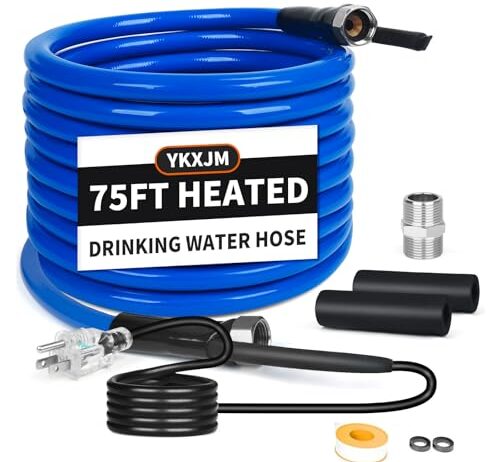
Seventy-five feet of heated hose is a lot of hose. It reaches hookups that shorter options can’t, and it’s the right choice when your site puts the spigot far from the rig. But 75 feet also means the most coil points, the most bend stress in storage, and the longest run of heating element drawing power from a single circuit.

The YKXJM’s self-regulating element is the feature that makes this length practical for multi-season use. In a coil, inner layers insulate each other. A fixed-resistance element would keep pumping the same wattage into those warm inner sections, accelerating jacket aging at the exact points where mechanical stress from bending is already highest. A self-regulating element backs off automatically — less heat where it’s already warm, more where it’s exposed to cold air. That reduces the thermal cycling amplitude at coil points, which is the single biggest driver of jacket fatigue.

The lead-free and BPA-free construction matters if you’re running drinking water through it — and if you’re connected to a campground spigot, you probably are. At $185.99 it’s the most expensive hose here by a wide margin, but $2.48 per foot is less than either 25-foot option on a per-foot basis.

Continuous Use vs. Power Cycling

Leaving a heated hose plugged in and pressurized all winter is standard practice. The element keeps the water above freezing, the insulation jacket holds that heat in, and the water flows on demand. Unplugging it overnight to save electricity means the water inside cools — and if it freezes, the expansion puts enormous stress on the hose walls.

One full freeze-thaw cycle is more mechanically damaging than a week of continuous powered operation. Water expanding 9% as it transitions to ice generates pressures that dwarf anything normal water pressure produces. The hose might survive one freeze. It might survive ten. But each one is a high-stress event that the hose was designed to prevent, not withstand.

The power draw argument for cycling is real — a heated hose running 24/7 adds to your electrical load — but the cost of replacing a burst hose, cleaning up a flooded compartment, and being without water in a freezing campground is higher than the electricity. Leave it on.

Storage Habits That Extend Hose Life

Store in the largest loops the space allows. Every tighter coil increases curvature at the bend point and increases fatigue accumulation per cycle. If you can hang the hose in a loose figure-eight from two hooks, the bend radius at each curve is wide enough that thermal cycling doesn’t concentrate stress the way a tight coil does.

Drain the hose before storing. Water left inside during off-season storage can freeze in an unheated compartment, and a single uncontrolled freeze in a depressurized hose can crack fittings or break the heating element at a bend point.

Keep fittings clean and inspect them before each season. Corrosion on brass threads doesn’t just cause leaks — it changes the mechanical bond between the fitting and the hose jacket, which changes how thermal expansion stress distributes at that joint. A fitting that was hand-tight and leak-free last March might be the failure point next January if corrosion has weakened the seal.

FAQ

How long do heated RV water hoses last with daily winter use?

Most heated RV hoses last two to four winter seasons with continuous use. The main variables are storage habits and how many tight bend points accumulate fatigue. A hose stored in gentle loops between seasons lasts longer than one jammed into a tight compartment, because each sharp bend is an independent fatigue site that accumulates damage with every temperature cycle.

Can you leave a heated water hose plugged in all winter?

Yes, and you should. A single freeze-thaw cycle — water expanding 9% as it turns to ice — puts more mechanical stress on the hose than weeks of continuous powered operation. The power draw is real but modest, and the cost of a burst hose in a freezing campground is far higher than the electricity.

Why do heated hoses fail at the ends first?

The ends are where PVC meets brass, and those two materials expand at very different rates — PVC moves roughly three times as much per degree as brass. Every temperature cycle works that joint. Over hundreds of cycles across a winter, the repeated push-and-pull at the boundary weakens the seal until it leaks.

Do you need to uncoil a heated hose completely for it to work?

The hose will heat whether coiled or uncoiled, but a coiled hose traps heat in the inner layers. With a fixed-resistance element, this creates unnecessary hot spots that accelerate jacket aging. With a self-regulating element, the inner coils automatically draw less power. Either way, running the hose fully extended is better for longevity and even heat distribution.

What’s the difference between a self-regulating and fixed-resistance heated hose?

A self-regulating element adjusts its heat output based on local temperature — warm sections draw less power, cold sections draw more. A fixed-resistance element puts the same wattage everywhere regardless. The practical difference shows up most in coiled storage and partially sheltered runs, where a self-regulating element avoids overheating sections that are already warm.

Will a heated hose work if part of it freezes?

If the element is powered and only a short section froze due to a power interruption, the element will eventually thaw it. But ice expanding inside the hose generates extreme pressure — potentially exceeding 25,000 psi — and each freeze event risks cracking the hose wall or breaking the heating element at a bend point. Prevention is far better than recovery.