
We research every product we recommend. We may earn a commission from the links on this page.
Electronics › Glasses

Open-Air Speakers Lose Most of Their Sound Before It Reaches Your Ear

We compare published specifications and marketplace data. We do not test these products.

Bluetooth Audio Sunglasses Run Two Radios at Once
Photo by Kindel Media on Pexels

A sealed earbud pushes sound straight down your ear canal. A speaker mounted in a sunglasses temple pushes sound in every direction at once — and your ear catches a fraction of it. That physics problem sits behind every complaint about Bluetooth audio sunglasses: not loud enough, battery dies too fast, the person next to you hears your podcast. Four current models handle the trade-offs differently, and the right one depends less on which sounds best than on where you plan to wear it.

Affiliate disclosure: This article contains affiliate links. We may earn a commission if you buy through them, at no extra cost to you.

Everything we recommend
4 picks
Also great · photochromic
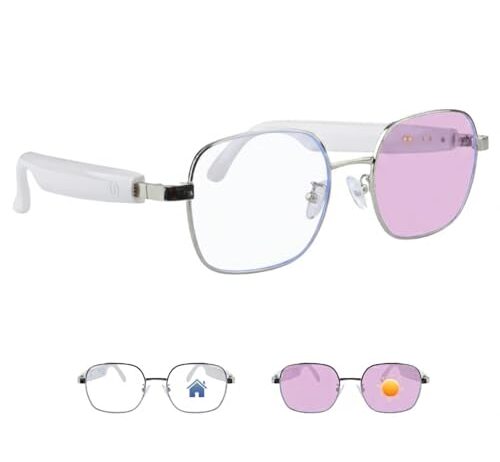
Translation plus photochromic lenses

Translation plus photochromic lenses

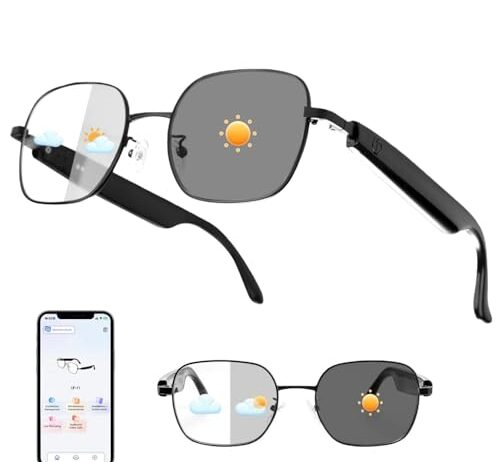
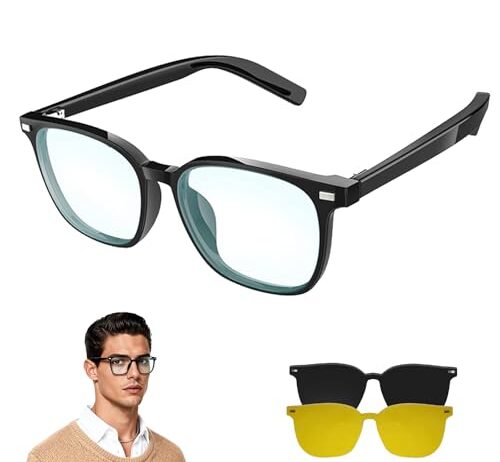
AI Smart Glasses, Bluetooth Audio Glasses with Real-Time Translator (164 Languages), Free APP, Photochromic Sunglasses, Music/Call, Unisex Translation Glasses for Travel/Work (Black)
★ 4 16 reviews

164-language translation with lenses that darken automatically in sun and clear indoors. Requires a free companion app for translation. Suits travelers who move between indoor and outdoor settings throughout the day.
How we picked

We did not wear these glasses. Judgements rest on published driver size, battery capacity, lens specifications, and marketplace feedback patterns.

Speaker efficiency, not peak volume

Measured driver diameter and stated sensitivity determine how much sound reaches the ear at a given battery draw.

Lens physics, not feature lists

Polarization filters reflected glare; photochromics respond to UV intensity. Different mechanisms suit different lighting conditions.

Battery capacity against feature load

Translation processors and auto-tint circuitry pull current. Stated mAh must cover declared runtime under the full feature set.

Frame geometry from published dimensions

Temple length, bridge width, and lens height determine speaker position relative to the ear canal and suit different face proportions.
Why turning up the volume costs you three times over

A sealed earbud directs virtually all its acoustic energy into a small, closed space — your ear canal. An open-air speaker in a sunglasses temple radiates omnidirectionally. The sound pressure reaching your ear drops by 15 to 30 dB compared to what a sealed earbud delivers at the same amplifier output. To get equivalent perceived loudness, the amplifier has to push 5 to 10 times more electrical power through the driver.

That’s not just a battery problem. It’s three problems stacked.

First, the battery drains faster — proportionally to how hard the amplifier works. Second, the extra energy that doesn’t reach your ear goes everywhere else, which means bystanders within a few feet hear a tinny version of whatever you’re playing. Third, the tiny lithium-polymer cell in a sunglasses temple has far less capacity than the one in an earbud case, and it’s already powering a Bluetooth radio that draws 1 to 3 watts during active audio streaming.

Every Bluetooth audio sunglasses user eventually finds their volume ceiling: the point where it’s loud enough to hear but quiet enough that the person at the next café table can’t. That ceiling moves depending on ambient noise, and it’s always lower than you want it to be.

Translation adds a second processor drawing from the same cell

Two of these four models include real-time AI translation — one across 169 languages, the other across 164. That feature requires more than a Bluetooth radio and an amplifier. It needs a data connection through your phone, processing overhead for the translation engine, and continuous microphone input to capture speech.

Standard Bluetooth audio streaming is already the dominant power consumer in smart glasses. Adding translation processing on top means the battery is serving two demanding masters simultaneously. You’re streaming audio in one direction and piping speech recognition and translation data in the other, all through the same Bluetooth connection and the same small battery.

The two models without translation — one with photochromic lenses and women-specific frame geometry, the other with a magnetic dual-lens system — don’t carry that processing overhead. Their batteries serve only audio and connectivity. That’s a real difference in how long a charge lasts during active use, not because the batteries are necessarily larger, but because less is drawing from them at any given moment.

If you need translation for travel, you’re accepting shorter runtime per charge as part of the deal. If you don’t need translation, you’re paying for circuitry and software that actively competes with your music for power.

Photochromic versus polarized: different problems, different physics

The lens choice here splits two ways, and they solve different things.

Photochromic lenses contain molecules — typically naphthopyrans — that change shape when UV radiation hits them. Walk outside and they darken within 30 to 60 seconds. Step back inside and they fade over two to five minutes. The transition speed slows in cold weather because the molecular reaction is temperature-dependent. You get one pair of glasses that works indoors and out, but you don’t get glare reduction. Photochromic darkening and polarization are separate optical properties.

Polarized lenses contain a fixed vertical filter that blocks horizontally oscillating light — the kind that bounces off water, pavement, and car hoods. They cut reflected glare by 50 to 90 percent depending on the angle. But they’re always dark. Wear them inside and everything looks dim.

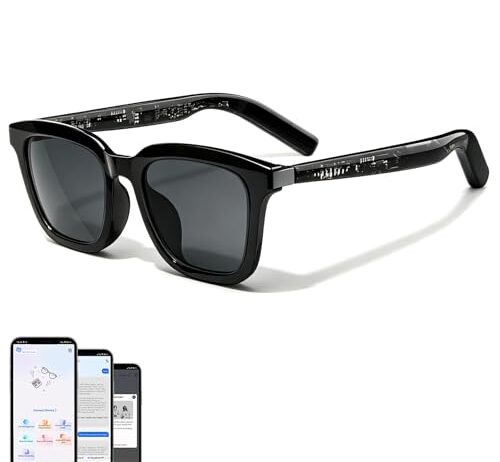
One model solves this with a magnetic attachment system: clear blue-light-blocking lenses for indoor screen work, polarized UV400 lenses that snap on for outdoor use. You carry two sets of lenses instead of relying on chemistry to handle the transition. That’s more versatile but means keeping track of a second pair of lenses.

UV400, for reference, means the lens blocks ultraviolet wavelengths up to 400 nanometers — covering both UVA and UVB. That designation alone doesn’t tell you anything about polarization or visible light filtering. It’s a UV safety baseline, not an optical performance claim.

The magnetic lens system is the distinguishing feature here. Instead of relying on photochromic chemistry — which can’t polarize and takes minutes to clear indoors — you physically swap between two lens types. Clear lenses with blue-light filtering for screen work. UV400 polarized lenses for driving or water. The magnet holds them in place; switching takes seconds.

The auto on/off wearing sensor addresses one of the quieter battery drains in audio sunglasses. A Bluetooth radio consumes baseline current even when no audio is playing, just maintaining the connection to your phone. If you set these on a desk and forget to manually power them down, that idle draw eats into your next listening session. The sensor cuts power when the frames leave your face. Whether that saves meaningful battery depends on how often you take them off — during a workday of on-and-off wear, it adds up. During a continuous four-hour drive, it’s irrelevant.

This model doesn’t include translation. That’s the trade-off for the lens versatility: no processing overhead competing with audio playback for power. If your use case is cycling between indoor meetings and outdoor commuting with music or calls, the dual-lens system and power management focus fit that pattern better than a translation engine you’d never activate.

When translation justifies the battery cost

Real-time translation through sunglasses sounds like it should be a gimmick. For a specific kind of traveler, it’s not.

Both translation models require a companion app on your phone and an active data connection — the processing happens through the app, not on the glasses themselves. That means no offline translation. If your phone loses signal in a foreign subway station, the glasses are just sunglasses with speakers.

But in the right context — navigating a market in a language you don’t speak, sitting through a business meeting conducted in a second language — having translation piped directly to speakers at your temples while your hands stay free is functionally different from holding up a phone with a translation app on screen. You hear the translation while maintaining eye contact and social normalcy. That’s not a spec advantage. It’s a behavioral one.

The processing demand is real, though. Active translation means the Bluetooth connection is carrying bidirectional data — incoming audio from the phone’s translation engine and outgoing speech from the glasses’ microphone — on top of whatever music or call audio you might pause during a conversation. Battery draw during active translation sessions will be measurably higher than during music-only playback.

The 169-language range covers the major travel corridors plus most regional languages you’d encounter across Europe, Asia, and South America. The polarized lenses handle tropical and equatorial glare — water, sand, road surfaces — without needing to darken or transition. For someone who travels internationally and spends time outdoors, the combination targets the right problems simultaneously.

The auto on/off sensor matters more here than on a purely audio pair. Translation sessions tend to be intermittent — a five-minute conversation at a hotel desk, then twenty minutes of walking, then another exchange at a restaurant. Without automatic power management, you’d either leave the glasses running between conversations (draining idle battery) or manually cycle them (annoying with sunglasses you’re wearing continuously). The sensor handles the gap.

Frame geometry is designed for wider faces. If your head measures on the narrow side, the temples may not seat the speakers close enough to your ears for comfortable listening volume — and with open-air speakers, every millimeter of extra distance between driver and ear canal reduces what you actually hear. Fit isn’t cosmetic here. It’s acoustic.

The fit problem nobody warns you about

With conventional sunglasses, a loose fit is a cosmetic issue. With audio sunglasses, it’s a functional one.

The speakers sit in the temple arms, positioned to fire sound toward your ear opening. If the frames slide down your nose — from sweat, from activity, from being slightly too wide — the speaker angle shifts. You lose volume. You lose whatever bass response the small driver was producing. And because you can’t seal the acoustic path the way an earbud does, you can’t compensate by just turning up the volume without also broadcasting to everyone nearby.

This is why frame geometry descriptions matter more than they would on passive sunglasses. A model designed for wide faces on a medium-width head will sit with the temples angled outward, pulling the speakers away from the ear. The reverse — narrow-designed frames on a wide head — presses the temples uncomfortably and may push the speakers past your ear opening entirely.

There’s no universal fit standard across these products. Try the frame on and play audio before committing. If you can’t, measure your current glasses temple-to-temple and compare.

What wears out first

Lithium-polymer batteries lose roughly 20 percent of their capacity after 500 full charge cycles. That’s the same chemistry in your phone, but the cell in a sunglasses temple is much smaller — so 20 percent of a small battery is a bigger functional loss than 20 percent of a 4,000mAh phone cell.

Temple-mounted batteries also face a specific environmental stress that phone batteries mostly avoid: sustained solar heat exposure. You’re wearing these outside, in direct sun, on your head. The battery sits inside a dark plastic temple arm that absorbs heat. High temperatures accelerate lithium-polymer degradation. After a year of daily outdoor use, you may notice runtime dropping noticeably — not because the glasses are broken, but because the chemistry has aged faster than it would inside a pocket or bag.

The mechanical concern is the hinge. Standard sunglasses hinges flex a simple frame. Audio sunglasses hinges flex a frame that contains wiring connecting the temple electronics to whatever sits in the bridge or front. Repeated folding and unfolding stresses those internal connections. A wire that fatigues inside a sealed temple is invisible until one side stops producing sound.

None of these products advertise user-replaceable batteries. When the cell degrades past usability, the glasses are done. Plan accordingly.

Matching the pair to the situation

The decision isn’t which pair sounds best — open-air speakers in this size class all share the same fundamental acoustic limitations. It’s which combination of secondary features fits the way you’ll actually use them.

Outdoors all day, moving between sun and shade: photochromic lenses save you from carrying a second pair or swapping lenses. You lose polarization, which means glare off water and pavement isn’t filtered, but you gain seamless indoor-outdoor transitions.

Commuting between office and outside, screens to sunlight: the magnetic dual-lens system covers both environments with the right optical filter for each, and the lack of translation overhead means more of the battery goes to audio.

International travel with language gaps: translation is the reason to buy, and both translation models cover the major language sets. The choice between them comes down to lens preference — polarized and fixed, or photochromic and adaptive — and face width.

If your primary use is just music and calls while driving or walking, any of the four will do that. The question is whether you’re paying for translation you won’t use or lenses that don’t match your light conditions. Strip the feature list to what you’ll actually activate on a given Tuesday, and the right pair usually becomes obvious.

FAQ

Can people near me hear what I’m playing on audio sunglasses?

Yes, especially above moderate volume. Open-air speakers radiate sound in all directions — there’s no seal between the driver and your ear. In a quiet room, someone within three to four feet will hear a tinny version of your audio. Outdoors with ambient noise, the leakage is less noticeable because background sound masks it, but you’ll also need higher volume to hear it yourself, which increases leakage again.

Do translation sunglasses work without an internet connection?

The translation models here require a companion app on your phone and an active data connection. The speech recognition and translation processing happen through the app, not on the glasses. No signal means no translation — the glasses still play music and take calls via standard Bluetooth, but the language features go offline with your phone’s connection.

Do photochromic lenses drain extra battery in audio sunglasses?

No. Photochromic darkening is a chemical reaction triggered by UV light — the lens molecules change shape when sunlight hits them and revert when it doesn’t. There’s no electrical component to the tinting process. The battery powers only the Bluetooth radio, amplifier, and speakers regardless of what the lenses are doing.

How long do Bluetooth sunglasses last before the battery wears out permanently?

Lithium-polymer batteries typically lose about 20 percent of their capacity after 500 full charge cycles. If you charge daily, that’s roughly 18 months before you notice shorter sessions. Temple-mounted cells face additional heat stress from sun exposure during outdoor wear, which can accelerate degradation. None of these models offer user-replaceable batteries.

Will Bluetooth audio sunglasses stay connected if my phone is in my bag?

Standard Bluetooth maintains a reliable connection within about 30 feet with no obstructions. A phone in a bag on your person — back pocket, purse, backpack — is well within range. You may get dropouts if you walk 20-plus feet from a bag you’ve set down, or if thick walls or dense crowds create interference. The connection is the same Bluetooth profile your wireless earbuds use.