We research every product we recommend. We may earn a commission from the links on this page.

Shelf Brackets Sag Because of Where You Put the Weight, Not How Much

We compare published specifications and marketplace data. We do not test these products.

Shelf Brackets Bend When the Load Sits Too Far Forward
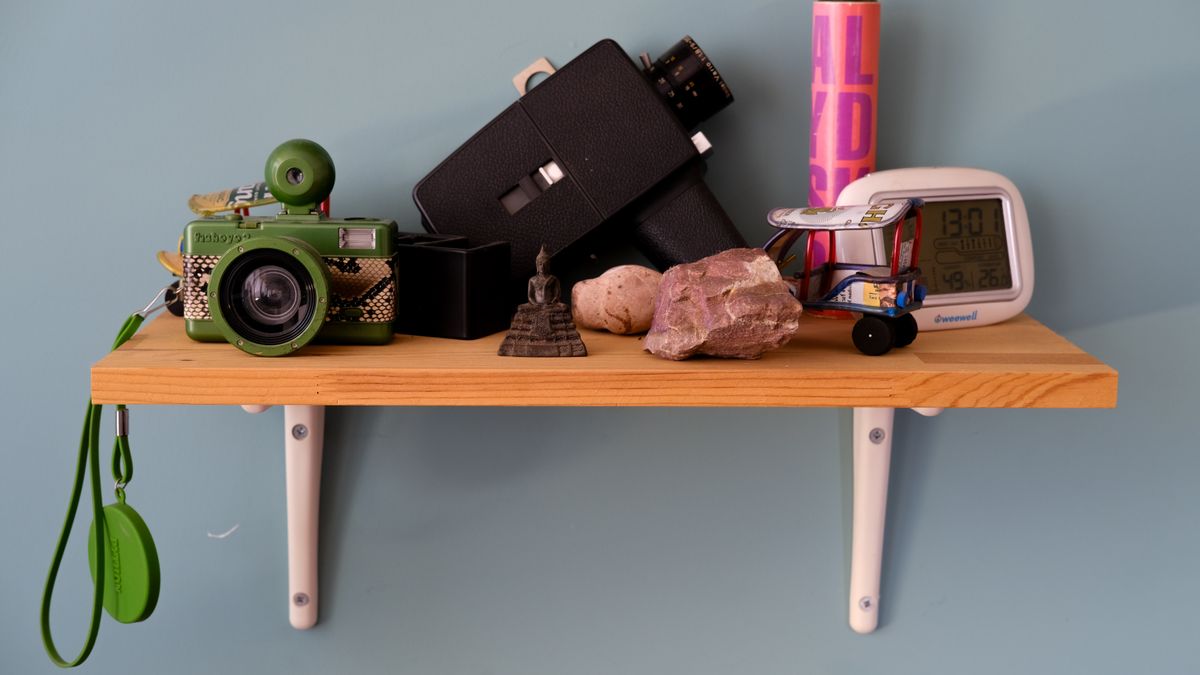
Photo by Cem Nisan on Pexels

An 8-inch shelf bracket holding 20 pounds dead-center at 4 inches from the wall experiences half the bending stress of the same bracket holding the same 20 pounds at the front edge. That’s not a design flaw — it’s a lever. And it’s the single biggest reason brackets sag under loads well within their stated capacity. Understanding where stress actually concentrates changes how you choose a bracket, how you mount it, and where you place the heavy stuff.

Affiliate disclosure: This article contains affiliate links. We may earn a commission if you buy through them, at no extra cost to you.

Everything we recommend
4 picks
Also great · lighting
Forty inches with built-in light

Forty inches with built-in light

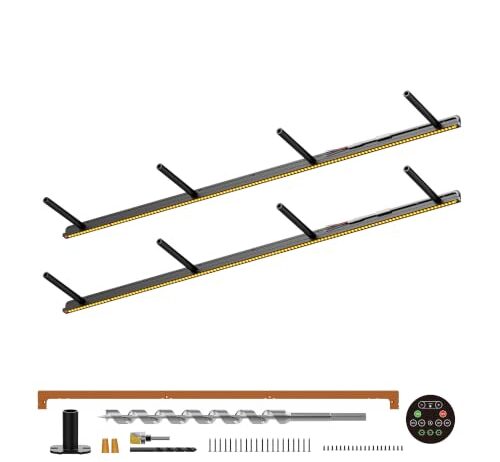
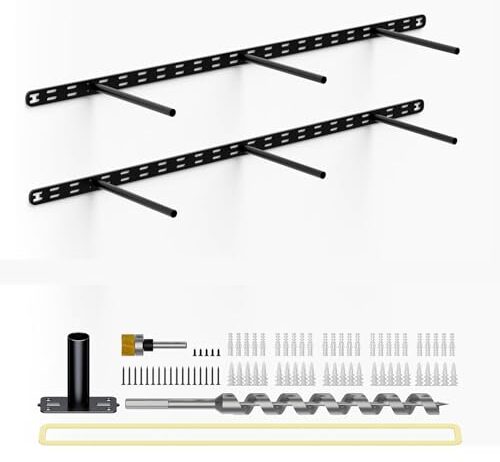
2pcs Floating Shelf Bracket with LED Lights,Hidden Shelf Brackets Heavy Duty Floating Shelf Hardware with Remote Control,Mantel Bracket Lighting (40"x8"x1.2")
★ 4.2 28 reviews

The longest bracket here at 40 inches with integrated LED lighting and a 1.2-inch profile that adds roughly 44% more bending resistance than the 1-inch alternatives — the thickness serves double duty as both wiring channel and structural reinforcement.
Budget pick
Shorter lever, less anchor stress

Shorter lever, less anchor stress

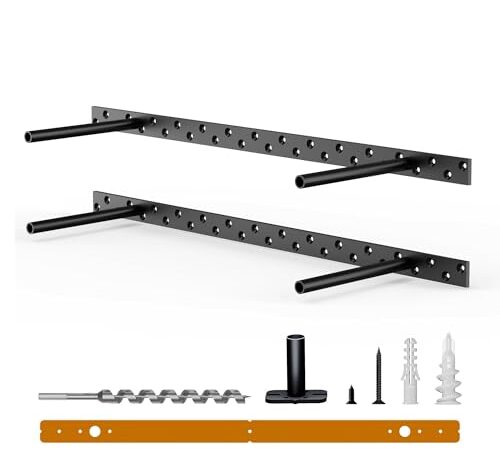
2pcs Floating Shelf Bracket Heavy Duty Decorative Floating Shelf Hardware Black Hidden Shelving Brackets for Wall,Floating Mantel Bracket for Over Fireplace (34X6X1 inch (for 1.5"-2" Thick S
★ 4.3 38 reviews

Six-inch projection at 34 inches of span — the shortest depth in this set reduces wall-mount pull-out force by 25% compared to 8-inch brackets, a meaningful advantage when mounting into drywall anchors instead of studs.

How we picked

We do not mount or load-test brackets. These recommendations derive from published dimensions, material specifications, and marketplace review patterns.

Load center distance, not capacity claims

Bracket depth and projection geometry determine bending stress at the wall mount far more than stated weight limits.

Material thickness, not finish

Steel gauge and cross-sectional profile directly determine deflection resistance under asymmetric loading conditions.

Triangle versus cantilever design

Diagonal bracing converts bending forces into compression; floating brackets rely entirely on material stiffness and wall anchoring.

Aspect ratio, not span alone

The ratio of bracket length to projection depth determines mid-span deflection behavior under distributed loads.
A Shelf Bracket Is a Lever You Bolted to the Wall

Every shelf bracket is a cantilever — one end fixed to the wall, the other hanging free. The bending moment at the wall mount equals the weight on the shelf multiplied by the horizontal distance from the wall to wherever that weight sits. Move a 10-pound vase from 2 inches out to 6 inches out, and you’ve tripled the stress at the mounting point without adding a single ounce.

This is why bracket depth is the most consequential dimension on the package, and why it’s the one most buyers skip past. An 8-inch bracket projecting from the wall gives a book sitting at the front edge an 8-inch lever arm. A 6-inch bracket shortens that arm by 25%, which means 25% less bending stress at the wall for the exact same book in the exact same position relative to the shelf’s front edge. The trade-off is real: a shallower bracket means the shelf sits closer to the wall, which limits what you can store on it. But for a display shelf holding picture frames and small plants, that shorter moment arm is doing more structural work than any amount of “heavy duty” stamped on the steel.

Deflection — the visible sag — scales even more aggressively. Double the bracket’s projection and tip deflection increases by a factor of eight for the same load and cross-section. That’s a cubic relationship. It’s why an 8-inch bracket that feels rock-solid holding a candle near the wall develops a visible bounce when you stack books at the front edge.

Triangle Versus Floating: Two Different Answers to the Same Force

A triangular bracket — the kind with a visible diagonal brace running from the wall to the shelf’s underside — handles load fundamentally differently from a hidden floating bracket. The diagonal member converts the downward shelf load into compression along the brace and tension at the upper wall mount. That’s efficient. Compression along a steel bar is what steel is best at resisting, and it avoids the pure bending that cantilever brackets fight against.

A floating bracket does the opposite. It embeds into the shelf’s back edge and cantilevers straight out from the wall, relying entirely on its cross-section to resist bending. The visual payoff is a shelf that appears to hover — no visible hardware underneath. The structural cost is that all the stress concentrates at the embedded portion where the bracket enters the wall, and the bracket’s resistance depends entirely on its section modulus: how thick and how tall the metal is at that critical junction.

Neither approach is wrong. But they fail differently. A triangle bracket that’s overloaded shows it at the diagonal — the brace buckles or the fastener at the bottom pulls. You can see it happening. A floating bracket that’s overloaded rotates slowly at the wall, tipping the shelf forward in a way that looks like the shelf is pulling away from the wall when it’s actually the bracket bending at its root.

Span Length Changes the Problem

A 28-inch bracket and a 40-inch bracket projecting the same 8 inches from the wall are not the same structural problem scaled up. The longer bracket introduces bending between its own wall-mounting points — the bracket itself becomes a beam spanning the distance between screws, loaded by the shelf weight distributed along its length.

Think of it this way: a short bracket transfers load almost directly into two nearby wall anchors. A 40-inch bracket spreads the load across a much wider span, but the bracket’s own material has to bridge that gap without sagging. If the mounting points are at the ends, the bracket’s midpoint is an unsupported beam carrying the shelf load above it. The bracket needs enough stiffness in its own right to resist bending along its length, not just enough depth to resist the cantilever moment perpendicular to the wall.

This is where thickness matters. A 1.2-inch-thick bracket has roughly 70% more section modulus than a 1-inch bracket of the same height — meaningful when the bracket is spanning 40 inches between its outermost mounting points. That extra material isn’t cosmetic. It’s the difference between a bracket that holds flat across its full span and one that develops a gentle bow at center under load.

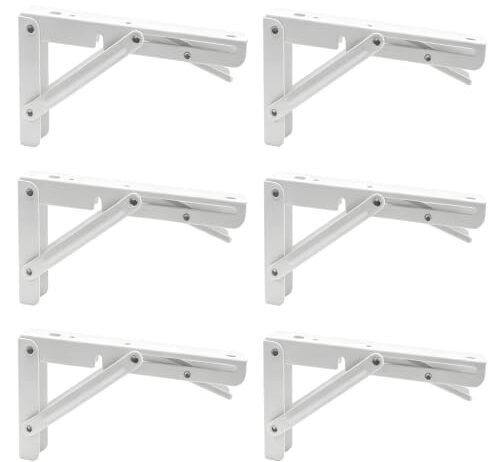
The triangle design here isn’t decorative. That diagonal brace running from the wall to the shelf’s underside is doing the structural work that hidden brackets handle with sheer material thickness. Downward force on the shelf pushes the brace into compression — steel resisting a squeeze along its length, which is the loading condition steel handles best. The top mount takes tension, pulling straight out from the wall. Neither load path asks the bracket to bend, which is why triangular bracing has been the default in structural engineering for centuries before floating shelves became a style preference.

The stainless steel construction trades some yield strength for corrosion resistance — stainless grades typically yield around 30 ksi versus 36-50 ksi for structural mild steel. In a bathroom or kitchen where moisture is constant, that trade-off matters. The 8-inch depth gives a moderate moment arm, and because the diagonal brace shortens the effective cantilever, the actual stress at the wall mount is lower than an 8-inch floating bracket carrying the same load. At $39.99, it’s roughly half the cost of the floating alternatives here, which tracks: less material, simpler fabrication, no embedded mounting hardware to engineer.

When Bracket Depth Should Match Shelf Depth — and When It Shouldn’t

The instinct is to match the bracket’s projection to the shelf’s depth. If you have a 10-inch-deep shelf, you want a 10-inch bracket. That instinct is mostly right, but the reasoning matters.

A bracket shorter than the shelf leaves the front portion of the shelf unsupported. Load placed on that overhang creates an additional lever arm beyond the bracket’s tip, and the shelf board itself has to resist bending across that gap. For solid hardwood, that’s usually fine — wood has reasonable flexural strength across the grain, and a 2-inch overhang on a 1.5-inch-thick oak shelf won’t deflect noticeably. For particleboard or MDF, that same overhang sags under a stack of books because the board’s internal structure can’t resist the bending.

Going the other direction — a bracket deeper than the shelf — wastes projection. The bracket extends past the shelf’s back edge and contributes nothing, or worse, the shelf doesn’t sit flush against the wall because the bracket prevents it.

For decorative shelves holding light objects, a bracket that’s 60-70% of shelf depth often works. The front third of the shelf carries almost nothing, and the shorter bracket reduces visual bulk (for triangle brackets) or wall-mount stress (for both types). The math is straightforward: if 90% of your load sits within the bracket’s depth, the overhang contributes almost nothing to the bending moment.

At 6 inches of projection versus 8, this bracket shortens the moment arm by a quarter. For the same load at the same relative position on the shelf, bending stress at the wall drops by 25%. That’s not a subtle difference — it’s the margin between a bracket that holds firm in drywall anchors and one that slowly works its fasteners loose over months.

The 34-inch span puts it in the middle of this set, long enough for a mantel-style shelf but not so long that mid-span deflection becomes a concern. The explicit compatibility with 1.5- to 2-inch shelf stock is worth noting because floating brackets need enough shelf thickness to embed into without the mounting hardware showing through. A shelf thinner than the bracket’s designed range sits loose on the bracket or requires shimming, neither of which maintains the rated load path. The pair ships together at $98.99, which prices out to roughly $49.50 per bracket — reasonable for a hidden-mount design that eliminates visible hardware entirely.

Studs Versus Drywall: The Wall Is the Weakest Link

Every bracket capacity assumes a wall that can hold the fasteners. That assumption does more work than most buyers realize.

A wood screw driven 1.5 inches into a solid stud resists several hundred pounds of pull-out force. The bracket’s steel will yield before the screw pulls free. Drywall is a different material entirely. Gypsum board has a compressive strength around 400 psi — strong enough to hang a picture, not strong enough to resist the levered pull-out force of a loaded shelf bracket. Toggle anchors spread the load across a larger area of drywall, which helps, but their capacity is a fraction of a stud-mounted screw.

This matters most for floating brackets, where all the reaction force concentrates at the wall attachment. A triangle bracket splits the load between the top mount (tension) and the bottom of the diagonal (compression against the wall surface), which distributes stress across two points and two different loading directions. A floating bracket concentrates everything into the screws or bolts holding the bracket’s back plate — pure pull-out force, straight out from the wall.

If you’re mounting into drywall with anchors, the 6-inch projection bracket has a real advantage: less moment arm means less pull-out force at the anchor for the same shelf load.

LED Brackets Add Thickness for a Reason

Integrated lighting in a shelf bracket sounds like a feature bolted onto a structural component, and in a sense it is — the LED strip and its wiring occupy space inside the bracket’s profile. But the 1.2-inch thickness of the LED-equipped bracket versus 1 inch for the others has a structural side effect worth understanding.

A rectangular cross-section’s resistance to bending scales with the square of its height. Going from 1 inch to 1.2 inches — a 20% increase in thickness — yields roughly 44% more section modulus. That’s the bracket’s resistance to bending under load, and it’s a meaningful gain for a 40-inch span where mid-span deflection is the primary concern. The extra material wasn’t added for structural reasons, but it delivers structural benefit regardless.

The trade-off is that a thicker bracket requires either a deeper shelf to conceal it or sits proud of the shelf’s bottom surface. For a floating-shelf aesthetic where the bracket is supposed to disappear, that extra 0.2 inches can be the difference between invisible mounting and a visible metal edge below the shelf board.

FAQ

Why does my shelf bracket sag even though I’m under the weight limit?

The rated capacity almost certainly assumes the load is centered over the bracket or distributed evenly. When you place heavy items near the front edge of the shelf, the lever arm — the distance from the wall to the load — increases, and bending stress at the wall mount increases proportionally. A 20-pound load at 8 inches from the wall produces twice the bending moment of the same load at 4 inches. Move heavy items closer to the wall and the sag disappears.

Do I need to mount shelf brackets into studs or will drywall anchors work?

It depends on the load and the bracket type. Wood studs resist several hundred pounds of pull-out force per screw. Drywall anchors — even toggle bolts — are limited by gypsum’s low compressive strength, around 400 psi. For lightly loaded decorative shelves, quality toggle anchors in drywall can work. For anything holding books, dishes, or heavy objects, hit the studs. Floating brackets are more sensitive to anchor quality than triangle brackets because they concentrate all reaction force into pull-out at the wall plate.

What’s the difference between a floating bracket and a triangle bracket for the same weight?

A triangle bracket uses a diagonal brace to convert downward force into compression along the brace and tension at the top wall mount — two forces that steel handles efficiently. A floating bracket cantilevers straight out from the wall and resists load purely through its cross-sectional thickness. For the same weight, the triangle bracket produces less stress at the wall mount, but it’s visible beneath the shelf. The floating bracket hides inside or behind the shelf but demands more from its material and its wall fasteners.

Can I use a shorter bracket if my shelf is mostly decorative?

Yes. If 90% of the load sits within the bracket’s depth, the small overhang beyond the bracket tip contributes very little additional bending moment. A bracket that’s 60-70% of the shelf’s total depth works for display items like picture frames and small plants. The key is shelf material — solid hardwood handles the unsupported overhang better than particleboard or MDF, which will sag at the front edge even under light loads.

How do longer brackets affect the number of wall anchors I need?

Longer brackets span more distance between their outermost mounting points, which means the bracket itself acts as a beam between those points. A 40-inch bracket loaded along its full length needs enough mounting points to prevent the bracket from bowing at midspan. The bracket’s own instructions will specify mounting hole positions, but as a general principle, a bracket spanning more than 24 inches benefits from at least three wall attachment points rather than two — especially if the middle section carries the heaviest portion of the shelf load.