We research every product we recommend. We may earn a commission from the links on this page.
Tools & Home Improvement › Flood & Security Lights

Lumens Sell Security Lights. Beam Pattern Is What Lights the Driveway.

We compare published specifications and marketplace data. We do not test these products.

Solar Flood Lights Dim When the Panel Faces the Wrong Season
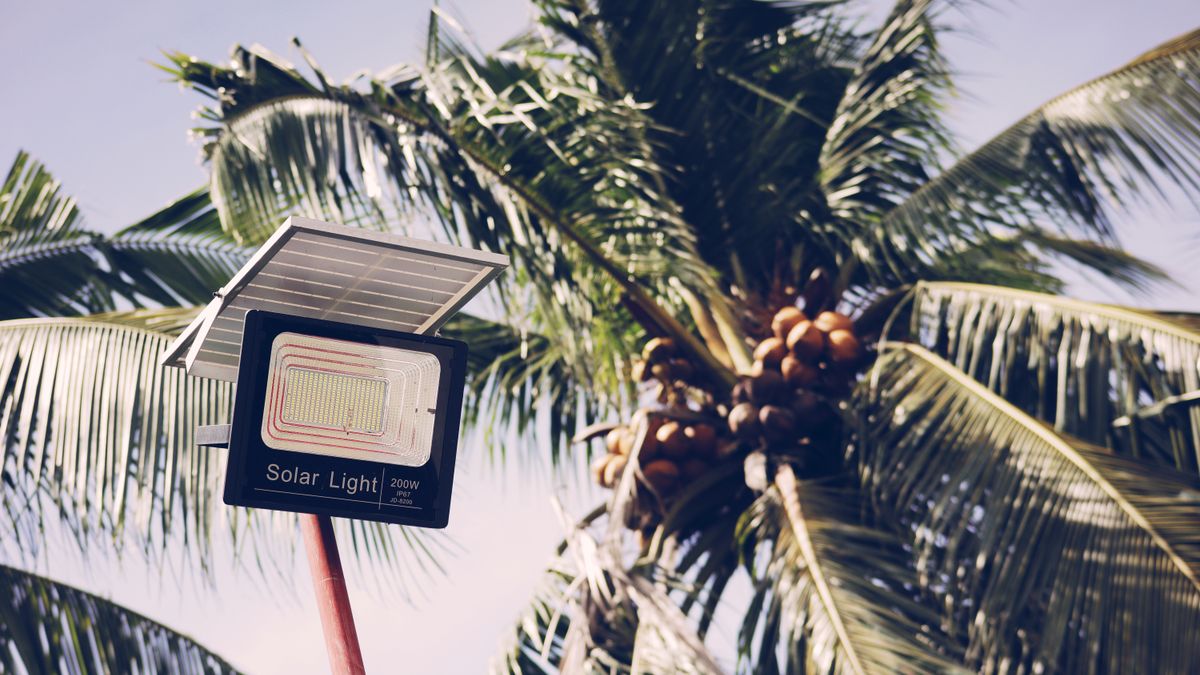
Photo by Nothing Ahead on Pexels

An 18,000-lumen flood light can leave half your driveway in shadow. A 3,000-lumen fixture with a 320-degree spread can cover a two-car garage entrance without a dark spot. The lumen number on the box tells you how much light leaves the fixture — not how much lands where you need it. Wattage, beam angle, sensor type, and mounting height decide that, and they trade off against each other in ways the big number on the front doesn’t show.

Affiliate disclosure: This article contains affiliate links. We may earn a commission if you buy through them, at no extra cost to you.

Everything we recommend
4 picks

How we picked

We do not install these fixtures. Judgments derive from published lumen ratings, beam-angle specifications, sensor type, and operating-current data.

Beam angle, not raw lumens

A 320-degree spread covers more ground with fewer lumens than a narrow flood of higher output.

PIR sensor type and range

Passive infrared detection distance and false-trigger resistance in cold weather separate functional motion activation from decorative.

Operating cost, not purchase price

Wattage multiplied by expected nightly hours determines yearly electricity spend, which overtakes fixture cost inside two years.

Circuit load at full count

Four 150-watt fixtures demand 5 amps continuous on a standard 15-amp residential circuit, leaving minimal headroom.

What Lumens Actually Measure (and What They Don’t)

Lumens are total visible light output — every photon leaving the fixture in every direction, summed into one number. A 120-watt LED producing 18,000 lumens is genuinely putting out six times more light than a 25-watt LED at 3,000 lumens. That’s real physics, not marketing.

But lumens don’t tell you where the light goes. A bare bulb radiates in all directions. A fixture with reflectors and lenses concentrates that output into a beam pattern — narrow and far, or wide and close. Two fixtures with identical lumen ratings can produce completely different pools of light on the ground depending on their optics.

The number that connects lumens to the ground is lux: lumens per square meter at the surface you’re trying to illuminate. Mount a tight-beam 18,000-lumen fixture at 15 feet and it might deliver 200 lux to a 10-by-10-foot patch directly below — brilliant, but small. Spread 3,000 lumens across 320 degrees from the same height and you get far less lux at any single point, but the light reaches the edges of a driveway, the walkway beside it, and the side yard. Neither approach is wrong. They solve different problems.

This is why comparing security lights by lumens alone is like comparing garden hoses by water pressure without asking about the nozzle. The nozzle is the optic.

Wattage, Efficiency, and What 150 Watts Costs to Run

LED efficacy — lumens per watt — varies across fixtures, and the gap matters more than it looks. The SANSI 25W produces 3,000 lumens: 120 lumens per watt. The SANSI 40W hits 5,000 lumens: 125 lumens per watt. Both are solid efficiency for consumer outdoor LEDs.

The 120W BIRITALO at 18,000 lumens runs at 150 lumens per watt — higher efficacy, but six times the power draw. If it runs dusk to dawn through a 14-hour winter night, that’s 1.68 kilowatt-hours per fixture per night. Four of them: 6.72 kWh. At the U.S. average of roughly $0.16 per kWh, that’s about a dollar a night, or $30 a month just for those four lights.

The SANSI 25W running the same 14 hours burns 0.35 kWh — about six cents. Even if you install four of them to match the coverage, you’re at 1.4 kWh total. The motion sensor changes this further: a fixture that only fires at full brightness when something moves, and dims or shuts off otherwise, might run at peak draw for two hours a night instead of fourteen.

Wattage isn’t just brightness. It’s your electrical bill, your circuit load, and how hot the fixture runs — and heat is what kills LEDs over time.

Motion Sensors and Cold Weather: The PIR Problem

Passive infrared sensors detect motion by reading temperature contrast. Your body at 37°C moves across a background at, say, 5°C on a winter night, and the sensor sees a sharp infrared differential. That’s a strong signal. The detector triggers.

On a 35°C summer evening, the contrast between you and the air shrinks to almost nothing. Detection range drops. This is physics, not a defect — PIR sensors are thermometers, and thermometers need a difference to measure.

Cold weather is actually where PIR works best. The thermal contrast between a human body and freezing air is enormous. If your motion sensor stops triggering in winter, the sensor isn’t the problem. Ice on the lens is. Or the mounting angle shifted because the bracket contracted in cold. Or the detection zone was aimed where people walk in summer and nobody walks in winter because the path changed with the snow.

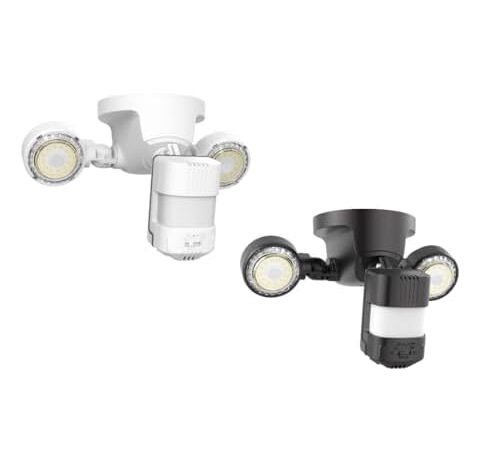
The two SANSI fixtures both offer four operating modes. One of those modes is typically motion-only — the light stays off until something moves. Another is dusk-to-dawn with motion boost — a low baseline glow that jumps to full brightness on detection. That second mode solves the complaint people have about motion lights leaving them in the dark for the first two seconds while they fumble for keys. The baseline light handles navigation; the motion burst handles security.

How Far Does 320 Degrees Actually Reach?

A 320-degree coverage angle means the light spreads across nearly a full circle — only a 40-degree wedge directly behind the fixture stays dark, which is the wall it’s mounted on. That sounds like it covers everything, but angle and distance are different measurements.

Beam angle tells you the shape of the cone. It doesn’t tell you how far the usable light extends. A 320-degree spread from a 3,000-lumen source at a 10-foot mounting height puts light on the ground in a wide circle, but the intensity drops with the square of the distance from the fixture. Double the distance, quarter the brightness. At the far edge of that circle, you might have enough light to see a person walking but not enough to read a house number or spot black ice on pavement.

For a fixture mounted at height H with a beam half-angle of 160 degrees (half of 320), the theoretical illuminated radius is H × tan(160°) — which is roughly 2.7 times the mounting height. At 10 feet up, that’s a 27-foot radius on paper. But useful security illumination — enough to trigger a camera, enough to identify a face — needs roughly 10 to 20 lux. The math on where that lux threshold falls depends on total lumens, reflector efficiency, and how much light the lens wastes. The 320-degree number is the starting shape. Everything else narrows it.

The SANSI 40W puts out 5,000 lumens at 125 lumens per watt and spreads it across 320 degrees. That combination — moderate output, very wide throw — makes it a single-point solution for spaces where you need light in multiple directions from one electrical box. A garage corner, a back door that faces both the yard and a side passage, a carport with foot traffic on two sides.

The four operating modes let you match the fixture to the situation rather than picking one behavior at install time. Dusk-to-dawn keeps a baseline glow from sunset to sunrise — the photocell triggers when ambient light drops below roughly 3 to 10 lux, which is civil twilight. Motion mode fires only when the PIR sensor picks up an infrared differential. The combined mode runs a dim baseline and boosts to full on motion. At 40 watts, even constant-on operation costs under a dime a night.

The 40W version costs about $11 more than the 25W SANSI and delivers 67 percent more light for 60 percent more power. That’s nearly linear scaling — you’re not paying a premium for the extra output, you’re just buying a bigger version of the same engineering. If your space is wider than a single-car garage door, the 40W earns that $11 back by eliminating the need for a second fixture.

Photocells: Why Your Dusk-to-Dawn Light Isn’t Lying to You

A photocell is a light-sensitive resistor or photodiode wired into the power circuit. When incoming light drops below a threshold — typically 3 to 10 lux, roughly the light level at civil twilight — the circuit closes and the fixture turns on. When light rises above that threshold at dawn, it shuts off.

The concern people have — “will it turn on during the day if I mount it under an eave?” — comes from a misunderstanding of how the threshold works. The sensor doesn’t need direct sunlight. It needs ambient daylight. Even a north-facing mount under a deep overhang receives scattered daylight well above 10 lux during the day. The photocell stays open. It would take a mounting location so deeply shaded that it’s darker than dusk at midday — inside a covered parking structure, maybe — to fool it.

The opposite problem is real, though. A photocell aimed at a neighboring fixture or a streetlight can receive enough artificial light to stay above threshold all night, preventing the fixture from turning on. This is a mounting issue, not a sensor defect. Point the photocell away from other light sources, toward open sky.

A dusk-to-dawn light stays on all night. There’s no timer. It turns off when the photocell sees dawn. In winter, that means 14 hours of operation. In summer, maybe 8. Your electricity bill follows the same curve.

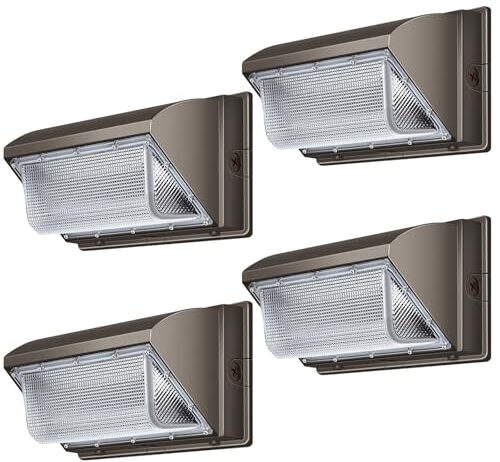
The BIRITALO 120W is a wall pack, not a motion light. No sensor logic, no modes. It’s a high-output LED array behind an IP65 housing that bolts to a wall and stays on whenever it has power. The 100-277V input means it runs on standard residential 120V or commercial 277V without a transformer — useful if you’re lighting a pole barn that’s already wired for commercial equipment.

At 18,000 lumens per fixture, four of these put 72,000 lumens on a property. That’s parking-lot territory. For a residential driveway, it’s almost certainly too much — you’ll light your yard, your neighbor’s yard, and the street. Light trespass complaints start here. But for a gravel yard around a workshop, a farm access road, or the loading side of a small warehouse, raw lumens win because you’re covering hundreds of feet of open space with no corners or obstacles to shape around.

The trade-off is blunt: no photocell means you wire it to a manual switch or a separate timer, and 480 watts across four fixtures needs its own 15-amp circuit. These aren’t fixtures you add to an existing outdoor outlet with Christmas lights already on it. They’re infrastructure.

One Bright Fixture or Several Smaller Ones?

An L-shaped driveway can’t be lit by one light source. Neither can a corner of a house where the front yard wraps around to a side gate. Any space with a turn, an alcove, or an obstruction creates a shadow that no single beam pattern can fill — wide angle or not, light travels in straight lines.

Two 25-watt fixtures at opposite corners of an L draw 50 watts total and cover both legs. One 120-watt fixture at the bend draws more than twice the power and still leaves the far end of one leg dim, because the inverse-square law eats intensity with distance. More fixtures at lower wattage, placed at the points where light is needed, almost always outperforms fewer fixtures at higher wattage placed where wiring is convenient.

The exception is open rectangles. A parking area, a straight driveway, a barn wall — geometry with no corners. Here, a single high-output fixture mounted high enough to spread its beam can cover the space, and one fixture means one electrical run, one mount, one maintenance point. The BIRITALO four-pack at 18,000 lumens per unit is built for this scenario: big, flat, open.

If your space has corners, buy for placement. If your space is a rectangle, buy for output.

Circuit Load: Can You Run Four 150-Watt Fixtures on One Circuit?

A standard U.S. residential outdoor circuit is 15 amps at 120 volts — 1,800 watts total capacity. Four 150-watt fixtures draw 600 watts: 33 percent of that circuit. Electrically, it’s fine. You could run twelve of them before tripping the breaker.

The practical limit isn’t total wattage. It’s wire gauge and run length. A 14-gauge wire on a 15-amp circuit loses voltage over distance — roughly 3 percent per 50 feet of run at full load. If your four fixtures are daisy-chained across 200 feet of building wall, the last fixture in the chain might receive 110 volts instead of 120. LEDs tolerate voltage variation better than incandescents, but the driver still has a minimum input voltage, and chronic under-voltage shortens driver life.

The 120W BIRITALO accepts 100-277V input, which means it handles voltage drop gracefully — its driver was designed for the sag you see on long commercial runs. A fixture rated only for 120V has less margin. Check the input range on the label, not just the wattage.

If you’re adding fixtures to an existing circuit that already powers outdoor outlets, add up everything on that circuit first. The four fixtures might be fine, but the four fixtures plus the outlet you plug a pressure washer into are not.

FAQ

How many lumens do I need to light a driveway?

A two-car driveway roughly 20 by 40 feet needs about 10 to 20 lux for safe navigation and 50 lux for security-camera-quality visibility. At a 10-foot mounting height, a single 5,000-lumen fixture with a wide beam can hit 10 lux across that area. For 50 lux, you need either a much higher output fixture or two moderate ones at each end.

Do motion sensor lights work in cold weather?

PIR sensors work better in cold weather, not worse. The thermal contrast between a 37°C human body and freezing air is larger than in summer, producing a stronger detection signal. If your motion light stops triggering in winter, check for ice on the sensor lens or a shifted mounting bracket before blaming the sensor.

Will a dusk-to-dawn light stay on all night?

Yes. A photocell turns the light on when ambient light drops below a threshold at dusk and off when it rises above that threshold at dawn. There is no timer. The fixture runs for as long as it’s dark — roughly 8 hours in summer, 14 in winter.

What’s the difference between 120 watts and 40 watts for outdoor security lights?

The 120-watt fixture draws three times the power and produces roughly 3.6 times more light than a 40-watt fixture. But the extra output only matters if your space is large enough to absorb it. In a typical residential yard, 120 watts creates glare and light trespass. The 40-watt fixture with a wide beam angle covers a normal driveway and entrance without overwhelming the space or the neighbor’s bedroom window.

Can I run multiple LED security lights on one outdoor circuit?

A standard 15-amp, 120-volt residential circuit handles 1,800 watts. Four 150-watt LED fixtures draw 600 watts — well within capacity. The real constraint is wire gauge and run length: voltage drops roughly 3 percent per 50 feet on 14-gauge wire, so fixtures at the far end of a long daisy chain may receive less voltage than the driver expects. Check the fixture’s rated input voltage range.