We research every product we recommend. We may earn a commission from the links on this page.
Tools & Home Improvement › Housing & Trim Kits

Canless LED Recessed Lights Dim Themselves in Insulated Ceilings

We compare published specifications and marketplace data. We do not test these products.

Canless Recessed Lights Dim Themselves When Insulation Traps Heat
Photo by Curtis Adams on Pexels

Canless LED recessed lights cut their own brightness when they get too hot — a built-in thermal protection circuit reduces drive current to keep the LED junction from cooking itself. In an insulated ceiling, where the heat sink has nowhere to dump its heat, that throttling can kick in within twenty minutes and drop your light output noticeably. Here’s what’s actually happening inside the fixture, why an IC rating doesn’t prevent it, and how to pick a fixture that holds up.

Affiliate disclosure: This article contains affiliate links. We may earn a commission if you buy through them, at no extra cost to you.

Everything we recommend
4 picks

How we picked

We do not install these fixtures in insulated ceilings. Judgement is based on published thermal ratings, driver wattage, and fixture geometry.

Wattage, not lumens

Lower drive current generates less heat at the junction, reducing the thermal protection circuit’s need to throttle output in the first place.

Thermal ratings over marketing claims

We checked junction temperature limits and heatsink geometry, not adjectives like ‘premium’ or ‘ultra-bright’ that don’t predict throttling behavior.

Warm CCT advantage

3000K appears brighter to the eye than 5000K at the same lumen count, partially compensating for throttled output without drawing more power.

Adjustability after installation

CCT switching and dimmer compatibility let you adapt to actual in-ceiling performance rather than locking in a fixed output at purchase.

Heat Goes One Direction in a Canless Fixture

A traditional recessed can gives you a metal cylinder with ventilation holes. Air moves through it. Heat from the lamp rises into the ceiling cavity, and cooler air gets pulled in from the room side. It’s not elegant, but it works — the fixture has a convection loop.

Canless fixtures killed the can. The LED array, driver circuit, and heat sink are all sealed into a single disc that mounts flush against the ceiling drywall. Every watt of heat the LEDs generate conducts through the rear-mounted heat sink and radiates into the ceiling cavity above. There’s no airflow path through the fixture. No convection loop. Just a metal surface pressed against whatever is on the other side of the drywall.

In an uninsulated ceiling — an unfinished basement, a first-floor ceiling with a conditioned room above — that heat sink radiates into open air. Temperature rises modestly, the fixture reaches thermal equilibrium well below its protection threshold, and you get rated output indefinitely.

Pack fiberglass batts or blow cellulose over that same fixture and the physics change completely. Insulation works by trapping still air. That’s its entire job. The heat sink is now radiating into a pocket of air that can’t move, surrounded by material specifically engineered to prevent heat transfer. The fixture’s surface temperature climbs until the thermal protection circuit trips.

What Thermal Throttling Actually Does

The thermal protection circuit is a thermistor on the heat sink connected to the LED driver. When the heat sink temperature crosses the rated threshold, the driver reduces current to the LED array. Less current means less light and less heat. The fixture dims itself until it reaches a new thermal equilibrium — one where the reduced heat output matches the heat sink’s limited ability to dissipate into insulation.

This is reversible. Turn the lights off for an hour, let the heat sink cool, and they’ll come back at full brightness. Then throttle again as the temperature climbs back up. That’s the cycle you’re living with in an insulated ceiling: full brightness for a window of time, then a gradual fade to whatever the fixture can sustain.

How much brightness you lose depends on how aggressively the driver cuts current and how hot the ceiling cavity gets. A 1,800-lumen fixture might settle at 1,200 lumens. A 1,200-lumen fixture might drop to 800. You won’t know from the box — nobody prints the throttled output number.

Over years, sustained high junction temperatures also accelerate lumen depreciation. LEDs don’t burn out like incandescents. They fade. An LED running consistently near its thermal protection threshold will hit 70% of its original output years earlier than the same LED running cooler. The protection circuit keeps the fixture from failing catastrophically, but it doesn’t keep it young.

IC Rated Doesn’t Mean Heat-Proof

IC rating — Insulation Contact — means the fixture has been tested and listed for direct physical contact with insulation. It will not start a fire. That’s the bar. It’s a safety certification, not a performance guarantee.

An IC-rated fixture touching insulation on all sides will still throttle. It’s designed to. The thermal protection circuit is part of how it earns the IC rating — the fixture proves it can limit its own temperature to a safe level even in the worst-case thermal environment. Safe for the house. Not necessarily bright enough for the room.

Non-IC-rated fixtures require a three-inch air gap between the fixture and any insulation. That gap is doing the same job the ventilation holes did on an old can — giving the heat somewhere to go. If your ceiling cavity has room for that gap and you can maintain it reliably (insulation doesn’t stay where you push it, especially blown-in), a non-IC-rated fixture in an air gap will generally sustain higher output than an IC-rated fixture packed in insulation.

But most people choosing canless retrofits are putting them into finished ceilings where the insulation is already there and not moving. That’s the whole point of the retrofit form factor. Which means the IC rating is table stakes, and the real question is how much light the fixture holds onto after the thermistor does its job.

Wattage Tells You More Than Lumens Here

Lumens is the number on the box. It’s measured at full drive current, in open air, at room temperature — conditions your insulated ceiling will never replicate. The lumen rating tells you the theoretical ceiling of what the fixture can produce. It doesn’t tell you what it will produce after thermal throttling cuts the drive current.

Wattage tells you how much heat the fixture generates. A 16W fixture dumps 16 watts of electrical energy into the system. LEDs convert roughly 40-50% of input power to light; the rest becomes heat. So a 16W fixture produces roughly 8-10 watts of thermal energy that the heat sink has to deal with. A 12W fixture produces roughly 6-7 watts.

In an insulated ceiling, where heat dissipation is the constraint, lower wattage means less thermal stress, later throttling onset, and a smaller gap between rated and actual output. A 12W fixture producing 1,200 lumens in open air might sustain 900 lumens in insulation. A 16W fixture producing 1,800 lumens might sustain 1,100. The higher-wattage fixture still wins on absolute output, but it lost a larger percentage of its rated brightness to get there.

This is where missing wattage specs hurt. If you can’t see the wattage, you can’t estimate the thermal load, and you’re buying on lumen ratings that won’t survive contact with your ceiling.

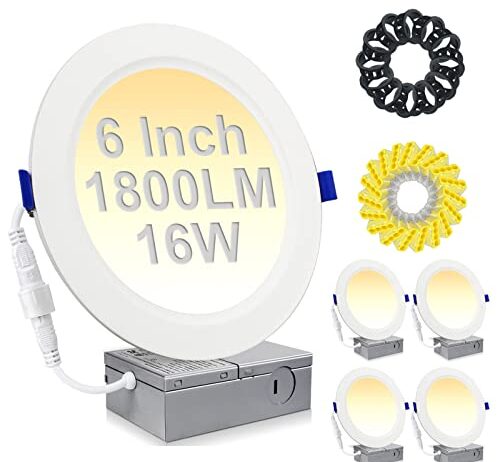
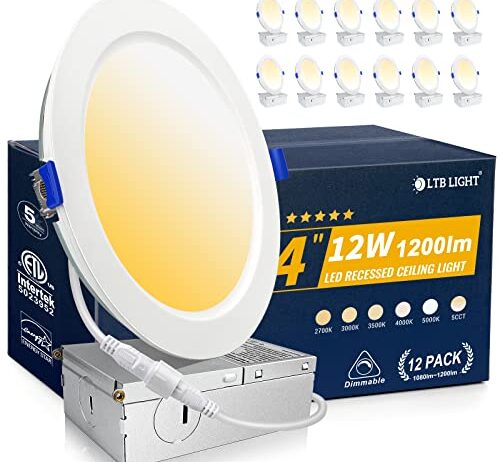
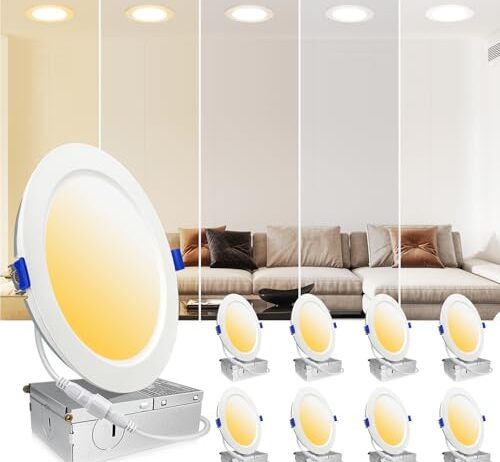
This LTBLIGHT 6-inch fixture draws 16W and produces 1,800 lumens at full output. In an insulated ceiling, it will throttle like everything else. But it has something the fixed-CCT fixtures here don’t: a 5CCT selector that lets you change color temperature after installation.

That matters because of how your eye perceives brightness at different color temperatures. A warm 2700K light at 1,200 lumens looks subjectively brighter in a living room than a cool 5000K light at the same 1,200 lumens, because warm light has more energy in the wavelengths your eye is most sensitive to under typical indoor conditions. If thermal throttling drops your output by a third, shifting from daylight to warm white partially compensates for the perceived dimming.

The Energy Star certification also means this fixture met standardized thermal testing requirements — not a guarantee against throttling, but confirmation that the thermal protection system works as intended and the fixture maintains its safety ratings under thermal stress. At $12.37 per fixture in an eight-pack, it sits between the budget 4-inch options and the smaller, pricier 6-inch four-pack.

Size and Thermal Mass: 4-Inch vs. 6-Inch

A 6-inch fixture has a larger heat sink surface than a 4-inch. More surface area means more radiating area, which means the heat sink reaches its thermal limit more slowly — all else being equal. But all else is never equal, because the 6-inch fixtures in this category also run higher wattages to drive more lumens from their larger LED arrays.

The two 6-inch fixtures here both produce 1,800 lumens. The 4-inch HiBay produces 1,200 lumens at 12W. The per-watt efficiency is similar — around 100 lumens per watt for the 4-inch, around 112 for the 6-inch at 16W. But the 6-inch fixture is generating a third more heat in absolute terms.

If your ceiling has R-38 insulation packed tight — common in attic floors in cold climates — the extra thermal mass of the 6-inch heat sink buys you time but not immunity. You’ll still throttle. The question is whether you’d rather start at 1,800 lumens and settle at 1,100, or start at 1,200 and settle at 900. For a kitchen or workspace, the higher starting point usually wins. For a hallway or bedroom where you’re dimming to 40% anyway, the smaller fixture wastes less energy heating insulation it doesn’t need to fight.

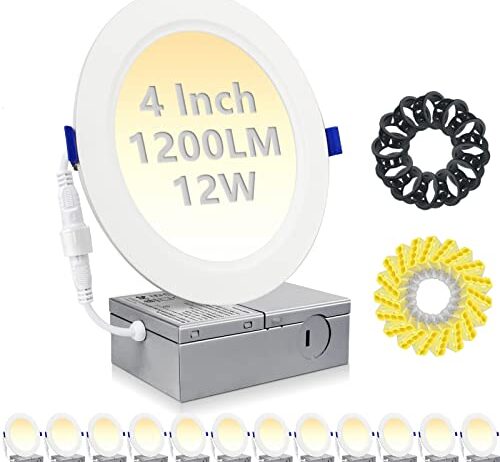
The HiBay 4-inch 12-pack runs each fixture at 12W to produce 1,200 lumens in daylight-white 5000K. That 12W draw is the lowest specified wattage in this set, and in an insulated ceiling, lower input power directly means less heat the fixture has to dump through a blocked heat sink.

The 5000K color temperature is a trade-off here. Daylight white works in a garage, laundry room, or home office where you want alertness and color accuracy. In a living room or bedroom, it reads as harsh — and unlike the 5CCT-adjustable LTBLIGHT, you’re locked in at installation. At $8.32 per fixture across twelve units, this is the lowest per-fixture cost in the set, which matters when you’re lighting an entire floor and might lose one or two to early lumen depreciation from sustained thermal stress.

The ultra-thin form factor also helps in shallow ceiling cavities. Thinner fixtures leave more space between the rear heat sink and the insulation above, which can create a small air pocket even in a packed cavity. It’s not the three-inch gap a non-IC fixture needs, but any air movement around the heat sink extends the time before throttling onset.

How to Actually Reduce Throttling

You can’t insulate a ceiling and run recessed lights at full brightness indefinitely. That’s the constraint. But you can shrink the gap between rated output and sustained output.

First: don’t overlight. If you need 800 lumens of sustained output, a 1,200-lumen fixture throttled by a third gets you there. A 1,800-lumen fixture throttled by 40% gets you to 1,080 — more light, but also more heat cycling and faster lumen depreciation. Buy for the output you need after throttling, not the number on the box.

Second: if you’re doing new construction or have access to the cavity, build a dam. A simple metal or rigid-foam barrier around the fixture — not touching it, just holding insulation back three to four inches — restores enough convective airflow to cut heat sink temperature significantly. This is standard practice for non-IC-rated fixtures, but it helps IC-rated fixtures too.

Third: dimmer switches. Running a 1,800-lumen fixture at 60% on a compatible dimmer reduces its electrical input and heat output proportionally. The driver produces less current, the LEDs run cooler, and you may never hit the thermal protection threshold at all. The fixture lasts longer, the light stays steady, and you’re using less electricity. The catch is dimmer compatibility — older rotary dimmers and many cheap triac dimmers cause flickering or low-end dropout with LED drivers. Check the fixture manufacturer’s dimmer compatibility list before assuming your existing switch will work.

FAQ

Can you put canless recessed lights in insulated ceilings?

Yes, if the fixture is IC rated — meaning it’s tested and listed for direct contact with insulation. It won’t start a fire. But the insulation traps heat around the heat sink, which causes the fixture’s thermal protection circuit to reduce brightness. The light works safely; it just won’t sustain its rated lumen output.

Why do my LED recessed lights dim after being on for a while?

The fixture’s thermal protection circuit is cutting drive current to the LEDs because the heat sink temperature exceeded its threshold. This is most common in insulated ceilings where the heat sink can’t dissipate heat through convection. The dimming is automatic and reversible — turn the lights off, let them cool, and they’ll return to full brightness before throttling again.

What happens if recessed lights overheat?

In a properly designed LED fixture, the thermal protection circuit reduces drive current before the junction temperature reaches a damaging level. The light dims but doesn’t fail. If the thermistor or driver malfunctions and protection doesn’t engage, sustained high junction temperatures accelerate lumen depreciation and can eventually cause the LED array or driver to fail permanently.

How much clearance do canless recessed lights need?

IC-rated canless fixtures are designed for zero clearance — direct insulation contact. Non-IC-rated fixtures typically require three inches of air gap on all sides. Even with IC-rated fixtures, any air space you can maintain around the heat sink improves thermal performance and reduces throttling.

Do canless LED lights get hot?

The rear heat sink gets warm to hot during operation — typically 60-80°C at the surface in open air, higher when surrounded by insulation. The room-facing side stays cool because the LED array and driver are thermally isolated from the trim. The heat is concentrated on the ceiling-cavity side, which is why insulation contact matters so much.

How do you keep recessed lights from overheating in insulation?

Three approaches: use a lower-wattage fixture so there’s less heat to dissipate, run fixtures on a dimmer at 60-80% so the driver produces less current, or build a rigid dam around the fixture to hold insulation back a few inches and restore some convective airflow around the heat sink. All three can be combined.