
We research every product we recommend. We may earn a commission from the links on this page.
Pet Supplies › Beds

Why Orthopedic Dog Beds Flatten Out (and What Actually Helps)

We compare published specifications and marketplace data. We do not test these products.

Why Your Dog's Bed Goes Flat in One Spot
Photo by Josh Sorenson on Pexels

Your dog’s bed has a dent. Not everywhere — just the one spot where she drops every night, same hip, same curl. The rest of the bed looks new. That’s not a defect. It’s compression fatigue, and it happens because fill materials don’t recover fully between sleep cycles. The shape of the bed, the type of fill, and how much surface area your dog actually uses determine how fast that dent becomes permanent.

Affiliate disclosure: This article contains affiliate links. We may earn a commission if you buy through them, at no extra cost to you.

Everything we recommend

3 picks
Also great · portability
Portability with a known cost

Portability with a known cost

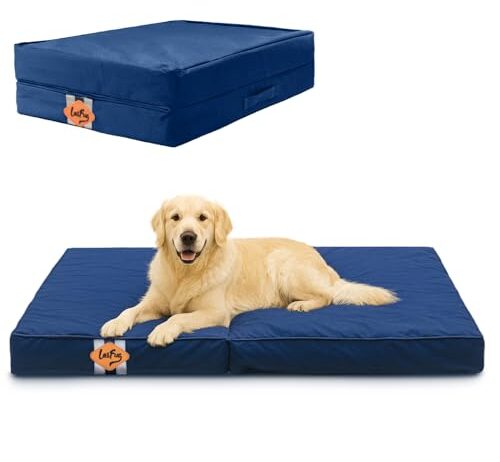
Laifug Foldable Waterproof Dog Bed for Large Dogs - Outdoor Orthopedic Dog Bed with Washable Removable Cover, Pet Mattress with Handles,Navy Blue, (36 x 27 x 3.5, inches)
★ 4.6 111 reviews

Foldable with handles for transport, waterproof against outdoor use. The fold lines will become compression zones over time — that's the trade for a bed you can actually move. Removable washable cover lets you inspect and manage fill condition.
How we picked

We did not test these beds with dogs. Judgements rest on published fill specifications, construction details, and owner-reported compression patterns.

Fill recovery rate, not density alone

Materials rated by how much height they regain after compression, not just grams per cubic inch at manufacture.

Deck area, not total bed size

Usable surface where a dog can lie flat, excluding bolsters and unused perimeter that doesn’t reduce pressure points.

Layer construction, not single-block thickness

Multiple independent layers so one compressed zone doesn’t collapse the entire sleeping surface beneath it.

Cover removal access, not waterproofing

Whether you can inspect fill condition and redistribute or replace inserts without destroying the bed.


What’s Actually Happening Inside the Flat Spot

A 60-pound dog lying in sphinx position concentrates roughly 40 percent of her body weight — about 24 pounds — on her chest and forelimbs. That’s 2 to 4 PSI pressing into a contact patch smaller than a dinner plate. Every night, same patch.

Fill materials fail in two different ways under this kind of load. Foam — particularly polyurethane — experiences compression set: a permanent reduction in thickness that accelerates when the material is held at more than 25 percent compression. Your dog’s body runs at 38 to 39°C, and heat speeds the process. The foam under her shoulder is warm and squeezed for eight hours straight. It doesn’t get a chance to recover before she’s back.

Fiberfill fails differently. Individual polyester fibers slide past each other under pressure, migrating away from the loaded zone. They don’t slide back. You can shake the bed, flip it, knead it — some loft returns, but the fibers have found new positions. The high-pressure zone stays thin.

This is why the rest of the bed looks fine. The damage is entirely localized. A bed with a single flat spot isn’t wearing out — it’s wearing out in one place, because that’s the only place the load exists.

Why “Orthopedic” Doesn’t Mean “Won’t Flatten”

The word gets used on beds with memory foam, beds with polyester fiberfill, beds with unspecified fill. It has no regulated definition in pet products. What it usually signals is initial firmness — the bed pushes back when you press your hand into it at the store or on day one.

Initial firmness and compression resistance over months are different properties. A dense foam base resists bottoming out. A soft memory foam comfort layer deforms slowly under sustained load and recovers slowly after the load lifts — if your dog returns to the same spot before full recovery, which typically takes 30 to 60 minutes, residual compression accumulates cycle over cycle. The bed felt supportive on the first night because no cycles had stacked yet.

Multi-layer construction helps here by isolating the problem. A firm base layer stays intact while the softer contact layer absorbs the compression damage. You lose surface cushion over time, but you don’t bottom out onto the floor. That’s a meaningful difference at three in the morning when a dog with stiff joints shifts position — there’s still something underneath her, even if the top inch has gone flat.

How Shape Changes Where the Damage Lands

A flat rectangular bed lets fill migrate in every direction. Pressure at the center pushes material outward toward all four edges. The flattening is gradual and radial — a wide, shallow bowl that deepens over weeks.

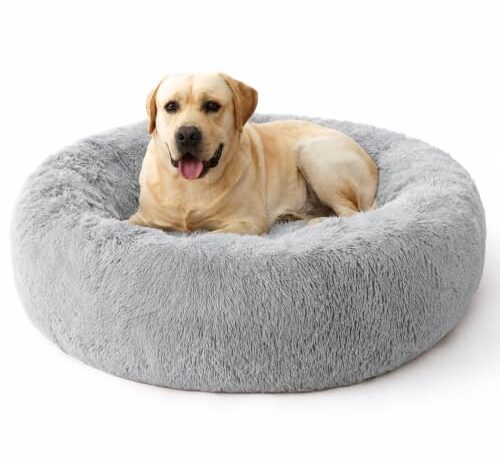
A donut or bolster bed constrains that migration. Fill is concentrated in the raised perimeter ring, and the center — where the dog actually curls — starts with less fill volume than a flat bed of the same diameter. The dog compresses a thinner layer from the start. But the bolster itself retains loft much longer, because no body weight lands on it directly. You get a bed that looks almost new around the edges while the center goes flat. The visual contrast makes it seem worse than it is, but the center was always the thinner layer.

Then there’s the fold. A bed designed to fold for transport introduces crease lines — hinges where the fill material is pre-stressed. A dog lying across that fold accelerates localized flattening at the hinge point. The crease becomes a preferential compression zone, a line of weakness that collapses faster than the surrounding fill. It’s not a flaw in construction; it’s the structural cost of portability.

Surface Area Is Doing More Work Than Fill Type

A bigger bed doesn’t just give your dog more room. It reduces the pressure per square inch at any single point, because the same body weight spreads across more surface. A 48-inch bed offers roughly 78 percent more usable area than a 36-inch bed, assuming proportional use. That means the fill under any given contact point is absorbing less force per cycle, and compression fatigue accumulates more slowly.

This matters most for dogs who sprawl. A curler concentrates weight in a tight circle regardless of bed size — more surface doesn’t help much if the dog only uses a 20-inch patch of it. But a side-sleeper who stretches out actually distributes load across the available surface, and the difference between 36 and 48 inches becomes real over months of nightly use.

The catch: bigger beds cost more, take more floor space, and the fill still flattens eventually. You’re buying time, not immunity. But if the question is why one bed lasted four months and another lasted eight, the answer might be square inches more than fill type.

At 48 inches, this is a third larger than the 36-inch beds in this set. That’s not just comfort room — it’s physics. The same 60-pound dog on a bigger surface means fewer pounds per square inch at the shoulder, the hip, the ribcage. Compression fatigue still happens, but it happens more slowly because each square inch of fill absorbs less force per cycle.

The three-layer construction matters here for a specific reason. When the top comfort layer eventually compresses — and it will — the lower layers still provide structure. You lose the plush feel over months, but you don’t get the dog-on-floor problem that single-layer beds produce once the fill gives out. The base layer carries the long-term load, and it’s not the layer your dog’s body heat is softening every night.

The trade-off is footprint. Forty-eight inches of dog bed takes real floor space. If you’re fitting this into a corner of a bedroom or beside a couch, measure first. The bed doesn’t fold, doesn’t compact, doesn’t tuck away. It’s there.

Can You Actually Fix a Flat Spot?

Depends on the fill. Fiberfill beds respond to manual redistribution — unzip the cover, reach in, pull fill from the edges back toward the center. It’s a temporary fix. The fibers will migrate again within a few sleep cycles, because the pressure pattern hasn’t changed. You’re resetting the clock, not solving the problem.

Foam doesn’t redistribute. Compression set in polyurethane is permanent deformation at the cellular level — the cell walls have buckled and won’t unbuckle. No amount of fluffing restores collapsed foam. Some owners flip the bed, which works if the construction is symmetrical. Most aren’t. A bed with a non-slip base on the bottom and a plush top has a designed orientation, and flipping it puts slippery fabric up and textured rubber against your dog’s body.

Rotating helps more than flipping. Turn the bed 90 or 180 degrees so your dog’s pressure points land on fresh fill. Dogs are creatures of habit, though — many will reposition themselves to match their old orientation, which puts the same joints on the same flat spot, now just rotated within the bed. Worth trying. Don’t count on it.

The donut design does something specific with fill distribution that a flat bed can’t replicate. The raised bolster ring holds a substantial portion of the total fill volume in the perimeter, and almost no body weight lands there. A dog curled in the center compresses the flat middle — which is thinner to begin with — while the walls retain their loft. The bolster becomes a structural surround that supports the dog’s neck and back from the sides rather than from below.

At 420 GSM, the plush cover is dense enough to resist pilling and matting in the short term. The removable, washable cover means you can inspect the fill underneath without destroying the bed — unzip, check whether the center has compacted, redistribute if the fill type allows it. The anti-slip base keeps the bed from skating across hardwood when the dog jumps in, which matters because a bed that slides puts lateral stress on the fill every time the dog lands.

Rated for dogs up to 80 pounds. That’s a real number to work with — a 50-pound dog is well within the margin, meaning the fill density and volume were sized for more load than it’s absorbing. An 80-pound dog is at the ceiling, and compression will accumulate faster. A 100-pound dog is past it.

The Fold Problem

Foldable beds solve a real problem: storage, transport, moving the bed between rooms or into a car. But every fold is a crease, and every crease is a line where fill material is pre-stressed before your dog ever lies on it.

Imagine folding a foam mattress in half. The material at the bend compresses on the inside and stretches on the outside. Unfold it, and there’s a memory of that bend — a slight softness along the crease. Now put 60 pounds of dog across that crease line every night. The fill at the hinge compresses faster than the fill on either side of it, creating a valley that deepens over weeks.

This isn’t a manufacturing defect. It’s the structural cost of a feature. A bed that folds has joints, and joints are weak points. If your dog happens to sleep aligned with the fold, the compression concentrates along that line. If she sleeps perpendicular to it, the effect is less pronounced but still present — the crease is still softer than the surrounding material.

For a bed that stays in one place, this doesn’t matter. For a bed that travels — camping, visiting family, moving between a crate and the living room — portability might be worth the faster wear at the hinge.

When to Replace Instead of Rotate

The honest answer: when your dog is resting on the floor through the fill. Press your hand into the flat spot. If you can feel the hard surface underneath — floor, crate bottom, whatever the bed sits on — the fill has failed in that zone. No rotation or redistribution will fix structural collapse.

A subtler sign: your dog stops using the bed. Dogs aren’t particular about aesthetics, but they notice support. A dog who used to settle immediately and now circles, readjusts, or migrates to the couch is telling you something about the surface she’s lying on. Stiff joints in the morning that weren’t there six months ago might be the bed, not the dog.

The unfilled zones of the bed are irrelevant. A bed that’s pristine on three sides and bottomed out in one spot is a failed bed for the dog who sleeps on that spot. Don’t let the good parts convince you the bad part is fine.

FAQ

Why does my dog’s bed flatten in one spot but stay puffy everywhere else?

Your dog sleeps in the same position every night, concentrating body weight on the same small area. Fill materials — foam or fiberfill — compress under that localized pressure and don’t fully recover between sleep cycles. The rest of the bed never takes that load, so it stays lofted.

Does rotating a dog bed make it last longer?

It can. Turning the bed 90 or 180 degrees moves your dog’s pressure points onto fresh fill. The catch is that many dogs reposition themselves to match their old sleeping orientation, putting the same joints on the same spot regardless of how you’ve turned the bed.

Do heavier dogs flatten beds faster?

Yes. More weight means more PSI at each contact point, which drives compression fatigue faster. A bed rated for 80 pounds will compress more slowly under a 50-pound dog than under an 80-pound dog, because the fill absorbs less force per cycle.

Can you refluff a flattened dog bed?

Fiberfill beds can be partially restored by manually pulling fill back into the compressed zone — unzip the cover and redistribute. It’s temporary; the fill migrates again within a few sleep cycles. Foam beds with compression set cannot be refluffed — the cellular structure has permanently deformed.

How do I know when my dog’s bed needs replacing?

Press your hand into the spot where your dog sleeps. If you can feel the floor through the fill, the support in that zone is gone. Another sign: your dog circles, readjusts, or stops using the bed entirely — dogs notice when the surface no longer supports their joints.