
We research every product we recommend. We may earn a commission from the links on this page.
Pet Supplies › Playpens

Pet Playpen Height Matters More Than Size — Here’s How to Pick

We compare published specifications and marketplace data. We do not test these products.

Why a Bigger Playpen Doesn't Keep a Dog In
Photo by Helena Lopes on Pexels

A ten-inch acrylic wall will not contain a twelve-week-old puppy for long. By four months, most small breeds can clear it from a standstill. The single variable that determines whether a playpen works is height — not panel count, not floor area, not material. These four enclosures span a 9.5-to-1 height range, from a low border meant for newborn puppies to a nearly eight-foot chain-link kennel built for large dogs with real vertical reach. The right one depends on your dog’s breed, age, and how high its hind legs can actually push it.

Affiliate disclosure: This article contains affiliate links. We may earn a commission if you buy through them, at no extra cost to you.

Everything we recommend
4 picks

How we picked

We did not set these up with dogs inside. Selection is based on published dimensions, materials, and owner feedback.

Height relative to breed, not height alone

A 30-inch wall contains a Corgi. It does not contain a Border Collie. We matched barrier height to known jump ranges.

Containment mechanism, not panel count

Panels set floor area. Height stops escapes. We prioritized enclosures where the vertical barrier exceeds realistic jump capability for their intended animal size.

Material trade-offs, not material rankings

Acrylic lets you see in. Chain link lets air through. Each costs something the other doesn’t.

Installation honesty, not convenience labels

Floor suction on tile is different from floor suction on carpet. Permanent installation means permanent. We noted what each setup actually requires.


The Only Measurement That Prevents Escape

Floor area makes a dog comfortable. Height makes a dog stay. Those are two different engineering problems, and buying a playpen with twelve panels arranged in a wide circle does nothing if the wall is shorter than your dog’s jump.

The physics are straightforward. A dog jumps by crouching and firing its hind legs — the gastrocnemius and quadriceps store elastic energy like a compressed spring, then release it in a single extension. The height that extension produces depends on three things: the dog’s mass, its muscle power relative to that mass, and whether it had a running start. A running approach adds roughly 30 to 50 percent more height because forward momentum partially converts to vertical lift at takeoff.

This means the barrier needs to exceed not just the dog’s standing jump but its running jump — and inside a playpen with any real floor area, there is room for a running start. A pen that is four feet across gives a medium dog two strides of acceleration. That is enough.

Smaller, lighter dogs generally jump higher relative to their body size. A fifteen-pound terrier with long hind legs will outjump a forty-pound Bulldog every time, because leg length is lever length. Longer lever, more height per extension. Short-legged breeds — Dachshunds, Bassets, Corgis — generate less vertical per stroke because there is simply less limb to extend.

Shoulder Height Plus Jump Equals the Number You Need

Here is where most people miscalculate. A 24-inch playpen wall sounds tall until you remember your dog’s shoulders are already at 14 inches. It does not need to jump 24 inches to escape — it needs to jump 10 inches and hook its front paws over the edge. From there, upper body strength and scrambling do the rest.

The formula is simple: the barrier must exceed the animal’s shoulder height plus its maximum vertical extension. For a dog with 14-inch shoulders that can jump 18 inches vertically, you need a wall taller than 32 inches. A 30-inch wall fails by two inches, and two inches is all it takes for a paw to catch the rim.

This is why the height spread across these four products matters so much. Ten inches contains a very young puppy whose hindlimb muscles have not developed enough to push it more than a few inches off the ground. But puppies build full jumping capability between six and twelve months as muscle mass and tendon strength mature — often doubling or tripling their early jump height. The pen that worked at eight weeks may be useless by six months.

Acrylic Lets You Watch. Chain Link Lets Them Breathe.

Material choice in a playpen is a visibility-versus-airflow trade-off, and there is no version that wins both.

Clear acrylic gives you an unobstructed view of the animal from any angle. You can see a puppy chewing something it shouldn’t from across the room. The cost is durability under contact: claws scratch acrylic during jump attempts, and those scratches accumulate. One owner of the LoveTail 30-inch model reports the plexiglass turning “very cloudy after one and a half months of use.” That is one person’s experience, but it aligns with how acrylic behaves under repeated abrasion — the surface haze is permanent and progressive.

Chain link solves the scratch problem entirely. Galvanized steel does not care about claws. It also moves air freely, which matters in outdoor installations during warm weather when a solid-walled enclosure becomes a heat box. The trade-off is that chain link limits your sightline — you can see movement and shape but not detail. A dog chewing something small is harder to spot through a mesh pattern than through clear panels.

Neither material affects jump containment. A dog that can clear 30 inches will clear it whether the wall is acrylic or steel. Material is about what happens during the attempt and what you can see from outside, not whether the wall holds.

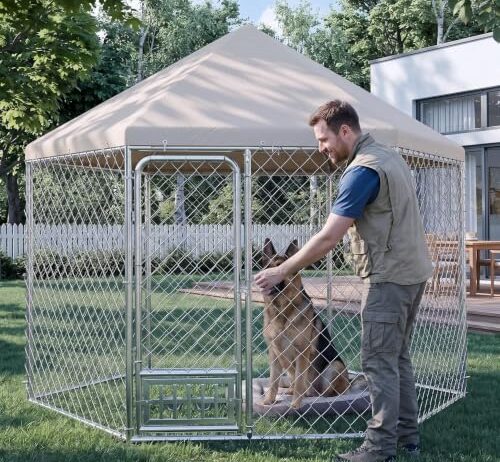
Ninety-five inches of vertical barrier is not a playpen. It is a kennel, and the distinction matters. This is a permanent outdoor structure measuring roughly nine feet square with a lockable door and a waterproof shade top. You are not folding this up and moving it to the living room.

What you get for that commitment is absolute containment. No domestic dog breed — not a Belgian Malinois, not a Greyhound, not a pit bull mix with a running start across a nine-foot enclosure floor — generates enough vertical to hook a paw over a barrier this tall. The math does not work. The tallest documented standing jumps for competition-level dogs top out around six feet, and those are animals bred and trained for vertical events. Your pet is not clearing eight feet.

Galvanized chain link handles weather, claws, and body weight against the panels without degrading. The lockable door is a genuine security feature for dogs that have learned to manipulate latches — and some do. At $129.99, this is also the least expensive enclosure in the set on a per-inch-of-height basis: about $1.37 per vertical inch, compared to nearly $12 per inch for the portable acrylic option. The cost is space. You need a backyard, and that backyard needs to tolerate a nine-by-nine chain-link structure permanently.

Portable Means Temporary — Know Which One You Need

Three of these four products use modular panels. You connect them, arrange the shape, and set them on the floor. The fourth is bolted to the ground. That is not a spectrum — it is two completely different product categories sold under the same search term.

Modular panels solve the problem of a dog that needs temporary containment in a space you also use for other things. Cooking dinner and need the puppy out of the kitchen but visible. Guests arriving and the dog needs thirty minutes behind a barrier. Traveling to a relative’s house and bringing containment with you. These are real use cases, and they require a pen that sets up and breaks down quickly on a smooth floor.

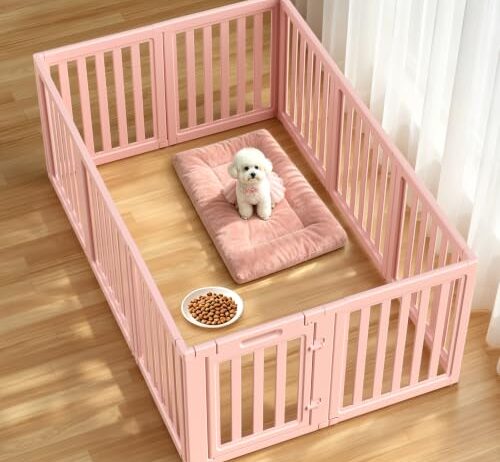
The floor suction that the LoveTail 30-inch model uses works on hard, flat surfaces — tile, hardwood, polished concrete. It does not grip carpet, textured stone, or outdoor decking. If your dog leans against the panels with any real weight, the stability of the entire structure depends on those suction cups holding. One owner notes the gate closure is “wobbly” and “feels very cheap,” requiring precise alignment before locking. That suggests the connection points between panels are a weak link under lateral force.

Permanent installation solves lateral force entirely. Chain link bolted to stakes or a concrete pad does not move when a seventy-pound dog hits it at speed. But you cannot take it with you, and it lives where you put it.

The Puppy Problem: What Works Now Won’t Work in Four Months

A ten-inch barrier contains a six-week-old puppy. It will not contain that same puppy at six months.

Hindlimb muscle and tendon development in dogs follows a steep curve in the first year. A puppy at eight weeks has the skeletal structure for jumping but almost none of the muscular power. By twelve weeks, it is experimenting. By six months, most breeds have developed enough hindlimb strength to double or triple their early jump height. A puppy that could barely hop over a ten-inch wall in January is clearing it without effort by May.

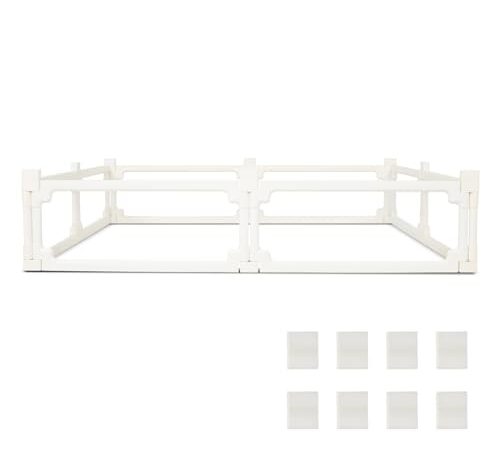
This makes the stackable design of the EVOTAILS 10-inch model an interesting idea in principle. If you could add vertical inches as the puppy grows, you would not need to replace the entire pen. The practical question is whether stacked acrylic panels maintain rigidity under impact — a growing puppy does not gently test the wall, it crashes into it sideways during play. Stacked connections need to be as strong as single-piece panels, or the joint becomes the failure point.

The alternative is buying for the adult size from the start. A 30-inch wall contains most small-to-medium adult dogs whose shoulder height plus jump clears under 28 inches. If you know the breed, you can calculate the adult requirement now and skip the interim sizing entirely.

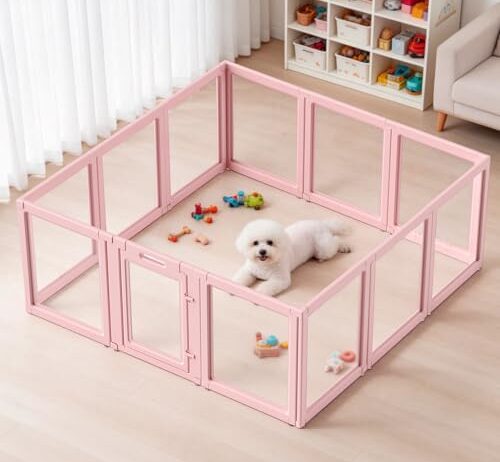
Thirty inches is the threshold height for indoor containment of small-to-medium dogs. A Cavalier King Charles Spaniel with a 12-inch shoulder height and a 14-inch standing jump cannot reach the top of this wall. A Beagle at 15-inch shoulders and an 18-inch jump is right at the edge — the math says 33 inches needed, which means a determined Beagle with a running start might hook a paw over. Know your breed before committing.

The twelve-panel count gives this the largest configurable footprint of the modular options. More panels means more possible arrangements — a wide circle for open play, a long rectangle against a wall, an L-shape around furniture. Clear acrylic means you are watching the dog the entire time without walking over to check, which is the actual daily use case for an indoor pen.

At $359.99, this costs more than twice the outdoor chain-link kennel that stands three times taller. You are paying for portability, transparency, and indoor aesthetics. Whether that premium makes sense depends on whether you need to move the pen between rooms, take it apart for cleaning, and see through it while working. If the pen lives in one spot permanently and visibility is not critical, the price is hard to justify on containment alone.

Cats Change the Calculation Entirely

Dogs jump with power. Cats jump with precision and height that makes most dog-rated enclosures irrelevant.

A healthy adult cat can clear five to six times its own body height from a standing position. A cat with a 10-inch shoulder height routinely jumps 50 to 60 inches vertically — and does so with a controlled, quiet launch that gives you no warning. Cats also climb. A chain-link surface is a ladder to a cat, not a barrier. An acrylic surface is harder to grip but not impossible if the cat can hook the top edge.

Of the four enclosures here, only the 95-inch chain-link kennel exceeds a cat’s vertical range — but chain link is climbable, which defeats the height advantage. The acrylic panels are not climbable, but at 30 inches, 24 inches, and 10 inches, none of them exceeds an adult cat’s jump.

If you are containing a cat, you need either a fully enclosed top or a smooth-walled enclosure taller than 60 inches. None of the modular panel systems here meet that requirement. The two products described as suitable for cats — the LoveTail models — work only for kittens young enough that their jumping ability has not yet developed. That window closes fast.

Price per Inch of Height, Not Price per Panel

The intuitive way to compare playpen prices is per panel. The useful way is per inch of height, because height is the containment variable and panels are the comfort variable.

The EXTRAFEIN chain-link kennel costs $129.99 for 95 inches of height: $1.37 per inch. The LoveTail acrylic costs $359.99 for 30.3 inches: $11.88 per inch. The EVOTAILS costs $89.99 for 10 inches: $9.00 per inch. The LoveTail 23.6-inch model costs $109.99: $4.66 per inch.

That spread tells you something real. The cheapest barrier per inch of containment is permanent outdoor chain link. The most expensive per inch is portable indoor acrylic. You are paying for convenience, aesthetics, and the ability to put the pen away when guests come over — not for containment performance. The chain link is better at the one job a playpen exists to do, and it costs a quarter as much per unit of that job.

Whether that matters depends on where the pen lives. You cannot put chain link in a living room. You cannot move acrylic panels to the backyard and expect suction cups to grip grass. They solve different problems in different rooms, and comparing them on containment price alone ignores that most buyers need the pen in a specific place.

FAQ

How high can my dog actually jump?

It depends on breed morphology more than weight. Long-legged breeds like terriers and herding dogs jump highest relative to their size — a Jack Russell can clear five feet from standing. Short-legged breeds like Basset Hounds and Dachshunds typically max out around two feet. For your specific dog, measure shoulder height, then look up the breed’s typical vertical jump. Add those together — the total is the minimum wall height that will contain them.

Will my puppy outgrow a playpen it can’t escape now?

Almost certainly. Puppies develop full jumping capability between six and twelve months as hindlimb muscles and tendons mature. A puppy that cannot clear a 10-inch wall at eight weeks may double or triple that height by six months. Buy for the adult breed’s jump capability, not the puppy’s current one.

Does floor area matter for preventing escapes?

Floor area affects comfort and exercise space, not escape prevention. In fact, a larger floor area can make escapes easier by giving the dog room for a running start, which adds 30 to 50 percent to jump height compared to a standing leap. Height is the only dimension that prevents jumping out.

Can cats jump higher than dogs the same size?

Yes, substantially. A healthy adult cat can clear five to six times its own body height from standing — a cat with 10-inch shoulders routinely jumps 50 to 60 inches. Dogs of the same body size rarely exceed three times shoulder height. Cats also climb, which means chain-link walls that stop dogs become ladders for cats.

Do I need to measure from the floor or from the dog’s shoulder?

The wall height is measured from the floor, but what matters is the gap between the wall top and the dog’s shoulder height. A 30-inch wall facing a dog with 14-inch shoulders only needs to stop a 16-inch jump — but the dog can also hook its front paws over and pull itself up if the margin is close. Add a few inches of safety margin beyond the calculated minimum.