We research every product we recommend. We may earn a commission from the links on this page.
Electronics › Two-Way Radios

Five Miles of Range, Fifty Feet of Trees

We compare published specifications and marketplace data. We do not test these products.

Line of Sight Doesn't Mean Your Radios Will Reach
Photo by Bo Allen on Pexels

UHF radio waves at 462 MHz travel in straight lines, but they need more than a clear sightline to arrive intact. The signal occupies a football-shaped volume called the Fresnel zone — an ellipsoid stretching between the two antennas — and anything that intrudes into that volume, even off to the side, scatters energy and weakens reception. Dense tree cover is the worst offender: the NTIA’s own propagation studies show foliage absorbing enough UHF energy to cut effective range to half or less of what the same signal covers over open water. That gap between printed range and actual range isn’t a defect. It’s physics, and it determines which walkie-talkie features matter and which ones are decorative.

Affiliate disclosure: This article contains affiliate links. We may earn a commission if you buy through them, at no extra cost to you.

Everything we recommend
4 picks

A walkie-talkie’s range claim is a number measured over flat water or open desert with nothing between the two antennas. The moment you add terrain — trees, a hillside, even the steel hull of a cruise ship — that number stops meaning what it looks like it means.

The reason is the Fresnel zone. Radio waves between two antennas don’t travel along a single thread. They propagate through an ellipsoid volume, widest at the midpoint, tapering to each antenna. For a half-mile UHF link at 462 MHz, the first Fresnel zone bulges about eight feet wide at center. Anything that intrudes into that volume — a tree trunk, a ridgeline, the corner of a building — reflects and diffracts energy away from the receiving antenna. For reliable signal, at least sixty percent of that zone needs to stay clear.

This is why antenna height matters more than most buyers expect. Raising both radios a few feet — clipping one higher on a pack, holding the other above your head — lifts the Fresnel zone above ground-level brush. That change in geometry can recover more range than any increase in transmit power, because power follows an inverse-square relationship with distance: doubling your wattage extends range by only about forty percent, a consequence of the signal spreading across four times the area at twice the distance. A tree you can walk under does more damage to your signal than halving your battery.

How we picked

We did not carry these radios into the field. Judgements rest on published specifications, FCC power-limit data, and patterns in verified owner reports.

Fresnel-zone resilience, not printed miles

Range claims assume flat, open terrain. We weighted transmit power and owner-reported real-world distance instead.

Runtime under intermittent duty, not capacity alone

Battery life depends on how often you transmit. A stated mAh without a runtime tells you less than an owner saying it lasted a full day.

Ingress protection with evidence, not assumption

An IP67 rating means tested submersion. No rating means you’re guessing about rain.

Failure patterns, not star counts

Recurring owner complaints about the same component — buttons, clips, antennas — signal a design weakness a rating average hides.

What Two Watts Buys You

FRS radios are capped by the FCC at 2 watts on channels 1–7 and 15–22, and half a watt on channels 8–14. That ceiling matters because power determines how much energy you push into the Fresnel zone — more watts means the signal arriving at the other end is stronger after the trees and terrain have taken their cut.

At the legal maximum of 2 watts, you’re transmitting enough to punch through light suburban obstacles at a few hundred yards reliably. Cut that to half a watt on the mid-band channels and the same obstacles reduce your usable range noticeably. The difference between a radio transmitting at the 2-watt maximum and one that doesn’t disclose its power is the difference between knowing what you have and hoping.

This is also where FRS and GMRS diverge. FRS is license-free and tops out at 2 watts. GMRS allows up to 5 watts on certain channels but requires an FCC license — about thirty-five dollars, good for ten years, covering your whole family. Some radios sold as FRS can access GMRS channels, which means higher power is available on paper but illegal to use without the license. If you see 22 channels on a radio, the first seven and last eight are FRS at up to 2 watts; the middle seven are the lower-power FRS channels.

Battery Life Is a Duty-Cycle Problem

An 1800mAh lithium-ion cell holds a fixed amount of charge. How long that charge lasts depends almost entirely on how often you transmit. Pressing the push-to-talk button and speaking draws several times more current than sitting on receive. A radio used for occasional check-ins on a hiking trail — thirty seconds of talk every ten minutes — can run all day on a single charge. The same radio used for continuous coordination on a job site might last four hours.

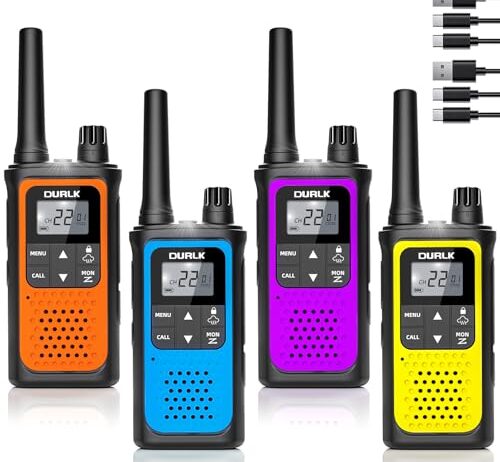
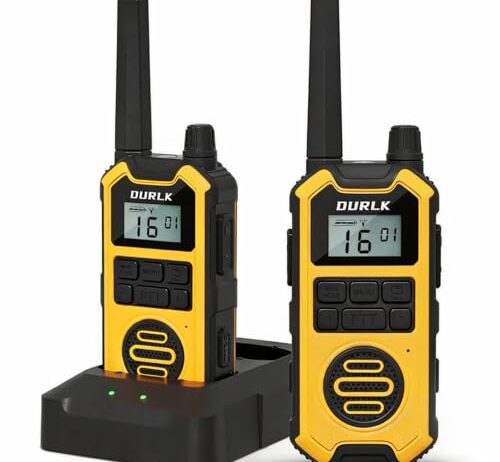
That’s why a bare milliamp-hour figure without a runtime estimate tells you the size of the tank but not the mileage. One owner of the DURLK 2-pack describes using them for intermittent household tasks — calling between the attic and the yard — and finding the charge holds comfortably through a workday. [R10] That matches what you’d expect from intermittent duty on a lithium cell of any reasonable size.

USB-C charging is standard across all four radios here, which matters less for the connector itself than for what it implies: you can top off from any phone charger, portable battery, or car adapter without packing a proprietary dock. The DURLK 2-pack includes a desktop charging cradle as well, though one owner notes the dock’s fit is inconsistent. [R10]

Water, Dust, and What IP67 Actually Covers

IP67 means two things. The six: total protection against dust ingress. The seven: the device survived submersion in one meter of water for thirty minutes in a lab. That’s a real, tested standard — not a marketing phrase. It means you can drop the radio in a puddle, fish it out, and keep talking.

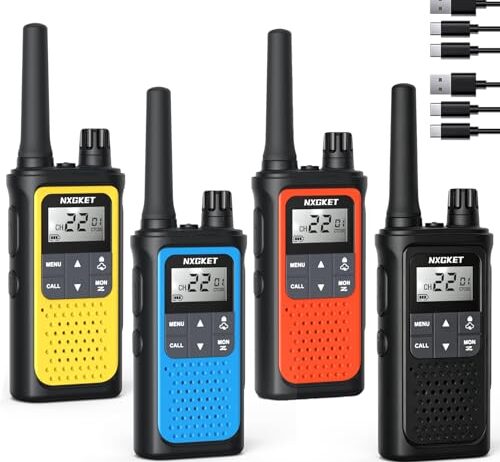
Rain is a different question. Sustained rain hits the radio from angles and durations that submersion testing doesn’t replicate, and any open port — the USB-C charging cover, the speaker grille — is a potential entry point. One owner of the NXGKET 4-pack describes a unit falling into a creek during a hike and surviving after drying in rice, but that radio carries no IP rating at all — it was luck, not engineering. [R12]

The DURLK 2-pack is the only radio in this group with an IP67 rating. If you’re buying for kayaking, fishing, or any situation where the radio might go underwater briefly, that rating is the only one here backed by a tested standard. For general hiking in variable weather, the practical question is whether the charging port cover stays sealed — and owners of radios without ratings report those covers loosening or popping open with use. [R11]

The DURLK 2-pack is the one radio here where you know exactly how much power is going into the antenna: 2 watts, the FRS legal ceiling on the primary channels. That matters because every other radio in this set leaves transmit power undisclosed, and power is the single variable — after antenna height and Fresnel-zone clearance — that determines whether your signal arrives.

IP67 sealing adds genuine insurance for outdoor use. Owners confirm the audio clarity and range perform well at close to moderate distances, though one notes that the advertised long-range figures don’t hold past about a quarter mile in obstructed terrain — exactly the Fresnel-zone effect in action. [R9] The antenna housing is a weak point: multiple owners report the plastic cover snapping off within weeks of regular use. [R7] [R8] That doesn’t kill the radio, but it exposes the antenna base to moisture and debris, which matters more on a radio you chose specifically because it’s sealed.

A 24-hour battery life claim on intermittent duty is plausible for a lithium cell of this class. It comes in a 2-pack, so if you need four radios for a group, you’re buying two boxes — a real cost consideration against the 4-packs below.

Channels, VOX, and Features That Earn Their Space

All 22 FRS channels are the same 22 channels on every FRS radio ever made. They’re not proprietary, not encrypted, and not private. Anyone within range on the same channel hears you. For a family camping trip, that’s fine — pick a channel, agree on it before you split up, and you’re set. For a crowded campground or theme park, you’ll share that channel with every other family who picked the same number.

VOX — voice-operated exchange — triggers transmission when the microphone hears sound above a threshold. Hands-free convenience when you’re climbing or carrying gear. The trade-off is false triggers: wind across the microphone, a zipper pulled near the radio, a kid’s backpack rustling against the housing. In quiet terrain it’s useful. In a noisy environment you’ll turn it off inside ten minutes and go back to the push-to-talk button.

NOAA weather channels receive dedicated emergency broadcast frequencies — a one-way feed from the National Weather Service. They don’t use your FRS channels and don’t drain extra battery. Three of the four radios here include them. On a day hike they’re nice to have. On a multi-day backcountry trip in storm season, they’re the one feature that could matter more than range.

Where the Cruise Ship Kills Your Signal

A cruise ship is a steel box. Steel reflects UHF radio waves almost completely — the signal doesn’t pass through decks, it bounces off them. One owner tried communicating between deck 5 and deck 12 and got nothing. [R11] Another found the radios worked only when both people were on the same side of the ship. [R6] That’s consistent with what the Fresnel zone predicts: the path between two radios separated by multiple steel decks has zero clearance, and the signal has nowhere to go.

If you’re buying walkie-talkies for a cruise specifically, set your expectations at same-deck, same-side communication with occasional success across open pool areas. The steel superstructure turns every internal wall into a radio mirror. No consumer FRS radio at 2 watts or below will reliably penetrate multiple decks on a large vessel — that’s a limitation of physics, not of any particular radio.

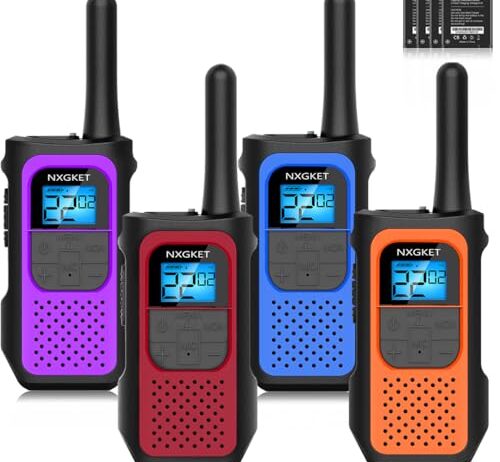
The DURLK 4-pack shares the same brand as the top pick but trades IP67 sealing and disclosed wattage for two extra radios in the box. For a family of four splitting up at a campground or resort, having one radio per person without purchasing two 2-packs simplifies logistics and cuts cost per unit.

VOX is included here, which earns its keep when kids are wearing the radios — a child climbing a trail doesn’t want to find the push-to-talk button before yelling for a parent. NOAA weather alert adds the same emergency broadcast reception as the other radios here. The 1800mAh lithium-ion cells charge via USB-C.

Owner reports flag two issues worth knowing. The belt clips are flimsy enough that radios detach from clothing during activity — one owner lost two into a creek. [R12] And the charging port cover tends to open on its own, which on a radio without a water resistance rating means every puddle is a risk. [R11] Build quality is adequate for occasional recreational use; for daily or rough-condition use, the sealed DURLK 2-pack above is the better investment per radio.

When a 4-Pack Is Four Chances for One to Fail

Buying four radios instead of two means four batteries, four sets of buttons, four antennas, four charging ports. The probability that at least one unit has a defect rises with the count. Owners of the NXGKET 4-pack report volume knobs loosening within days and a small retaining bolt falling out, making the radio difficult to turn on reliably. [R5] One owner describes a unit catching fire in a coat pocket — an extreme case, but one that underscores the importance of lithium-ion cell quality in devices that get jostled and compressed. [R3]

The pattern across owner reports for budget 4-packs is consistent: two or three units work well, and one arrives with a defect or fails early. That’s not unusual for consumer electronics at this price point, but it’s worth factoring into your per-unit math. A 4-pack where one radio is dead on arrival costs the same per working radio as a higher-quality 2-pack.

FAQ

Why does my walkie-talkie only reach a few hundred feet in the woods when it says 5 miles?

Range claims are measured over flat, open terrain with nothing between antennas. Trees absorb UHF radio energy — dense canopy can reduce effective distance to a fraction of the rated figure, because foliage intrudes on the Fresnel zone and scatters the signal before it arrives. Five miles over water might be two hundred yards through heavy timber.

Do FRS walkie-talkies need a license?

No. FRS — Family Radio Service — is license-free in the United States. GMRS, which shares some channels with FRS but allows higher power, does require an FCC license (about thirty-five dollars, valid ten years, covers your household). If your radio has channels beyond the 22 FRS frequencies, check whether those extra channels are GMRS before transmitting on them.

What does 2 watts of transmit power actually mean for range?

Two watts is the FRS legal maximum on channels 1–7 and 15–22. More power pushes a stronger signal through the Fresnel zone, but doubling wattage only extends range by roughly forty percent because of how radio energy spreads with distance. The bigger gain comes from antenna height: lifting both radios a few feet clears more of the Fresnel zone than any legal power increase.

Can I use an IP67 walkie-talkie in the rain?

IP67 means the device survived submersion in one meter of water for thirty minutes in a controlled test. Rain hits from different angles and durations, and any port left open — the USB-C cover, for instance — is a potential entry point. An IP67 radio will survive a rainstorm far better than an unrated one, but keep the port covers sealed.

Will walkie-talkies work on a cruise ship?

Poorly. A cruise ship’s steel hull and internal bulkheads reflect UHF signals almost completely. Owners report success only when both radios are on the same side of the same deck, with open line of sight. Communication between decks — through steel floors and ceilings — rarely works with any consumer FRS radio.

How many channels do I need for a family camping trip?

One. You agree on a channel before you separate, and everyone uses that channel. All 22 FRS channels are identical in performance. The extra channels are useful only if your chosen channel has interference from other groups nearby — then you switch to a quieter one.