We research every product we recommend. We may earn a commission from the links on this page.
Tools & Home Improvement › Tool Chests & Cabinets

Why Big Tool Cabinets Boom When You Drop a Wrench

We compare published specifications and marketplace data. We do not test these products.

Tool Cabinets Ring Like Bells Because Large Flat Panels Have Low Resonant Frequencies
Photo by Кайрат Сатдиков on Pexels

A 72-inch steel tool cabinet has side panels roughly four feet tall and six feet wide. Hit the worktop with a dead-blow hammer and those panels flex, ring, and push air — the same physics that makes a drum head loud. The difference between a cabinet that booms for three seconds and one that thuds and stops comes down to panel span, steel thickness, and what sits between the steel and the thing that hit it. Three cabinets at three different sizes show where the noise comes from and what actually interrupts it.

Affiliate disclosure: This article contains affiliate links. We may earn a commission if you buy through them, at no extra cost to you.

Everything we recommend
3 picks

How we picked

We read specs and owner feedback. We did not roll these cabinets across a shop floor.

Panel span, not cabinet size

Width determines how low the side panels resonate. Wider means louder at frequencies ears catch.

Damping layers, not padding

Rubber wood and drawer liners shear under flex and convert vibration to heat. Bare steel does not.

Internal partitions, not drawer count

More drawers mean more cross-braces dividing panels into smaller, higher-frequency segments.

Mounting method, not weight class

Floor-coupled rolling cabinets receive vibration through casters. Wall-mounted units skip that path entirely.


A flat steel panel is a speaker you didn’t ask for

Sheet steel is stiff enough to hold tools and flexible enough to vibrate. When something strikes the worktop — a dropped ratchet, a mallet blow, even rolling the cabinet over a crack in the concrete — the impact energy travels through the frame and into the large flat side panels. Those panels flex back and forth at a frequency set by their size, thickness, and how they’re supported at the edges.

The fundamental frequency of a rectangular panel drops with the square of its longest unsupported dimension. Double the width, and the resonant frequency falls to one quarter. That matters because a 60-inch panel resonates somewhere in the low hundreds of hertz — right where a door slam or a dropped tool lives. A 72-inch panel drops even lower.

Lower frequencies do two things that make the problem worse. They travel farther through air before losing energy. And a large panel is physically big enough to push air efficiently at those frequencies, so the vibration doesn’t just stay in the steel — it radiates into the room. A small panel vibrating at 800 Hz is too small relative to the wavelength of sound to move much air. A six-foot panel vibrating at 150 Hz moves plenty.

What breaks up the ring

Three things shorten the time a panel spends vibrating. All three work, and they stack.

Structural stiffening. Every internal partition — a drawer divider, a vertical brace, a shelf — cuts the unsupported span of the panel behind it. A panel divided into quarters resonates at four times the frequency of the same panel undivided. Higher frequencies decay faster and radiate less efficiently from the same surface area. Ten drawers stacked vertically behind a side panel create nine horizontal dividers. That is real cross-bracing, whether or not the manufacturer intended it as acoustic treatment.

Mass loading. A loaded drawer is harder to move than an empty one. The added mass from sockets, wrenches, and boxes raises the energy needed to sustain vibration and shifts the resonant frequency down to a point where the panel can’t radiate efficiently anymore. This is why the same cabinet sounds different empty versus full — it’s not imagination, it’s physics.

Constrained-layer damping. When a stiff panel is bonded to a softer material — rubber, foam, wood — flexing the assembly forces the soft layer to shear. Shearing converts mechanical energy into heat. A rubber wood worktop bolted to a steel frame does this at the point of impact. Drawer liners do it inside each compartment. Neither eliminates vibration, but both shorten the ring from seconds to a fraction of a second.

Sixty inches versus seventy-two

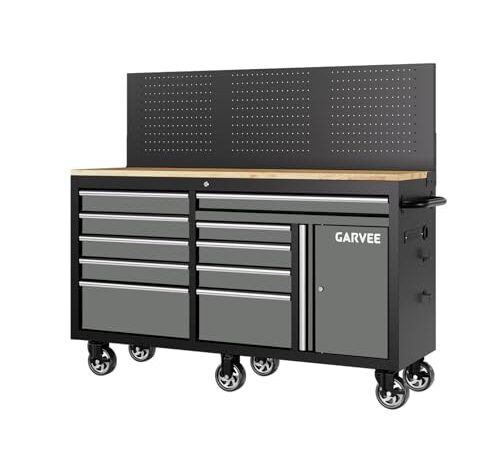
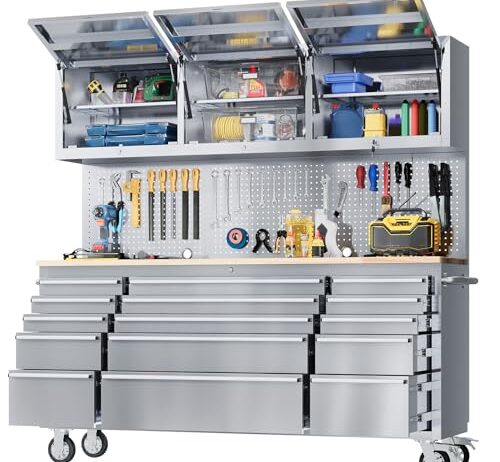
The Garvee 60-inch cabinet and the Garvee 72-inch cabinet are both rolling steel floor units with multiple drawers, but the twelve-inch difference in width changes the acoustics more than it changes the storage.

That extra twelve inches adds roughly 44 percent more unsupported panel span on the sides. The fundamental resonant frequency drops proportionally — not by 20 percent, but closer to 40 percent, because frequency scales with the inverse square of span. The 72-inch unit’s side panels want to vibrate at a frequency that sits squarely in the range of common workshop impacts: footfalls, door slams, tools dropped from bench height.

The 72-inch unit compensates in two ways the 60-inch does not. Its rubber wood worktop acts as a constrained-layer damper right where impacts land — set a tool down on wood and the energy dissipates in the grain before it reaches the steel frame. Its drawer liners do the same inside each compartment, damping rattle from contents shifting when the cabinet rolls.

The 60-inch unit has neither. Its ten drawers provide meaningful cross-bracing — nine horizontal partitions stiffening each side panel — but every impact on the bare steel top transfers directly into the frame with nothing to absorb it first. Whether that matters depends on how you use the surface. If you’re setting tools down gently, the steel top is fine. If you’re dropping things from a foot up, you’ll hear the difference.

A rubber wood worktop is not a cosmetic upgrade over bare steel. Wood is a viscoelastic material — it deforms slightly under impact and converts that deformation into heat through internal friction. Steel, by contrast, is almost perfectly elastic: it flexes, springs back, and keeps flexing until the energy radiates away as sound. Bolting wood to the top of a steel frame gives you constrained-layer damping at the exact point where most impacts happen.

Fifteen drawers plus three top cabinets also means eighteen internal partitions breaking up those wide side panels. That is more cross-bracing than the 60-inch unit’s ten drawers provide, and it matters more here because the panels being braced are larger. The combination — damping at the surface, stiffening through the structure — is why a cabinet this wide doesn’t necessarily boom louder than a narrower one built from bare steel alone.

The wall changes everything

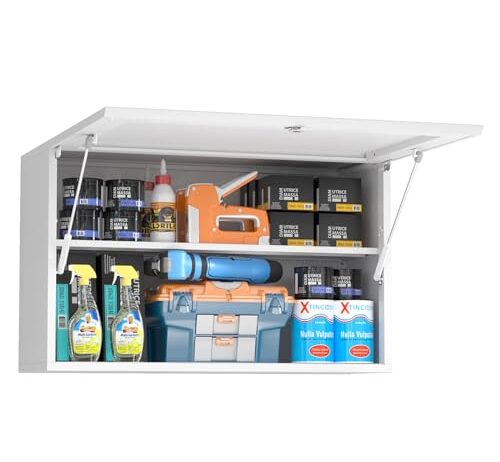
The Polup wall-mounted cabinet is twenty inches tall, made of metal, and bolts to a wall instead of rolling on casters. It solves the vibration problem by refusing to participate in it.

Rolling cabinets receive vibration two ways: through the worktop (impacts) and through the floor (footfalls, compressor rumble, rolling over uneven concrete). Casters are rigid enough to transmit all of it. A wall-mounted cabinet eliminates the floor path entirely. No casters, no floor coupling, no excitation from walking past it.

The trade-off is real. A single-door cabinet with one adjustable shelf holds a fraction of what a 15-drawer rolling unit holds. You’re not choosing between two versions of the same thing — you’re choosing between a workstation and a locker. The wall cabinet is for the chemicals, the precision instruments, the things that need to stay still and stay locked. It is not a replacement for a rolling chest any more than a medicine cabinet replaces a dresser.

One thing worth knowing: mounting a steel box to a wood-framed wall can turn the wall itself into a sounding board. Drywall on studs vibrates readily, and a rigid bolt transfers energy from the cabinet into the framing. If the cabinet sits against an exterior wall with insulation behind it, the effect is mild. Against an interior wall shared with a living space, you may notice it. Rubber washers between the mounting bracket and the wall break that path.

Ten drawers behind each side panel means nine horizontal partitions acting as cross-braces. That is enough internal structure to push the panel’s resonant frequency well above the range where large-surface radiation is most efficient. The cabinet will still ring if you hit the bare steel top with a hammer — nothing between the impact and the frame absorbs energy — but the ring will be higher-pitched and shorter-lived than a cabinet with fewer internal divisions.

The charging station and pegboard are functional additions that don’t affect acoustics. The lock matters for a different reason: a locked cabinet with heavy drawers is a loaded cabinet, and a loaded cabinet vibrates less than an empty one. If you’re filling all ten drawers with hand tools, the mass loading alone changes how the cabinet sounds. Empty, it rings. Full, it thuds. That is not a quality difference — it is a physics difference, and it applies to every steel cabinet ever made.

What you can add after the fact

If you already own a bare-steel cabinet that rings, you have options. None of them require welding or fabrication.

Adhesive-backed butyl damping sheets — the same material used inside car doors to stop them from drumming — stick directly to the inside of side panels. A single layer on each panel adds mass and introduces a constrained damping layer. The effect is immediate and obvious: knock on a treated panel versus an untreated one and the difference is a thud versus a ring. Two sheets per side panel is usually enough for a 60-inch cabinet; the 72-inch unit might want three.

Drawer liners are even simpler. Rubber or foam liners prevent tools from sliding and rattling inside drawers, which eliminates the secondary noise that makes a vibrating cabinet sound worse than it is. The primary panel vibration is one sound; twenty sockets shifting inside a drawer is another. Liners kill the second one completely.

A rubber mat on the worktop does for an aftermarket steel top what rubber wood does from the factory — it absorbs impact energy before it reaches the frame. A quarter-inch nitrile mat is enough. Thicker is not meaningfully better because the damping happens in the first few millimeters of deformation.

Steel gauge is the number nobody prints

Bending stiffness increases with the cube of thickness. That means going from 20-gauge steel (0.036 inches) to 16-gauge (0.060 inches) — a difference you cannot see — nearly quadruples the panel’s resistance to flexing. A panel that resists flexing vibrates at a higher frequency with less amplitude, and both changes reduce the perceived loudness.

None of these three cabinets names a steel gauge. That is common across the category and frustrating for anyone trying to compare construction quality before buying. The proxy is weight: a heavier cabinet of the same external dimensions almost certainly uses thicker steel. If you can find the shipping weight and subtract the packaging estimate, the per-square-foot steel weight tells you more about long-term rigidity than any phrase in any listing ever will.

For context, 16-gauge steel is what commercial-grade cabinets typically use for side panels. 18-gauge is standard in mid-range consumer units. 20-gauge flexes noticeably under hand pressure and is found in budget enclosures. The difference between 18 and 16 gauge is roughly one-third more thickness and nearly two and a half times the stiffness — enough to change whether a panel drums when you lean on it.

FAQ

Do bigger tool cabinets always sound louder when you drop something on them?

Not always, but they start with a disadvantage. A wider side panel resonates at a lower frequency, and lower frequencies radiate more efficiently from a large surface. A 72-inch cabinet with thick steel and internal bracing can be quieter than a 48-inch cabinet made from thin, unbraced panels. Size sets the baseline; construction determines whether it stays there.

What makes some steel cabinets ring like a drum and others stay quiet?

Three factors: panel span (wider rings lower and louder), steel thickness (thicker resists flexing), and internal structure (more partitions mean shorter unsupported spans). A cabinet with fifteen drawers has fourteen horizontal braces stiffening each side panel. One with a single large compartment has none. Same steel, dramatically different sound.

Will drawer liners actually reduce cabinet noise or are they just for scratches?

Both. A liner prevents tools from sliding, which eliminates rattle — the secondary noise that makes vibration sound worse than it is. The liner also acts as a thin damping layer inside each drawer compartment, absorbing a small amount of vibrational energy through shear. The anti-rattle effect is the bigger win in practice.

Does a wall-mounted cabinet stop vibration or just move it into the wall?

It eliminates floor-borne vibration entirely — no casters, no coupling to footfalls or rolling. But a rigid bolt into a wood-framed wall can transfer impact vibration into the studs, and drywall vibrates readily. Rubber washers between the bracket and the wall break that path. Against a concrete or masonry wall, transfer is negligible.

Can you add damping material to a cabinet after you buy it?

Yes. Adhesive butyl sheets on the inside of side panels add mass and constrained-layer damping — the same treatment used in car doors. Rubber or foam drawer liners kill tool rattle. A quarter-inch nitrile mat on the worktop absorbs impact before it reaches the frame. All three are reversible and none require tools beyond a utility knife.

Is a wood top quieter than a steel top when you set tools down?

Measurably. Wood is viscoelastic — it deforms slightly on impact and converts kinetic energy to heat through internal friction. Steel is nearly perfectly elastic: it flexes, springs back, and keeps oscillating until the energy radiates as sound. A wood top shortens the ring from seconds to a fraction of a second by absorbing energy at the point of contact.