
We research every product we recommend. We may earn a commission from the links on this page.
Electronics › Compressed Air Dusters

RPM Doesn’t Clean Your Keyboard. Air Velocity Does.

We compare published specifications and marketplace data. We do not test these products.

Why Air Duster Vacuum Attachments Pick Up Nothing Despite Strong Blower
Photo by Liliana Drew on Pexels

A 150,000 RPM motor sounds like it should strip paint. Point it at a keyboard through a wide nozzle in vacuum mode and the crumbs sit there, unmoved. The problem isn’t the motor. It’s the opening the air has to pass through — double the diameter of a nozzle and you quarter the speed of the air moving through it, because area scales with the square of diameter. That’s why two dusters with identical RPM numbers can feel completely different when you flip them to vacuum mode, and why owners keep writing that the blower works fine but the vacuum does nothing.

Affiliate disclosure: This article contains affiliate links. We may earn a commission if you buy through them, at no extra cost to you.

Everything we recommend
4 picks

How we picked

We did not use these dusters. Picks are based on motor specs, nozzle design, and owner-reported vacuum performance.

Velocity potential, not RPM

A fast motor with a wide inlet moves slow air. We weighted toward units whose attachments concentrate airflow.

Vacuum evidence, not blower claims

Blower mode is easy. Vacuum mode is where these fail. Owner reports of actual pickup mattered more than rated speed.

Nozzle variety, not nozzle count

One narrow nozzle that concentrates airflow beats five wide ones. We looked at whether attachments change the inlet geometry meaningfully.

Speed control that matters

More settings let you match airflow to the job — full blast scatters light dust instead of capturing it. Granularity counts.
The number on the box measures the wrong thing

Motor speed in RPM tells you how fast the impeller rotates inside the housing. That rotation creates airflow — a volume of air moved per unit of time, measured in cubic feet per minute. But airflow volume is only half the equation. The other half is velocity: how fast that air is moving at the exact point where it meets the particle you want to pick up.

Velocity equals volume divided by area. A motor pushing a fixed volume of air through a 25mm opening produces a certain air speed. Push the same volume through a 50mm opening and the area quadruples — so the velocity drops to one quarter. The crumb sitting on your desk doesn’t care how many RPM are happening inside the motor housing. It cares whether the air passing over it is fast enough to overcome friction and gravity and drag it into the stream.

This is why blower mode almost always works and vacuum mode often doesn’t. Blowing only needs to push air outward — volume and modest velocity over a wide area will scatter dust effectively. Vacuuming needs to pull particles upward against gravity through a specific inlet, which demands concentrated, high-velocity airflow at one point. Same motor, same power, completely different physics problem.

What owners actually report about vacuum mode

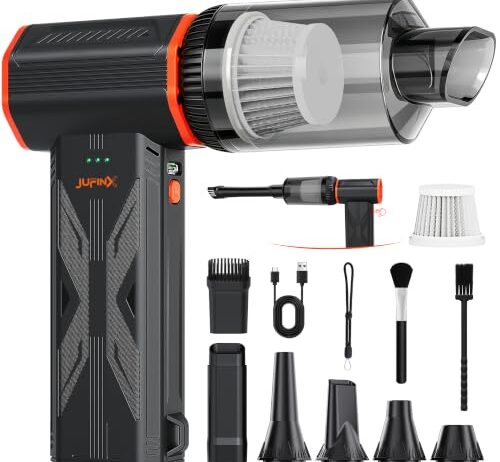
The pattern in reviews is consistent enough to qualify as a finding rather than a complaint. Owners of the JUFINX-US 150,000 RPM unit describe the blower as effective and the vacuum as functionally useless. One owner called the vacuum “absolutely pathetic” with “no suction at all” even at the highest setting, while confirming the blower “works reasonably well” [R1]. Another described the vacuum as “underwhelming” with “very weak” suction, calling it “way more work than its result” — while rating the air duster function as effective on keyboards and car crevices [R2]. A third owner’s vacuum attachment broke almost immediately and no longer stayed attached to the device [R3].

That first pattern — blower works, vacuum doesn’t — is exactly what the physics predicts. The same motor generates adequate airflow volume for scattering dust outward, but the vacuum attachment’s inlet is too wide to accelerate that air to the speed needed for particle entrainment. Owners blame the motor. The motor is fine. The geometry is the problem.

Why a narrower nozzle changes everything

Particle entrainment — the moment air actually grabs a crumb and carries it — requires the air velocity to exceed the particle’s settling velocity. Fine dust is light: a few thousand feet per minute of air speed will carry it. A breadcrumb or a strand of pet hair sitting wedged between keycaps is heavier, stickier, and harder to dislodge. It needs faster air at the contact point.

A narrow nozzle forces the same volume of air through a smaller cross-section, which raises velocity. This is Bernoulli’s principle at work: constrict the flow path and the air accelerates, dropping static pressure and creating the suction effect that lifts debris. A unit with a modest motor and a tight nozzle can generate more pickup force at the contact point than a screaming 150,000 RPM motor dumping air through a wide-mouth attachment.

This is the reason some owners find that brush attachments clean better than open nozzles on the same device. The bristles don’t add suction — they reduce the effective inlet area, which concentrates the airflow into a smaller cross-section and raises velocity at the surface.

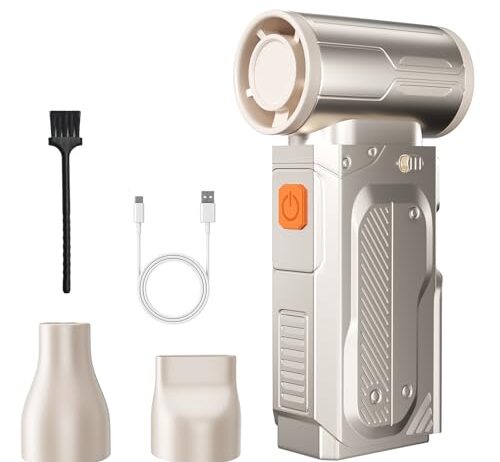
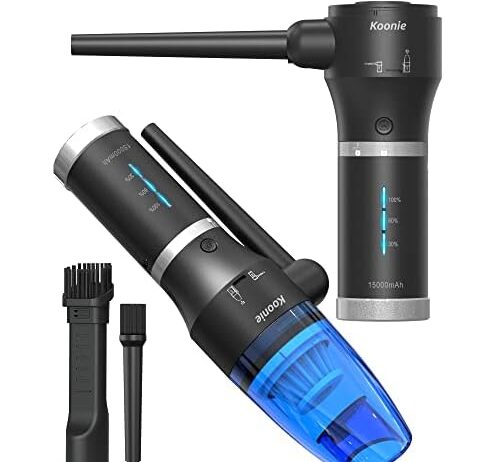
The Koonie runs its motor nearly half as fast as the two 150,000 RPM units in this set. That sounds like a disadvantage until you look at what it measures instead. Suction power in Pascals describes the pressure differential the motor creates — the force pulling air (and particles) inward through the inlet. RPM describes how fast the impeller rotates, which contributes to that pressure differential but doesn’t determine it alone. Impeller blade geometry, housing seal quality, and motor torque all factor in. A well-designed impeller at 77,000 RPM can generate more usable suction than a poorly sealed housing at twice the speed.

The 15,000mAh detachable battery is the other practical detail here. Because it detaches, you can carry a spare and swap mid-job, and you can replace the battery when it degrades without replacing the whole unit. That said, owners have reported quality control issues with the battery housing — one received a unit with a cracked battery case, and a replacement arrived with the same defect [R5]. Another found water condensation collecting inside the tube [R4]. The motor and suction design solve the velocity problem; the build quality is where the risk sits.

Speed settings are not a volume knob

More speed settings don’t just mean “louder” and “quieter.” On a device where nozzle geometry determines air velocity at the pickup point, speed adjustment lets you match the motor output to the task. Full blast through a narrow nozzle on fine dust can scatter particles away from the inlet faster than the vacuum can capture them — the air velocity is high enough to entrain the dust, but the turbulence at the edges of the stream kicks particles sideways before they reach the filter.

Dialing back to a middle setting reduces volume and velocity together, which can produce a more laminar flow pattern at the nozzle inlet — less turbulence, more consistent capture. This is the same reason a shop vacuum with a speed dial picks up sawdust more reliably on medium than on max: the air enters the nozzle in a more orderly stream instead of creating a chaotic vortex that bounces particles off the rim.

Five settings give you finer control over that balance than two. Whether you need that granularity depends on what you’re cleaning. Keyboard dust and desk crumbs are forgiving — two speeds will cover it. If you’re cleaning inside electronics with mixed debris sizes, the ability to find the exact speed that entrains without scattering has real value.

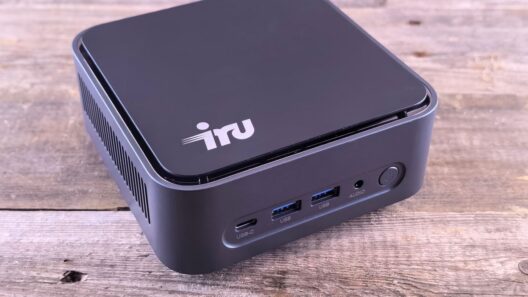
The Cimesen costs less than half what any other unit here costs, and it gives you more speed settings than any of them — five, compared to three on the two 150,000 RPM units and two on the Koonie. That granularity matters for the reason described above: different debris types need different air velocities, and being able to dial in a middle setting rather than toggling between low and high lets you find the speed that captures rather than scatters.

The magnetic nozzle attachment system is the other distinguishing feature. Magnetic connections snap on and release faster than friction-fit or twist-lock attachments, which matters less for a single cleaning session and more for switching between blower and vacuum modes mid-job — pop off the blower tip, snap on the vacuum nozzle, keep going. The 110,000 RPM brushless motor sits between the Koonie’s 77,000 and the two 150,000 RPM units, but without a suction power measurement or nozzle diameter, RPM alone cannot predict how well the vacuum mode performs. What the price does tell you is that this is the lowest-risk way to find out whether a cordless duster-vacuum fits your workflow at all.

Brushless motors and what they actually change

Three of the four units here use brushless motors. A brushed motor passes current to the rotor through physical carbon brushes that press against a spinning commutator. That contact creates friction, generates heat, and wears the brushes down over time. A brushless motor uses electronic commutation instead — no physical contact, less friction, less heat, longer life.

For a cordless device running on a battery, the efficiency gain matters directly. Less friction means less energy wasted as heat, which means more of the battery’s stored charge goes toward spinning the impeller and moving air. On two devices with identical battery capacity, the brushless one runs longer. On two devices with the same runtime target, the brushless one can use a smaller, lighter battery.

The Koonie doesn’t identify its motor type. That doesn’t mean it uses a brushed motor — it means you cannot confirm the motor architecture from available information. What you can confirm is the 15,000mAh battery capacity, which is large enough to compensate for motor inefficiency if the motor is brushed, and generous enough to deliver extended runtime if it isn’t.

Matching the tool to the job

These four units occupy three distinct use cases, not four points on a single scale.

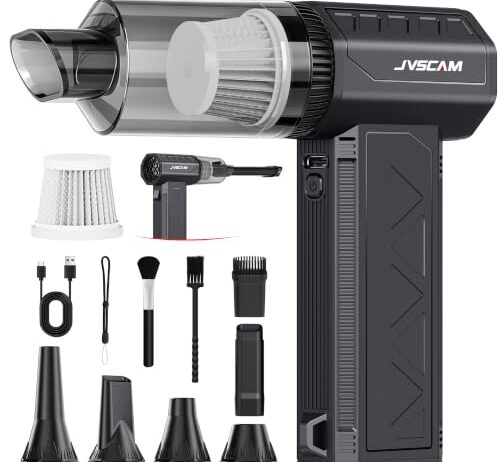
If you need a blower that also vacuums light dust — keyboard cleaning, clearing vents, blowing out a PC case — the two 150,000 RPM units deliver high airflow volume for scattering dust effectively. Vacuum mode on these units is a secondary function, and owner reports confirm it performs like one. Use the narrowest nozzle attachment available, keep expectations modest, and they’ll handle surface dust. They will not pick up crumbs, pet hair, or anything wedged between surfaces.

If vacuum pickup is the primary job and blowing is secondary, the Koonie’s 11,000 Pascals of suction pressure is the spec that matters. Lower RPM, higher measured suction, and a large battery that detaches for replacement. The quality control risk is real — check the battery housing on arrival.

If you want to try the category without committing much money, or you need fine speed control for mixed tasks, the Cimesen’s five-speed adjustment and magnetic nozzles at under twenty dollars let you experiment with both modes and learn what your actual cleaning needs demand before spending more.

FAQ

Does higher RPM mean better suction in a compressed air duster?

No. RPM measures motor speed, not suction. Suction depends on the pressure differential the motor creates, which is influenced by impeller design and housing seal quality, not rotation speed alone. A 77,000 RPM motor with a well-designed impeller can generate more pickup force than a 150,000 RPM motor with a loose housing seal.

Why does my air duster work as a blower but not as a vacuum?

Blowing scatters dust outward over a wide area — volume and moderate velocity are enough. Vacuuming requires concentrated high-velocity airflow at one narrow point to lift particles against gravity. The same motor produces adequate volume for both, but the vacuum attachment’s inlet is often too wide to accelerate the air fast enough for particle pickup.

Is a narrow nozzle better than a wide one for picking up debris?

For vacuum mode, yes. Air velocity equals volume divided by area. A narrower nozzle forces the same air volume through a smaller opening, which raises speed at the contact point. That higher velocity is what overcomes gravity and friction to pull particles into the airstream. For blowing, a wider nozzle covers more area, which is usually what you want.

What specs should I look for in a cordless duster that also vacuums?

Suction power in Pascals tells you more than RPM about vacuum performance, because it measures the pressure differential that actually pulls debris inward. Battery capacity in milliamp-hours indicates runtime. And nozzle attachment variety matters — at least one narrow-inlet option that concentrates airflow for pickup rather than spreading it for blowing.

Does changing the speed setting affect how well a duster vacuums?

It can. Maximum speed through a narrow nozzle can create turbulence that scatters light particles sideways instead of pulling them in. A medium setting can produce a more orderly airflow pattern that captures dust more consistently. More speed settings give you finer control over that balance, which matters most when cleaning mixed debris sizes.