Affiliate disclosure: This article contains affiliate links. We may earn a commission if you buy through them, at no extra cost to you.
LED bulbs emit less than 1% of their energy as ultraviolet radiation. Incandescent bulbs run ten to fifteen times that. So switching to an LED floor lamp should stop your shade from yellowing — except it doesn’t, not entirely. The bulb was never the only source of UV hitting that fabric. Window sunlight, blue-spectrum visible light, and the shade material itself all play a role, and understanding which factor dominates in your room changes which lamp actually helps.
What yellows a lamp shade
Yellowing is photodegradation — ultraviolet photons breaking carbon-carbon bonds in the polymers that make up fabric, paper, or synthetic shade materials. When those bonds snap, the broken chains rearrange into structures called chromophores. Chromophores absorb blue light and reflect yellow wavelengths back at your eye. That’s the color shift.
The process is cumulative. It depends on UV dose: intensity multiplied by time. A shade sitting in direct afternoon sun for eight hours accumulates dose faster than one in a dim hallway, regardless of which bulb is inside the lamp.
Incandescent bulbs were a major UV source indoors — roughly 10 to 15% of their output fell in the UV-A range (315 to 400 nanometers), a byproduct of heating a filament until it glows. Compact fluorescents were better but still emitted UV from mercury vapor discharge. LEDs changed the equation. They generate photons through electroluminescence in a semiconductor, with emission clustered tightly around visible wavelengths. The UV component is negligible.
But “negligible from the bulb” doesn’t mean “zero hitting the shade.” Sunlight through a window carries plenty of UV-A, and it doesn’t care what bulb you screwed in.
The window matters more than the bulb
Once you’ve switched to LED, the dominant UV source in most rooms is the window. South- and west-facing windows in the Northern Hemisphere deliver the most cumulative UV exposure to anything sitting nearby. A floor lamp three feet from an uncovered window gets more UV dose from sunlight in a single afternoon than the LED inside it emits in a year.
This is where placement decisions overtake product decisions. Moving a floor lamp to an interior wall or behind a curtain does more to prevent yellowing than any feature printed on the box. UV-filtering window film blocks most UV-A transmission and costs less than replacing a shade.
The shade material determines how fast the damage shows. Natural fibers — cotton, linen, silk — are cellulose-based polymers. They yellow at a moderate, predictable rate under UV. Paper shades contain lignin, an organic polymer that yellows faster than cellulose alone, which is why unbleached paper products turn color before bleached ones do. Synthetic materials like polyester degrade too, but at a different rate and through a slightly different chemical pathway. Faux silk — a polyester weave meant to mimic silk’s drape and sheen — falls in this synthetic category.
Blue light: the slow second factor
Here’s where it gets less intuitive. Blue-spectrum visible light — wavelengths between 400 and 450 nanometers — isn’t UV. It’s visible. But it carries higher photon energy than warmer colors, and over extended exposure, it contributes to photodegradation in some polymer types. The effect is slower than UV damage by a wide margin, but it’s not zero.
This matters because color temperature settings on LED lamps control exactly this part of the spectrum. A lamp running at 6500K (“daylight”) pushes more blue-spectrum photons than one running at 2700K (“warm white”). Over months of daily use, the cumulative blue-light dose to the shade differs meaningfully between those settings.
Does that make adjustable color temperature a shade-preservation feature? Not in the way a UV filter would be. But if you’re already placing the lamp away from windows and running it for ten or twelve hours a day, choosing a warmer color temperature removes one small contributor to the total photon load on the shade material. It’s a marginal gain, not a solution.
What color control actually gives you
The two Honeywell models — the F01WT and F01BK — both offer five color temperature presets with five brightness levels, controllable by remote. That combination lets you run the lamp at its warmest, dimmest setting when you don’t need task lighting, which reduces both blue-spectrum photon output and total light intensity hitting the shade.
Is that a meaningful difference for shade longevity? Over a year, probably not. Over five years of daily use at eight-plus hours, the cumulative dose gap between running at 2700K and 6500K adds up. It’s the kind of factor that matters more if you’ve already handled the bigger variable — window UV — and you’re trying to squeeze extra life out of a shade material you like.
The two Honeywell units are functionally identical in their light output and control scheme. The F01WT and F01BK differ in finish color, not in capability. Pick the one that matches your room.
Replacement shades: the question nobody asks early enough
Shade yellowing is inevitable over enough time, even with LED bulbs and good placement. The practical question isn’t whether it’ll happen — it’s whether you can replace the shade without replacing the lamp.
Traditional floor lamps with standard harp-and-finial shade attachments use interchangeable shades. The AIDENOEY, with its classic drum shade on a swing arm, fits this category. You buy a new shade for fifteen or twenty dollars and swap it out in thirty seconds.
Modern minimalist and smart floor lamps often integrate the shade into the fixture. The diffuser may be a rigid polymer tube or a custom-molded shape that isn’t sold separately. Before buying any floor lamp with an integrated diffuser, look at whether the manufacturer sells replacement diffusers or shades as separate parts. If they don’t, the shade’s lifespan is the lamp’s lifespan.
The order of operations
If shade yellowing is something you’re trying to prevent — or slow down — the interventions stack in a clear priority order.
First: move the lamp away from direct window light. This eliminates the largest UV source in most rooms and costs nothing. An interior wall, a corner away from south- or west-facing glass, behind a curtain — any of these work.
Second: use LED bulbs. You’re probably already doing this. If you’re still running incandescent or CFL, switching to LED cuts the bulb’s UV contribution by roughly 90% or more.
Third: run warmer color temperatures when you don’t need cool daylight. This reduces the blue-spectrum component. It’s a marginal gain, but it’s free if your lamp supports it.
Fourth: choose a lamp with a replaceable shade. Yellowing will happen eventually. The question is whether it costs you fifteen dollars or a hundred and seventy.
Fifth: if you want to keep a lamp near a window, consider UV-filtering window film. It blocks most UV-A transmission through glass and protects everything in the room, not just the lamp shade.
Everything we recommend
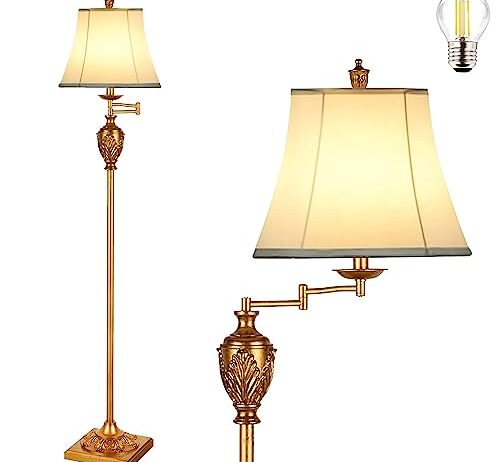
Replaceable shade, known material
AIDENOEY Traditional LED Floor Lamp with 350° Adjustable – Vintage Pole lamp Swing arm for Living Room, Bedroom and Office – Rustic Upright Floor Light for Home Décor with Faux Silk Fabric SFaux silk drum shade on a 350-degree swing arm — when the shade eventually yellows, you swap it out for a standard replacement, not a new lamp.
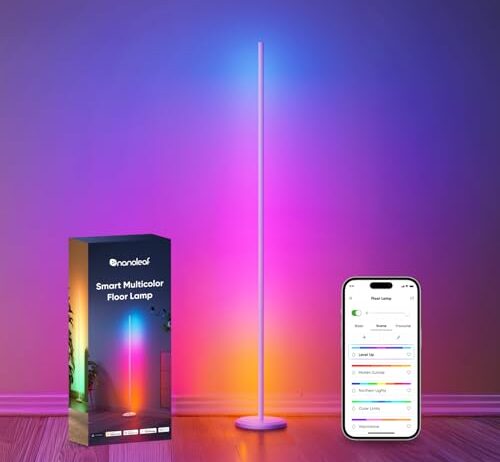
Eliminate blue wavelengths entirely
Nanoleaf Matter Smart Floor Lamp, 1700lm RGBTW LED Standing Lamps | Work with Alexa, Corner Floor Lamp with Music Sync, 16M+ Colors, Voice Control for Living Room, Ambient Lighting, WhiteFull RGBTW at 1,700 lumens lets you cut blue-spectrum output to zero while keeping the room well lit. Smart scheduling automates the shift.
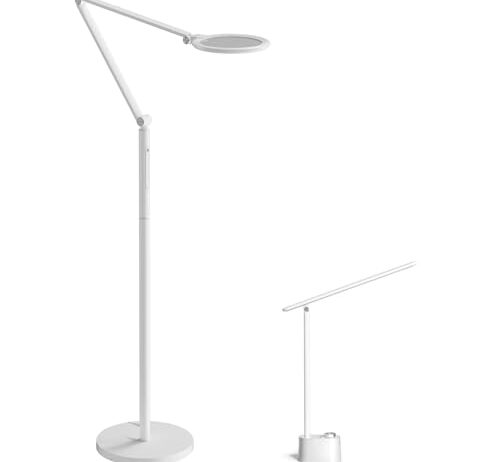
Five temperatures, five brightness levels
Honeywell LED Floor Lamp - F01WT Sunturalux™ Eye Caring Dimmable Standing Light with Remote,Bright Natural Daylight 5 Colors & 5 Brightness Adjustable Tall Lampara for Home Office Living RooPreset color temperature control with remote dimming — simpler than full RGB, but enough to keep the lamp running warm when task lighting isn't needed.
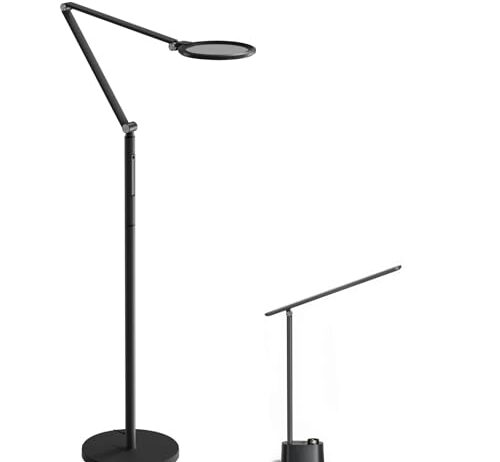
The F01WT's twin in black
Honeywell LED Floor Lamp - F01BK Sunturalux™ Eye Caring Dimmable Standing Light with Remote,Bright Natural Daylight 5 Colors & 5 Brightness Adjustable Tall Lampara for Home Office Living RooIdentical five-temperature, five-brightness system in a darker housing. Same light output, same remote, same shade-friendly flexibility.
FAQ
Do LED floor lamps prevent lampshade yellowing?
They eliminate one cause — UV from the bulb itself — but not all causes. Sunlight through windows carries far more UV than any LED emits, and blue-spectrum visible light contributes to slow degradation over time. LEDs reduce the problem significantly but don’t stop it entirely.
Does color temperature affect how fast a shade yellows?
Slightly. Cooler color temperatures (5000K–6500K) output more blue-spectrum light, which carries higher photon energy than warmer tones. Over years of daily use, running a lamp at warmer settings reduces the cumulative energy hitting the shade. The effect is real but small compared to window UV exposure.
Will a lamp shade still yellow if the lamp isn’t near a window?
Much more slowly. With an LED bulb and no nearby window, the shade receives minimal UV. Yellowing can still occur over many years from blue-spectrum visible light and from oxidation of the shade material itself, but the rate drops dramatically compared to a window-adjacent position.
Can you replace a yellowed shade on an LED floor lamp?
On traditional floor lamps with standard harp-and-finial fittings, yes — replacement drum shades cost fifteen to twenty dollars and swap in seconds. On modern or smart lamps with integrated diffusers, often no. Check whether the manufacturer sells replacement diffuser parts before buying.
What shade material resists yellowing the longest?
Synthetic materials like polyester and acrylic generally resist photodegradation longer than natural fibers like cotton or linen. Paper shades yellow fastest because they contain lignin, which is more UV-sensitive than cellulose. Faux silk — typically polyester — falls in the middle-to-durable range among common shade materials.