We research every product we recommend. We may earn a commission from the links on this page.
Tools & Home Improvement › String Lights

Why String Lights Get Dimmer Toward the End

We compare published specifications and marketplace data. We do not test these products.

String Light Voltage Sags as Wire Length Grows
Photo by Andy Lee on Pexels

The warm glow you plugged in at one end turns cooler and dimmer by the time it reaches the other. That’s voltage drop — current flowing through copper wire loses voltage with every foot, and the LEDs farthest from power get less of it. The effect is worse on longer runs, thinner wire, and daisy-chained sets. Here’s how the physics works and which designs handle it differently.

Affiliate disclosure: This article contains affiliate links. We may earn a commission if you buy through them, at no extra cost to you.

Everything we looked at
4 picks
Also great · solar
49 feet without a plug

49 feet without a plug

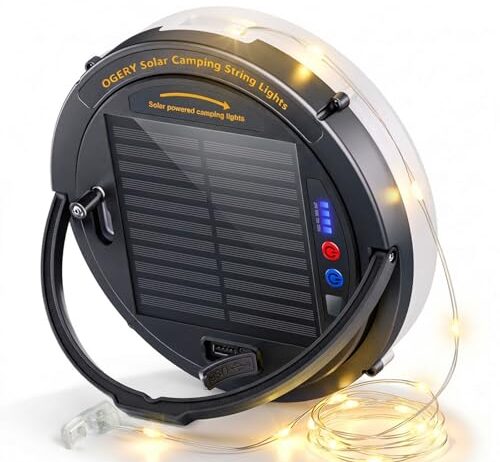
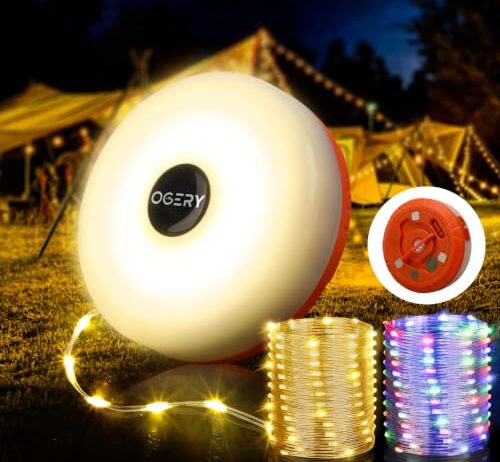
OGERY Solar Camping String Lights, 5400mAh/ 49.2FT/ 11 Modes Rechargeable Camping Lights Outdoor/Indoor, 4-in-1 Quick Storage Fairy Tent Lights Portable LED Lamp for Patio Yard Party Decor E
★ 4.1 183 reviews

The longest string here at 49.2 feet, powered by a 5400mAh solar-rechargeable battery. No extension cord variables, but battery state-of-charge affects brightness — full charge means warm white, partial charge shifts cooler.
How we picked

We did not install these string lights. Judgements rest on wire gauge, published LED counts, total length, and power-supply topology.

Wire run, not bulb count

Total copper path matters more than LED quantity — voltage drops with distance regardless of how many emitters hang on the line.

Power topology, not brightness claims

Plug-in with daisy-chain capability versus sealed battery determines where and how voltage drop manifests.

UL certification, not category norms

Safety testing confirms wire gauge and current handling match the declared LED load and extension limits.

Rated LED spacing, not total LEDs

Density determines how evenly current distributes and whether the gradient from first to last LED becomes visually obvious.

What Voltage Drop Actually Does to an LED

An LED doesn’t dim like an incandescent bulb — it doesn’t just get fainter. When the voltage feeding a white LED falls below its rated drive level, two things happen at once. Light output drops, which you’d expect. But the color shifts too, toward cooler and bluer, because the phosphor coating that converts blue light into warm white needs a certain excitation level to work efficiently. Underpower it and the conversion falls off before the blue diode itself dims, so you see more raw blue bleeding through.

That’s why the far end of a long string doesn’t just look dim. It looks wrong.

The mechanism is Ohm’s law, and it’s cumulative. Copper wire has resistance — roughly 16 ohms per thousand feet at 22 AWG, about 6 ohms per thousand feet at 18 AWG. Current flowing through that resistance converts voltage into heat. In a series-wired string, every LED sits behind all the wire that came before it. The first LED loses almost nothing. The fiftieth LED loses the sum of every wire segment between it and the plug. On a 15-foot string, the total drop might be invisible. On a 50-foot string, or three 15-foot strings daisy-chained together, it stacks up.

Length Is the Biggest Variable, but Not the Only One

A 15-foot string and a 50-foot string using the same gauge wire and the same LEDs will behave very differently at their endpoints. The longer string accumulates roughly three times the wire resistance. If the shorter string drops half a volt across its full run — enough that you’d never notice — the longer one drops closer to a volt and a half, which is enough to push end-of-string LEDs below their forward voltage threshold for warm-white emission.

But length alone doesn’t tell the whole story. LED count matters because more LEDs draw more current through the same wire, and higher current multiplied by the same resistance means a larger voltage drop. A string packing 100 LEDs into 27 feet pulls more current per foot of wire than one spreading 50 LEDs across 15 feet, even though the second string is shorter. The denser string asks the wire to deliver more power per unit length, and the wire’s resistance doesn’t care about your intentions — it takes its cut regardless.

Wire gauge is the hidden lever. Thinner wire resists more. Most consumer string lights use wire thin enough to stay flexible and unobtrusive, which means resistance per foot is on the higher end. You can’t change this after purchase.

Daisy-Chaining Makes It Worse in a Specific Way

Connecting two plug-in sets end to end doesn’t just double the number of LEDs. It doubles the total wire run that current has to travel through. The first set works fine — its LEDs see roughly the same voltage they’d see alone. But the second set’s LEDs sit behind all the wire from set one plus all the wire from set two. The third set, if you add one, sits behind everything.

This is why manufacturers print a maximum number of connected sets on the box, and why ignoring that number doesn’t cause a dramatic failure — it causes a gradual, ugly fade. The last set in a chain of five might still light up, but it’ll be noticeably dimmer and bluer than the first. The string didn’t break. You just exceeded the wire’s ability to deliver consistent voltage across the total distance.

A heavier-gauge extension cord between the outlet and the first set helps with the run from the wall to the string, but it does nothing for the wire inside the strings themselves. The bottleneck is the thin internal wire, not the cord feeding it.

Battery Power Changes the Problem Without Eliminating It

A battery-powered string sidesteps extension-cord resistance and daisy-chain compounding entirely. There’s no wall outlet 30 feet away through a 16-gauge extension cord — the battery sits right at the start of the string, so the only wire resistance in the circuit is the string’s own internal copper.

But batteries introduce a different voltage variable. A lithium cell starts at about 4.2 volts fully charged and sags to 3.7 volts at half charge, then drops more steeply toward 3.3 volts near depletion. That decline happens over hours, not feet — the whole string dims together rather than fading from one end. You get uniform color across the run, but the color itself shifts over the evening as the battery drains. Warm white at dusk, cooler white by midnight.

A solar-rechargeable battery adds another layer: charge level depends on how much sun the panel collected that day. A cloudy afternoon might leave the battery at 60 percent by dark, which means the string starts the night already partway down the voltage curve. The LEDs work. They just start cooler than they would on a full charge.

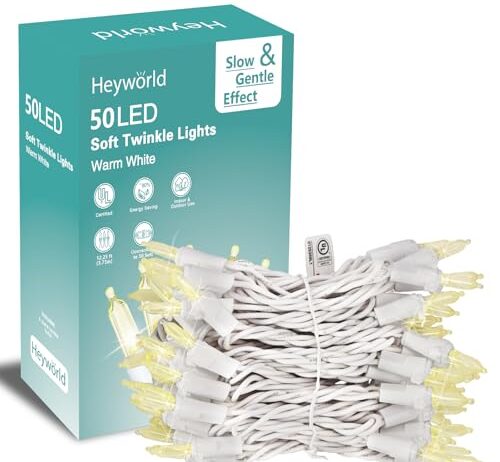
At 14.58 feet with 50 LEDs, this Heyworld string has the highest LED density of anything here — roughly 3.4 LEDs per foot. That’s a lot of current demand per foot of wire, but the wire run is short enough that cumulative resistance stays low. The physics favors short and dense over long and sparse when your goal is even brightness from end to end.

It connects up to 50 sets in series, which sounds like a license to build an enormous chain. In practice, each set you add extends the total wire run by another 14.58 feet. Five sets gives you about 73 feet of total wire — long enough for voltage drop to show up on the last set. The advantage is granularity: you can add one set at a time and stop when you see the far end start to fade, rather than committing to a single 50-foot run with no way to shorten it. The white wire disappears against a white soffit or gutter line, which matters if you’re wrapping architecture rather than draping trees.

What LED Density Does to the Brightness Gradient

A string with widely spaced LEDs hides voltage drop better than one with LEDs packed close together, for a simple perceptual reason: your eye compares adjacent lights. If two LEDs are six inches apart and one is 10 percent dimmer, you see the difference. If they’re two feet apart, the same 10 percent difference disappears into the ambient darkness between them.

This doesn’t mean sparse strings have less voltage drop. The physics is identical. But the visual effect — the thing you actually notice when you look at your patio — is less obvious. A 49-foot string with LEDs every 12 inches looks more uniform than the same string would with LEDs every 4 inches, even if the actual voltage at the last LED is the same in both cases.

Dense strings give you more total light output and a richer glow up close. But they’re also the ones where end-of-string dimming is most visible, because your eye has more nearby reference points to compare against.

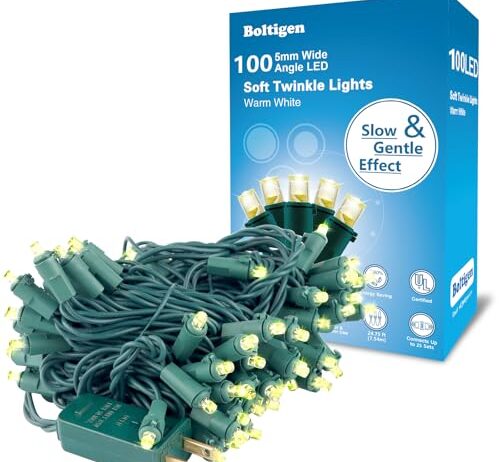
This Boltigen string puts 100 LEDs on 27 feet of wire — about 3.7 LEDs per foot, the densest packing here. The 5mm wide-angle LED shape throws light sideways rather than straight ahead, which fills the gaps between LEDs better than a narrow-beam design. That wider throw helps mask minor brightness differences between the start and end of the run, even though the higher LED count means more current flowing through the wire.

It’s extendable, and that’s where the math matters. One set at 27 feet is a moderate run — voltage drop exists but probably isn’t visible. Two sets daisy-chained give you 54 feet of total wire carrying current for 200 LEDs. Three sets: 81 feet, 300 LEDs. At some point — and the manufacturer doesn’t tell you where — the last set in the chain will be feeding its LEDs noticeably less voltage than the first. The wide-angle optics buy you some visual forgiveness, but physics doesn’t care about lens shape. If you’re planning a multi-set installation, start from the middle of the run with your power source rather than one end.

Fixing Voltage Drop After the Fact

You have three real options once you notice the far end fading, and one of them actually works well.

Power injection — running a separate feed from the outlet to the midpoint or far end of the string — is the professional solution. Christmas light installers do this on large residential displays. You’re feeding fresh voltage to the LEDs that are starving for it, bypassing all the accumulated wire resistance. It requires a second outlet or a heavy extension cord run to the injection point, and it voids whatever simplicity you were hoping for when you bought plug-and-play string lights. But it works.

A thicker extension cord between the wall and the first set helps only with the voltage lost in that particular segment. If your outlet is 50 feet from the first string and you’re using a 16-gauge cord, swapping to a 12-gauge cord recovers whatever voltage the thin cord was eating. But once current enters the string’s own internal wiring, you’re back to the same thin-gauge bottleneck.

Shortening the total run — fewer daisy-chained sets, or a physically shorter string — is the most reliable fix because it removes wire resistance from the circuit entirely. Less wire, less drop.

How to Choose Based on What You’re Covering

The decision comes down to how many feet you need to cover and whether you have outlets where you need them.

For a short, dense glow — a mantel, a window frame, a single tree — a plug-in string under 15 feet keeps voltage drop invisible. You get the brightest, most uniform light because the wire run is too short for resistance to matter. Daisy-chain a few if you need more length, but count the total feet and stop before you triple the original run.

For a long single run — a fence line, a roofline, a patio perimeter — battery power eliminates the endpoint-fade problem entirely. The trade-off is finite runtime and gradual dimming across the whole string as the battery depletes, rather than end-to-end fade. A solar-rechargeable battery recharges itself but depends on sun exposure, so winter installations or shaded locations may start each night at partial charge.

For large installations where you want plug-in reliability across serious distance, plan to inject power at the midpoint rather than feeding everything from one end. Or run two separate circuits from two outlets and let them meet in the middle. The electricity doesn’t care about your aesthetic — it cares about wire length.

FAQ

Do LEDs at the end of a string always get dimmer than the ones near the plug?

Yes. In any series-wired string, current flows through progressively more wire to reach each successive LED. Wire has resistance, and resistance converts voltage to heat. The last LED always receives less voltage than the first. On short strings — under 15 feet — the difference is usually invisible. On longer runs or daisy-chained sets, it becomes noticeable as both dimming and a color shift toward blue.

Does daisy-chaining multiple sets of string lights make the dimming worse?

Yes, because each added set extends the total wire run. The second set’s LEDs sit behind all the wire from set one plus set two. Voltage drop is proportional to total wire length, so two sets don’t just double the LEDs — they roughly double the resistance the farthest LEDs have to overcome. Three sets triple it.
Are battery-powered string lights less prone to end-of-string dimming?

They eliminate the end-to-end fade pattern because the battery sits at one end of a single, fixed-length wire run — no extension cords or daisy-chained sets adding resistance. But they introduce a different dimming pattern: the entire string dims uniformly as the battery discharges over hours, and the color shifts cooler as voltage drops from full charge to depleted.

Why do my warm-white LEDs look bluish at the far end of the string?

White LEDs produce warm light by coating a blue diode with yellow phosphor. When voltage drops, the phosphor conversion becomes less efficient before the blue diode itself dims — so more raw blue light passes through unfiltered. The result is a cooler, bluer tone at the end of the run rather than the warm white near the plug.

Can I fix voltage drop by using a heavier extension cord?

Only partly. A thicker extension cord reduces voltage lost between the outlet and the first string, which helps if that cord is long. But it does nothing about the thin wire inside the strings themselves. The bottleneck is the internal wiring, not the feed cable.

Is there a way to add power in the middle of a long string to keep brightness even?

Yes — power injection. Run a separate power feed from an outlet to the midpoint of the string, giving the far-end LEDs fresh voltage that bypasses the accumulated wire resistance. Professional Christmas light installers use this technique on large displays. It works, but it adds wiring complexity.