We research every product we recommend. We may earn a commission from the links on this page.

Stair Treads Peel Off Wood Because the Wood Moves, Not the Adhesive

We compare published specifications and marketplace data. We do not test these products.

Adhesive Stair Treads Lose Grip Where Wood Grain Runs Parallel
Photo by FOX ^.ᆽ.^= ∫ on Pexels

Wood moves. Not visibly, not quickly, but a hardwood stair tread can expand 4 to 8 percent across the grain between January and July — enough to shear a pressure-sensitive adhesive bond that felt rock-solid on install day. When your stair treads curl at the edges after a few weeks, the adhesive isn’t failing. The wood underneath is pushing it off. Understanding that mechanism changes how you choose treads, where you place them, and what size actually works on your stairs.

Affiliate disclosure: This article contains affiliate links. We may earn a commission if you buy through them, at no extra cost to you.

Everything we looked at
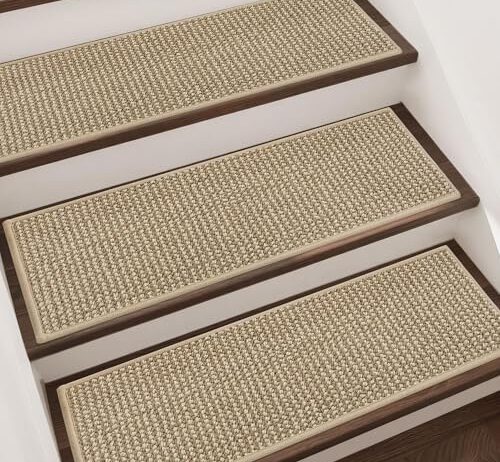
4 picks

How we picked

We do not install stair treads. Judgement is based on published dimensions, backing material specifications, and installation durability patterns in marketplace reviews.

Dimensional fit, not coverage claims

Measured tread dimensions against standard 10-inch step depth and nosing projection to confirm whether a tread size will actually work without overhang.

Backing material, not pile thickness

TPE and rubber backing ratings for adhesion persistence under seasonal wood movement, not the face fiber composition or density.

Installation volume, not recency

Review concentration at 6+ months post-installation to capture seasonal expansion cycles, not first-week impressions.

Washability evidence, not manufacturer assertion

Confirmed post-wash retention reports in reviews, not laundry instructions in the listing copy.

Why Pressure-Sensitive Adhesive Works Until It Doesn’t

Pressure-sensitive adhesive — the tacky layer on the back of every peel-and-stick stair tread — bonds by flowing into tiny surface irregularities when you press down. It doesn’t melt. It doesn’t cure. It physically grips the peaks and ridges of whatever it touches, creating mechanical interlocking at a microscopic scale.

On a flat, stable surface, that’s enough. On wood, you’ve introduced a variable the adhesive can’t negotiate.

Wood grain has a direction. Along the grain — the long way on most stair treads — expansion from moisture is negligible, under 0.1 percent. But across the grain, the same piece of oak or maple can swell 4 to 8 percent depending on species and how much moisture the air carries. That expansion is perpendicular to the bond plane. The microscopic peaks the adhesive originally flowed into shift position, opening gaps that weren’t there when you first pressed the tread down. The adhesive didn’t weaken. The surface it was gripping rearranged itself.

This is why the same tread can hold perfectly on tile or concrete and peel on hardwood within weeks. The adhesive is identical. The substrate isn’t.

Grain Direction Is the Variable Nobody Mentions

Most residential stair treads run their grain parallel to the front edge of the step — the nosing. That means the cross-grain expansion happens front to back, along the depth of the tread. Your adhesive tread is bonded in a direction where the wood beneath it is doing the most moving.

Think of it like a long stick glued to a surface that stretches side to side. The stick doesn’t stretch with it. The bond fails at the edges first, which is exactly the pattern you see: curling starts at the front and back edges of a stair tread, not at the sides.

A 9-inch-deep tread has less bonded surface experiencing that cross-grain stress than an 11-inch tread, but the stress per unit area is higher because there’s less adhesive contact distributing the load. A wider tread spreads the stress across more bond points — but also covers more of the expanding surface. Neither size escapes the problem. They just fail differently.

Polyurethane Finish Makes It Worse

If your stairs have a glossy polyurethane or oil-based finish, you’ve added a second failure mode on top of the first. Pressure-sensitive adhesive grips by flowing into irregularities. A polyurethane coat fills those irregularities before the adhesive ever arrives — you’re bonding to a smooth polymer film, not to wood grain.

The adhesive can’t tell the difference during installation. It feels sticky. It holds when you step on it. But the mechanical interlocking is shallow, and the first thermal cycle or humidity swing peels it free.

Bare wood or a matte-finish stain gives the adhesive actual texture to grip. If your stairs are glossy, no tread — regardless of brand or backing material — will bond as reliably as it would on an unfinished surface. That’s not a product deficiency. It’s physics applied to the wrong surface.

Size Isn’t Just About Coverage

Standard US residential stair treads run 10 to 11 inches deep from nosing to riser. A 9-inch-deep tread on an 11-inch step leaves two inches of exposed wood at the back — visible, but structurally harmless. Your foot lands on the front two-thirds of a step during descent anyway.

An 11-inch tread on a 10-inch step is the real problem. That extra inch has to go somewhere, and it folds over the nosing or curls up against the riser. Either way, you’ve created a trip hazard where you were trying to prevent one. And the curled edge lifts the adhesive at the point of highest foot traffic — the nosing — accelerating bond failure exactly where it matters most.

Measure your actual stair depth before ordering. Not the first step. Not the widest one. The narrowest one. A tread that fits your shallowest step fits all of them. One sized for your deepest step may overhang your shallowest by an inch you didn’t expect.

The BEQHAUSE set measures 28 inches wide by 9 inches deep. On a standard 10-to-11-inch step, that leaves an inch or two of exposed wood at the back. On a 9-inch step — common in pre-war homes and steep basement stairs — it sits flush without folding over the nosing.

That smaller footprint means less adhesive contact area, which concentrates the stress from wood movement across fewer bond points. On stairs that see heavy traffic, the edges may lift sooner than a larger tread would. But a tread that actually fits the step without overhang is doing less fighting with the nosing geometry in the first place — and nosing curl is the failure mode that creates a tripping hazard, not edge lift at the riser.

Four pieces at $25.99 puts each tread at about $6.50, the lowest per-piece cost in this set. If your staircase has 13 or 14 risers, you’re buying multiple packs regardless of brand.

Landings Are a Different Problem Entirely

A landing isn’t a wide step. It’s a turning platform, and the forces acting on it are nothing like the front-to-back loading of a normal tread.

On a straight step, your foot lands near the nosing and pushes backward during descent. The adhesive resists shear in one direction. On a landing, you’re planting, pivoting, and pushing off at angles that change with every pass. The adhesive sees multi-directional stress, and any single edge is a potential peel point.

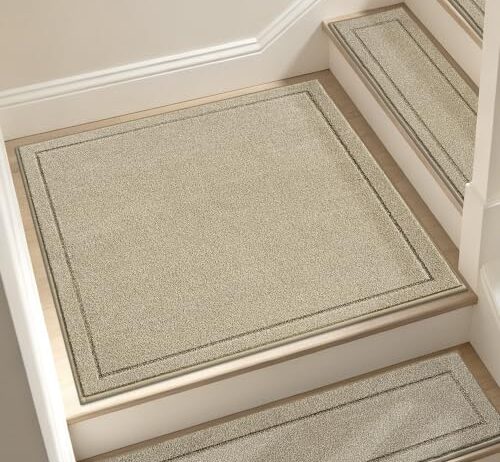
A square mat — 30 inches by 30 inches — addresses this by distributing adhesive contact evenly in all directions. There’s no front or back, no preferential peel direction. TPE backing adds grip through friction rather than relying solely on adhesive bond, which matters on a surface where the load vector rotates with every footstep.

Polyester face fibers resist moisture absorption better than nylon or cotton blends, which means a landing mat that gets wet from tracked-in snow or a mopped floor recovers its pile faster and doesn’t wick moisture down to the adhesive layer as readily. That’s a durability factor on landings that it isn’t on mid-flight treads, because landings are where wet shoes arrive first.

The JSEI landing mat is 30 inches square with a 100% polyester face and TPE backing. It’s not a stair tread scaled up. It’s shaped for the place where your foot changes direction — the half-landing or L-turn where most stair falls actually happen.

TPE — thermoplastic elastomer — combines rubber-like grip with enough flexibility to conform to minor surface irregularities. Its coefficient of friction on dry surfaces typically falls between 0.5 and 1.2, which means it holds position through friction as well as adhesive bond. On a landing where foot traffic hits from multiple angles, that dual mechanism matters more than on a straight step where the load is predictable.

At $34.99 for a single piece, the price reflects the larger material area — 900 square inches versus roughly 270 to 330 for a standard tread. You’re covering nearly three times the surface with a single application.

Washability Sounds Simple. It Isn’t.

Every stair tread gets dirty. Foot traffic grinds dust, skin cells, and outdoor debris into the pile, and textured surfaces trap particles that a vacuum can’t fully extract. Washing solves the cleaning problem. It creates an adhesive problem.

Water swells wood. If your treads sit on hardwood and you wash them without fully removing them first, moisture seeps to the bond line and accelerates exactly the expansion-driven shear stress that causes edge lift. If you remove them to wash, you’re re-bonding to a surface that may have shifted dimensionally while the tread was off — the peaks and valleys the adhesive originally gripped may not be in the same position.

A tread marketed as washable is telling you the textile survives a wash cycle. It’s not telling you the bond survives the reinstallation. On wood stairs, washability is a maintenance feature with a hidden reinstallation cost that accumulates over time.

What Actually Helps Treads Stay Down

You can’t stop wood from moving. You can manage the consequences.

Acclimate the treads indoors for 48 hours before installation. The adhesive and the wood should be at the same temperature and humidity when they first meet — bonding a cold tread to warm wood, or vice versa, guarantees they’ll be at different dimensions within a day.

Install in the season your house is driest. The wood is at its smallest dimension, and when it swells through humid months, it’s pushing outward from its smallest state rather than contracting away from an expanded one. Swelling pushes the adhesive. Contraction pulls gaps open underneath it. Swelling is the lesser failure mode.

Clean the step surface with isopropyl alcohol, not water, before applying. Alcohol evaporates without swelling the wood grain and removes the dust film that prevents full adhesive contact.

Press from the center outward. Air trapped under the tread creates a void where the adhesive isn’t touching wood at all — and those voids become the first failure points when the wood starts moving.

FAQ

Do stair treads stay stuck on hardwood floors?

They stay stuck until the wood moves — which it does seasonally. Hardwood expands across its grain by 4 to 8 percent between dry winter air and humid summer months. That expansion shears the adhesive bond at the edges. Expect edge lift in the first full seasonal cycle, especially on unfinished or matte-finish wood.

Can you wash peel-and-stick stair treads?

You can wash the textile if the manufacturer says so. The harder question is whether the bond survives removal and reinstallation. Each cycle of peeling off and re-pressing a tread degrades the adhesive contact, and water from washing can swell the wood surface, changing the microscopic profile the adhesive originally gripped.

How do you center a stair tread if the adhesive grabs on first contact?

Measure and mark the step with painter’s tape before peeling the backing. Align the tread edges to the tape, then peel the adhesive backing halfway, set the exposed half, and peel the rest while pressing forward. Repositioning after full contact pulls adhesive off the wood surface and weakens the bond.

Will a 30-inch-wide tread hang over the edge of a normal staircase?

Width isn’t usually the problem — most residential stairs are 36 inches wide, giving you 3 inches of clearance on each side with a 30-inch tread. Depth is where overhang happens. A tread that’s 11 inches deep on a 10-inch step will fold over the nosing or bunch against the riser.

Do polyurethane-finished stairs need a special tread?

They need a rougher surface, not a special tread. Polyurethane fills the microscopic texture that pressure-sensitive adhesive relies on for grip. Lightly sanding the finish with 120-grit paper in the area where the tread will sit gives the adhesive something to grab without stripping the whole step.