
We research every product we recommend. We may earn a commission from the links on this page.
Cell Phones & Accessories › Portable Power Banks

20,000mAh Doesn’t Mean 20,000mAh

We compare published specifications and marketplace data. We do not test these products.

20,000mAh Doesn't Mean 20,000mAh
Photo by Tara Winstead on Pexels

A 10,000mAh power bank and a 3,000mAh phone battery. Simple division says three full charges. You’ll get two, maybe one and three-quarters. The gap between the printed number and what reaches your phone is physics, not a defect — and it gets worse if you charge wirelessly. Here’s how to read the real capacity, what the conversion losses actually cost you, and which power banks make sense for different jobs.

Affiliate disclosure: This article contains affiliate links. We may earn a commission if you buy through them, at no extra cost to you.

Everything we recommend
4 picks

How we picked

We do not charge phones with these banks. Selections are based on stated capacity, conversion efficiency, output specifications, and aggregated buyer experience.

Watt-hours, not milliamp-hours

Actual stored energy matters more than the larger number printed on the case. Wh shows what you get after voltage conversion.

Output wattage for device compatibility

A power bank needs enough delivery speed to charge the device you’re carrying, not just enough stored energy.

Wireless efficiency against the use case

Magnetic wireless loses fifteen to thirty percent to coil alignment and heat. Worth it only when convenience justifies the cost.

Weight per watt-hour delivered

Higher capacity means more cells and more mass. The ratio decides whether you’ll actually carry it.

The mAh number is measured at the wrong voltage

Every lithium-ion cell in a power bank operates at 3.7 volts. That’s the chemistry — lithium cobalt oxide, lithium polymer, doesn’t matter. The nominal voltage is 3.7V. When a label says 10,000mAh, it means 10,000 milliamp-hours at 3.7 volts. Multiply those together and you get 37 watt-hours of stored energy.

Your phone charges at 5 volts. Some fast-charging protocols push 9V or even 12V, but the baseline is 5V. To get from 3.7V to 5V, the power bank runs a DC-DC boost converter — a chip that steps the voltage up. That conversion isn’t free. A good converter runs at about 85 to 90 percent efficiency. The rest becomes heat.

So your 37Wh of stored energy becomes roughly 31 to 33Wh of delivered energy at 5V. Divide by 5 volts and you’re looking at about 6,200 to 6,600 usable milliamp-hours — not 10,000. That’s where your missing charge went. Not a bad battery. Not a scam. A voltage step-up that costs energy every time it runs.

A 25,000mAh bank stores about 92.5Wh at 3.7V. After conversion, you’re working with roughly 78 to 83Wh at 5V. Still a lot of energy. But the gap between the printed number and the delivered number scales with capacity — bigger banks lose more in absolute terms, even though the percentage stays the same.

Wireless charging compounds the loss

Plug a cable into your phone and the power bank’s converter does its work once: 3.7V up to 5V (or 9V, or whatever the phone negotiates). One conversion, one set of losses.

Set your phone on a wireless power bank and you add a second lossy stage. The bank still converts 3.7V to whatever the transmit coil needs. Then the coil transfers energy across an air gap to the receive coil in your phone. That inductive coupling runs at roughly 70 to 80 percent efficiency under good alignment. Under bad alignment — phone slightly off-center, a thick case in the way — it drops further.

Stack the two losses. The DC-DC converter keeps 85 to 90 percent. The wireless transfer keeps 70 to 80 percent of what’s left. Multiply those together: you’re delivering 60 to 72 percent of what the cells stored. A 10,000mAh bank wirelessly charging a phone delivers the equivalent of about 5,500 to 6,000mAh at 5V. That’s roughly one and a half charges for a typical 4,000mAh phone battery, not the two and a half the box math promised.

This is why wireless charging drains a power bank noticeably faster than wired charging for the same device. It’s not a defective unit. It’s physics stacking two inefficiencies on top of each other.

Watt-hours tell you more than milliamp-hours

If you want to compare power banks honestly, watt-hours is the number that matters. It accounts for voltage. A 10,000mAh bank at 3.7V stores 37Wh. A 25,000mAh bank stores 92.5Wh. Those numbers are directly comparable — no mental gymnastics about rated voltage versus output voltage.

To estimate how many charges you’ll get, take the bank’s stored energy in Wh, multiply by 0.85 for conversion losses (conservative), and divide by your phone’s battery capacity in Wh. A phone with a 4,000mAh battery at 3.85V has about 15.4Wh of capacity. A 37Wh bank, after losses, delivers about 31.5Wh. Divide: just over two full charges. That matches what people actually experience, and it’s the number the mAh figure on the box never told you.

For wireless charging, use 0.65 instead of 0.85. Same 37Wh bank now delivers about 24Wh. That’s one and a half charges of the same phone. The formula is simple once you know the real efficiency numbers; the hard part was knowing to distrust the mAh figure in the first place.

Output wattage decides what you can charge, not how much

Milliamp-hours and watt-hours tell you the tank size. Output wattage tells you how fast the pump runs — and whether certain devices can drink from it at all.

A 20W USB Power Delivery output handles any phone on the market. It’ll fast-charge most of them, too. But plug a laptop into a 20W bank and one of two things happens: the laptop ignores the trickle entirely, or it charges at an agonizing crawl while still draining faster than it fills during use.

Laptop charging needs 45W minimum for ultrabooks, 65W for most standard machines, and some gaming laptops want 100W or more. A power bank rated at 100W output can actually feed a laptop at full speed through USB-C Power Delivery, negotiating up to 20V at 5A. That demands beefier internals — thicker copper traces, larger power FETs to handle the current without sagging or overheating.

More wattage doesn’t mean more energy. A 100W bank with 25,000mAh and a 20W bank with 10,000mAh each deliver their stored energy at different speeds, but the total energy is determined by capacity alone. The 100W bank just empties faster because it’s feeding a hungrier device.

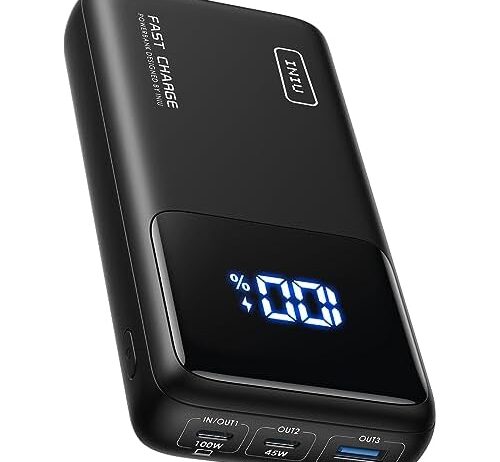
Most power banks are phone chargers that happen to have a USB-C port. This one is built around the opposite premise: enough capacity and enough output wattage to keep a laptop running. At 100W, it can negotiate 20V/5A with a USB Power Delivery sink, which means a MacBook Air or a Dell XPS draws at full speed instead of trickling.

The 25,000mAh rating translates to about 92.5Wh at the cell level. After conversion losses, expect roughly 78 to 83Wh of delivered energy. A MacBook Air battery holds about 52Wh, so you’re looking at one full charge with some headroom — not three or four, but one real one when you need it. That math is honest, and the gap between it and the mAh number on the box is the entire point of understanding conversion losses.

The trade-off is weight. Lithium cells run about 250 to 270Wh per kilogram at the cell level. At 92.5Wh, the cells alone weigh roughly 340 to 370 grams before you add the casing, the 100W converter board, and the ports. This is not a pocket power bank. It’s a bag power bank, and knowing that before you buy it is the difference between a useful tool and a heavy brick you stop carrying after a week.

Built-in cables solve one problem and create another

A power bank with built-in cables means one fewer thing to forget. No rummaging through a bag for a cable that migrated to the bottom. No borrowing someone else’s fraying Lightning cord. The cable is attached. It’s there.

The trade-off is connector lock-in. Whatever connectors are molded into the bank are what you get. If your next phone uses a different port, or you want to charge a tablet that needs more power than the built-in cable can deliver, the built-in solution becomes a limitation. A bank with standard USB-C ports works with any cable — current, future, borrowed.

There’s a durability question, too. Built-in cables flex at the same junction point every time you wrap them for storage. A detachable cable that develops a short costs a few dollars to replace. A built-in cable that fails means the entire bank loses a port.

For someone who charges one phone and wants the simplest possible grab-and-go kit, built-in cables are a genuine convenience. For someone who charges multiple devices or upgrades phones every year or two, separate cables and a bank with standard ports give you more room to adapt.

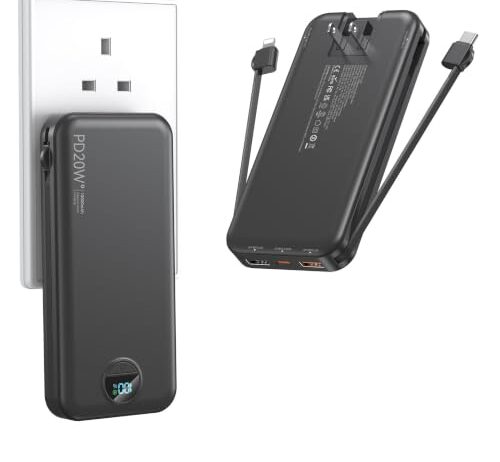
At 10,000mAh and 20W, this is a phone charger, full stop. No laptop aspirations, no wireless coils adding a second efficiency penalty. Plug in, charge, done. The 20W Power Delivery output is enough to fast-charge an iPhone or a mid-range Android at close to full speed.

The built-in cables eliminate the most common power-bank frustration: having the bank but not the cable. That simplicity has a price — you’re locked into the connectors that ship in the box, and you can’t swap in a longer cable or a different connector type. But for a daily phone backup that lives in a jacket pocket or a purse, that trade-off lands correctly.

At $23.39, it also costs less per milliamp-hour than anything else here. That doesn’t make it better — it makes it cheaper, which matters when the alternative is spending three times as much on wireless convenience you may not need.

When wireless charging on a power bank makes sense

Wireless charging from a power bank loses 20 to 30 percent more energy than wired charging from the same bank. That’s a real cost. A 10,000mAh bank that gives you two wired charges gives you one and a half wireless ones. You’re paying for convenience in capacity.

That convenience is real in specific situations. If you’re on a video call and need to charge, a magnetic wireless bank stuck to the back of your phone is one object in your hand instead of a phone tethered to a brick by a cable. If you charge at your desk throughout the day in short bursts — stick the phone on, take a call, pull it off — wireless removes the plug-unplug friction that wears out ports over thousands of cycles.

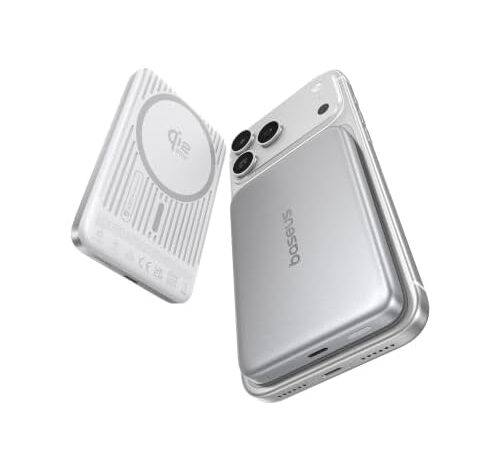
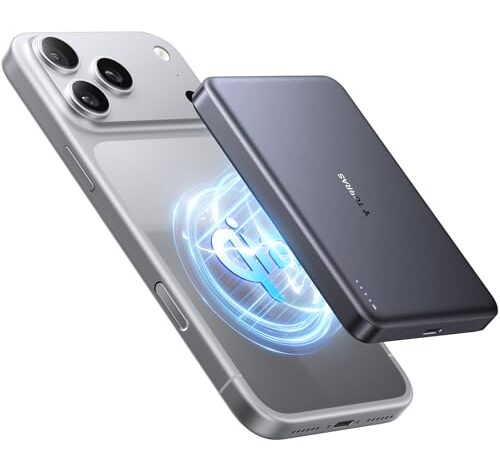
Qi2.2 with magnetic alignment solves the biggest historical problem with wireless power banks: coil misalignment. Older wireless banks needed careful positioning or they’d charge at a fraction of their rated speed, or not at all. Magnetic snap alignment means the coils line up every time, pushing efficiency toward the top of that 70 to 80 percent range instead of the bottom.

If you charge once a day and carry a cable anyway, wireless adds cost, weight, and inefficiency for a feature you won’t use. If you charge in fragments throughout a day and hate cables, it’s worth the efficiency penalty.

The weight math you can’t avoid

Lithium-ion energy density is roughly 250 to 270 watt-hours per kilogram at the cell level. That’s a hard physical limit of the chemistry, not something a better brand engineering away.

A 10,000mAh bank (37Wh) needs about 140 to 150 grams of cells. Add the casing, circuit board, ports, and any cables, and you’re looking at 200 to 280 grams total depending on how slim the design is. That sits comfortably in a pocket.

A 25,000mAh bank (92.5Wh) needs roughly 340 to 370 grams of cells alone. Total weight with electronics and housing lands somewhere around 450 to 550 grams — about a pound. That’s noticeable in a bag and uncomfortable in a pocket. There is no trick to get around this. Doubling the capacity very nearly doubles the weight. If someone tells you their 25,000mAh bank is ultralight, either the cells are smaller than claimed or the casing is flimsier than you’d want protecting lithium cells in the bottom of a bag.

Pick your capacity based on what you’ll actually carry, not what sounds like the best deal per milliamp-hour.

FAQ

Why does my 10,000mAh power bank only charge my phone twice?

The 10,000mAh rating is measured at the cell’s native 3.7 volts. Your phone charges at 5 volts, so the power bank’s internal converter has to step the voltage up, losing about 10 to 15 percent as heat. After that conversion, you’re working with roughly 6,200 to 6,600 usable milliamp-hours at 5V — enough for about two charges of a typical phone battery, not the three that raw division suggests.

Does wireless charging drain a power bank faster than a cable?

Yes. Wireless charging adds a second efficiency loss on top of the voltage conversion that every power bank already performs. The inductive coil transfer runs at about 70 to 80 percent efficiency, so a wireless charge from the same bank delivers roughly 20 to 30 percent less energy to your phone than a wired charge would.

What is the difference between mAh and Wh on a power bank?

Milliamp-hours (mAh) measure charge capacity at a specific voltage — usually the cell’s 3.7V. Watt-hours (Wh) measure total energy regardless of voltage. Wh is the more honest comparison number because it accounts for the voltage difference between the cell and your device. A 10,000mAh bank stores 37Wh; a 25,000mAh bank stores 92.5Wh.

How do I calculate how many times a power bank will charge my phone?

Convert the power bank’s capacity to watt-hours (mAh × 3.7 ÷ 1000). Multiply by 0.85 for wired charging losses or 0.65 for wireless. Then divide by your phone’s battery in watt-hours (your phone’s mAh × 3.85 ÷ 1000). For example: a 10,000mAh bank wired to a 4,000mAh phone gives roughly (37 × 0.85) ÷ 15.4 = about 2 full charges.

Can a power bank charge a laptop?

Only if the output wattage is high enough. Most laptops need at least 45W to charge, and many need 65W or more. A power bank with 20W output won’t meaningfully charge a laptop — either the laptop ignores it or it charges slower than it drains during use. Look for 65W or 100W USB-C Power Delivery output if laptop charging is the goal.

Why are high-capacity power banks so heavy?

Lithium-ion cells have a fixed energy density of about 250 to 270 watt-hours per kilogram. Doubling the capacity means roughly doubling the cell mass. A 10,000mAh bank’s cells weigh about 140 to 150 grams; a 25,000mAh bank’s cells weigh about 340 to 370 grams. No amount of engineering changes this — it’s the chemistry.