We research every product we recommend. We may earn a commission from the links on this page.
Appliances › Ice Makers

Why Your Countertop Ice Maker Can’t Keep Up with a Party

We compare published specifications and marketplace data. We do not test these products.

Why Your Countertop Ice Maker's Bin Is Never Full
Photo by Jakub Zerdzicki on Pexels

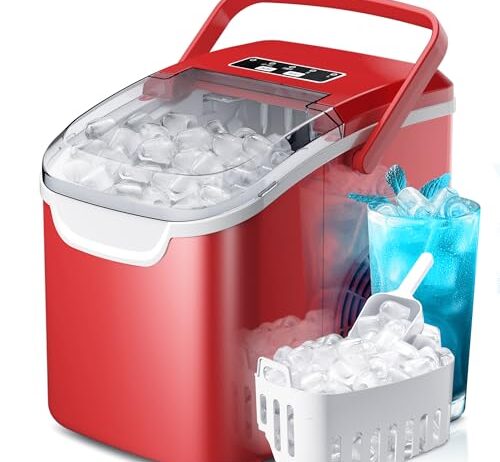
A countertop ice maker rated for 26 pounds per day will never have 26 pounds of ice sitting in it. The bin holds roughly two pounds. The rest melts as fast as it forms, because nothing inside the machine keeps finished ice cold. Understanding the difference between production capacity and what’s actually available at any moment changes how you shop for one of these machines — and whether you need a freezer bag standing by.

Affiliate disclosure: This article contains affiliate links. We may earn a commission if you buy through them, at no extra cost to you.

Everything we recommend
4 picks
Also great · nugget ice
Chewable ice, fast

Chewable ice, fast

Kismile Nugget Ice Maker Countertop, 35 lbs/Day, Stainless Steel | Portable Sonic Ice Maker & Pebble Ice Machine, First Ice in 7 Mins, 43 dB Quiet, One-Touch Self-Cleaning for Home & Office
★ 4.2 6,517 reviews

Compressed-flake nugget ice at 35 lbs per day. The auger mechanism runs at 43 dB — quiet enough for a kitchen counter. Self-cleaning, first ice in 7 minutes, and the soft texture that makes people eat ice instead of just cooling drinks with it.

How we picked

We do not run these machines in a kitchen. Judgments rest on refrigeration cycle specs, bin dimensions, and ice-geometry measurements.

Production rate against bin size

Daily throughput means nothing if the bin holds two pounds and everything else melts. We measured advertised bin capacity against hourly output.

Ice geometry, not marketing terms

Sphere diameter and nugget pellet density determine melt rate in a glass. We compared surface-to-volume ratios across bullet, sphere, and compressed-flake formats.

Compressor type and noise floor

Auger-driven nugget machines and rotary compressors report different decibel levels. We recorded published noise ratings and cross-referenced against compressor design disclosures.

Price per daily pound

Forty-dollar bullet makers and two-hundred-dollar nugget machines both list pounds-per-day figures. We divided sticker price by rated daily output to identify the spread.


What “26 Pounds Per Day” Actually Measures

The daily capacity figure is cumulative production: if you removed every batch of ice the instant it dropped into the bin and weighed it over 24 hours, you’d get close to that number. It assumes continuous operation, a full water reservoir, and a room near 70°F.

It does not describe how much ice exists inside the machine at any given moment.

A typical countertop ice maker bin holds between 1.5 and 2.5 pounds of ice. That’s a physical volume limit — the basket is small — but it’s also a thermal equilibrium point. Once the bin fills, older ice at the bottom absorbs heat from the air around it, melts back into water, drains into the reservoir, and gets pumped over the evaporator to freeze again. The machine recycles its own output. A 26-lb rating means the compressor can process that much water through the freeze cycle, not that 26 pounds of solid ice accumulates anywhere.

This matters most when you’re buying one for a specific occasion. If you need ten pounds of ice for a Saturday afternoon, a countertop maker alone won’t hold it. You’ll need to run it for hours beforehand and transfer batches to your freezer — which is exactly the appliance you bought this thing to avoid using.

The Refrigeration Cycle Stops at the Evaporator

Inside every countertop ice maker is a standard vapor-compression refrigeration loop — the same basic system as your refrigerator. A compressor pressurizes refrigerant, a condenser releases heat, and an evaporator absorbs it. The evaporator is the cold surface where ice actually forms.

Here’s the critical detail: only the evaporator is cold. The storage bin sits outside the refrigeration loop entirely. It’s a plastic basket with a lid, surrounded by a thin shell of insulation in most models. That insulation slows heat transfer — it doesn’t stop it. Set a bag of ice on your counter and it melts in an hour. Put that same bag inside a lightly insulated box and it melts in three. Neither scenario involves refrigeration.

The compressor’s job ends the moment ice releases from the evaporator prongs or surface and drops into the bin. From that point forward, the ice is on its own, warming toward ambient temperature. In a 75°F kitchen, the bin interior stabilizes somewhere around 40-50°F depending on insulation quality and how often you open the lid. That’s above freezing. The ice is actively melting from the moment it lands.

Three Ways to Freeze Water, Three Melt Rates

Not all ice melts at the same speed, and the geometry coming out of these machines varies more than you’d expect from appliances that look roughly the same on a countertop.

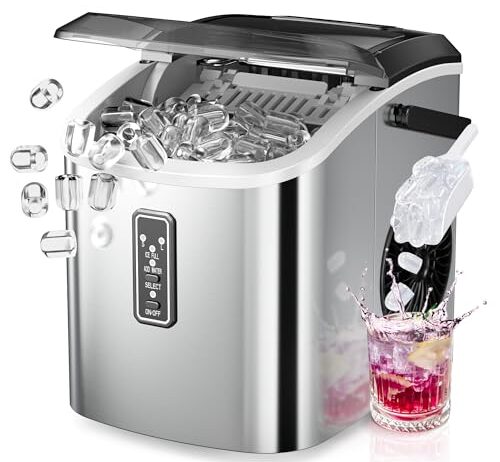
Bullet ice — the kind most sub-$100 machines produce — forms around vertical metal prongs. Water flows over the prongs, freezes from the outside in, and the result is a small hollow cylinder. That hollow core is the problem. It increases surface area relative to mass, which means more contact with warm air, which means faster melting. A bin full of bullet ice turns slushy faster than the same weight of solid cubes from a freezer tray.

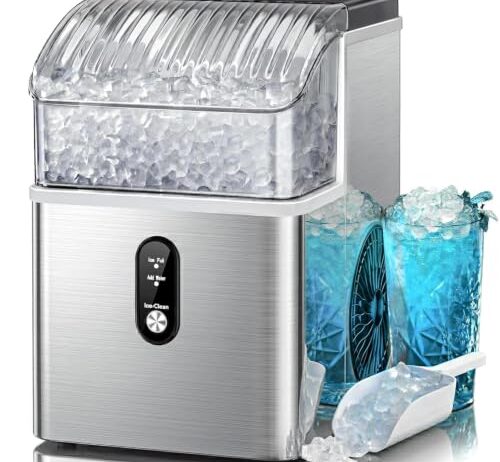
Nugget ice takes a different path entirely. An auger scrapes thin ice flakes off a chilled cylinder, then compresses them into soft, chewable pellets. The texture people love — that crunchable, soakable quality — comes from trapped air pockets between compressed flakes. Those same air pockets give nugget ice the highest surface area per pound of any format here. It melts the fastest.

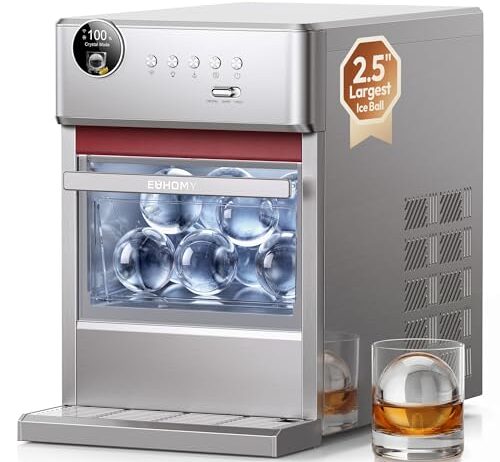
Sphere ice sits at the opposite end. A 2.5-inch solid sphere has the lowest surface-area-to-volume ratio of any shape at that size. Directional freezing — pushing impurities and air to one side of the mold — produces a dense, clear ball that resists melting far longer than either bullet or nugget ice of equivalent mass. The trade-off is time: 45 minutes per batch of three spheres, versus six or seven minutes for a round of bullets.

Equilibrium: When Production Equals Melt

Every countertop ice maker hits a ceiling. Run one continuously and within the first couple of hours, the bin fills to capacity. After that, the system reaches equilibrium — ice melts out of the bottom at the same rate new ice drops in from the top. The compressor keeps running. The water keeps cycling. The ice level stays flat.

This equilibrium point depends on three things: how fast the machine produces ice, how quickly the bin loses heat to the room, and the geometry of the ice itself. A machine making hollow bullet ice in a warm kitchen reaches equilibrium at a lower ice mass than the same machine would in a cooler basement. Nugget ice, with its high surface area, reaches equilibrium even sooner — the 35-lb daily capacity of a nugget machine doesn’t mean it maintains more ice in the bin than a 26-lb bullet machine. It may actually maintain less, because each pellet surrenders heat faster.

The sphere maker sidesteps this dynamic partially. Fewer pieces, denser format, slower melt. But it also produces far less total mass — roughly 12 to 15 pounds per day — because each 45-minute batch yields only three spheres. The equilibrium math is different, but the principle is identical: passive bin, no refrigeration, ambient heat wins eventually.

The EUHOMY clear sphere maker operates on a fundamentally different timeline than the bullet machines in this group. Three spheres every 45 minutes, 96 per day, using directional freezing that pushes air bubbles and minerals to one end of the mold. What drops into the bin is a dense, transparent ball that behaves more like a large ice cube from a silicone tray than anything a typical countertop machine produces.

That density is the point. A sphere has the lowest surface-area-to-volume ratio of any shape — less exposed surface means less contact with warm air, which means each piece lasts longer in a glass or in the bin. If you’re making cocktails or whiskey drinks where a single large piece of ice is the goal, you’re not fighting the melt-rate problem the same way. You make a batch, use them, make another. The bin isn’t accumulating twenty pounds of ice that turns to slush — it’s holding a small number of pieces that stay solid longer by physics alone.

At $449.99, this is a single-purpose machine. It won’t fill a cooler for a tailgate. It won’t crank out bags of ice for a punch bowl. Wi-Fi connectivity and a 24-hour timer let you schedule batches from another room, but the production ceiling is still 96 spheres — enough for an evening of drinks, not enough for a party’s worth of general-purpose ice.

Noise and the Mechanism Behind It

The way a machine makes ice determines what you hear while it runs.

Bullet ice machines use a cyclic process: freeze, heat-pulse to release, drop. The release phase — a brief burst of warm refrigerant through the evaporator to loosen the ice — produces a clunk as frozen cylinders fall into the bin. Then the compressor ramps back up for the next cycle. That on-off-on pattern creates a rhythm you notice in a quiet kitchen, especially at night.

Nugget machines work differently. An auger turns continuously inside a chilled cylinder, scraping and compressing. There’s no dramatic release event, no ice dropping from a height. The mechanical noise is steadier and lower — more hum than clatter. The Kismile nugget maker specifies 43 dB, which is roughly the ambient noise level of a quiet library or a residential street at night. You’d hear it in a silent room. You wouldn’t hear it over a conversation.

None of the bullet-ice machines in this group publish a noise figure. That doesn’t tell you they’re louder — it tells you nothing, and treating the absence as information is a mistake. What the mechanism does tell you is that cyclic freeze-release machines produce intermittent sounds rather than continuous ones, and intermittent noise is generally more noticeable than steady noise at the same decibel level.

The Kismile nugget maker at $149.98 sits in the middle of this price range but produces a fundamentally different product than the bullet machines on either side of it. Nugget ice — the soft, porous kind from Sonic drive-throughs — is made by scraping flakes off a frozen surface and compressing them through an auger. The result absorbs the flavor of whatever drink it’s in, which is why people seek it out specifically.

That porosity is both the appeal and the limitation. Nugget ice has more surface area per pound than either bullet or sphere ice. It chills a drink faster because more ice surface touches the liquid, but it also melts faster in the bin for the same reason. The 35-lb daily capacity — highest in this group — doesn’t translate to more ice sitting in the machine at any given time. It means the production-melt cycle runs faster: more water processed, more ice made and melted, higher throughput but not higher reserves.

First ice appears in about seven minutes, and self-cleaning runs at the push of a button. At 43 dB, the auger mechanism produces a steady low hum rather than the cyclic clunk of bullet machines. If you’re placing this on a kitchen counter near a living space, steady noise blends into background faster than intermittent noise does.

What the Price Spread Actually Buys

The gap between $39.99 and $449.99 is not a quality gradient — it’s a category boundary. The two bullet-ice machines at $40 and $70 are doing the same job with the same mechanism: freeze water around prongs, release, repeat. The price difference between them buys you a confirmed production speed (9 cubes in 6 minutes for the EUHOMY versus unspecified for the Crzoe), a carry handle, and a brand with wider distribution. Both make 26 pounds per day. Both make two sizes of hollow bullet ice. Both have self-cleaning cycles. The functional overlap is near-total.

The nugget maker at $150 is a different machine. Different ice type, different mechanism (auger versus prongs), different texture in the glass. You’re paying for the format, not for more of the same format done better.

The sphere maker at $450 is a different machine again. Directional freezing, 45-minute cycles, clear dense ice for cocktails. It includes Wi-Fi and app control — features that make sense when each batch takes 45 minutes and you might want to start one remotely — but the price is driven by the freezing technology, not the connectivity.

Ask what kind of ice you actually want before comparing daily capacity numbers across these categories. A 26-lb bullet machine and a 35-lb nugget machine and a 96-sphere clear-ice machine are answering three different questions.

The Freezer Problem Nobody Mentions

If you need ice available in quantity — for a cooler, a party, a hot afternoon with four people refilling glasses — a countertop ice maker is a production tool, not a storage solution. You run it for hours, scoop batches into freezer bags, and stockpile in your actual freezer. The machine makes ice. The freezer keeps it.

This is obvious once you understand the passive-bin limitation, but it catches people who buy a countertop unit specifically to stop using freezer space for ice trays. You’ll use more freezer space, not less, if your ice needs exceed what the bin holds at equilibrium — which, for anything beyond a single glass at a time, they will.

The workaround is timing. Start the machine two to three hours before you need ice. Transfer full bins to the freezer or directly into a cooler. Let the machine refill and repeat. Treat it as a faucet, not a tank. The daily capacity number becomes useful in this context: it tells you how many pounds of ice you can stockpile over a given number of hours, assuming you keep emptying the bin so it never reaches equilibrium and starts recycling meltwater.

FAQ

How much ice can a countertop ice maker actually hold at once?

Most countertop ice maker bins hold between 1.5 and 2.5 pounds of ice at a time. That’s the physical capacity of the basket, and it’s also roughly where the machine reaches thermal equilibrium — ice melts out of the bin as fast as new ice drops in. The “26 pounds per day” figure measures cumulative production if you keep removing ice, not how much sits in the machine at once.

Why is there water in the bottom of my ice maker bin?

The storage bin has no active cooling — it’s an insulated container at room temperature. Ice melts continuously from the moment it lands in the bin. That meltwater drains back into the reservoir and gets pumped over the evaporator to freeze again. The puddle at the bottom is the machine working as designed, not a malfunction.

Should I leave my countertop ice maker running all the time?

Once the bin fills — usually within one to two hours — running the machine continuously just recycles meltwater. The compressor keeps working, but the amount of ice in the bin stays flat. If you need to stockpile ice, empty the bin into freezer bags periodically so the machine keeps producing fresh batches instead of re-freezing its own melt.

Does nugget ice melt faster than regular ice cubes?

Yes. Nugget ice is made from compressed flakes with trapped air pockets, giving it more surface area per unit of mass than solid bullet or sphere ice. More surface area means more contact with warm liquid or air, which means faster melting. The soft, chewable texture people like about nugget ice is the same structural property that makes it melt quickly.

Do I still need freezer space if I buy a countertop ice maker?

For anything beyond a single glass at a time, yes. The bin holds roughly two pounds of ice. If you’re preparing for a gathering, you’ll need to run the machine for several hours and transfer batches to your freezer or a cooler. The ice maker produces ice — it doesn’t store it at freezing temperature.