We research every product we recommend. We may earn a commission from the links on this page.
Tools & Home Improvement › Wall Stickers & Murals

Why Peel-and-Stick Tiles Fall Off Your Wall

We compare published specifications and marketplace data. We do not test these products.

Peel-and-Stick Tile Adhesive Creeps Downward on Vertical Surfaces
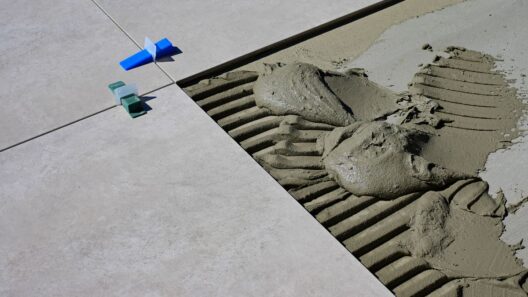
Photo by Vladimir Srajber on Pexels

A peel-and-stick backsplash tile weighing a few ounces doesn’t rip itself off your wall. It slides — millimeters at a time, over weeks, pulled by gravity through an adhesive layer that slowly flows like cold honey. The bond thins at the top edge first, the corners lift, and one morning the whole sheet is curling away from the drywall. The failure isn’t dramatic. It’s physics running on a slow clock. Understanding why it happens changes what you buy and how you install it.

Affiliate disclosure: This article contains affiliate links. We may earn a commission if you buy through them, at no extra cost to you.

Everything we recommend
3 picks

How we picked

We did not install these tiles on a wall. Selections are based on published dimensions, adhesive format, and owner-reported durability patterns.

Shear load, not aesthetics

Heavier tiles stress adhesive bonds faster. We compared thickness and sheet size to estimate sustained downward force.

Intended duration, not just adhesion

A tile meant for a weekend event faces different creep demands than one installed as a semi-permanent backsplash.

Owner failure patterns, not star counts

We read for where tiles fail — top edges, corners, near heat — not how many people clicked five stars.

Coverage per dollar, not price alone

A cheaper box covering half the area costs more per square foot. We divided total coverage by price.
What’s Actually Holding the Tile Up

Pressure-sensitive adhesives don’t cure, don’t harden, and don’t chemically bond to your wall the way epoxy or thinset does. They’re viscoelastic polymers — materials that behave like both a solid and a liquid depending on how fast you load them. Press a tile on quickly and the adhesive feels solid, gripping the wall on contact. But leave that tile hanging vertically for weeks, and the adhesive responds to gravity’s constant, slow pull the way a liquid would: it flows.

This flow has a name. Creep. It’s the time-dependent deformation of a material under constant stress, and it’s why a tile that felt rock-solid on installation day is curling at the corners two months later.

The stress driving that creep is simple to calculate: the tile’s weight divided by its contact area. A 12-by-12-inch tile bonded across its entire back has 144 square inches of adhesive resisting gravity. But adhesive coverage is rarely perfect — air bubbles, dust, wall texture, and incomplete pressing all reduce the real contact area. Cut that effective bond in half, and you’ve doubled the stress on every square inch that is still holding.

Why the Top Edge Always Goes First

Gravity doesn’t pull evenly on every part of the adhesive bond. It concentrates stress at the top edge.

Think of the tile as a rigid plate hanging from a sticky surface. The entire weight of the tile acts downward, but the bond resists by shearing — the adhesive stretches sideways like pulling on taffy. At the top edge, the adhesive is doing the most work: supporting the full weight of everything below it. At the bottom edge, there’s almost no shear at all, because there’s no tile weight below that point to pull on.

As creep thins the adhesive at the top, the remaining bond area shrinks. Less area means higher stress on what’s left, which accelerates the creep, which thins the bond further. It’s a feedback loop. Once the top edge releases, the failure front moves downward until the tile is hanging by its bottom edge — which is why you see tiles peeling forward from the top like a page turning, not dropping straight off the wall. One owner of the STICKGOO tiles described exactly this pattern, noting that installation was a one-shot affair — pulling a tile off to reposition it meant the adhesive wouldn’t grip again.

Heat Makes the Clock Run Faster

Every pressure-sensitive adhesive has a temperature range where it performs. Warm the polymer and its chains move more freely — viscosity drops, creep accelerates. This is why backsplash tiles near a cooktop fail months before identical tiles on the opposite wall.

Acrylic-based adhesives generally tolerate heat better than rubber-based formulations, but none of these three products disclose their adhesive chemistry. You’re left guessing. The practical rule is distance: adhesive exposed to radiant heat from a burner within 12 to 18 inches is working in a different thermal environment than the rest of your backsplash. Owners of peel-and-stick tiles regularly report softening, sagging, or outright detachment in exactly that zone.

Cold matters too, but differently. Below about 50°F, most pressure-sensitive adhesives stiffen and lose tack. If you’re installing in an unheated kitchen during a renovation, the adhesive may never wet the wall surface properly — dwell time at installation temperature is what establishes molecular contact between the adhesive and the substrate. Insufficient dwell time leaves microscopic voids that become the weak points where creep-driven failure starts months later.

Wall Texture Is a Contact-Area Problem

A pressure-sensitive adhesive bonds by wetting a surface — flowing into microscopic valleys to maximize molecular contact. Smooth drywall, glass, and ceramic tile are high-energy surfaces that let the adhesive spread and grip. Textured walls — orange peel, knockdown, popcorn — are a different situation entirely.

Texture creates peaks and valleys. The adhesive touches the peaks but bridges over the valleys, leaving air gaps where no bond exists. Your 144 square inches of tile back might only achieve 60 or 70 square inches of real contact on a heavily textured wall. That gap doesn’t just reduce initial bond strength. It concentrates stress on the contact points, accelerating creep at exactly the spots doing all the work.

Surface energy matters independently of texture. A dusty wall, a wall with residual grease from cooking, or a freshly painted wall where the paint hasn’t fully cured — all of these reduce the substrate’s surface energy, which reduces how well the adhesive wets it. Wiping with isopropyl alcohol before installation isn’t fussy prep work. It’s the difference between bonding to the wall and bonding to a film of dust on top of the wall.

Thickness, Weight, and the Creep Equation

A thicker tile is a heavier tile. More weight means more shear stress on the adhesive, which means faster creep. But thickness also affects rigidity — a stiffer substrate distributes load more evenly across the bond area instead of letting stress concentrate at one edge.

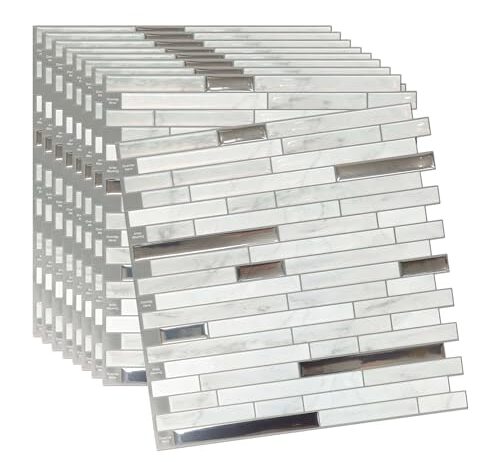
The Jeedeson tiles at 0.04 inches are thin enough to flex slightly, which helps them conform to minor wall irregularities and maintain contact. But thin also means light, and light means less shear stress. The STICKGOO tiles advertise a thicker design without specifying the measurement, and one owner noted they felt substantial enough that repositioning during installation was impossible — once pressed on, the adhesive committed.

That actually matters. A repositionable adhesive — one designed to release and re-stick — trades long-term creep resistance for installation convenience. A permanent adhesive grips harder but punishes mistakes. The STICKGOO owner’s experience of a one-chance bond suggests a more aggressive adhesive, which is what you want for a backsplash that needs to stay up for years. It’s a worse experience during installation and a better one six months later.

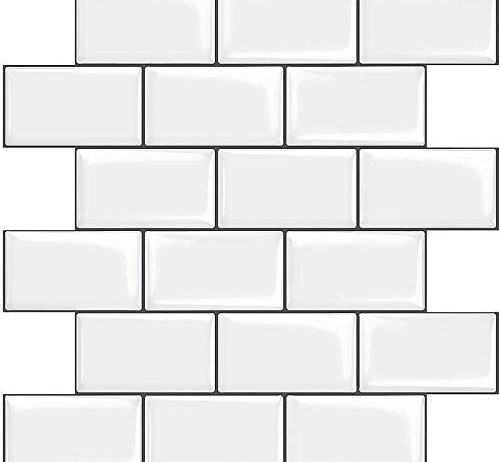
The STICKGOO tiles are built for the job most people actually have: covering a kitchen backsplash that needs to stay up indefinitely. Five sheets at 12 by 12 inches gives you about 5 square feet of coverage — enough for a modest section behind a sink or a short run beside a stove, not a full wall. At $23.99, that works out to roughly $4.80 per square foot, which is the premium you’re paying for an adhesive that commits rather than repositions.

Thousands of owners have installed these, and the failure reports follow the exact pattern creep physics predicts: top edges lifting, corners peeling, tiles near the stove failing first. That’s not a mark against this specific product — it’s what every pressure-sensitive adhesive does under sustained shear and heat. The value in having that many installations to learn from is knowing what to expect. Clean the wall thoroughly, press firmly across the entire surface during installation to maximize dwell time, and keep them at least 18 inches from direct burner heat. The grout lines run in one direction, so plan your cuts before you peel the backing — as one experienced installer noted, creativity with cutting is how you avoid a pile of wasted sheets.

Event Decor vs. Permanent Backsplash: Two Different Adhesive Jobs

A 3D heart sticker weighing a fraction of an ounce and a 12-inch rigid backsplash tile are both called peel-and-stick. They are not solving the same problem.

The BlissfulTie hearts are decorative accents — 60 lightweight pieces designed to go up for a party or a holiday and come down without damaging the wall. Creep barely applies because the weight-to-contact-area ratio is so low that the adhesive never reaches meaningful stress. One owner described them as obviously plastic with a high-gloss finish, durable enough to reuse, with sticky circles that peel off a backing and press onto each heart individually. That’s a fundamentally different adhesive strategy: small contact patches holding almost no weight for a limited time.

The STICKGOO and Jeedeson tiles, by contrast, are full-sheet rigid substrates with continuous adhesive backing, intended to stay on a wall for years while resisting heat, moisture, and the constant downward pull of their own weight. Comparing them to decorative stickers on adhesive strength is like comparing duct tape to a Post-it note — same basic mechanism, completely different engineering targets.

The Jeedeson set doubles the coverage of the STICKGOO at a lower total price: 10 square feet for $19.99 versus 5 square feet for $23.99. Per square foot, it’s less than half the cost. If you’re covering a full backsplash wall or wrapping an L-shaped kitchen, that math matters fast — a 20-square-foot project takes two Jeedeson boxes or four STICKGOO boxes, and the price difference compounds.

At 0.04 inches, these are thin. Thin means lighter per sheet, which means less shear stress on the adhesive — a genuine advantage for long-term creep resistance. But thin also means less rigid, which can be a problem on walls with minor imperfections. A stiffer tile bridges small bumps; a flexible one conforms to them, which is good for contact area but can telegraph wall texture through the finished surface. The marble-white-with-metal-silver finish is a different aesthetic than the STICKGOO’s subway pattern — a modern, polished look versus a traditional tile grid. With only a handful of installations to learn from, there’s less field data on long-term adhesive performance, so the creep resistance is an inference from the physics, not a certainty from experience.

How to Give the Adhesive Its Best Chance

You can’t change the physics of creep. You can shift the variables in your favor.

Clean the wall with isopropyl alcohol. Not a damp cloth — alcohol. You’re removing the invisible film of grease, dust, and skin oil that sits between the adhesive and the actual wall surface. Every contaminant particle is a void in the bond.

Press hard, press everywhere, press for longer than feels necessary. Dwell time — the duration and pressure of initial contact — is what lets the adhesive polymer wet the substrate and establish molecular-level grip. A quick slap-and-smooth leaves the adhesive touching the wall’s peaks while bridging its valleys. Thirty seconds of firm, even pressure with a roller or a credit card across every square inch is not optional.

Keep tiles away from direct heat. Eighteen inches from a cooktop burner is a reasonable minimum, but the real answer depends on your kitchen’s ventilation and how much radiant heat reaches the wall. If you can feel warmth on the wall with your hand while the burner runs, that spot will accelerate adhesive creep.

Don’t install in a cold room. Below 50°F, most pressure-sensitive adhesives won’t develop full tack. If you’re renovating and the heat is off, wait.

And accept the one-shot nature of a permanent adhesive. If you peel a tile to reposition it, the bond surface is compromised. Cut carefully, measure twice, and commit.

FAQ

Why do peel-and-stick tiles fall off after a few months?

The adhesive creeps — it flows slowly downward under the constant shear stress of the tile’s weight. The bond thins at the top edge first, stress concentrates on the remaining contact area, and failure accelerates. Higher temperatures, heavier tiles, and poor initial contact all speed up the process.

Can I put peel-and-stick tiles right next to my stove?

You can, but they’ll fail faster. Heat reduces the viscosity of pressure-sensitive adhesives, accelerating creep. Keep tiles at least 18 inches from direct burner heat, and check that you can’t feel warmth on the wall surface while the burner is running.

Do I need to prime the wall before installing stick-on backsplash?

Not primer — but you do need a clean, high-energy surface. Wipe with isopropyl alcohol to remove grease, dust, and oils. Heavily textured walls reduce contact area dramatically, which increases stress on the bond points that do make contact.

What’s the difference between repositionable and permanent peel-and-stick adhesive?

Repositionable adhesives are designed to release and re-stick, which means lower tack and less creep resistance over time. Permanent adhesives grip harder on first contact and resist long-term shear better, but you can’t move the tile once it’s placed without compromising the bond.

Does tile thickness affect how long peel-and-stick backsplash stays up?

Yes, through weight. Thicker tiles are heavier, which increases the downward shear stress driving adhesive creep. But a thicker, stiffer tile also distributes that stress more evenly across the bond, which can partially offset the extra weight. The net effect depends on the specific tile and adhesive combination.