We research every product we recommend. We may earn a commission from the links on this page.
Appliances › Beverage Refrigerators

The 30-Degree Problem: Why Beverage Fridges Fail in Summer Heat

We compare published specifications and marketplace data. We do not test these products.

Why Your Beverage Fridge Can't Keep Up in a Hot Garage
Photo by Boris Ivas on Pexels

A beverage fridge that held 38°F all winter reads 52°F by July — and the compressor is running exactly as designed. Heat moves through cabinet insulation in direct proportion to the temperature difference between inside and outside. A 30°F gap in January becomes a 60°F gap when a garage or patio hits 100°F, doubling the thermal load on the same walls and the same motor. That’s Fourier’s law, and it explains why thousands of owners watch their fridges fail every summer without a single part breaking.

Affiliate disclosure: This article contains affiliate links. We may earn a commission if you buy through them, at no extra cost to you.

Everything we recommend
4 picks

How we picked

We have not plugged in these refrigerators. Picks reflect published specs, thermodynamic principles, and owner-reported seasonal performance.

Ambient rating, not thermostat range

Outdoor-rated construction with sealed compressor compartments outranks indoor-only units when summer placement exceeds 90°F.

Insulation duty, not feature count

Cabinet materials and weather resistance that reduce heat infiltration matter more than LED lighting or digital displays.

Compressor headroom, not minimum price

Larger compressor-to-cabinet ratios maintain cooling when summer ambient doubles the thermal differential.

Owner evidence across seasons, not initial impressions

Reports spanning winter-to-summer transitions reveal whether a unit holds temperature year-round or only in moderate conditions.

Why a 60-Degree Differential Changes Everything

Your beverage fridge fights a simple equation. Heat moves through insulation in direct proportion to the temperature difference between inside and outside — Fourier’s law of thermal conduction, the same physics that makes your car’s engine overheat in traffic but run cool on the highway. In January, you’re asking the compressor to hold a 30°F gap between a 70°F room and a 40°F cabinet. In July, a garage or patio hits 100°F. That’s a 60°F differential — double the heat load pushing through the same walls.

The compressor doesn’t get twice as powerful in summer. It’s the same motor, the same BTU/hr rating, the same refrigerant charge. But now it’s working against twice the thermal pressure. Vapor-compression efficiency actually drops as the temperature lift increases — the same compressor moves less heat per watt when the gap between evaporator and condenser widens. So the unit runs longer, harder, and still falls behind.

This is why you can set a thermostat to 40°F and watch the display climb to 52°F without a single part failing. The compressor is running exactly as designed. It just wasn’t designed for this much heat.

R-4 Walls in a World That Needs R-13

Household refrigerators pack insulation rated around R-13 per inch or better into their cabinet walls. Most beverage coolers in this price range use polyurethane foam that delivers R-4 to R-6 per inch. That’s two to three times more heat infiltration per square foot of surface area, and it compounds fast.

Think of insulation as a dam. A thinner, more porous dam lets more water through — and when the river rises, the flow increases proportionally. A beverage fridge with R-5 insulation in a 100°F garage absorbs heat roughly three times faster than a household fridge in the same spot.

The glass door makes this worse. Glass conducts heat far more readily than insulated steel panels, even with double-pane construction. It’s the largest thermal weak point on any beverage cooler, and it’s the feature most people want — you pick a beverage fridge partly because you can see inside without opening the door. That trade-off is manageable at 75°F ambient. At 95°F, the glass becomes the primary path for heat gain, and no amount of compressor runtime overcomes a wall that conducts heat nearly as fast as the coils can remove it.

The Feedback Loop Nobody Warns You About

When a compressor runs longer to fight summer heat, it pulls in more humid air through door gaskets and drainage channels. That moisture hits the evaporator coils — the coldest surface in the cabinet — and freezes. Frost on evaporator coils acts as an insulating blanket, reducing the coil’s ability to absorb heat from the cabinet interior. The Department of Energy identifies this frost buildup as a direct cause of reduced refrigeration efficiency.

Now the coils can’t absorb heat as efficiently, so the compressor runs even longer. More runtime means more moisture infiltration, more frost, less cooling. It’s a cycle that accelerates until you intervene.

One Antarctic Star owner reported having to manually defrost weekly — sometimes more often — because frost kept the compressor running constantly. The owner gave up within 30 days. Another noted simply: keeps drinks cold, but it ices up after a while. That “after a while” is the feedback loop arriving on schedule — modest in spring, unmanageable by August.

Most beverage fridges in this price range use manual defrost or a basic timer cycle calibrated for moderate conditions. The frost builds faster than the cycle clears it.

What Owners Actually See When Summer Arrives

The pattern is consistent enough to be predictable. One Antarctic Star owner said it plainly: the unit was great in November, but by June nothing stayed cold. Thermostat set to 40°F, actual reading 52°F. Another owner in a warm climate reported the unit sitting at 66–70°F for three months, never reaching setpoint despite manufacturer troubleshooting suggestions.

These aren’t manufacturing defects. They’re small compressors hitting the wall of their rated capacity when ambient temperatures cross 85–90°F. The units work within their design envelope and fail predictably outside it.

An Electactic owner who placed a temperature sensor inside found something revealing: the compressor reaches 40°F before cycling on, runs about 10 minutes, cuts off at 35°F, then takes another 10 minutes to climb back to 40°F. Two cycles per hour, and the unit actually holds around 35°F — not the 32°F on the control panel. In moderate weather, that 3-degree gap is trivial. In summer, each off-cycle allows faster temperature rise through thin cabinet walls, the gap widens, and the compressor can’t recover the lost ground before the next cycle.

An ICEVIVAL commercial unit owner reported the cooler climbing to 78°F within two months. Whether that failure was mechanical or thermal-overload, the result is the same: a cabinet full of warm beverages and no easy way to tell the difference between a dead compressor and one that simply can’t keep up.

Compressor Sizing and the Differential It Was Built For

Every compressor has a BTU/hr rating — the amount of heat it can move from inside the cabinet to outside in one hour. If ambient heat gain exceeds that number, internal temperature climbs regardless of how long the compressor runs. Most beverage coolers in this category use compressors sized for a 35–40°F temperature differential. Push that to 50–60°F in a hot garage and you’ve exceeded the rated capacity before you load a single can.

The ambient operating range is the number that tells you whether a unit will survive your summer. Indoor-rated coolers typically handle 50–95°F ambient. Outdoor-rated units built to standards like UL 471 use sealed, weather-resistant compressor compartments and heavier insulation engineered for 100–110°F ambient temperatures.

That distinction is mechanical, not cosmetic. It’s the difference between a compressor compartment that overheats when hot air stagnates around it and one with ventilation designed for radiant heat exposure. When you put an indoor-rated beverage fridge on a patio, you’re running a unit outside every parameter its engineers designed for — and the thermodynamics are unforgiving.

Where You Put It Determines Whether It Works

A beverage fridge rated for indoor use can work in a garage — if the garage stays below 85°F. The problem is that most garages, patios, and outdoor kitchens don’t. A south-facing garage in the Sun Belt can hit 120°F in July. Even a shaded patio in a humid climate regularly exceeds 95°F with moisture levels that accelerate frost buildup inside the cabinet.

Before spending money on a bigger unit, check your actual conditions. A thermometer left in the intended spot for a week during your hottest month gives you real data. If ambient regularly exceeds 90°F, you need either outdoor-rated construction or a different location entirely.

Ventilation around the unit matters too. Compressors dump heat from their condenser coils into the surrounding air. If that air can’t circulate — because the fridge is recessed into cabinetry or pushed flat against a wall — the local temperature around the compressor climbs higher than the room itself. Three to four inches of clearance on sides and back, with open airflow above, prevents the unit from stewing in its own waste heat. That clearance costs nothing and can mean the difference between a compressor that cycles normally and one that runs without stopping.

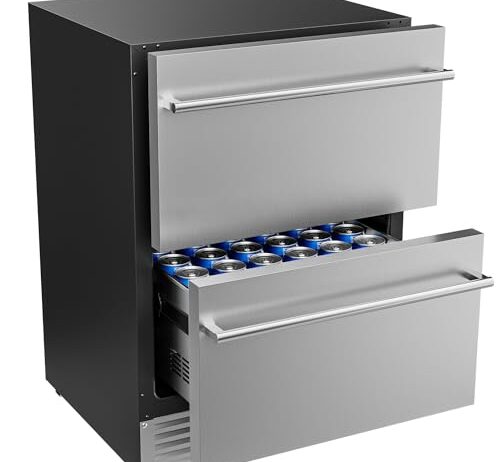
This is the unit in the set designed from the ground up for the problem this article is about. The weather-proof rating means a sealed compressor compartment, stainless steel cabinet construction, and insulation sized for outdoor ambient temperatures — the kind of engineering that keeps a compressor within its operating envelope when the air around it hits 100°F or higher.

The double-drawer configuration at 24 inches wide does something useful for thermal management: drawers expose less interior volume per opening than a full glass door. Every time you open a beverage fridge, warm humid air rushes in and cold dense air rolls out. A drawer that exposes half the cabinet swaps half the air. In a hot environment where the frost feedback loop is your biggest enemy, that geometry matters. Stainless steel also conducts heat differently than painted sheet metal — it’s denser and reflects radiant heat better, which helps on a sun-exposed patio where surface temperature can exceed air temperature by 20°F or more.

Matching the Fridge to the Heat

If your placement stays below 80°F year-round — a climate-controlled basement, an interior pantry, an air-conditioned bonus room — any of these units holds temperature reliably. The compressor differential stays within design limits, frost stays manageable, and the glass door’s thermal penalty is modest enough to ignore.

For unconditioned garages and covered patios that reach 90–100°F, you need outdoor-rated construction. The EUHOMY’s weather-proof stainless steel build and drawer design address both the heat-load and the humidity problems simultaneously — sealed construction for the compressor, reduced air exchange for the cabinet.

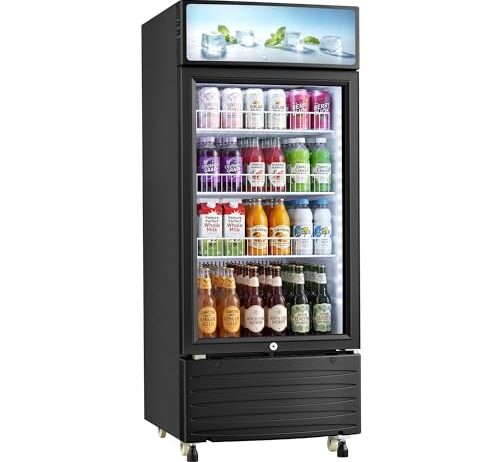
For spaces in the middle — a garage that touches 85°F on the worst days but not daily — the ICEVIVAL’s 6 cu.ft commercial cabinet with ETL certification gives you more thermal mass. Six cubic feet of cold air takes longer to warm up during each compressor off-cycle than 4.5 cubic feet does, buying margin against temperature spikes without outdoor-rated pricing. The casters and lock make sense for a garage where the unit might need to move seasonally.

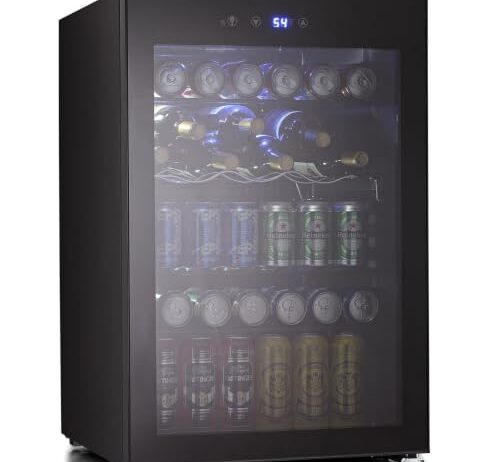
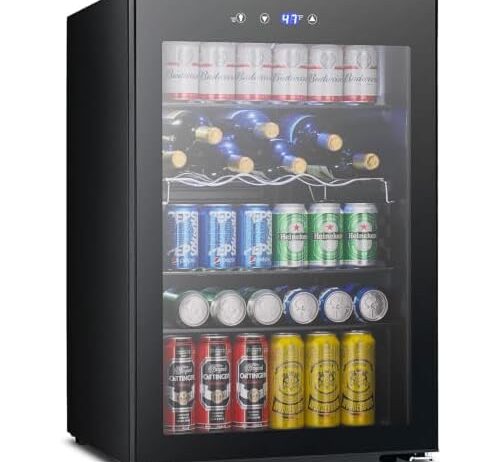
The dual-purpose Electactic raises a specific concern for summer use: wine storage runs 45–65°F while beverage cooling targets 33–40°F. A compressor splitting duty between those ranges in moderate weather faces a harder problem when summer heat pushes the ambient differential past its design limit for either temperature zone.

The physics here are straightforward: a larger volume of cold air takes longer to warm up during each compressor off-cycle. Where a 4.5 cu.ft unit might climb 5°F in ten minutes of compressor rest, six cubic feet of air at the same starting temperature absorbs that heat more slowly — the thermal mass acts as a buffer against ambient spikes. In a garage that bounces between 80°F and 90°F through a summer day, that buffer can be the difference between a fridge that holds setpoint and one that loses ground with every cycle.

ETL certification means the electrical and refrigeration systems passed third-party safety evaluation, which at minimum confirms the compressor and wiring meet rated specifications for their stated operating conditions. The casters let you roll the unit out from a wall for ventilation clearance — a small detail that matters when condenser airflow is the difference between normal cycling and continuous runtime. One owner reported the unit climbing to 78°F within two months, which underscores that even a commercial-grade cabinet has limits — if your garage exceeds 95°F regularly, commercial-grade still isn’t outdoor-rated.

FAQ

Why does my beverage fridge work in winter but not summer?

Heat infiltration through cabinet walls is proportional to the temperature difference between inside and outside. A 30°F gap in winter becomes 60°F in summer, doubling the heat load. The compressor can’t increase its output to match, so internal temperatures climb even though nothing is mechanically broken.

Is it normal for a beverage cooler to run constantly in hot weather?

Continuous operation is the compressor’s only response to heat load exceeding its rated capacity. It’s not a malfunction — it’s the unit working as hard as it can and still not keeping up. If ambient temperature exceeds the unit’s rated operating range, constant runtime is expected and won’t damage the compressor in the short term, but it will accelerate frost buildup.

Can I put a beverage fridge in my garage?

If your garage stays below 85°F, most indoor-rated units hold temperature fine. Above 90°F regularly, you need an outdoor-rated unit with a sealed compressor compartment and heavier insulation. Place a thermometer in the intended location for a week during your hottest month to get real data before buying.

What causes frost buildup in a beverage fridge during summer?

Longer compressor runtime pulls more humid air through door gaskets. That moisture freezes on the evaporator coils, insulating them and reducing their ability to absorb heat. The compressor runs longer to compensate, pulling in more moisture — a self-reinforcing cycle that worsens in hot, humid conditions.

What is the difference between an outdoor-rated and a regular beverage fridge?

Outdoor-rated units built to UL 471 or equivalent standards have sealed weather-resistant compressor compartments, thicker insulation, and components engineered for ambient temperatures up to 100–110°F. Indoor-rated units typically max out around 90–95°F before cooling falls short of setpoint.