We research every product we recommend. We may earn a commission from the links on this page.
Electronics › Over-Ear Headphones

85 dB Limiters Cut Bass First — Here’s the Physics

We compare published specifications and marketplace data. We do not test these products.

Volume-Limited Headphones Distort Before They Reach the Ceiling
Photo by William Bradshaw on Pexels

An 85 dB volume limiter caps the electrical signal before it reaches the driver. But bass frequencies below 200 Hz need roughly 15–20 dB more sound pressure than midrange to sound equally loud to a human ear — a gap defined by the equal-loudness contours in ISO 226. When that cap is in place, the driver has less voltage to work with, and bass is the first casualty. Parents hear “muddy” and blame the limiter. The real problem is usually cheaper: a small driver that runs out of physical travel before the limiter even kicks in.

Affiliate disclosure: This article contains affiliate links. We may earn a commission if you buy through them, at no extra cost to you.

Everything we recommend
4 picks

A volume limiter does one thing: it puts a ceiling on the electrical signal reaching the driver. Resistor-based limiters do it passively, dropping voltage across a fixed resistance. DSP-based limiters do it with real-time compression. Either way, the signal gets quieter before the driver ever moves.

That sounds like it should solve everything. Cap the signal, cap the loudness, protect the ears. And for midrange frequencies — speech, most music above 300 Hz — it does. The driver moves a small amount, the air pressure is modest, and 85 dB at the eardrum is exactly what the spec promises.

Bass breaks the math.

At 50 Hz, the human ear needs roughly 15–20 dB more sound pressure than at 1 kHz to perceive the same loudness. That’s not a headphone problem — it’s anatomy, mapped precisely in ISO 226’s equal-loudness contours. To produce that extra pressure, a driver’s diaphragm has to move farther. Much farther. And “farther” is the one thing a cheap, small dynamic driver does not have room to do.

How we picked

We did not listen to these headphones. Judgements are based on published specifications, driver technology, limiter implementation, and owner-reported behaviour.

Limiter method, not just presence

Whether a headphone limits via resistor, DSP, or brand-name circuit changes where distortion appears.

Driver physics, not driver marketing

A planar magnetic diaphragm and a budget dynamic cone fail differently under the same bass load.

Source independence, not just volume

Wired models form a voltage divider with the source device’s output impedance — the limiter’s real ceiling shifts per tablet.

Cost per unit, not box price

A five-pack at $39.95 is $7.99 each. That per-unit number decides what driver quality is inside.

Two failures that sound the same

Here is the thing parents, teachers, and bulk buyers almost never separate: there are two completely different ways a headphone distorts on bass, and they produce nearly identical muddy, buzzy results.

The first is the limiter engaging. The voltage cap compresses the signal, and because bass requires more voltage to sound equally loud, the low end gets proportionally more compressed than treble. Bass doesn’t disappear — it flattens. Dynamic range goes away. A kick drum and a sustained pad end up at the same level, and the result sounds lifeless.

The second is mechanical bottoming out. The driver’s voice coil former physically contacts the magnet structure, or the rubber surround reaches maximum extension. This happens when the diaphragm runs out of travel — its Xmax — before the voltage ceiling is reached. The limiter hasn’t even activated yet. The distortion is entirely mechanical: non-linear harmonics and intermodulation products that no amount of EQ or firmware can fix because the problem is a physical collision inside the driver housing.

Both sound bad. Only one has anything to do with the limiter.

Why cheaper drivers hit the wall first

A driver’s excursion limit — how far the diaphragm can move before distortion — is set by two mechanical properties: the stiffness of the surround material and the tension of the spider (the corrugated disc that centres the voice coil). These are fixed at manufacturing. No electrical signal changes them. No limiter widens them.

In a headphone built to a $7.99 per-unit price point, the driver is small, the surround is stiff, and the spider is tight. Maximum linear excursion might be a fraction of a millimetre. That’s fine for speech and treble, where the diaphragm barely needs to move. But a 60 Hz bass note in a movie soundtrack asks for real displacement, and the driver runs out of room while the voltage is still well within the limiter’s ceiling.

This is why owners of volume-limited classroom headphones report distortion on music but not on speech. Speech sits comfortably in the frequency range where a small driver can keep up. Bass-heavy content — game audio, animated films, anything with a score — asks for physical movement the driver cannot deliver.

The source device changes the ceiling

A wired headphone with a built-in limiter doesn’t have one volume ceiling. It has as many ceilings as there are devices you plug it into.

Here’s why. A wired headphone’s impedance — typically 32 ohms in consumer models — forms a voltage divider with the source device’s output impedance. An older tablet with 10+ ohm output impedance delivers less voltage to the driver than a modern phone with sub-1-ohm output impedance, even at the same volume setting. The limiter’s rated 85 dB threshold assumes a specific source impedance. Change the source, and the actual SPL at the eardrum shifts — sometimes by several decibels in either direction.

For a parent, this means the same headphone on a classroom Chromebook might sound fine, then sound distorted on a newer iPad at the same volume number, because the iPad’s lower output impedance delivers more voltage to the driver before the limiter activates. The driver reaches its mechanical limit earlier in the volume slider’s travel. The limiter hasn’t changed. The physics of the electrical path has.

The iClever uses its SafeSound Tech circuit to cap output before it reaches the driver — a passive, analog approach that works without batteries or firmware. Plug it into a 3.5 mm jack and the limiter is always on. There’s no app, no mode to bypass it, no way for a child to defeat it by holding a button.

That permanence is the point. But it also means the bass behaviour is locked to whatever the driver can do within that voltage envelope. Owners note the headphones work well for speech and classroom audio. Bass-heavy content is where budget drivers in this price range run short of excursion, and the limiter leaves no headroom to compensate. For a parent buying these for a six-year-old watching cartoons on a tablet, the question is whether thin bass matters more than a volume ceiling you cannot accidentally override. For school-age use with speech-heavy content, the limiter does exactly its job.

What a different driver does to the same problem

A planar magnetic driver doesn’t use a voice coil wound around a former, pushed through a magnetic gap. It uses a flat diaphragm with a conductive trace printed directly on its surface, suspended in a uniform magnetic field. Force is distributed across the entire diaphragm area rather than concentrated at a single coil.

The practical consequence: less excursion per unit of sound pressure. A planar diaphragm moves a shorter distance to displace the same volume of air, because it’s moving a larger area. Less excursion means more headroom before mechanical limits. More headroom means bass stays linear — clean, without harmonics — at volumes where a small dynamic driver would already be bottoming out.

This is not a volume-limiter story. It’s a geometry story. The physics that cause bass distortion in a $7.99 classroom headphone — a tiny diaphragm running out of travel — are addressed at the driver level by spreading the work across a larger surface. The limiter question becomes irrelevant when the driver never approaches its mechanical limit at normal listening levels.

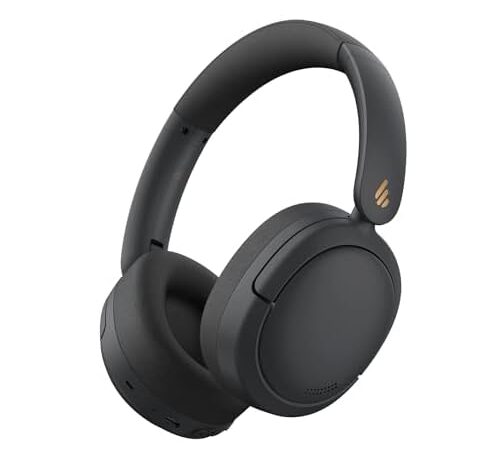
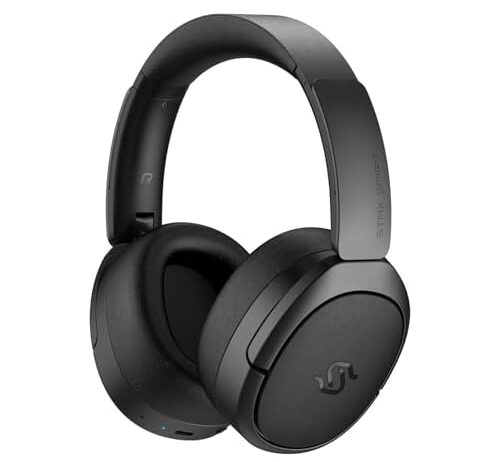
The Edifier STAX Spirit S5 runs a planar magnetic driver with Bluetooth 5.4, supporting aptX Adaptive, LDAC, and LHDC codecs. That codec stack matters here: lossless and near-lossless transmission preserves the bass transients that lossy codecs like SBC attenuate. You hear the full dynamic shape of a kick drum or a cello’s low register, and the planar driver has the excursion headroom to reproduce it without the non-linear distortion a small dynamic driver produces at the same frequencies.

At $499.99, this is not a comparison to the classroom headphones in this article — it’s a demonstration of what happens when you solve the bass-distortion problem at the driver level instead of managing it with a voltage cap. One owner reports a crackling noise developing after months of use, which is worth noting: planar diaphragms can develop creases or delamination over time, a different failure mode from dynamic drivers but a failure mode nonetheless. Eighty hours of battery life means charging is a weekly event rather than a daily one for most listeners.

Codec quality makes limiter distortion more obvious

A Bluetooth headphone running SBC — the baseline codec — applies psychoacoustic masking that softens bass transients before they reach the driver. The leading edge of a kick drum gets rounded. Sub-bass harmonics below the masking threshold get attenuated or dropped. The result sounds fine for casual listening, and it incidentally hides some of the distortion a driver produces at its excursion limit, because the sharpest transients never arrive.

Switch to LDAC or aptX Adaptive, and those transients survive transmission intact. The driver receives the full leading edge, the full sub-bass content, and if its diaphragm runs out of travel, you hear it. Clearly. A headphone that sounded acceptable on SBC sounds wrong on a lossless codec — not because the codec is worse, but because it’s more honest.

For the two Bluetooth headphones here, this is a real split. The Edifier W800BT Pro carries Hi-Res Audio certification at $39.99 with 45 hours of battery and hybrid active noise cancelling. It handles higher-bitrate streams than SBC. Whether its dynamic driver has the excursion headroom to deliver on that extra detail in the bass is the question the certification doesn’t answer — the codec can deliver it, but the driver has to finish the job.

Bulk pricing tells you about the driver

Five headphones for $39.95 means each unit costs $7.99. At that price, a manufacturer allocates material cost across the headband, earcups, cable, packaging, and driver — and the driver is the most expensive single component. What $7.99 buys is a small dynamic driver with a short excursion limit, a stiff surround, and a frequency response optimised for speech intelligibility in a classroom.

That’s not a criticism. It’s a constraint. The 85 dB limiter in these headphones does its stated job — it caps peak SPL to protect hearing during sustained use. But owners of this specific model report a recurring structural failure: the swivel joint where the earcup meets the headband snaps within weeks of classroom use. Multiple owners describe 4 out of 5 pairs breaking in the same spot within a month. One owner notes the sound quality itself is acceptable — no distortion — but comfort falls short for extended wear.

The durability reports are more immediate than the bass-distortion question for a classroom buyer. A headphone that breaks at the hinge in three weeks never gets the chance to distort on bass. For institutional purchasers buying in quantity, the per-unit replacement cost matters as much as the per-unit audio quality.

Matching the headphone to the actual content

The question isn’t whether a volume limiter is good or bad. It’s whether the content your listener encounters will expose the limiter’s interaction with a cheap driver.

Speech-heavy use — classroom instruction, audiobooks, language apps — sits in the frequency range where even a $7.99 driver handles 85 dB comfortably. The diaphragm barely moves. The limiter barely activates. Everything works as intended.

Bass-heavy use — animated films, game audio, music with a rhythm section — pushes the driver into excursion territory where budget dynamic models distort. The limiter isn’t the bottleneck. The driver is. And no amount of turning the volume down fixes mechanical distortion that happens below the limiter’s threshold.

For a parent choosing between a $18.99 limited headphone and an unlimited one at the same price, the honest answer is that the limiter protects hearing and the driver determines sound quality, and those are two separate engineering decisions packaged in one product. Spending more on the driver — not on removing the limiter — is what fixes the bass.

FAQ

Do 85 dB limiters cut bass more than treble?

Not electrically — the limiter reduces voltage uniformly. But because human hearing needs 15–20 dB more sound pressure at 50 Hz than at 1 kHz to perceive equal loudness, the bass sounds disproportionately quieter when overall volume is capped. The limiter treats all frequencies the same; your ear does not.

Why do kids’ headphones sound distorted even when they’re not loud?

The distortion usually comes from the driver, not the limiter. A small, cheap dynamic driver runs out of physical diaphragm travel on bass frequencies before the voltage limiter engages. The voice coil former contacts the magnet structure or the surround hits maximum extension, producing mechanical distortion at volumes well below the limiter’s ceiling.

Can you hear the difference between a limiter kicking in and a driver bottoming out?

A limiter compressing the signal sounds flat and lifeless — dynamic range disappears, and bass and midrange merge into one level. A driver bottoming out sounds buzzy and harsh, with audible rattling or cracking on transients. In practice, cheap headphones often exhibit both simultaneously, which is why the two are confused.

Do planar magnetic headphones need volume limiters?

They can have them, but the excursion-distortion problem that makes limiters interact badly with budget dynamic drivers is largely absent. Planar diaphragms distribute force across a larger area and require less excursion per unit of sound pressure, so they stay in their linear operating range at volumes where a small dynamic driver would already be distorting.

Why does the same limited headphone sound different on different devices?

A wired headphone’s impedance forms a voltage divider with the source device’s output impedance. A 32-ohm headphone on a high-impedance source gets less voltage than the same headphone on a low-impedance source at the same volume setting. The limiter’s effective threshold shifts, and the driver reaches its mechanical limits at different points in the volume slider’s range.