
Every PoE NVR camera system on Amazon advertises 4K. The NVR box says 4K. The camera bullet points say 4K. But a single Gigabit Ethernet backplane carries roughly 950 Mbps of usable throughput, and a single 8MP camera stream at 15 fps with H.265 compression demands 4–8 Mbps depending on how much is moving in the frame. Multiply that by sixteen cameras and the arithmetic stops cooperating. The result is a system that quietly reduces resolution, drops frame rate, or increases compression until every stream fits through the pipe — and none of those compromises appear on the product page.
Affiliate disclosure: This article contains affiliate links. We may earn a commission if you buy through them, at no extra cost to you.
Everything we recommend
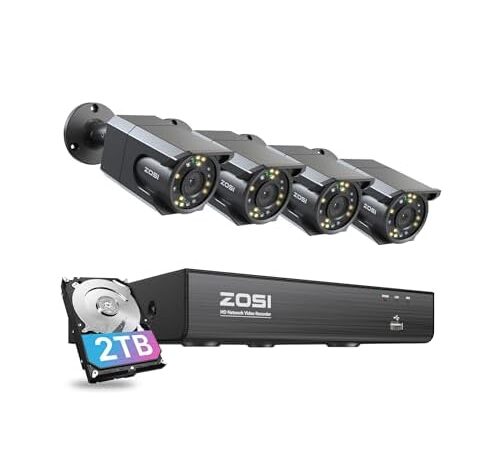
Half the channels used, all the resolution kept
ZOSI 4K 8MP PoE Security Camera System with Audio, 8CH H.265+ NVR, 2TB HDD for 24/7 Recording, 4 x 4K PoE IP Cameras Outdoor Indoor, Starlight Color Night Vision, Human Detection, Smart LighFour 8MP cameras on an 8-channel NVR with H.265+. Low channel load means each camera records near its rated resolution. Best per-camera storage at 500 GB each.
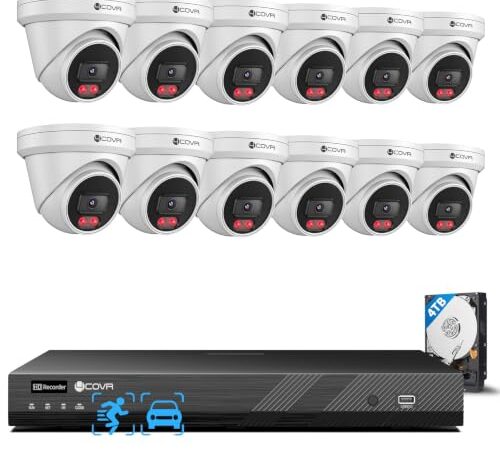
Twelve cameras now, four channels for later
4COVR 4K PoE Security Camera System 16 Channel with 4TB HDD, LY97SA8M1612 | AI Human Vehicle Detection, Night Vision, 12Pcs 8MP Wired Commercial Dome IP Camera IP67, NVR, Business SurveillanA 16-channel NVR at 75% load with full 8MP cameras. Four open channels absorb future expansion without forcing the existing twelve into heavy compression.
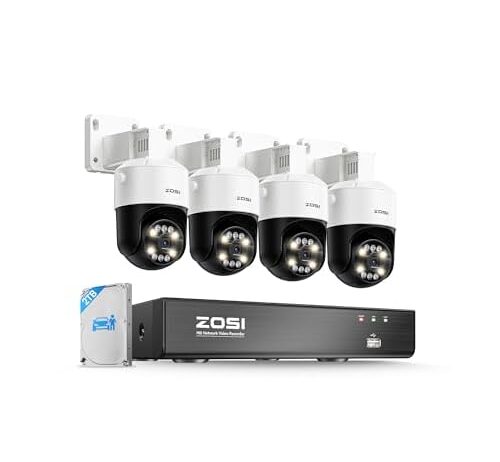
Cameras that follow instead of stare
ZOSI C296 8CH 4K PoE Camera System, 4 x 8MP Pan Tilt Audio Camera, 2TB HDD | Two-Way Talk, Color Night Vision, Auto Tracking, Spotlight Alarm, AI Human/Vehicle Detection, 24/7 Recording, 16CFour pan/tilt 8MP cameras with auto-tracking on an 8-channel NVR. Variable bitrate from camera movement costs bandwidth, but half-channel load absorbs the spikes.
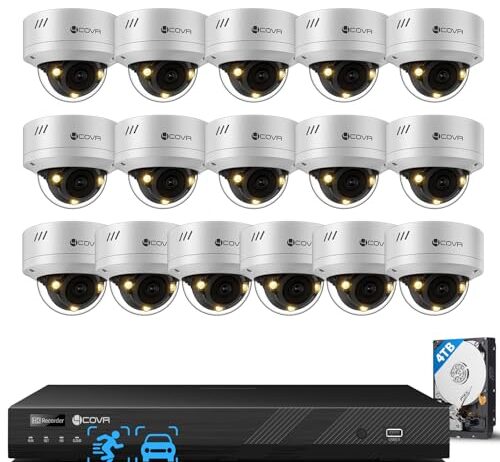
Every channel filled, every dome hardened
4COVR 16 Camera Security System PoE for Business with 4TB HDD, LY54FA5M1616 | 4K 16CH NVR, 16X 5MP IK10 Dome PoE IP Cameras IP67, Smart Color Night Vision, 2-Way Talk, Person/Vehicle DetectiSixteen IK10 vandal-resistant 5MP dome cameras on a 16-channel NVR. Resolution stepped down to 5MP to sustain all sixteen streams — built for coverage count over per-camera detail.
A PoE NVR is a closed network. The cameras, the switch, the recorder, and the hard drive all live on one Ethernet backplane inside the NVR chassis, and every video stream shares the same throughput ceiling. That ceiling is Gigabit Ethernet — roughly 950 Mbps after protocol overhead — and it does not change whether you plug in four cameras or sixteen.
What changes is how the NVR divides that budget.
An 8MP camera at 15 frames per second with H.265 compression generates somewhere between 4 and 8 Mbps, depending on scene complexity. A static hallway compresses efficiently — most of the frame is identical from one second to the next, so the encoder sends differences rather than full images. A parking lot with wind-blown trees, passing headlights, and rain generates far more data per frame because the entire scene changes constantly.
Four cameras at 8 Mbps each consume 32 Mbps. That is 3% of the available pipe. Sixteen cameras at 8 Mbps each consume 128 Mbps — still well within the theoretical limit. So where does the quality loss come from?
The bottleneck is usually not the network. It is the NVR’s decoding chipset. The processor that simultaneously decompresses, records, and serves live previews for every channel has a fixed processing budget, and when that budget fills, the NVR reduces the bitrate it requests from each camera. Lower bitrate means heavier compression, which means softer detail, more blocking artifacts in motion, and faces that were identifiable at six Mbps becoming smudges at two.
How we picked
We did not install these systems. Judgements come from published specifications, compression math, and owner-reported behavior.
How many cameras ship versus how many channels the NVR supports determines per-stream bandwidth. A half-loaded NVR breathes; a full one compromises.
A 4K NVR with 5MP cameras already made the trade-off for you. One shipping 8MP cameras on fewer channels let you keep more of it.
4TB across sixteen cameras gives each one 250GB. 2TB across four gives each 500GB. Recording duration depends on the per-camera share.
Pan/tilt cameras generate variable bitrate as the scene changes with every movement. Static cameras compress more predictably.