
We research every product we recommend. We may earn a commission from the links on this page.

Why Your Fitted Sheets Pop Off and What Actually Fixes It

We compare published specifications and marketplace data. We do not test these products.

Why 16-Inch Deep Pocket Sheets Still Pop Off (And What Depth Actually Works)
Photo by Sergey Meshkov on Pexels

A 12-inch mattress with a 4-inch topper measures 16 inches at the corner — but compress it under your hips and that corner pulls tighter than 16 inches of pocket can hold. That’s why “deep pocket” sheets still end up bunched at 3 a.m. The fix depends on whether you’re fighting the thickness, the elastic, or the bed frame itself.

Affiliate disclosure: This article contains affiliate links. We may earn a commission if you buy through them, at no extra cost to you.

Everything we looked at
3 picks

How we picked

We did not sleep on these bed skirts or mattress pads. Judgments are based on stated pocket depth, drop length, attachment method, and aggregate review patterns.

Drop length, not pocket depth

The distance from mattress edge to floor determines coverage on raised frames. Pocket depth only affects the fitted sheet layer.

Attachment method under load

Elastic attachment survives mattress compression better than tuck-under designs that rely on friction between the mattress and box spring.

GSM fill for pad alternatives

Quilted pads rated 500GSM or higher grip the mattress surface mechanically. Lower weights shift as easily as the sheet they replace.

Durability after washing

Materials that retain elastic recovery after repeated cycles. Heat-set polyester blends outperform natural fibers in grip retention over time.

What Happens at the Corner When You Lie Down

Your mattress isn’t the same height everywhere. Under your hips and shoulders — the heaviest pressure points — memory foam and pillow-top surfaces compress one to three inches. That compression doesn’t just make the mattress shorter in the middle. It pushes the fabric outward and upward at the edges, because the foam has to go somewhere.

A fitted sheet’s corner pocket wraps a 90-degree angle around the mattress corner. The elastic sewn into the hem pulls straight down to hold the pocket tight against that angle. But when body weight compresses the center of the mattress, the fabric between the corner and the compression zone gets pulled laterally — sideways, toward your body. The elastic now has to resist two forces at once: gravity pulling it down around the corner, and your body weight pulling it sideways toward the center of the bed.

That’s the gap between “fits when you make the bed” and “stays on while you sleep.” The sheet fits the static mattress. It doesn’t fit the mattress with you on it.

Pocket depth specifications measure the static corner. A 16-inch pocket fits a 16-inch corner when no one is in the bed. Add a person, and the effective tension demand at the corner increases by the amount of lateral displacement the compression creates. The elastic stretches further, the grip angle changes, and the pocket walks off the corner.

Why Elastic Fails After Washing

Elastic works by stretching and snapping back. Every material has a limit — stretch most elastic bands past about 150 percent of their resting length and the fibers deform permanently. They don’t snap back all the way. They stay a little longer, a little looser, every cycle.

Heat accelerates this. A dryer running at high heat softens the rubber or spandex core inside the elastic, and if the elastic is already near its stretch limit from fitting a thick mattress, the heat pushes it past the deformation threshold. The sheet comes out of the dryer fitting slightly worse than it went in. Do that forty times and the corners won’t hold at all.

Budget-priced fitted sheets cut cost partly by using narrower elastic bands and stretching them closer to their limit to achieve the advertised pocket depth. The sheet fits the measurement on the package, but it’s already operating near the edge of its elastic range before you wash it once. There’s no margin left for the inevitable stretch-and-heat degradation.

Three Different Problems, Three Different Fixes

The phrase “deep pocket” shows up on fitted sheets, mattress pads, and bed skirts — three products that solve entirely different problems. Confusing them is easy because they all reference mattress thickness, but they interact with the bed at different points.

A fitted sheet wraps the top and sides of the mattress. Its pocket depth determines how thick a mattress it can grip. A mattress pad sits on top of the mattress and adds its own thickness — which means every other fitted layer now has to accommodate more height. And a bed skirt hangs from the gap between the mattress and the box spring or platform, concealing the frame and whatever’s stored underneath. It doesn’t touch the mattress surface at all.

If your problem is sheets popping off, a mattress pad actually makes it worse unless the pad itself is the outermost fitted layer. If your problem is an ugly bed frame, neither sheets nor pads help — you need something that anchors below the mattress entirely.

That distinction matters more than it seems. A wrap-around bed skirt bypasses mattress thickness completely. It doesn’t care whether your mattress is 10 inches or 18 inches, because it attaches between the mattress and whatever’s beneath it. The measurement that matters for a bed skirt is the drop — how far from the attachment point to the floor.

Drop Length vs. Pocket Depth: Measuring Different Things

Drop and depth sound interchangeable. They’re not. Pocket depth is a horizontal measurement around a vertical corner — how far down the side of the mattress the fabric reaches. Drop length is a vertical measurement from the attachment point straight down to the floor.

A 15-inch drop on a bed skirt means the fabric hangs 15 inches. That’s enough for a standard box spring setup where the top of the box spring sits about 15 to 16 inches off the ground. A 24-inch drop handles tall bed frames — platform beds with storage drawers underneath, frames on risers, or any setup where you’ve deliberately raised the bed for clearance.

Getting the drop wrong is visible immediately. Too short, and you can see the frame legs and whatever’s stored under the bed. Too long, and the fabric puddles on the floor, catches under chair casters, and looks like a curtain that was hemmed for the wrong window.

Measure from where the mattress meets the box spring (or platform surface) straight down to the floor. That number is your drop. It has nothing to do with how thick your mattress is.

Most bed skirts ship with a 14- or 15-inch drop because that’s what fits a standard box spring on a basic metal frame. Raise the bed — risers for storage bins, a captain’s frame with drawers, a platform with extra clearance — and that standard skirt stops six to ten inches short of the floor. You can see everything it was supposed to hide.

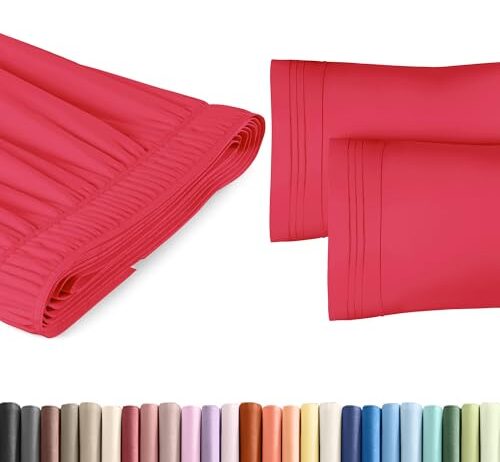
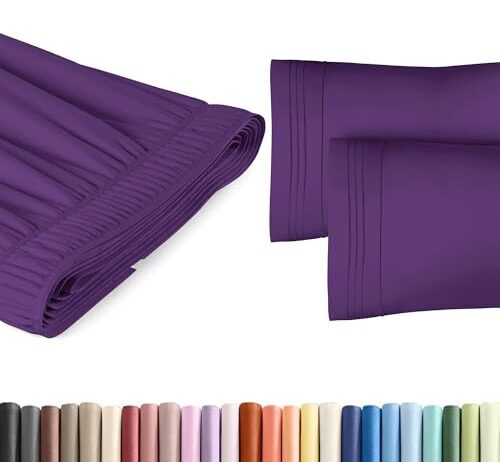
This CGK Linens skirt drops 24 inches, which covers the full distance on beds sitting as high as two feet off the ground. The wrap-around elastic strap anchors between the mattress and box spring, so the skirt stays put regardless of mattress thickness — your mattress could be 8 inches or 16 inches and the drop stays the same, because the attachment point doesn’t move. The adjustable pleating lets you control how much fabric bunches at the corners versus lying flat along the sides.

Twin-size only, so it fits a 38-by-75-inch mattress footprint. If you’re dressing a kid’s loft bed or a dorm frame on risers, that’s the size you’re working with — and those are exactly the setups that tend to sit high enough to need the extra drop.

When a Mattress Pad Makes Sense (and When It Makes Things Worse)

A quilted mattress pad adds cushioning and changes the sleeping surface. It also adds height. A 500GSM pad — 500 grams of fill per square meter — has real loft to it. That’s roughly twice the fill density of a lightweight pad, enough to feel the difference when you press your hand into it.

If your sheets already fit well, adding a pad means they now have to stretch further. A mattress that measured 12 inches is now 13 or 14 with a padded layer on top. Your 16-inch deep-pocket sheets still fit, but they’re operating closer to their elastic limit — and closer to the threshold where washing and nightly compression start costing you grip.

The alternative is to make the pad the outermost fitted layer. A pad with its own fitted pocket — 8 to 16 inches of depth accommodation — replaces the sheet’s job of gripping the mattress. The pad’s elastic does the holding, and you put a flat sheet on top or skip the top layer entirely. This works particularly well on memory foam and pillow-top mattresses, where the surface is too soft for a separate sheet to grip firmly at the corners.

But stacking a pad over a memory foam topper creates a different problem. The topper already compresses under body weight and shifts laterally. Adding a quilted layer on top of that means two surfaces that can slide against each other — the topper moving one direction under your weight, the pad moving with the sheet above it. On innerspring mattresses with firm, defined corners, a pad grips fine. On foam surfaces without those hard edges, it can bunch and migrate.

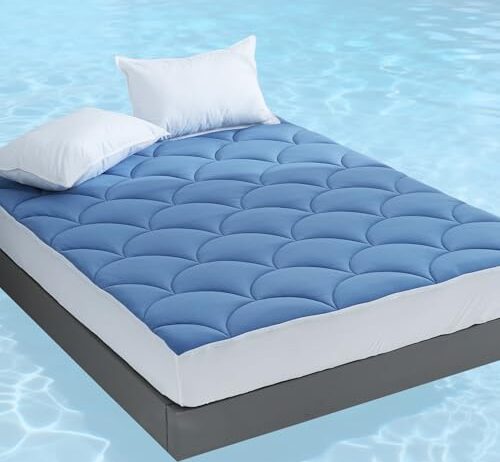
The YOUR MOON pad fits mattresses from 8 to 16 inches deep, which covers everything from a basic innerspring to a thick pillow-top without a topper. That range matters because the elastic doesn’t have to stretch to its absolute limit on a 12-inch mattress the way a sheet designed for exactly 12 inches does. There’s slack in the system, and slack is what keeps elastic functional over months of washing.

At 500GSM, the quilted fill is dense enough to add noticeable cushioning — it’s a comfort layer, not just a protector. The quilting anchors that fill so it doesn’t migrate to one end of the bed after a few nights. The trade-off is that the pad itself adds to your total mattress height, so if you’re already at 15 inches and you add this, you’re now at 16 or more. Any fitted sheet over the top needs to account for that new total.

The simpler approach: skip the fitted sheet underneath. Use the pad as your bottom fitted layer, put a flat sheet on top, and you’ve eliminated the corner-popping problem entirely because the pad’s own elastic is doing all the work against the mattress surface.

How to Actually Measure Your Bed

Grab a tape measure and a hardcover book. Set the book flat on top of the mattress at one corner so it overhangs the edge. Measure from the bottom of the book (the top of the mattress) straight down to the bottom of the mattress — or to the top of the box spring if you’re measuring for a bed skirt’s attachment point. That’s your mattress height.

Now add the topper. If you use one, measure from the top of the topper to the bottom of the mattress. That’s the number your fitted sheet or mattress pad needs to exceed — not match, exceed — by at least two inches. Those two inches are your elastic margin, the slack that lets the corner stay put when your body compresses the center of the bed.

For bed skirt drop, measure from the top of the box spring (or platform surface) straight down to the floor. Don’t measure from the top of the mattress — the skirt doesn’t attach there.

Write both numbers down. One is horizontal (how thick the sleeping surface is, for sheets and pads). The other is vertical (how far from the attachment ledge to the floor, for skirts). Mixing them up is how people end up with a bed skirt that’s ten inches too short or a fitted sheet that technically fits but pops off by midnight.

FAQ

Will a 16-inch deep pocket sheet fit a 12-inch mattress with a 4-inch topper?

Technically yes — 12 plus 4 equals 16. But you’ll have zero elastic margin. Body weight compresses the mattress and pulls the fabric laterally, so a sheet that exactly matches your total height is already at its stretch limit before you lie down. Look for at least 18 inches of pocket depth for that combination.

Why do my fitted sheet corners keep popping off at night?

When you compress the mattress center under your hips, the foam pushes outward at the edges. The elastic at each corner has to resist both downward grip and that sideways pull. If the pocket depth barely fits your mattress, the elastic is already near its limit and can’t absorb the extra demand. Washing in hot water accelerates the problem by permanently stretching the elastic fibers.

What does GSM mean for mattress pads?

Grams per square meter — it measures how much fill is packed into the quilted layer. A 500GSM pad has roughly twice the fill material of a 250GSM pad the same size, which means more cushioning, more insulation, and a thicker profile that adds to your total mattress height.

Do wrap-around bed skirts work with adjustable beds?

Only if the bed has a fixed base beneath the adjustable mattress platform. Wrap-around skirts anchor between the mattress and the surface below it. On adjustable frames that tilt the entire sleeping surface, the skirt moves with the mechanism and bunches at the head or foot. On frames where only the mattress articulates above a stationary base, the skirt stays put.

Can I put a mattress pad over a memory foam topper?

You can, but they’ll slide against each other. Memory foam compresses and shifts laterally under body weight, and a quilted pad on top of it has no firm edge to grip. On innerspring mattresses with defined corners, pads hold fine. On foam, expect the pad to bunch toward the center of the bed overnight.