We research every product we recommend. We may earn a commission from the links on this page.

Why Your Blackout Curtains Still Let Light In

We compare published specifications and marketplace data. We do not test these products.

Why Blackout Curtains Let Light Through the Sides
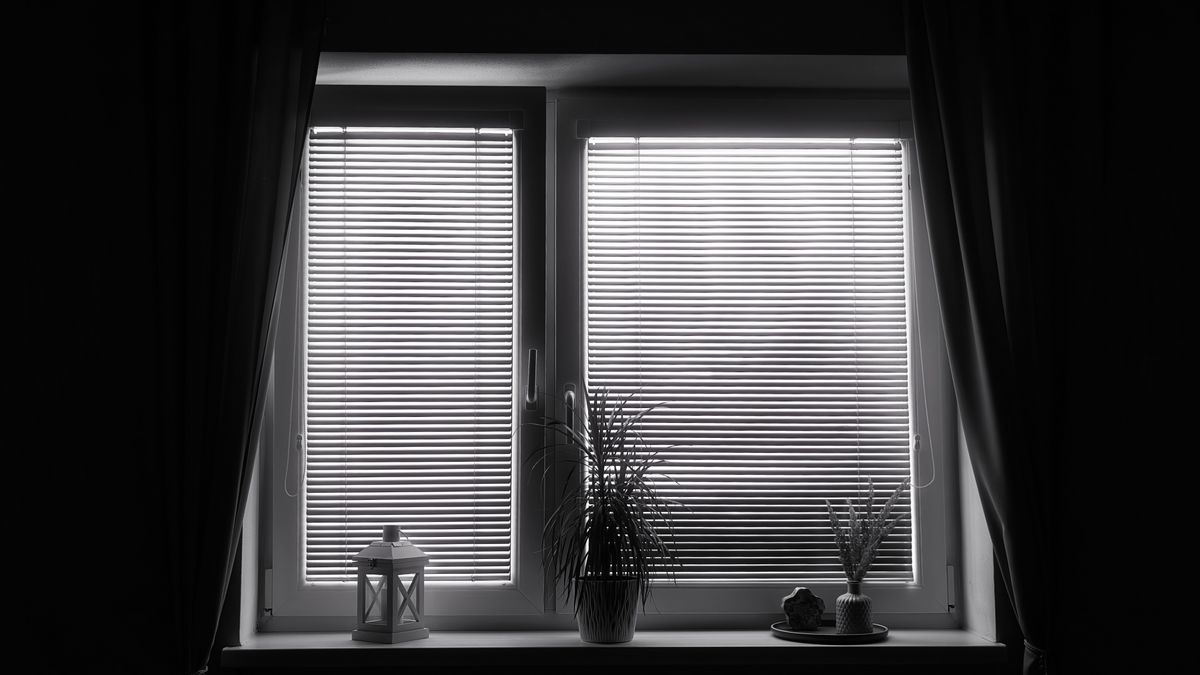
Photo by Kamil Čičila on Pexels

The fabric on most blackout curtains blocks 85 to 99 percent of light that hits it directly. That number sounds like the problem is solved until you wake up at 6 a.m. with a bright rectangle outlining your window — light pouring in from every edge the curtain doesn’t touch. The failure isn’t the material. It’s the geometry: where the curtain ends and the wall begins, how much gap sits above the rod, and whether two panels actually overlap or just meet. Every blackout product solves the through-fabric problem. Almost none solve the around-fabric problem out of the box.

Affiliate disclosure: This article contains affiliate links. We may earn a commission if you buy through them, at no extra cost to you.

Everything we looked at
4 picks

How we picked

We did not hang these curtains in a room. Judgment comes from published dimensions, fabric specifications, and mounting hardware details.

Gap distance, not opacity percentage

Blackout fabric blocks light that hits it. We measured how mounting systems reduce the space between fabric edge and wall.

Overlap design, not panel count

Two panels meet or overlap at center. We checked which construction methods force overlap rather than assume it.

Fabric weight per square yard

Heavier fabric holds position against the wall. We compared chenille and velvet weights to linen in matching pleat styles.

Total installed cost, not curtain price

Motorized shades require power and custom sizing. We calculated the final price including mounting hardware and necessary accessories.

Where the light actually gets in

Hold a blackout curtain up to a window with your hands flat against the wall on all sides. The room goes dark. Now hang it from a rod the normal way. Light everywhere.

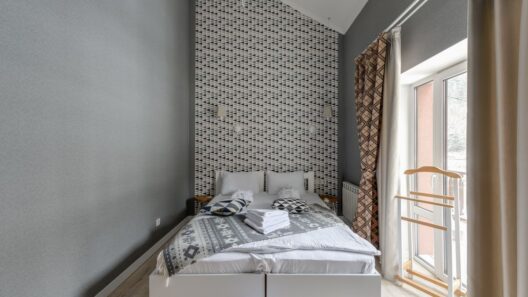
Three gaps do the damage. The top gap, between the rod and the wall above it, lets light spill over the curtain header and hit the ceiling. Side gaps appear wherever the curtain edge doesn’t press against the wall — and fabric hangs in a slight curve away from the wall, so there’s almost always a sliver. The center gap, where two panels meet, leaks a vertical stripe of light unless the panels overlap by several inches rather than just touching edge to edge.

The fabric itself typically blocks 85 to 99 percent of light passing through it. That’s the number on the label, and it’s usually honest. But the perimeter gaps can let in enough light to make the room feel like the curtains aren’t working at all. A one-inch gap running the full height of a window admits a surprising amount of light into a dark room — your eyes adapt to darkness, so even a thin bright line registers as a failure.

This is why rod placement matters more than fabric quality. Mounting a rod 8 inches or more above the window frame — not at the frame edge — lets the curtain fall past the top of the glass with enough drape to close the overhead gap. Extending the rod 10 inches beyond the frame on each side means the fabric wraps past the window’s edge when closed. And buying curtains 2 to 2.5 times the width of the window creates enough gathered fabric to press against the wall rather than hanging in a taut, gap-prone line.

How hanging style changes where light leaks

A rod pocket curtain threads the rod through a sewn channel at the top. The gathered fabric bunches tightly around the rod, which helps close the top gap — the bunching fills space between rod and wall. But that same bunching creates friction. Sliding the curtain open or closed takes effort, and daily use slowly drags the gathers out of position, opening side gaps that weren’t there on installation day.

Back tab curtains run the rod through hidden loops spaced along the back of the header. Less friction, smoother daily operation, and the curtain hangs in cleaner folds. But the loops leave small gaps between each tab where the header doesn’t press against the rod — potential pinpoints of light at the very top.

Pinch pleat curtains hang from hooks or clips attached to a track or rings. The pleats are permanently sewn, so the spacing stays consistent and the curtain folds the same way every time you close it. On a ceiling-mounted or wall-mounted track, pinch pleats can sit closer to the wall than rod-mounted styles, reducing side gaps. The trade-off is hardware: you need the track or the rings, and the hooks need to stay seated.

Each method has a gap profile. Rod pocket: good top seal, poor daily function. Back tab: smooth operation, minor top leaks. Pinch pleat on track: best wall contact, most hardware.

Curtains versus shades — a structural difference in where they fail

A roller shade sits inside or just outside the window frame. It rolls down flat against the glass. No folds, no gathers, no overlap — which means no through-fabric leakage and no center gap, since it’s a single sheet.

But a roller shade fails at the sides. The shade material stops at its edge, and the window frame or wall continues. That gap — typically a quarter inch to a half inch on each side for an inside-mount shade — runs the full height of the window. Light streams through it in two bright vertical lines. The only way to eliminate those lines entirely is a sealed track system, where channels mounted to the wall guide the shade edges and block side light mechanically. Standard roller shades, including motorized ones, don’t include sealed tracks unless specifically advertised.

Curtains have the opposite geometry. They can extend well past the window frame on all sides, wrapping light leaks in fabric. But they require correct rod placement, sufficient width, and overlapping panels to actually achieve that coverage. A curtain hung on a rod at frame height with panels that just meet in the middle leaks from three directions simultaneously.

Neither type is inherently better at blocking light. They fail in different places, and fixing those failures requires different interventions — wider mounting for curtains, sealed tracks for shades.

The reason this curtain matters for light control isn’t the chenille — it’s the hanging method. Pinch pleats on a track sit the fabric closer to the wall than any rod-mounted style. The pleats are permanently sewn, so the folds don’t shift with daily use, and the track eliminates the rod-to-wall gap that lets light spill over the top. Combined with the weight of chenille velvet, which hangs straight rather than billowing away from the wall, you get tighter perimeter contact without needing to engineer your own edge-sealing solution.

The thermal benefit follows from the same mechanism. Dense, heavy fabric sitting close to the wall traps a layer of still air between the curtain and the glass. That dead-air layer is what actually insulates — not the fabric alone. Chenille velvet’s weight keeps the curtain in position to maintain that air pocket. A lighter fabric that sways or lifts in a draft breaks the seal.

At 52 inches wide and 72 inches long, this is a single panel. For a standard window, you’d need two to get center overlap. The 72-inch length is shorter than the 84-inch options elsewhere here — measure your window-to-floor distance before ordering, because a curtain that stops short of the sill or floor creates a bottom gap that defeats the purpose.

The width problem nobody calculates correctly

A 36-inch-wide window needs curtains totaling 72 to 90 inches of fabric width when closed — two to two and a half times the window. That’s not a suggestion. It’s the math for the gathered fabric to press against the wall rather than hang flat with side gaps.

Most curtain panels in this category are 52 inches wide. Two panels give you 104 inches of fabric. For a 36-inch window, that’s nearly three times the width — more than enough for overlap and wall contact. For a 52-inch window, you’re at exactly two times width, which is the minimum. For anything wider, two standard panels start falling short.

Single-panel products require a second purchase to cover most windows properly. That’s not a flaw in the product — it’s how curtains work. But buyers routinely order one 52-inch panel for a 36-inch window, expecting it to cover the glass. It covers the glass. It doesn’t cover the wall on either side, and that’s where the light gets in.

The motorized roller shade sidesteps this calculation entirely by offering customizable sizing — you order the exact width of your window. But exact-width coverage is exactly the problem for a roller shade: it fits the opening precisely, with no extension past the frame, which is why the side gaps appear.

The center gap — that vertical line of light where two panels meet — is the failure mode most buyers notice first and fix last. Fixing it requires panels that overlap several inches at the center rather than butting edge to edge. Buying a two-panel set from the same product means the panels match in length, color, and pleat spacing, which makes the overlap consistent.

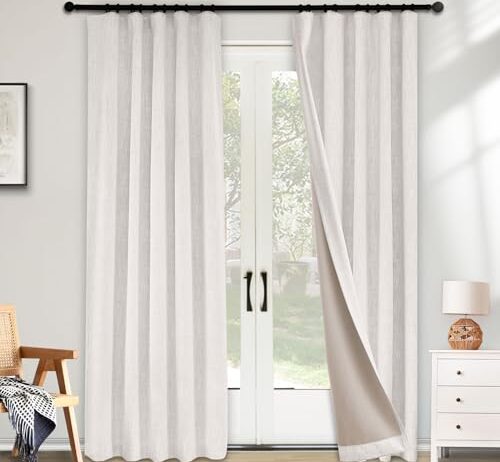
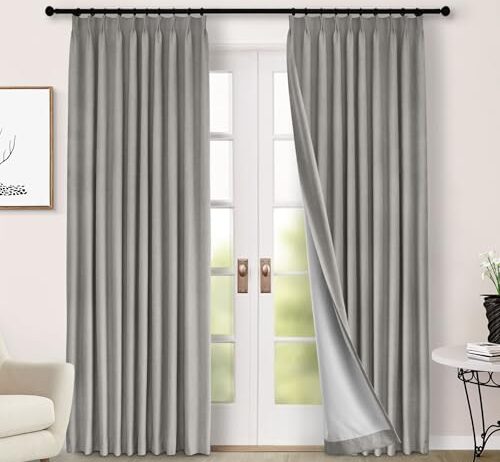
These panels use pinch pleats as the primary hanging style, giving you the structured, repeatable fold pattern that keeps the center overlap aligned each time you close them. The back-tab option lets you thread a rod through hidden loops instead if you don’t have a track system — less precise wall contact than a track, but smoother daily operation than a rod pocket. You choose the hanging method that matches your hardware without buying a different curtain.

Velvet is the material doing the thermal and acoustic work here. It’s denser than linen, heavier per yard, and it hangs with less movement in a draft. The weight keeps the panels in place once closed, which maintains the center overlap through the night rather than letting air currents pull the panels apart. At 84 inches long, these reach floor length on a standard 8-foot ceiling with the rod mounted well above the frame — exactly where it needs to be for top-gap elimination.

When motorized convenience costs you light control

A motorized roller shade opens and closes on a schedule, works from a remote, and requires no physical contact. For daily convenience, nothing here competes with it. But light blocking is a geometry problem, and motorized operation doesn’t change the geometry.

A roller shade mounts inside or just outside the window frame. When lowered, it covers the glass in a single flat sheet — no center gap, no fabric folds, no overlap to worry about. The failure is at the sides, where the shade edge meets the frame. Without sealed channel tracks guiding the shade edges, light passes through those vertical gaps every time.

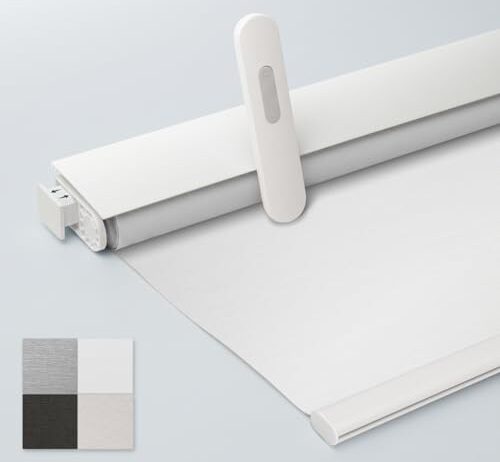
The customizable sizing of the Hapadif shade means you can order an exact fit for your window opening, which eliminates the common curtain problem of standard sizes not matching your window. But an exact fit for a roller shade means edge-to-edge coverage with no extension past the frame — the precise condition that creates side gaps. A curtain sized to extend 10 inches past the frame on each side wraps those gaps in fabric. A shade sized to match the frame leaves them open.

No-drill installation adds flexibility for renters or temporary setups, and remote-controlled operation is genuinely useful for hard-to-reach windows. If your priority is ease of use over maximum darkness, a motorized shade makes sense. If your priority is a truly dark room, the side-gap problem needs either sealed tracks or a curtain layered over the shade.

Velvet versus linen — weight is doing more than you think

Velvet and linen can both be constructed as blackout fabrics. Triple-layer construction with an opaque middle layer blocks light through either material. The difference is what happens after installation.

Velvet is heavy. It hangs straight, resists drafts, and stays where you put it. That weight maintains the curtain’s contact with the wall and the overlap between panels. A velvet curtain closed at 10 p.m. is still in position at 6 a.m. because it takes real airflow to move it.

Linen is lighter. It breathes — air passes through the weave more freely, which makes it better for warm climates where you want some airflow even with the curtains closed. But that lighter weight means more movement. A ceiling fan, an HVAC vent, a window cracked for air — any of these can shift a linen curtain enough to open a side gap or pull the center overlap apart.

For pure light blocking, velvet wins on physics. For a room where you want darkness and airflow simultaneously, linen with a blackout backing is a compromise — the backing blocks the light, and the linen face lets some air through. But you’ll need to be more precise about rod placement and curtain width to compensate for the lighter fabric’s tendency to move.

Chenille velvet — the cut-pile variant — adds texture and slightly more weight per yard than standard velvet. The practical effect is marginal: both hang well, both insulate well. The choice between them is aesthetic, not functional for light blocking.

Tiebacks and the daytime problem

Blackout curtains spend half their life open. During the day, you want light in the room, which means pulling the curtains to the sides. Tiebacks and holdbacks hold them there.

The problem comes at night. A tieback mounted at the midpoint of the window — the standard decorative position — pulls the curtain into a crease at that height every day. Over weeks, the fabric develops a memory fold at the tieback point. When you release the curtain at night and close it, that crease prevents the panel from hanging flat against the wall at that height. A strip of light leaks through where the crease holds the fabric away from the surface.

Mounting tiebacks lower — near the bottom third of the curtain rather than the middle — reduces this effect. The crease forms where the curtain already presses against the wall under its own weight. Magnetic tiebacks that release cleanly, without bunching, cause less permanent creasing than hook-style holdbacks that pinch the fabric into a fixed position.

Both the Macochico chenille and the Macochico linen blend include a tieback. The velvet’s weight resists creasing better than the linen blend, but neither is immune to it over months of daily use.

FAQ

How wide should blackout curtains be compared to the window?

Two to two and a half times the window width. A 36-inch window needs 72 to 90 inches of total curtain fabric so the gathered material presses against the wall instead of hanging flat with side gaps.

Do pinch pleat curtains block more light than rod pocket curtains?

Pinch pleats on a track sit closer to the wall, reducing side and top gaps. Rod pocket curtains bunch tightly around the rod for a good top seal but create friction that shifts the fabric out of position over time. The difference is in edge contact, not fabric performance.

Will a motorized blackout shade make my room completely dark?

Not by itself. Roller shades cover the glass effectively but leave side gaps where the shade edge meets the window frame. Complete darkness requires sealed track channels on both sides, which standard motorized shades don’t include.

Are velvet blackout curtains better than linen for blocking light?

Both can block light through the fabric equally well with blackout construction. Velvet’s advantage is weight — it hangs straighter, resists drafts, and maintains wall contact and panel overlap through the night. Linen is lighter and moves more easily, which can open gaps.

Can I use tiebacks with blackout curtains without ruining the light seal?

Yes, but mount them in the lower third of the curtain rather than the middle. Tiebacks at midpoint create a memory crease in the fabric that holds the curtain away from the wall at that height when closed, letting light leak through.

How far above the window should I mount a blackout curtain rod?

At least 8 inches above the top of the window frame. This lets the curtain fall well past the top of the glass, closing the gap between the rod and the wall where light otherwise spills over and hits the ceiling.