We research every product we recommend. We may earn a commission from the links on this page.
Home & Kitchen › Panels

Why Pinch Pleat Curtains Don’t Hang Straight

We compare published specifications and marketplace data. We do not test these products.

Grommet Curtains Pull Away from the Wall Under Their Own Weight
Photo by Max Vakhtbovych on Pexels

Pinch pleat curtains hang from clusters of stitched folds spaced along the header, and every one of those clusters is a pivot point. Mount the rod a few inches from the wall — which you have to, if you want the curtain to clear the window frame — and gravity pulls each pleat forward rather than straight down. The heavier the fabric and the farther the rod sits from the wall, the worse the lean. It’s not a manufacturing flaw. It’s a lever.

Affiliate disclosure: This article contains affiliate links. We may earn a commission if you buy through them, at no extra cost to you.

Everything we looked at
4 picks
Also great · dual mounting
Hooks or back tabs, your call

Hooks or back tabs, your call

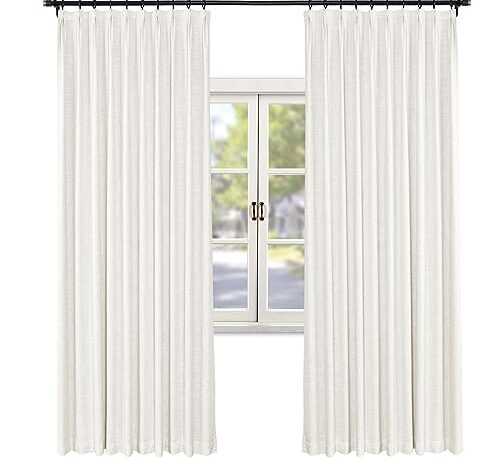
Natural Pinch Pleated Curtains 84 Inch Length 2 Panels for Living Room Bedroom Linen Textured Semi Sheer Privacy Window Curtain Boho Neutral Back Tab Pinch Pleat Drape with Hooks Rings 84 In
★ 4.5 264 reviews

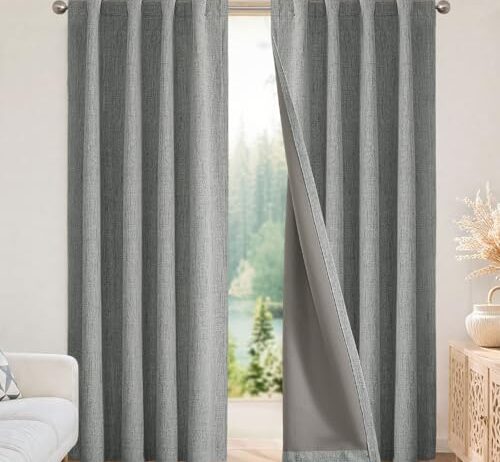
Drapenova's semi-sheer linen-textured pair ships with hooks, rings, and back tab slots. Thread the rod through the tabs to pin the panel flat against the wall, or use the hooks for traditional pleat drape with light filtering instead of blackout.

How we picked

We do not hang these curtains in a home. Judgements rest on fabric weight specifications, measured panel dimensions, and pleat construction details.

Fabric weight, not drape claims

Heavier linen amplifies forward lean at the pleat clusters; weight per square yard determines the magnitude of the tilt problem you’re buying.

Actual pleat count and spacing

Closely spaced pleats distribute weight across more pivot points, reducing the per-pleat lever arm and the resulting forward angle.

Rod clearance required, not aesthetics

The bracket’s minimum standoff distance sets the lever arm length; deeper brackets guarantee worse lean regardless of fabric choice.

Light blocking, not thermal marketing

Blackout backing adds material weight without changing pleat geometry, worsening the tilt while delivering the opacity some windows require.
Why Pleats Create a Lever Arm

A rod pocket curtain slides the rod through a continuous tunnel of fabric. Weight distributes evenly along the entire rod, and the fabric drapes straight down from a line that sits against the wall. Pinch pleats don’t work that way.

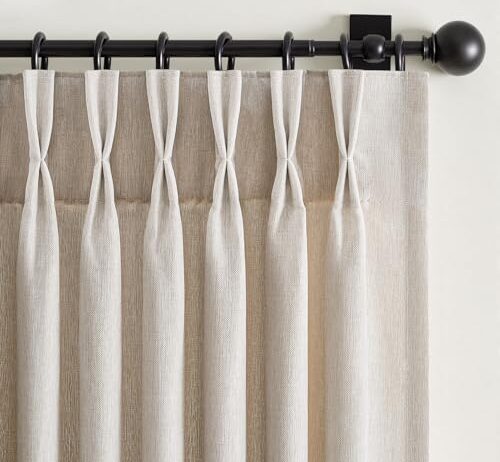
Each pleat cluster hangs from a single point — a hook or a ring — and the fabric between clusters has no direct contact with the rod. That makes every hook a pivot. The curtain’s center of mass sits somewhere in front of the rod, because the fabric’s own thickness and the fullness gathered into each pleat push the panel’s bulk forward. Gravity acts on that center of mass and creates a turning moment around the hook point.

The farther the rod mounts from the wall, the longer the lever arm. A bracket that positions the rod three inches out gives gravity three inches of horizontal distance to work with. Four inches, four. The fabric doesn’t get heavier, but the rotational pull at each pleat increases with every fraction of an inch.

Heavier fabrics amplify this. Linen at 200 gsm exerts more downward force than a polyester voile at 80 gsm, and that force acts through the same lever geometry. A lined or interlined panel adds another layer of mass. The pleat doesn’t care why it’s heavy — it just tilts more.

Back Tabs Change the Geometry

A back tab is a fabric loop stitched to the rear of the header. The rod threads through it, which means the rod sits inside the curtain structure rather than in front of it. That changes everything about where the weight sits relative to the support point.

With hooks or rings, the hanging point is forward of the fabric’s bulk. With a back tab, the rod is behind the fabric, pressing the panel against the wall. The center of mass shifts backward, and the turning moment that creates forward lean either shrinks or reverses entirely. The panel drapes closer to the wall, and the gap at the top narrows or disappears.

The trade-off is movement. A hook slides freely along a rod or a track. A back tab grips the rod — the fabric wraps around it, and friction holds it in place. Daily opening and closing means shoving fabric along a rod rather than sliding rings, and the pleats bunch unevenly because each tab resists differently. If you open and close curtains twice a day, that friction adds up fast. If they stay drawn most of the time, it barely matters.

Width, Weight, and What the Pleats Actually Consume

Curtain fullness — the ratio of flat fabric width to finished, pleated width — is where most sizing mistakes happen. A standard pinch pleat panel uses roughly 2 to 2.5 times its finished width in flat fabric. So a panel meant to cover 50 inches of rod needs 100 to 125 inches of material gathered into pleats.

That ratio matters because it determines how much fabric stacks behind each pleat. More fullness means deeper folds, which means more mass concentrated at each pivot point. A panel cut at 2x fullness has shallower pleats and less forward projection than the same fabric cut at 2.5x. The drape looks flatter, but it also tilts less.

Width also determines whether you’re working with one panel or two. A single wide panel eliminates the center seam where two panels meet — that vertical line of light that no amount of overlap fully hides in a dark room. But a single panel at 120 inches wide, pleated at 2x fullness, is gathering 120 inches of fabric into pleat clusters that each carry substantially more weight than the clusters on a 42-inch panel. The forward lean scales with that weight.

Two narrower panels split the load. Each panel tilts independently, and each one is lighter, so the lean at any single pleat point is smaller. The seam in the middle is the cost.

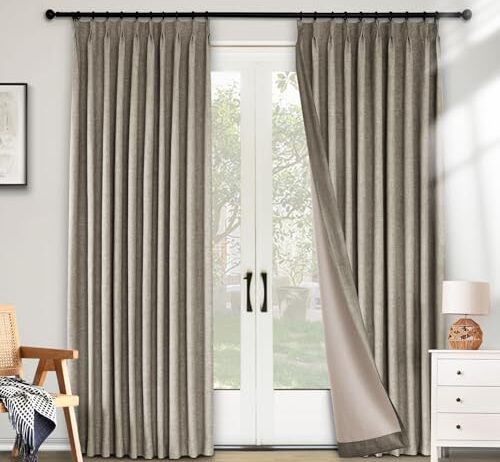
At 120 inches wide, this Macochico panel is built for picture windows, sliding doors, or any opening where you want one unbroken plane of fabric from edge to edge. That width means the pleats are gathering an enormous amount of linen into each cluster, and every cluster becomes a heavier pivot point. The forward tilt will be more pronounced than on a 52-inch panel of identical fabric, because there’s simply more mass per pleat acting through the same bracket geometry.

Linen is the right fabric for this job. It hangs with a soft irregularity that synthetic weaves can’t replicate — the threads vary in thickness, and the surface catches light unevenly, which is exactly what you want across a ten-foot span of wall where a flat synthetic would look like a bedsheet. The blackout layer adds weight, which adds to the lean, but also means this single panel does two jobs: light blocking and visual texture. Mount the rod as close to the wall as your window trim allows. Every inch of bracket depth you can eliminate reduces the lever arm and pulls the header back toward the wall.

Blackout vs. Light Filtering: The Opacity Divide

A semi-sheer curtain and a blackout curtain are not two points on the same spectrum. They’re different tools. A sheer panel diffuses light — it softens the view from outside, cuts glare, and lets you see the shape of the window from across the room. It does not block enough light to darken a bedroom for sleep. Not at one layer, not at two.

A blackout panel uses either a tight weave, a foam backing, or laminated layers to stop light transmission entirely. That construction makes it heavier per square foot than a sheer, which means more force through each pleat point and more forward lean. But it also means the gap between the curtain and the wall — the one the lean creates — becomes a light leak. The panel blocks light through its face, but light pours around its edges through the wedge-shaped gap the lever arm opens up.

This is why rod placement matters more for blackout curtains than for sheers. A sheer panel with a one-inch gap at the top still does its job, because the job is diffusion, not blockage. A blackout panel with the same gap fails at the one thing you bought it for. Ceiling-mounted tracks, return brackets that wrap the curtain around the rod ends, or wall-hugging back-tab hanging all reduce the gap. Standard hooks on a face-mounted rod maximize it.

Drapenova’s dual-header design is the interesting one here. The pinch pleats come with hooks and rings for a traditional installation, but the back tab slots let you bypass all of that and run the rod straight through the header. That second option changes the physics: instead of hanging from spaced-out pivot points, the panel’s weight distributes continuously along the rod, and the rod presses the fabric against the wall rather than letting it swing forward.

The semi-sheer construction works in this panel’s favor for lean. Lighter fabric means less gravitational force at each hanging point, regardless of which method you use. On hooks, the forward tilt will be milder than a blackout linen panel of the same width. On back tabs, it nearly disappears. The two-panel set at this price point is also doing something the 120-inch single panel can’t: it lets you open the curtains by pulling them apart to the sides, which you can’t do with one panel unless you’re gathering all ten feet of fabric to one end of the rod.

Hardware Confusion and What Pinch Pleats Actually Need

Pinch pleat curtains need either hooks or rings. They do not slide onto a rod through a pocket. The pleat header is rigid — multiple layers of fabric stitched and often stiffened with buckram — and it has no opening for a rod to pass through unless the panel also includes back tab loops.

The hooks are small metal pins that slide into a woven pocket behind each pleat cluster. One end of the hook holds the pleat; the other end hangs on a ring, which slides on the rod. Some panels ship with hooks already inserted. Others arrive with the pleats sewn but the hooks in a bag, and you pin each one into the pleat yourself. Neither approach requires special rods — any standard round rod with rings works.

Traverse rods are a different system. They have an internal track with carriers that slide via a cord mechanism, and the hooks clip directly into the carriers without rings. If you want to open and close curtains by pulling a cord instead of pushing fabric by hand, you need a traverse rod. But it’s not required. A decorative rod with rings does the same structural job; you just slide the rings manually.

The one exception is a back-tab panel. Those thread directly onto the rod and need no hooks at all. But the rod has to be small enough to fit through the tab — typically 1 to 1.5 inches in diameter — and you have to remove the rod from the brackets to install or remove the curtain. Hooks let you hang and unhang panels without touching the rod.

How to Size Pinch Pleat Panels for Your Rod

Measure the rod, not the window. The rod extends past the window frame on both sides — usually 3 to 6 inches per side — so the coverage area is wider than the glass. Multiply the rod width by 2 to 2.5 to get the total flat fabric width you need, then divide by the number of panels.

A 60-inch rod at 2x fullness needs 120 inches of fabric. Two panels means 60 inches each before pleating, which produces a finished pleated width of about 30 inches per panel. That’s tight — the panels will meet in the middle with no overlap. At 2.5x fullness, you’d need 150 inches total, or 75 per panel, finishing around 30 inches each but with deeper, more sculptural pleats.

Stack-back is the part everyone forgets. When you open the curtains, the pleated fabric bunches to the sides. A heavy linen panel stacks 6 to 8 inches deep. That stack sits on the rod, blocking 6 to 8 inches of glass on each side. If your rod doesn’t extend far enough past the frame, the stacked curtain covers part of the window even when open. Extend the rod at least 8 inches past the frame on each side for heavy panels, and you reclaim that light during the day.

FAQ

Why do pinch pleat curtains stick out from the wall?

Each pleat hangs from a single hook or ring, creating a pivot point. The curtain’s weight pulls forward through the distance between the rod and the wall, producing a turning moment that tilts the header into the room. Heavier fabrics and rods mounted farther from the wall increase the lean.

Do pinch pleat curtains need special hooks or hardware?

They need hooks or rings, not special ones. Small pin hooks slide into a pocket behind each pleat, then hang on rings that slide along a standard round rod. Traverse rods with internal carriers also work but aren’t required. Back-tab panels skip hooks entirely and thread the rod straight through the header.

How much wider should pinch pleat curtains be than the rod?

Multiply the rod width by 2 to 2.5. A 60-inch rod needs 120 to 150 inches of total flat fabric width to create proper pleat depth. Divide by the number of panels. Less fullness means shallower pleats and less forward projection; more fullness means deeper folds and heavier load per pleat.

Can you reduce pinch pleat curtain lean without changing the curtains?

Mount the rod as close to the wall as window trim allows — every inch of bracket depth you eliminate reduces the lever arm. Ceiling-mounted tracks eliminate the forward offset entirely. Return brackets that wrap the rod ends back to the wall also help contain the edges.

What is the difference between pinch pleat and back tab curtains?

Pinch pleats hang from spaced hooks, creating structured folds with dimensional depth. Back tabs are fabric loops that thread directly onto the rod, distributing weight continuously and pressing the panel flat against the wall. Some panels offer both options in the same header.