We research every product we recommend. We may earn a commission from the links on this page.
Electronics › Dome Cameras

Why Multi-Lens Security Cameras Lose Night Vision Faster Than You’d Expect

We compare published specifications and marketplace data. We do not test these products.

Why Your Dome Camera's Night Footage Looks Foggy
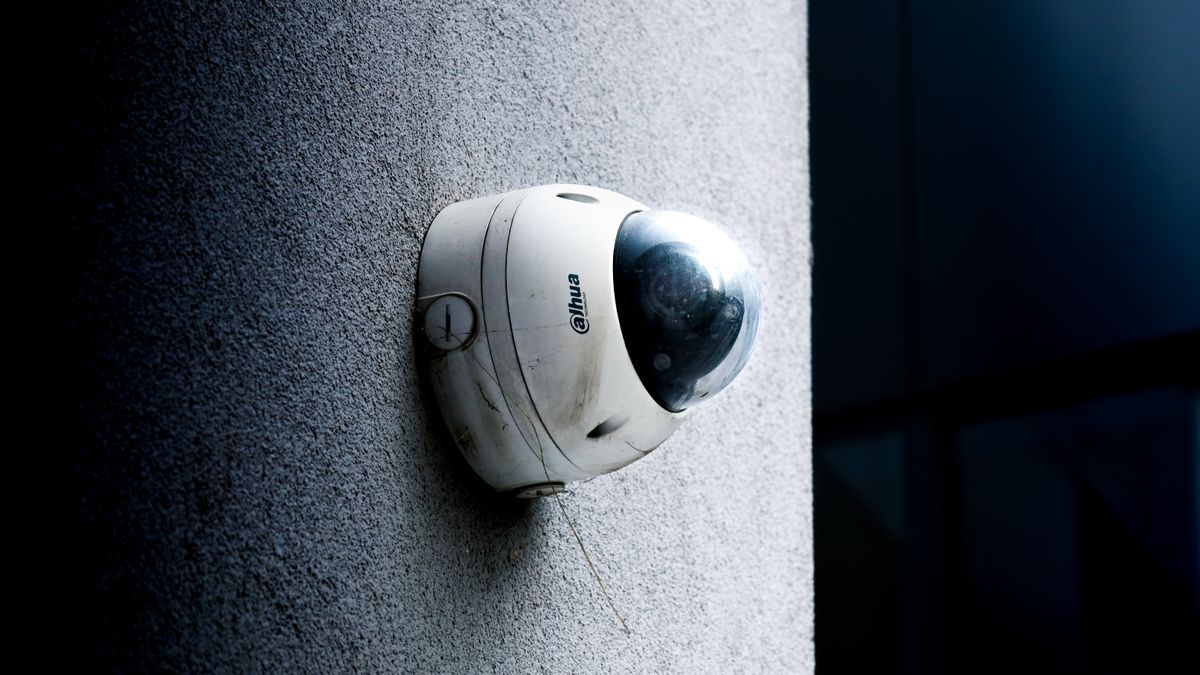
Photo by Thomas VEILLON on Pexels

Every infrared emitter inside a dome camera bounces light off the polycarbonate bubble between it and the scene. One lens means one ring of emitters. A triple-lens camera triples that count behind the same shared surface — and the wash-out that ruins night footage after a few months outdoors scales with it. Understanding why helps you decide whether the resolution premium is worth the maintenance trade-off.

Affiliate disclosure: This article contains affiliate links. We may earn a commission if you buy through them, at no extra cost to you.

Everything we recommend
3 picks

How we picked

We do not mount these cameras outdoors. Judgement is based on published IR emitter counts, dome geometry, and marketplace review patterns.

Emitter density behind the dome

Multi-lens systems concentrate more IR sources behind the same polycarbonate surface, amplifying reflection that causes wash-out.

IR range versus contamination sensitivity

Higher advertised ranges require more emitters, increasing the bounce-back problem when the dome accumulates film or condensation.

Fallback lighting modes

Cameras offering visible-light night modes or floodlights provide an alternative when IR becomes unusable due to dome contamination.

Mounting exposure, not feature count

Solar-powered models typically require exposed positions that accelerate pollen, dust, and moisture accumulation on the dome surface.


The Dome Problem Isn’t Dirt — It’s Geometry

Infrared LEDs on security cameras operate at 850nm — invisible to you, but highly reflective off dust, water droplets, and polymer surfaces. In a bullet camera, the lens sits recessed behind the emitter ring. IR light projects forward, past the lens plane, and any contamination on the outer housing scatters that light away from the optical path. The geometry protects the image.

Dome cameras invert this arrangement. The lens and the IR emitters sit together behind a curved polycarbonate bubble. That curvature isn’t incidental — it’s the problem. A dome’s curve concentrates reflected IR light toward the center of the enclosed volume, which is exactly where the lens is positioned. Intensity follows the inverse-square law: a reflection from a surface inches from the sensor hits with far more energy than the same reflection would from several feet away.

A clean dome handles this. The polycarbonate is transparent at 850nm, and a fresh surface passes IR through without meaningful scatter. But “clean” has a shelf life outdoors.

What Actually Degrades Behind the Bubble

Outdoor domes collect pollen, dust, and insect residue through static charge and moisture. Each particle sticks to the surface and acts as a microscopic IR reflector. That’s the slow version.

The fast version is condensation. When the air temperature drops below the dew point of the air trapped inside the dome, water condenses on the inner surface — the side you can’t reach without disassembly. That diffuse water layer scatters all wavelengths, including IR. Even after it evaporates, mineral deposits remain. Each cycle leaves more.

Then there’s the cleaning paradox. Polycarbonate scratches easily. Wiping down a dome with a rough cloth or dry paper towel creates microscopic facets that redirect light at angles the original smooth surface never would. Each scratch becomes a permanent tiny reflector. The camera that looked fine after you cleaned it three months ago now has worse night vision than before you touched it — not because of dirt, but because of what you did to remove the dirt.

Use a microfiber cloth, wet. No circular motion. Straight wipes, light pressure. And never dry-wipe polycarbonate.

Why More Lenses Means More Wash-Out

A single-lens dome camera has one ring of IR emitters. A dual-lens camera has two. A triple-lens camera has three — all enclosed behind the same shared polycarbonate surface. Every emitter is a source of potential backscatter, and every additional ring multiplies the number of light paths that can bounce off contamination and flood a neighboring sensor.

This is the part that catches people off guard. The triple-lens camera isn’t just three times the resolution. It’s three times the IR energy bouncing around inside that dome. A speck of dust that sits harmlessly between emitter ring one and lens one might be directly in the reflection path between emitter ring two and lens three. The cross-talk possibilities scale geometrically, not linearly.

None of this means multi-lens dome cameras are bad products. It means they demand more dome maintenance than a single-lens unit, and the consequences of neglecting that maintenance are more severe.

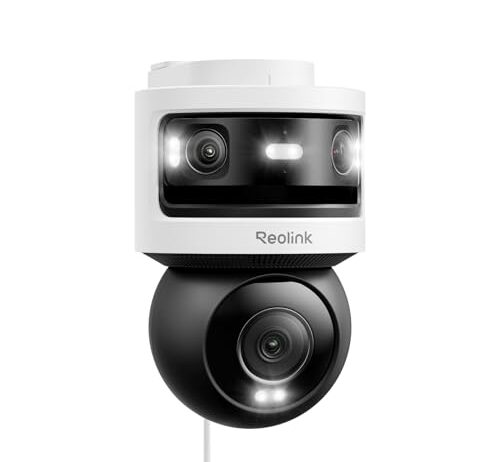
The Reolink OMVI 3i runs a 10MP sensor alongside an 8MP sensor across three lenses, delivering 4K output. That’s real resolving power — enough pixel density that digital crops of recorded footage still hold usable detail. When the dome is clean and the IR path is unobstructed, this configuration captures more scene information than either dual-lens alternative here.

The trade-off is arithmetic. Three lenses means three sets of IR emitters firing through the same polycarbonate bubble. Every particle on that dome surface has three times as many light sources to reflect back toward three times as many sensors. The wash-out failure mode that all dome cameras share hits harder and earlier on a triple-lens system, because the IR energy density inside the enclosure is simply higher.

At $279.99, the price reflects the sensor hardware. But the real cost is upkeep — this camera needs its dome cleaned more carefully and more often than a simpler unit, because its advantage disappears faster when the dome degrades. If you’re mounting it under a sheltered eave where pollen and moisture exposure is low, the resolution payoff is real. On an exposed fence post facing weather, you’re fighting the dome every season.

Solar Panels Don’t Change the Dome — But Placement Might

A solar-powered camera needs its panel facing the sun, which often means mounting higher and more exposed than a wired unit you’d tuck under a soffit. More exposure means more weather hitting the dome surface. More rain minerals, more pollen, more UV degradation of the polycarbonate over time.

The power source itself doesn’t affect IR reflection at all. But the mounting constraints that come with solar power can put the dome in a worse position for contamination buildup. A camera under a two-foot eave overhang stays cleaner than one mounted on top of a post in open sky — and solar panels need open sky.

This isn’t a reason to avoid solar. It’s a reason to budget for more frequent dome cleaning if you go that route.

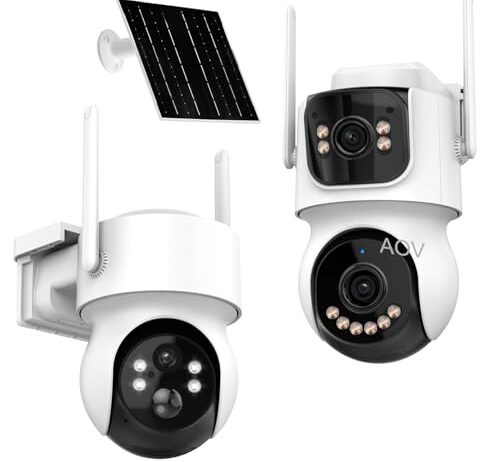
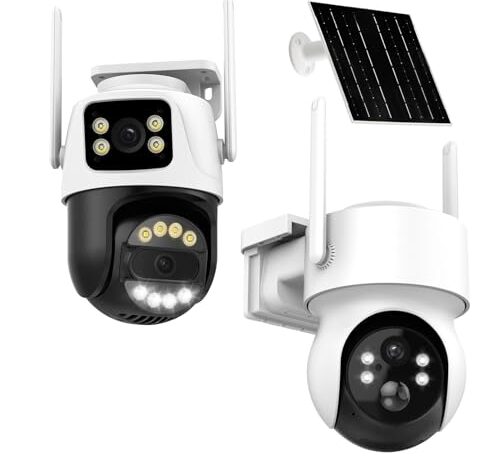
The STONVUE solar unit pairs 4MP and 8MP sensors in a dual-lens design with a 9W panel and 10,000mAh battery — enough to sustain 24/7 recording without a power cable. WiFi 6 handles the data side. The 360° PTZ capability means you can reposition the view remotely, which partially compensates for the fixed mounting position that solar placement demands.

Two lenses behind the dome means two emitter rings — half the IR density of the triple-lens Reolink, but still more than a single-lens camera would produce. The practical question is where you mount it. Solar panels need unobstructed sky, which usually means the dome sits higher and more exposed than a wired camera tucked under an eave. Rain doesn’t clean polycarbonate — it leaves mineral deposits. Direct sun accelerates UV yellowing of the dome material. Both degrade IR transmission over time.

At $104.73, this costs a third of the Reolink. The resolution ceiling is lower, but the wire-free installation opens mounting spots that wired cameras can’t reach. Just know that those spots tend to be the ones where the dome gets dirtiest fastest.

Does Higher Resolution Help When the Dome Is Dirty?

Not the way you’d hope. More megapixels capture more detail from the scene — but they also capture more detail from the IR wash-out. A 10MP sensor faithfully recording a fogged dome gives you a very high-resolution image of nothing useful. Resolution doesn’t compensate for optical contamination; it just renders the contamination more precisely.

Where resolution does help is in the window between “clean” and “degraded.” A higher-megapixel sensor holds usable image quality longer as the dome slowly accumulates contamination, because it starts with more data to lose. A 4MP sensor crossing into wash-out territory loses recognizable faces sooner than a 10MP sensor at the same contamination level. But once the IR backscatter overwhelms the scene signal, both sensors produce the same milky image.

Think of it as headroom, not immunity. More pixels buy you time before the cleaning becomes urgent. They don’t buy you a pass on cleaning.

The Floodlight Angle

Cameras with integrated floodlights introduce a different light source near the dome. A visible-spectrum floodlight doesn’t operate at 850nm — it’s not producing IR — but it does add heat to the housing. Heat differentials between the dome interior and exterior are exactly what drive condensation. A floodlight cycling on and off through the night warms the dome surface, then lets it cool when motion stops. Each cycle is an opportunity for moisture to form on the inner surface.

The upside is that when the floodlight is on, the camera can switch to color night vision mode and turn off the IR emitters entirely. No IR means no IR reflection — the dome contamination problem disappears as long as the floodlight is illuminating the scene. The downside is range. A floodlight might throw usable light 30 or 40 feet. IR emitters reach further because they don’t need to produce a visible image — they just need to bounce enough photons back to the sensor.

So a floodlight-equipped camera has two night modes with two different vulnerability profiles. Floodlight mode: no dome reflection problem, but limited range. IR mode: full range, full dome vulnerability.

What You Can Actually Fix Without Replacing the Camera

The dome is the problem, and the dome is a replaceable part on most cameras — though manufacturers don’t always make this obvious. A new polycarbonate dome costs a fraction of the camera and restores IR transmission to factory levels. If your night vision has degraded steadily over a year of outdoor use, a dome swap is often more effective than any setting adjustment.

Short of replacement: clean with a damp microfiber cloth, never dry, never circular. Isopropyl alcohol on stubborn spots — not household glass cleaner, which can leave a film that’s invisible in daylight but scatters IR. Apply a thin coat of automotive rain repellent to the outer surface; the hydrophobic layer sheds water before it can deposit minerals.

For condensation on the inner surface, the fix is ventilation or desiccant. Some cameras have a small vent hole with a Gore-Tex-style membrane that equalizes pressure without admitting water. If yours doesn’t, a silica gel packet tucked into the housing during installation absorbs moisture before it can condense. Replace it annually.

None of this is specific to any brand. It’s polycarbonate physics. Every dome camera benefits from the same maintenance.

FAQ

Do dome cameras always have worse night vision than bullet cameras?

Not always, but they’re structurally more vulnerable. Bullet cameras recess the lens behind the IR emitter ring, so contamination scatters light away from the sensor. Dome cameras put the lens and emitters together behind a curved surface that focuses reflections inward. A clean dome performs fine — the issue is that “clean” deteriorates faster outdoors than most people expect.

How do you clean a dome camera without making the night vision worse?

Damp microfiber cloth, straight wipes, light pressure. Never dry-wipe polycarbonate — it scratches easily, and each scratch becomes a permanent IR reflector. For stubborn residue, use isopropyl alcohol, not household glass cleaner. Glass cleaner can leave a film that’s invisible in daylight but scatters infrared.

Why does night vision get blurry after a few months outside?

Three things accumulate on the dome surface: dust and pollen from static charge, mineral deposits from rain evaporation, and micro-scratches from cleaning. Each acts as a tiny mirror for the 850nm IR light the camera emits. Condensation on the inner dome surface adds a diffuse scattering layer you can’t reach without opening the housing.

Does a triple-lens camera have three separate domes or one big one?

Most multi-lens dome cameras use a single shared dome covering all lenses and their IR emitter rings. This means every emitter’s light can reflect off any point on the dome and potentially interfere with any lens — the cross-contamination surface is shared, not isolated.

Can you fix IR reflection without replacing the camera?

Yes. Clean the dome properly, apply automotive rain repellent to shed water before it deposits minerals, and place a silica gel packet inside the housing to prevent interior condensation. If the dome is scratched beyond recovery, replacement domes are available for most models and cost a fraction of the camera.